The Charcoal Factory is a charcoal manufacturer based in Hefei, Anhui Province, China. We produce bamboo charcoal, wood charcoal, shisha charcoal, and coconut shell briquettes for distributors, retailers, supermarkets, and hookah lounge operators in 40+ countries. Our export team manages full DG-compliant shipping, Arabic and multilingual private label packaging, and complete export documentation for every market we supply. Questions about charcoal sourcing and export? Email
info@thecharcoalfactory.com
or use the bulk order form.
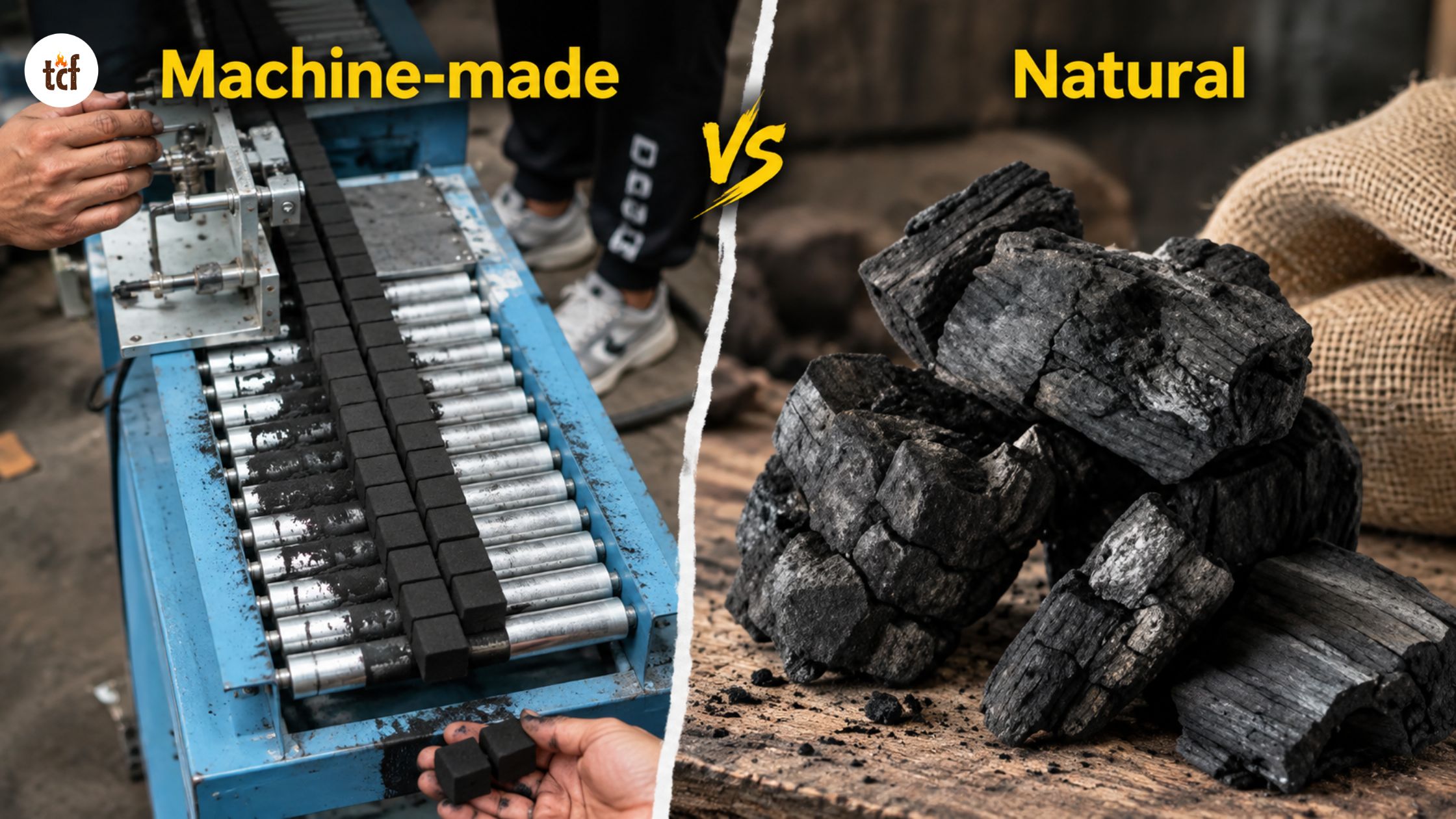
Machine-made vs natural charcoal: Natural charcoal is carbonized directly from whole pieces of wood, shell, or bamboo with no further processing, keeping an irregular shape and no additives. Machine-made charcoal starts as crushed or powdered raw material, mixed with a binder, then extruded or pressed into a uniform shape like a hexagon or cylinder.
The difference isn’t just cosmetic. It affects burn time, ignition speed, ash output, and in some cases, what’s actually in the charcoal you’re buying.
Table of Contents
How each one is actually produced
Natural charcoal goes through one process: carbonization. Whole logs, branches, or shells go into a kiln and heat in a low-oxygen environment until only carbon remains. Nothing gets added, and nothing gets reshaped. What comes out is what went in, minus the moisture and volatile compounds.
Machine-made charcoal starts differently. Instead of whole pieces, it’s often made from charcoal dust, sawdust, or shell fragments- the leftover material from processing natural charcoal or other biomass that would otherwise go to waste. That material gets crushed into powder, mixed with a binder (commonly a natural starch), and pushed through an extrusion or briquetting machine to form a consistent shape before drying.
This is actually one of the strongest arguments in favor of machine-made charcoal: it turns waste material, the fines and fragments too small to sell as natural lump, into a usable product instead of discarding it.
The part buyers need to watch for
Not all machine-made charcoal is created equal, and this is where the category gets murkier than most comparisons let on.
Legitimate machine-made charcoal uses 100% biomass, wood dust, shell dust, or bamboo dust, held together with a natural starch binder. It’s still additive-free in the sense that matters for flavor and health.
But some lower-cost machine-made products on the market are made with mineral char or anthracite (coal-derived material) blended into the biomass. This isn’t always disclosed clearly, and a buyer assuming “machine-made” automatically means “100% natural hardwood” can end up with a product that isn’t. Coal-blended charcoal burns differently, can carry a sulfur note, and isn’t something most cooks or shisha lounges actually want in their product.
If you’re buying machine-made charcoal, particularly at a price that seems unusually low, ask directly what the binder and base material are, and ask for a Certificate of Analysis confirming composition. Don’t assume “machine-made” and “adulterated” are the same thing, they aren’t, but don’t assume they’re mutually exclusive either.
Shorter, commonly around 1.5 hours for standard natural lump
Longer, commonly around 3 hours or more, depending on density
Ash output
Lower for high-quality lump
Can be higher unless raw material and binder are clean
Packaging and retail fit
Less predictable bag weight and appearance
Uniform pieces pack and display more consistently
Flavor
Directly reflects the source wood or shell
Neutral to mild, depending on raw material
Why the industry uses machine-made charcoal at all
Beyond turning waste into product, machine-made charcoal solves a few real problems natural charcoal doesn’t:
Consistency: a retail bag of natural lump charcoal has pieces ranging from fist-sized chunks to small fragments. Machine-made charcoal fills every bag with pieces of nearly identical size and burn behavior.
Longer, steadier burn: the denser, compressed structure typically burns longer than loose natural lump of the same weight, which matters for extended cooks or, in the shisha industry, long sessions that can’t tolerate frequent coal changes.
Shape control for specific markets: hexagonal and cylindrical shapes are standard in the shisha and hookah trade specifically because of how evenly they sit and heat on a bowl, something irregular natural lump can’t reliably replicate.
When natural charcoal is the better choice
You want the cleanest possible flavor tied directly to a specific wood, oak, hickory, mesquite, without any binder in the mix
You’re doing a shorter, high-heat cook where fast ignition matters more than multi-hour burn time
You’re a buyer for whom “100% natural, zero processing beyond carbonization” is a specific claim you need to stand behind, for labeling or certification reasons
When machine-made charcoal is the better choice
You need predictable burn time and shape for commercial or retail consistency
You’re supplying a shisha or hookah market where uniform hexagonal or cylindrical shape is close to a requirement, not a preference
You want to use a lower-cost raw material stream (dust and fragments) rather than paying a premium for whole natural pieces
How to verify what you’re actually buying
Ask for a Certificate of Analysis showing fixed carbon, ash content, and, ideally, confirmation of raw material composition
Ask specifically whether any coal-derived or mineral material is blended into the product, not just what the primary raw material is
Do a simple burn test: charcoal with coal-derived content often has a different smell and spark pattern during ignition compared to pure biomass charcoal
Buy a sample before committing to a full container order, especially with a new supplier
If you’re comparing raw material types rather than production method, our guides on charcoal manufacturing and charcoal grades cover how fixed carbon and ash specs differ across wood and bamboo charcoal, which matters regardless of whether the final product is natural lump or machine-shaped.
This article is for general informational purposes. Composition, binders, and production methods vary by manufacturer; confirm specifics directly with your supplier before purchasing, particularly for bulk or private label orders.
Frequently asked questions
Is machine-made charcoal the same as briquettes?
Closely related, but not identical terms. “Machine-made” describes the production method, extrusion or pressing from crushed material. “Briquette” describes the resulting shape. Most briquettes are machine-made, but the term “machine-made charcoal” is also used for shaped products (like hexagonal shisha charcoal) that aren’t always labeled as briquettes.
Is machine-made charcoal less natural than lump charcoal?
Not necessarily. Legitimate machine-made charcoal is 100% biomass held together with a natural starch binder. The concern is specifically products that blend in coal-derived material without disclosing it, which does happen in parts of the market at lower price points.
Which burns longer, natural or machine-made charcoal?
Machine-made charcoal generally burns longer due to its denser, compressed structure, commonly cited around 3 hours or more compared to roughly 1.5 hours for standard natural lump charcoal, though this varies by raw material and quality.
Why does the shisha industry use machine-made charcoal almost exclusively?
Uniform shape and predictable, extended burn time matter more in a shisha session than in typical grilling. Natural lump’s irregular shape and shorter burn don’t fit that use case as well as a consistently sized hexagonal or cylindrical briquette does.
There’s no single best type of charcoal for BBQ; the right choice depends on what you’re cooking. Lump charcoal wins for hot, fast sears. Briquettes win for long, steady low-and-slow cooks. Coconut shell charcoal and binchotan win when you want high heat without heavy smoke.
Instead of another general lump-vs-briquette breakdown, here’s how to match charcoal type to the actual dish in front of you, plus the burn data behind why each one performs the way it does.
Table of Contents
The 4 main types, in one table
Type
Heat output
Burn time
Ash produced
Best for
Lump charcoal
Highest, fast to peak
Shorter, needs replenishing
Low to moderate
Searing, quick high-heat grilling
Hardwood briquettes
Moderate, steady
Long, consistent
Higher
Low-and-slow smoking, long cooks
Coconut shell charcoal
High
Long
Low
High heat over extended time, delicate proteins
Binchotan (white charcoal)
High, very stable
Very long
Very low
Premium, flavor-neutral grilling
Match the charcoal to the cook, not the other way around
Searing steaks or burgers: lump charcoal
Lump charcoal is 100% pure wood with no binders, so it lights fast and hits high heat quickly, which is exactly what you want for a hard sear that locks in a crust. The tradeoff is a shorter, less predictable burn, fine for a 15 to 20 minute cook, less ideal if you’re feeding a crowd over several hours.
Low-and-slow brisket, ribs, or pulled pork: hardwood briquettes
Briquettes are compressed into a uniform shape specifically for predictable, steady burning. That consistency is worth more than peak heat when you’re managing a smoker at a stable temperature for 8 to 16 hours. Standard briquettes do produce more ash than lump charcoal; budget extra time for mid-cook cleaning on very long sessions.
Whole chicken or indirect roasting: briquettes, with lump for direct pieces
Indirect cooking (whole birds, roasts) benefits from the same long, steady burn briquettes are built for. If you’re doing bone-in pieces over direct heat instead, lump charcoal’s higher heat gets you better skin crisping in less time.
Fish and delicate seafood: coconut shell charcoal or binchotan
Delicate proteins pick up smoke flavor fast, and heavy or chemical-tinged smoke from lower-quality charcoal can overpower them entirely. Coconut shell charcoal burns clean with minimal smoke while still delivering high heat, and binchotan goes a step further as the flavor-neutral premium option favored for yakitori and similarly delicate grilling styles.
Grilled vegetables: coconut shell charcoal
The same clean-burning quality that protects delicate fish works in vegetables’ favor too. A neutral, low-smoke burn lets natural char and sweetness develop without a heavy smoke flavor overwhelming lighter ingredients.
Why the burn characteristics differ: what’s actually in each type
Lump charcoal is wood, carbonized and nothing else. No binders, no fillers. That purity is what gives it a hot, fast burn and why enthusiasts favor it for flavor.
Briquettes are compressed from charcoal dust, sawdust, or shell material, held together with a starch binder, sometimes with sodium nitrate to aid ignition or limestone to whiten the ash. This is also why lower-quality briquettes can carry a faint chemical smell during lighting, a detail worth checking for if you’re buying based on price alone. Premium briquette brands minimize additives, but “briquette” alone doesn’t guarantee a clean burn the way pure lump charcoal does.
Binchotan is a traditional Japanese white charcoal, made from oak through a slower, higher-temperature carbonization process. That process is what gives it an exceptionally clean, long, stable burn, and why it commands a premium price over standard lump or briquette charcoal.
A quick buying checklist
Check for additive-free labeling if you want a clean burn, especially for lump charcoal, where “100% hardwood, no additives” should be stated plainly
Match bag size to cook length: lump charcoal for a single quick grill session, briquettes if you’re planning a multi-hour smoke and don’t want to replenish mid-cook
Look for sustainability sourcing claims if that matters to you; coconut shell charcoal and other agricultural-byproduct charcoals are commonly marketed on this basis; verify the claim rather than assuming it from the name alone
Smell test at lighting: a sharp chemical odor when lighting briquettes usually points to lower-quality binders or fillers
Neither is universally better; it depends on the cook. Lump charcoal suits hot, fast cooking like searing. Briquettes suit long, low-and-slow cooks like brisket or ribs, where a steady, predictable burn matters more than peak heat.
Is coconut shell charcoal better than regular charcoal?
It depends on your priority. Coconut shell charcoal generally burns cleaner and longer than standard wood briquettes, with high heat and low smoke, making it a strong choice for extended cooks or delicate proteins. However, it’s typically priced higher than standard lump or briquette charcoal.
What charcoal is best for smoking meat for many hours?
Hardwood briquettes are the standard choice for long smoking sessions, since their compressed, uniform shape is built specifically for a steady, predictable burn over time.
Does the type of charcoal affect the taste of grilled food?
Yes. Pure lump charcoal tends to produce a cleaner wood flavor, while lower-quality briquettes with heavier additive content can carry a faint chemical note, particularly noticeable during lighting.
Private label charcoal packaging means a manufacturer produces charcoal under your own brand name, logo, and custom packaging design, rather than their generic packaging. Minimum order quantities typically run 18 to 26 tons, tied to container size, and full lead time from artwork approval to vessel departure usually takes 4 to 6 weeks.
Here’s the full process, what drives the MOQ, and where the timeline actually goes if you’re planning a launch date.
Table of Contents
Private label vs white label: what’s the difference?
Private label means the product formulation and packaging are customized specifically for your brand, often with input on packaging materials, bag or box format, and sometimes product spec. White label means you’re applying your logo to an existing, unchanged product the manufacturer already produces for multiple customers.
Most charcoal manufacturers offering “private label” are really offering a hybrid: your branding and packaging design applied to their existing product line and specs. True custom formulation (a unique blend, binder, or shape developed only for you) is less common and usually requires higher minimum order quantities.
How the process actually works
Step 1: Inquiry and NDA
Most manufacturers will sign a mutual NDA before sharing detailed specs, pricing breakdowns, or production capacity, especially if you’re discussing a custom formulation rather than a standard product with new packaging.
Step 2: Product and packaging selection
You choose the charcoal type (lump, briquette, coconut shell cube, shisha hexagon) and the packaging format (kraft bags, printed woven PP bags, retail boxes, jars for cube-format charcoal). Each format has its own MOQ and lead time, so lock this down before requesting a final quote.
Step 3: Artwork and design approval
You provide your logo and brand assets, or the manufacturer’s design team builds packaging artwork from your brief. This stage typically takes 1 to 2 weeks, longer if you’re iterating on multiple design rounds or need multilingual packaging for a specific export market, Arabic labeling for Middle East distribution, for example.
Step 4: Sample production and approval
The factory produces a physical sample run in your actual packaging before committing to full production. This step matters more than it seems; it’s your last checkpoint to catch a packaging or print issue before it’s replicated across tons of product.
Step 5: Mass production
Once the sample is approved, full production begins. This is where charcoal-specific timing enters the picture: product needs to complete its weathering period (commonly a minimum of 14 days) before it can be packed, since charcoal ships as Dangerous Goods under UN1361, Class 4.2.
Step 6: Compliance documentation and quality inspection
A pre-shipment inspection, along with the Dangerous Goods Declaration, weathering records, and packing-day temperature documentation, gets prepared before the container is booked.
Step 7: Container loading and shipment
The finished, packed product loads into the container and departs.
MOQ for private label charcoal is driven by container economics more than packaging minimums. Manufacturers price and produce around full container loads (FCL) because partial containers cost more per ton and complicate compliance documentation for Dangerous Goods shipments.
Typical figures cited by charcoal manufacturers:
Shisha or coconut shell charcoal: around 18 tons per 20ft container
BBQ or wood charcoal: around 26 tons per 40ft container
If you can’t meet a full container MOQ on your first order, ask whether the manufacturer allows LCL (less than container load) private label runs; some do, generally at a per-ton premium, or offer a lower-MOQ “starter” packaging format to test a market before committing to a full container.
Lead time: what the 4 to 6 week estimate actually includes
A single “4 to 6 weeks” quote usually bundles together phases that are worth understanding separately, since delays tend to happen in specific stages, not evenly across the whole timeline:
Phase
Typical duration
Artwork and design approval
1 to 2 weeks
Sample production and approval
1 to 2 weeks
Weathering period (before packing)
Minimum 14 days
Mass production and packing
1 to 3 weeks, depending on order size
Pre-shipment inspection and documentation
5 to 7 business days, can run parallel to packing
These phases overlap in a well-run factory, weathering happens during production, and inspection scheduling starts before packing finishes. That’s why total lead time usually lands around 4 to 6 weeks rather than the full sum of every phase run sequentially.
Payment terms you should expect
Private label charcoal orders commonly follow a 50% deposit, 50% balance structure: 50% paid by Telegraphic Transfer (T/T) after signing the sales contract or purchase order, with the remaining 50% due shortly before container loading, often around 5 days ahead of the loading schedule.
What’s often excluded from the quoted price
Read your quote carefully for what’s excluded, not just what’s included. Two charges commonly billed separately from the base private label price:
Self-Heating Test (SHT): a test some carriers or destination markets require to confirm the charcoal’s self-heating classification, separate from the standard export price
Vanning weathering costs: additional charges tied to the mandatory weathering period before container packing, sometimes billed as a separate line item rather than folded into the base rate
Ask specifically whether these are included before comparing quotes between manufacturers; a lower headline price that excludes compliance costs isn’t actually the cheaper option once they’re added back in.
Packaging format considerations for private label
Kraft or recycled paper bags: increasingly requested for sustainability positioning, generally at a moderate cost premium over standard woven PP bags
Printed woven PP bags: the most common format for bulk and mid-size retail bags, cost-efficient at scale
Retail boxes and jars: used for cube-format shisha or premium BBQ charcoal, typically the highest per-unit cost and often the longest lead time due to die-cut tooling and box assembly
Multilingual labeling: required for many export markets; factor extra design and proofing time if you’re printing in more than one language on the same package
Questions to ask before committing to a private label run
What’s the MOQ for this specific packaging format, not just the bulk product MOQ?
Does the quoted lead time include weathering and inspection, or are those additional?
Is the Self-Heating Test included, and is it required for my destination market?
How many design revision rounds are included before additional design fees apply?
What happens to unused custom packaging inventory if I need to change suppliers later?
Frequently asked questions
What’s a typical MOQ for private label charcoal?
Commonly 18 tons for a 20ft container (shisha or coconut shell charcoal) and around 26 tons for a 40ft container (BBQ or wood charcoal), since pricing and production are structured around full container loads.
How long does private label charcoal packaging take from order to shipment?
Typically 4 to 6 weeks, covering artwork approval, sample production, the mandatory weathering period, mass production, and pre-shipment compliance documentation.
Can I order less than a full container for a private label run?
Some manufacturers allow LCL (less-than-container-load) orders, usually at a higher per-ton cost. Ask directly, since it’s not always advertised as a standard option.
Are compliance costs included in a private label quote?
Not always. Self-Heating Test fees and weathering-related charges are sometimes billed separately from the base product and packaging price. Confirm this before comparing quotes.
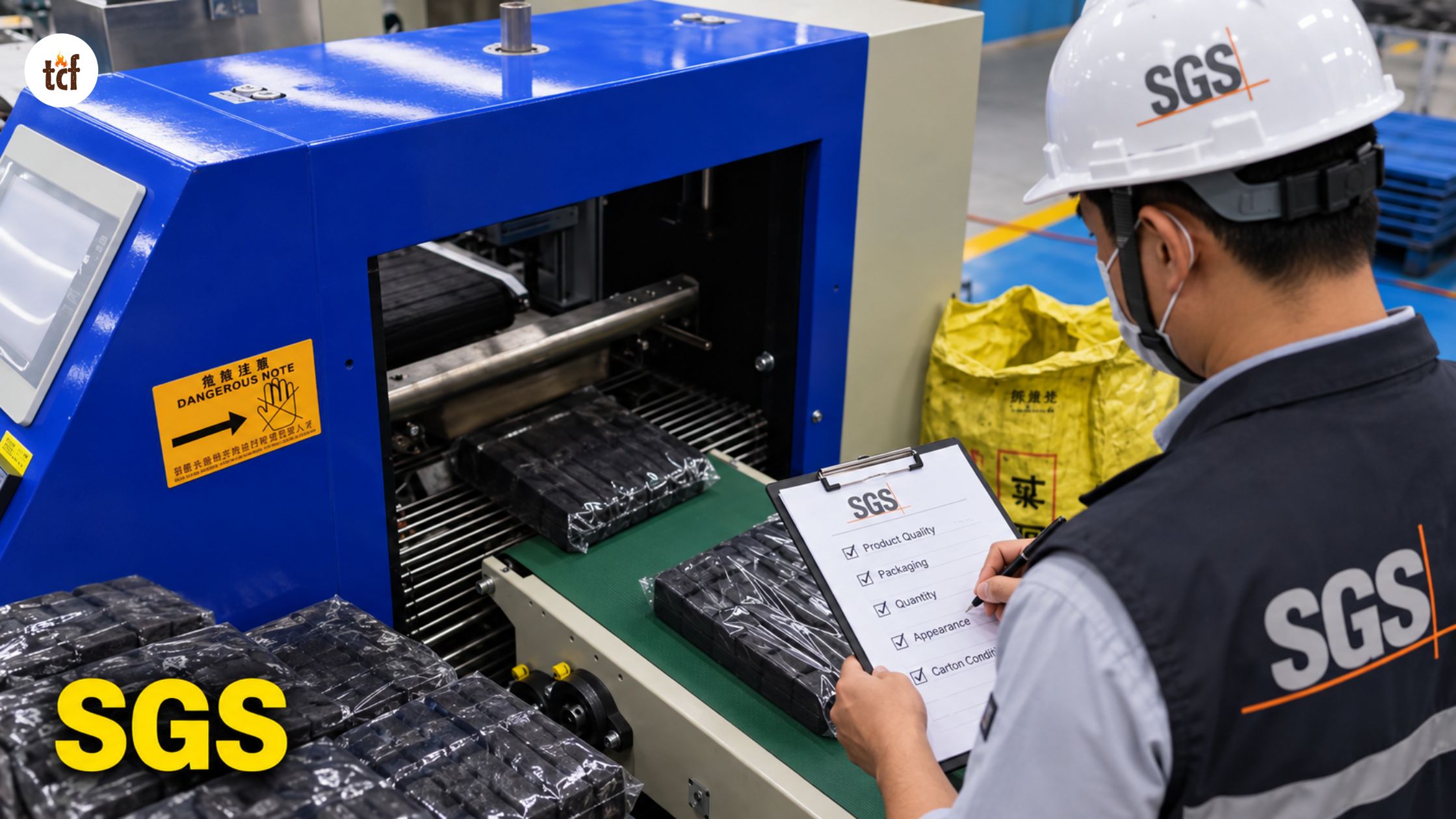
A pre-shipment inspection for charcoal is an independent, third-party check of your charcoal’s quality and quantity before it leaves the factory, done by an inspection company like SGS, Bureau Veritas, or Intertek. It confirms the container actually holds what the contract says it should, in the amount and grade agreed, before you release final payment.
Here’s what it actually checks, how the process works, and why skipping it costs buyers more than the inspection fee itself.
Table of Contents
What is SGS?
SGS (Société Générale de Surveillance) is the world’s largest inspection, testing, and certification company, founded in 1878 and operating in 140+ countries. In the charcoal trade, SGS acts as a neutral third party between buyer and seller, testing the actual product against the specification in the sales contract rather than relying on the supplier’s own internal report.
SGS isn’t the only option. Bureau Veritas, Intertek, and country-specific labs like Vinacontrol in Vietnam offer comparable services. “SGS” gets used generically in trade conversations the way “Xerox” got used for photocopiers; the process matters more than the specific inspection brand, as long as the lab is independently accredited.
What does a pre-shipment inspection for charcoal actually check?
Quantity verification
Bag or box count against the packing list
Weight verification, sample weighing against declared net weight
Container loading confirmation, matching what’s physically loaded to what’s on the shipping documents
Quality testing
Moisture content: typically specified under 8 to 12% depending on charcoal type, tested by drying a sample and measuring weight loss
Ash content: lower is generally better, since high ash reduces airflow and clogs grills
Fixed carbon: the percentage of carbon remaining after volatile matter burns off, a core driver of burn duration
Volatile matter: higher volatile matter generally means more smoke and a less clean burn
Calorific value: heat output, measured in kcal/kg, calculated using standard methods like ASTM D5865 or ISO 1928
Packaging and condition
Bag or box integrity, checking for damage that could let moisture in during transit
Labeling accuracy, confirming country of origin, net weight, and any required Dangerous Goods marking match the actual shipment
Palletizing or stacking condition if applicable
Documentation cross-check
Confirming the Certificate of Analysis, packing list, and commercial invoice all describe the same shipment consistently
Booking: the buyer, seller, or both jointly request the inspection once production is complete and the shipment is ready, usually a few days before container loading.
Sampling: an inspector takes samples from multiple bags or pallets across the shipment, not just from the top layer or the bags nearest the door, since that’s where quality substitution is easiest to hide.
Lab testing: samples go to an accredited lab, commonly ISO 17025 certified, for moisture, ash, fixed carbon, and calorific value testing.
Loading supervision (optional but recommended): an inspector can physically witness the container being loaded and sealed, confirming the tested lot is what actually goes into the container, not a different batch swapped in afterward.
Report issuance: the inspection company issues a report referencing the specific lot number, loading date, and container or seal number. Turnaround is typically 5 to 7 business days from sampling to final report.
That lot-specific detail matters more than it sounds. A report tied to a specific lot and loading date is evidence about the container actually being shipped, not a general quality claim about what the factory can produce under good conditions.
Why this matters: the actual failure modes it prevents
Grade inflation. A supplier quotes and samples A-grade charcoal, then ships B-grade in the actual container. Without an SGS report on that specific shipment, a buyer has no documented basis to reject it or renegotiate, and no leverage once the goods have left port.
Short shipment. The packing list says 20 tons, the container holds 18. Quantity verification during loading supervision catches this before the container is sealed, not after it arrives and the shortfall is already the buyer’s problem.
Golden samples. Some suppliers send an excellent sample for approval, then ship ordinary production stock in the actual order. Independent sampling directly from the shipment being loaded, not from a pre-approved sample set aside earlier, is the specific defense against this.
Payment disputes under a Letter of Credit. For LC transactions, banks often require inspection certificates as a condition of releasing payment. Without one, payment can stall even when the shipment itself is fine, simply because the documentation requirement wasn’t met.
What it costs, and who pays
Inspection costs typically run in the range of a few hundred to around two thousand dollars per container, a small fraction of a shipment’s total value. Buyer and seller commonly split this cost or negotiate who pays as part of the supply contract itself, along with who has the right to request one and on what timeline.
If you’re negotiating a supply contract, this is worth locking in explicitly rather than assuming it’s covered. A contract that requires an SGS or equivalent report for every container, not just the first sample order, closes the exact gap that lets grade inflation happen after a relationship becomes comfortable.
Inspection certificate fraud is a known problem in commodity trade, not a rare edge case. A fraudulent seller can produce a certificate using a real company’s logo and formatting with a fabricated certificate number.
Always verify a certificate directly with the inspection company before relying on it for payment release or cargo acceptance; don’t take the PDF at face value just because it looks official. Most inspection companies offer a certificate verification service or a direct contact for exactly this purpose.
Frequently asked questions
Is a pre-shipment inspection mandatory for charcoal imports?
Not by law in most cases, but it’s commonly required contractually, especially for Letter of Credit transactions where banks need documented proof of quality and quantity before releasing payment.
How long does a charcoal pre-shipment inspection take?
Typically 5 to 7 business days from sampling to final report, though this can vary depending on the lab’s schedule and whether loading supervision is included.
What’s the difference between a sample test and loading supervision?
A sample test checks quality against your specification. Loading supervision adds a physical witness to the container being loaded and sealed, confirming the tested lot is what actually ships, not a substituted batch.
Who typically pays for the inspection, buyer or seller?
It varies by contract. Some buyers pay directly to keep the inspection fully independent, others split the cost with the seller. This should be defined explicitly in the supply contract rather than assumed.
A bulk charcoal supply contracts should lock down 6 things: pricing mechanism, quality specifications, volume commitments, delivery penalties, payment terms, and force majeure conditions. Miss any one of these, and you’re exposed to a price spike, a quality drop, or a stockout with no contractual recourse.
Here’s what to negotiate in each category, and why suppliers often prefer you don’t ask.
Table of Contents
Why a purchase order isn’t enough
A one-off purchase order covers a single shipment. It doesn’t protect you against next quarter’s price increase, a quality slip after the relationship gets comfortable, or a supplier prioritizing a bigger customer during a supply crunch.
A supply contract is what gives you leverage across multiple shipments instead of renegotiating from scratch every time. For restaurant chains and distributors ordering regularly, that difference is worth the extra negotiation upfront.
1. Pricing mechanism
Raw charcoal material costs move with wood and coconut shell availability, seasonal harvest cycles, and fuel costs for transport. A fixed price for 12 months protects you from increases but exposes the supplier to their own cost risk, which is exactly why most suppliers resist it.
What to negotiate instead:
Fixed price with a review window: lock the price for 3 to 6 months, with a defined renegotiation date rather than an open-ended contract that either side can reprice anytime.
Price cap with index adjustment: tie adjustments to a named reference, like a regional wood price index, with a maximum percentage move per quarter. This protects both sides from wild swings while still letting cost pass through.
Volume-tiered pricing: negotiate a lower per-ton rate at defined order thresholds, so scaling your order size has a built-in payoff instead of requiring a fresh negotiation.
Get the exact adjustment formula in writing. “Subject to market conditions” is not a pricing mechanism; it’s a blank check.
This is where verbal assurances cost distributors the most money. “Consistent quality” isn’t enforceable. Specific numbers are.
Put these in the contract, not just the product spec sheet:
Moisture content maximum (commonly under 8 to 12% for export-grade charcoal, confirm the number for your specific product type)
Ash content maximum
Fixed carbon percentage minimum
Calorific value range (in kcal/kg)
Size and shape tolerance, especially for briquettes where uniformity affects burn time
Acceptance testing method: specify whether a Certificate of Analysis (COA) from a named third-party lab is required per shipment, or only on request
Then negotiate what happens when a shipment fails spec. A rejection clause without a resolution path just means a dispute. Better contracts define a tolerance band (product within X% of spec is accepted at a price adjustment) and a hard reject threshold (product beyond that triggers replacement or refund, not renegotiation after the fact).
3. Volume commitments
Suppliers want predictability. You want flexibility. The contract needs to reconcile both.
Minimum order quantity (MOQ) per shipment: usually tied to container size, a 20ft or 40ft container load, since partial containers cost more per ton and most charcoal ships FCL only.
Minimum annual volume: what you’re committing to across the full contract term, often with a lower-than-expected penalty if you fall short, and a rebate or price break if you exceed it.
Forecast flexibility: negotiate the ability to adjust order volume within a defined range (say, plus or minus 15%) per shipment without renegotiating the whole contract, since restaurant demand isn’t perfectly flat month to month.
Distributors serving multiple restaurant locations should push for volume commitments calculated annually, not shipment by shipment. A single slow month shouldn’t put you in breach of a rigid per-shipment minimum.
Late charcoal delivery isn’t just an inconvenience for a restaurant chain running weekly service; it’s a direct hit to operations. The contract should specify:
Lead time from order confirmation to vessel departure, separate from ocean transit time, since production and packing delays are the part actually within the supplier’s control
Penalty clause for late departure, commonly a percentage credit per day of delay beyond an agreed grace period
Force majeure carve-out, covering genuine disruptions (port strikes, extreme weather, regulatory holds) that shouldn’t trigger a penalty, but defined narrowly enough that it doesn’t become a blanket excuse
Charcoal ships as Dangerous Goods under UN1361, which means weathering time, packaging compliance, and carrier booking all sit upstream of the vessel departure date. Ask your supplier to build their standard compliance timeline into the lead time they quote you, not treat it as a separate delay that shows up later.
5. Payment terms
Payment structure is where new supplier relationships carry the most risk, and where established relationships have room to improve terms.
New supplier relationships: expect a deposit (commonly 30%) against a Telegraphic Transfer (T/T), with the balance due against shipping documents or a Letter of Credit (LC). An LC gives you more protection since a bank confirms document compliance before releasing payment, but it costs more to set up and adds processing time.
Established relationships: negotiate toward open account terms (net 30 or net 60 after delivery) once a track record of consistent quality and on-time shipment exists. This is usually a 12 to 24 month progression, not a first-contract ask.
Currency and exchange risk: specify which currency the contract is priced in, and who absorbs exchange rate movement between order and payment if it’s not USD.
Don’t negotiate payment terms in isolation from pricing. A supplier offering a lower per-ton price but demanding 100% upfront T/T is shifting risk onto you in a way that isn’t reflected in the headline number.
6. Force majeure and supply disruption
A generic force majeure clause copied from a template contract usually favors whoever wrote it. Push for specifics:
Named events: port closures, natural disasters, government export restrictions, not just “unforeseen circumstances”
Notice requirement: how many days the supplier has to notify you once a force majeure event affects your order
Alternative sourcing rights: whether you’re contractually free to source from a backup supplier during a prolonged disruption without breaching exclusivity, if your contract has one
Duration threshold: define how long a force majeure event has to run before either party can cancel the affected order without penalty
Exclusivity: think before you sign it
Suppliers sometimes push for exclusivity in exchange for better pricing. Before agreeing, weigh what you’re giving up: negotiating leverage on future price reviews, and your ability to dual-source during a compliance issue or quality dispute with that one supplier.
If you do agree to exclusivity, tie it to volume performance; exclusivity holds only if you meet your committed annual volume, not indefinitely regardless of order size.
Private label and OEM terms
If you’re buying under your own brand, the contract needs a separate section covering:
Packaging design ownership and confidentiality
Minimum order quantity specific to custom packaging (usually higher than bulk packaging, since custom printing has its own minimums)
Lead time for first-run custom packaging versus repeat orders
What happens to unused custom packaging inventory if the contract ends
A short negotiation checklist
[ ] Pricing mechanism with a defined adjustment formula, not “market conditions”
[ ] Quality specs with numeric tolerances and a named testing method
[ ] Volume commitment calculated annually, with forecast flexibility per shipment
[ ] Delivery lead time that accounts for Dangerous Goods compliance, plus a late-delivery penalty
[ ] Payment terms matched to your relationship stage, not accepted at face value
[ ] Force majeure clause with named events and a cancellation threshold
[ ] Exclusivity, if any, tied to volume performance
Frequently asked questions
What’s a reasonable minimum order quantity for a bulk charcoal contract?
Usually tied to a full container load, commonly 10 to 20 tons for a 20ft container depending on product density. Distributors ordering below that threshold typically pay a per-ton premium or need to consolidate orders with other buyers.
Should I ask for a fixed price or an indexed price?
Fixed price protects you short term but rarely lasts more than 3 to 6 months before a supplier pushes back. An indexed price with a capped adjustment percentage tends to be more sustainable for both sides over a longer contract term.
How do I protect against a quality drop after the relationship is established?
Put numeric specs (moisture, ash, fixed carbon, calorific value) directly in the contract, not just the initial product spec sheet, and require a Certificate of Analysis per shipment or at defined intervals.
Is exclusivity worth agreeing to for a better price?
Only if it’s tied to your own volume performance and you’ve already vetted the supplier’s reliability. Unconditional exclusivity removes your ability to dual-source during a dispute or disruption.
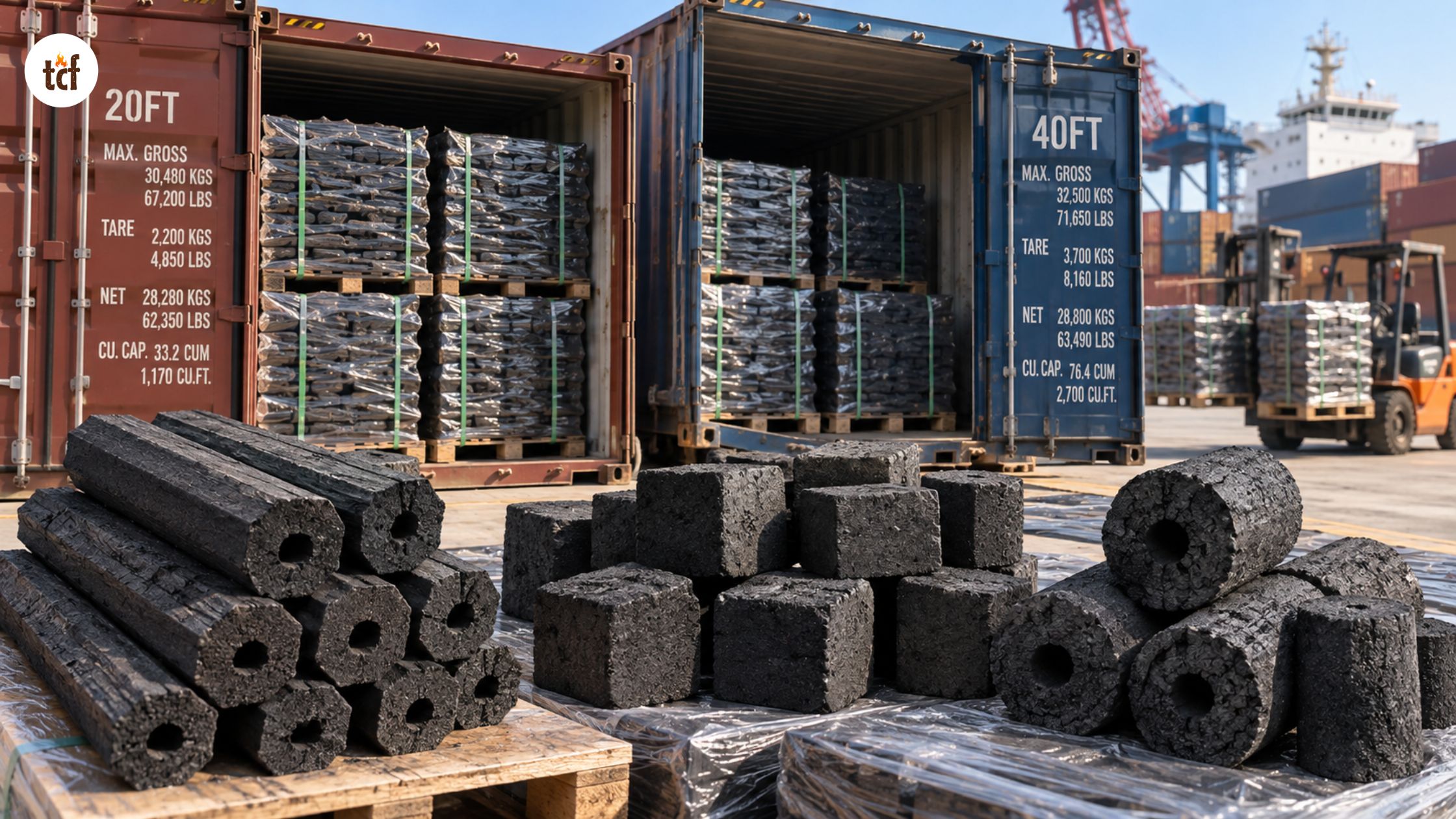
Charcoal Container Loading Guide: A 20ft container typically holds 10 to 20 tons of charcoal, and a 40ft container holds 24 to 28 tons, depending on the charcoal type, packaging, and whether it’s floor-stuffed or palletized. Dense coconut shell briquettes load heavier than lump wood charcoal, and pallets cost you 15 to 20% of usable capacity.
There’s no single answer here; charcoal isn’t a uniform product. Below is the breakdown by type, plus the safety limits that cap how full you can actually pack a container.
Table of Contents
Why charcoal capacity varies so much
Container capacity is limited by 2 different things: weight and volume. For most cargo, weight is the limiting factor; you hit the container’s maximum payload before you run out of physical space.
Charcoal is different. It’s light and bulky relative to its weight. For lump charcoal and low-density briquettes, you often run out of usable space before you hit the container’s weight limit. For dense coconut shell cubes, you can get much closer to the structural weight maximum.
That’s why “how many tons fit in a container” doesn’t have one answer; it depends on what kind of charcoal you’re loading and how dense it is.
Container capacity by charcoal type
Charcoal type
20ft container
40ft / 40ft HQ container
Lump wood charcoal, bagged
10 to 14 tons
24 to 25 tons
Sawdust or hexagon briquettes
13 to 14 tons
25 tons
Coconut shell briquettes (cube, full retail packaging)
17 to 18.5 tons
25 to 26 tons
Coconut shell briquettes (bulk packaging, no inner box)
19.5 to 20 tons
26 to 28 tons
General BBQ charcoal in 10kg bags
Roughly 1,000 to 1,100 bags (10 to 11 tons)
Roughly 2,000 to 2,800 bags (20 to 28 tons)
These are industry-typical figures pulled from multiple exporters’ loading data, not a fixed standard. Ask your specific supplier for their loading spec sheet, since bag size, box type, and stacking pattern all shift the number.
Palletizing a container costs real capacity. Pallets take up space that could otherwise hold product, and they can’t be stacked as tightly against the container walls and ceiling.
20ft container, floor stuffed: up to 17.5 to 20 tons of coconut charcoal (full packaging)
20ft container, palletized: drops to roughly 14 to 16.5 tons, a loss of about 3 to 4 tons
40ft container, floor stuffed: up to 25 to 26 tons
40ft container, palletized: around 22 tons, fitting about 20 standard pallets
The tradeoff is unloading speed. Palletized cargo comes out with a forklift in a fraction of the time floor-stuffed cargo takes to unload by hand. If your destination warehouse has forklift access and labor costs are high, palletizing can still be worth the lost capacity. If you’re optimizing purely for cost per ton shipped, floor stuffing wins.
Why you can’t just fill the container to the ceiling
Charcoal is classified as Dangerous Goods under UN1361, Class 4.2, and that classification comes with physical loading limits, not just paperwork:
30cm minimum headspace is required between the top of the stacked cargo and the container roof, to allow heat generated by the charcoal to dissipate rather than build up
Bag weight limits cap commonly at 30kg per bag under current carrier guidance, though 50kg bags are permitted in some cases
Stowage pattern matters too; guidance from cargo insurers recommends specific stacking patterns designed to prevent heat accumulation in the center of the load, not just maximum density packing
Skipping the headspace requirement to squeeze in more tonnage isn’t a minor infraction. It’s one of the loading errors tied directly to the container fire incidents that led to charcoal’s current Dangerous Goods enforcement. A container packed to the ceiling is a container more likely to get flagged, held, or rejected at the port, not just a safety risk at sea.
A simple way to estimate your own load
If your supplier gives you a bulk density figure instead of a tonnage number, you can estimate capacity yourself:
Take the container’s usable internal volume (roughly 28 to 30 cubic meters for a 20ft, 58 to 68 cubic meters for a 40ft, before subtracting headspace)
Subtract the volume taken up by the mandatory 30cm headspace across the container’s floor area
Multiply the remaining volume by your product’s bulk density (commonly 250 to 350 kg per cubic meter for loose lump charcoal, 450 to 600 kg per cubic meter for pressed briquettes)
That gives you an estimated maximum weight; cross-check it against the packaging and bag-count figures your supplier quotes
This is a rough estimate, not a substitute for your supplier’s actual loading plan. Packaging air gaps, pallet use, and stacking pattern all shift the real number in either direction.
Questions to ask your supplier before booking a container
What’s your standard tonnage for this exact product and packaging, not a general “charcoal” figure?
Is that figure floor-stuffed or palletized?
Does your loading plan account for the 30cm headspace requirement?
What bag or box weight are you using, and does it fall within current carrier limits?
Can you provide a vanning survey or loading photos before the container is sealed?
A supplier who can answer these with specific numbers for your exact product, rather than a general range, is one whose loading plan you can actually trust.
How many tons of charcoal fit in a 20ft container?
Typically 10 to 20 tons, depending on the charcoal type. Dense coconut shell briquettes in bulk packaging load closer to 20 tons, while lighter lump wood charcoal loads closer to 10 to 14 tons.
How many tons of charcoal fit in a 40ft container?
Typically 24 to 28 tons, again depending on product density and whether the container is floor-stuffed or palletized.
Why does charcoal load lighter than other cargo in the same container?
Charcoal is bulky relative to its weight, so it often reaches its volume limit before reaching the container’s maximum weight capacity. Dense briquettes get closer to the weight limit than loose lump charcoal does.
Does using pallets reduce how much charcoal fits in a container?
Yes. Pallets typically cost 15 to 20% of usable capacity compared to floor stuffing, since the pallets themselves take up space and can’t be packed as tightly against the container walls.
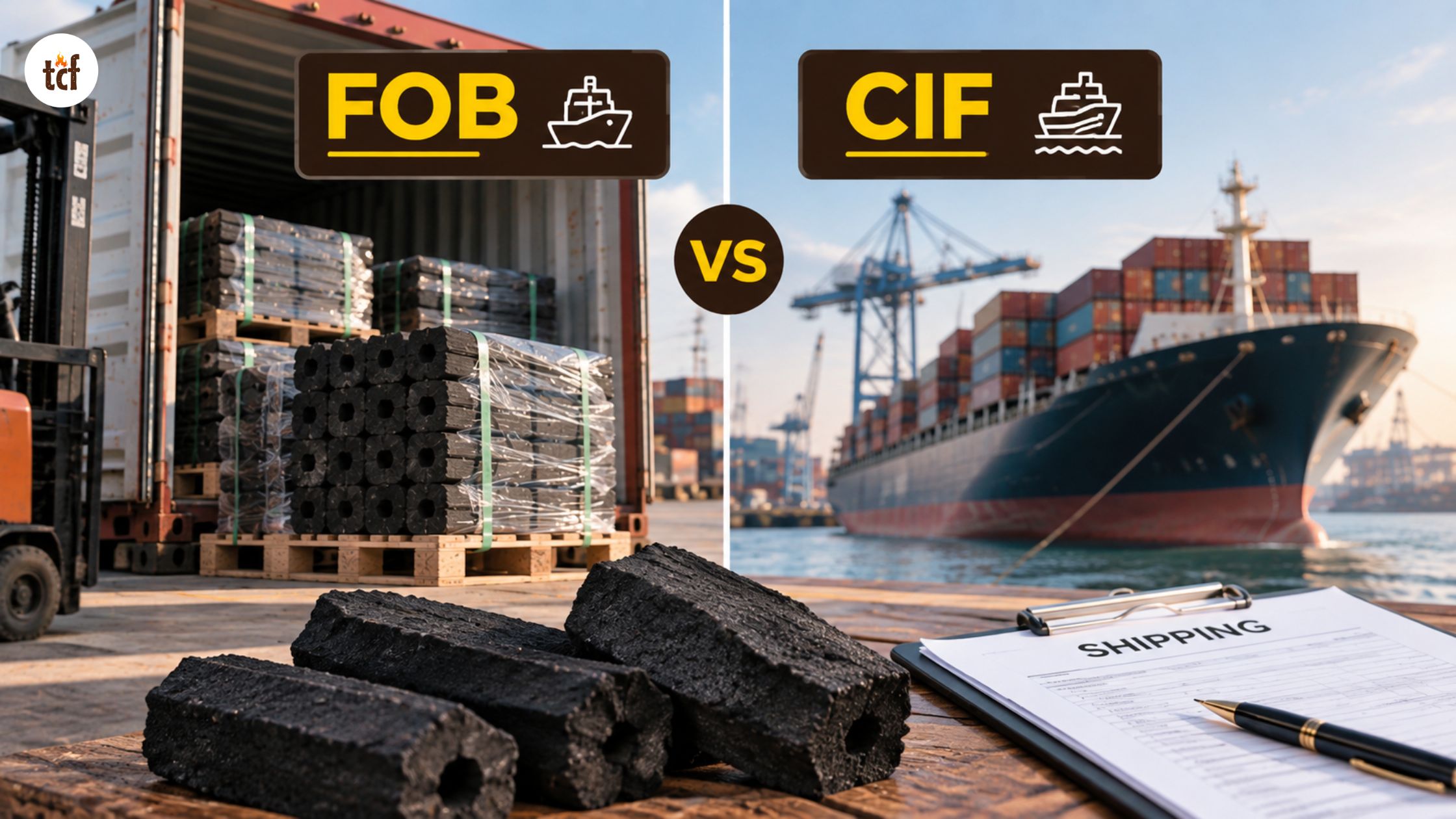
FOB vs CIF charcoal pricing: FOB (Free On Board) charcoal pricing covers the product up to loading onto the vessel at the origin port, freight and insurance are on you. CIF (Cost, Insurance, and Freight) pricing includes the product, international freight, and marine insurance all the way to your destination port.
Comparing an FOB quote to a CIF quote as if they’re the same number is the single most common pricing mistake buyers make. Here’s what’s actually inside each one, and how to normalize quotes so you’re comparing real costs.
Table of Contents
What is FOB charcoal pricing?
FOB means the seller’s responsibility ends once the charcoal is loaded onto the vessel at the port of origin. The FOB price typically includes:
Product cost
Domestic packing (bags, cartons, or big bags)
Inland transport to the port
Export customs clearance
Port handling and loading onto the vessel
Everything after that- ocean freight, marine insurance, destination port charges, and inland delivery at your end- is arranged and paid by the buyer.
What is CIF charcoal pricing?
CIF includes everything in FOB, plus 2 additional cost components the seller arranges and pays for:
International ocean freight to your named destination port
Marine insurance covering the cargo for the voyage
CIF gives you one number that’s supposed to represent the full delivered cost to your port, minus your own destination-side charges (customs duties, port handling at your end, and inland delivery from the port to your warehouse).
What about CFR?
CFR (Cost and Freight) sits between the two. The seller pays for freight to your destination port, same as CIF, but doesn’t arrange insurance. That part is still on you. You’ll see CFR quoted less often than FOB or CIF, but it’s worth knowing since some suppliers default to it without labeling clearly.
Side-by-side comparison – FOB vs CIF Charcoal Pricing
FOB
CFR
CIF
Seller pays freight
No
Yes
Yes
Seller pays marine insurance
No
No
Yes
Who books the shipping
Buyer
Seller
Seller
Who handles Dangerous Goods booking
Buyer
Seller
Seller
Risk transfers to buyer
When loaded on vessel
When loaded on vessel
When loaded on vessel
Paperwork burden on buyer
High
Medium
Low
One detail buyers miss: under all 3 terms, risk transfers to the buyer at the same point, once the cargo is on board the vessel. What changes between FOB, CFR, and CIF is who pays for freight and insurance, not who bears the risk during the voyage. CIF covering insurance means a claims process exists if something goes wrong, it doesn’t mean the buyer has no exposure at all.
Why this matters more for charcoal specifically
Charcoal ships as Dangerous Goods under UN1361, Class 4.2. Booking a Dangerous Goods shipment isn’t the same as booking a standard container. It requires a carrier that accepts DG cargo, a completed Dangerous Goods Declaration, weather and temperature documentation, and UN-certified packaging.
Under FOB, all of that downstream coordination- finding a DG-capable carrier and getting the paperwork right- falls on the buyer or their freight forwarder. Under CIF, the exporter, who typically ships UN1361 charcoal on a routine basis, handles that part.
This is the real reason CIF tends to get recommended to first-time charcoal importers. It’s not just about a simpler invoice; it’s about shifting a compliance-heavy booking process to the party who already does it regularly.
This is where most buyers get tripped up. A quote comparison only works if you’re comparing the same scope of cost. Here’s the process:
Confirm the Incoterm on each quote. Don’t assume, ask directly. “FOB Bangkok” and “CIF Los Angeles” are not comparable numbers without conversion.
Convert FOB quotes to a landed estimate. Add estimated ocean freight, marine insurance, and destination charges to the FOB number before comparing it to a CIF quote.
Check what “destination port charges” means in the CIF quote. Some CIF quotes stop at the port of discharge, before Terminal Handling Charges (THC), demurrage, or inland delivery at your end. Ask specifically what’s excluded.
Ask who handles the Dangerous Goods declaration and packaging compliance. A cheaper FOB quote that leaves DG booking to you may cost more once you factor in a freight forwarder’s DG handling fee.
Compare insurance coverage terms, not just the fact that insurance exists. CIF insurance is often set at a minimum coverage level (commonly 110% of invoice value under standard terms). If you want broader coverage, you may need to arrange supplemental insurance regardless of the Incoterm.
Normalize per unit, not per shipment. If container sizes or fill rates differ between quotes, convert both to a cost per metric ton or per kilogram before comparing.
A worked example
Say Supplier A quotes $650 FOB per metric ton, Bangkok, and Supplier B quotes $780 CIF per metric ton, Los Angeles.
To compare fairly, estimate the freight and insurance cost for Supplier A’s shipment to Los Angeles, say $110 in ocean freight and $8 in marine insurance per ton. Supplier A’s landed estimate becomes roughly $768 per ton, close to Supplier B’s CIF quote, not the $130 gap the raw numbers suggested.
This is also where destination charges matter. If Supplier B’s CIF quote excludes THC and inland delivery, and Supplier A’s forwarder includes an all-in estimate, the real gap could run the other way once you add those costs to both.
When FOB makes sense
You already work with a freight forwarder experienced in Dangerous Goods bookings
You ship high enough volume to negotiate better freight rates than what’s baked into a supplier’s CIF quote
Your destination port is well-served with frequent charcoal-carrying routes, keeping freight costs predictable
When CIF makes sense
You’re new to importing charcoal and want one clear delivered number
Your destination port is harder to reach or further from major charcoal-exporting regions
You’d rather not manage Dangerous Goods carrier bookings and insurance coordination directly
You want the exporter accountable for the cargo through the full voyage, since they’re the one arranging it
Questions to ask before accepting either quote
What exactly does “destination port” mean: the port of discharge, or delivered to my warehouse?
Is the marine insurance value based on invoice value, and at what percentage?
Are Terminal Handling Charges (THC) included or billed separately at destination?
What happens to pricing if the shipment gets flagged for a Dangerous Goods compliance issue and delayed?
A supplier who answers these clearly and specifically, rather than with a general reassurance, is usually the one whose quote you can trust at face value.
Not necessarily once you add freight and insurance to the FOB number yourself. CIF often looks more expensive at first glance because it’s a single bundled number, while FOB looks cheaper because it’s missing 2 major cost components you’ll still have to pay someone.
Does CIF mean I have no responsibility during shipping?
No. Risk transfers to the buyer once the cargo is loaded onto the vessel, under FOB, CFR, and CIF alike. CIF means the seller arranged and paid for insurance, not that the buyer has zero exposure.
Why does the Dangerous Goods classification affect which Incoterm I should choose?
Because UN1361 charcoal requires DG-specific carrier bookings, packaging, and documentation. Under FOB, that coordination burden sits with the buyer. Under CIF, the seller, who typically already handles it routinely, takes it on instead.
What should I ask a supplier before comparing their FOB and CIF quotes?
Ask exactly what’s included at the destination end (THC, inland delivery, demurrage exposure), what the marine insurance coverage percentage is, and who’s responsible for the Dangerous Goods paperwork.
US Charcoal Import Requirements: Charcoal imported into the US is classified under HTS 4402 and generally carries a 0% duty rate from most countries. Clearing customs also requires a Lacey Act declaration for formal entries, since wood charcoal has been on APHIS’s declaration list since 2009.
Here’s the full picture: the correct code, what CBP checks at entry, and every document you need before your shipment reaches a US port.
Table of Contents
What HTS code does charcoal fall under?
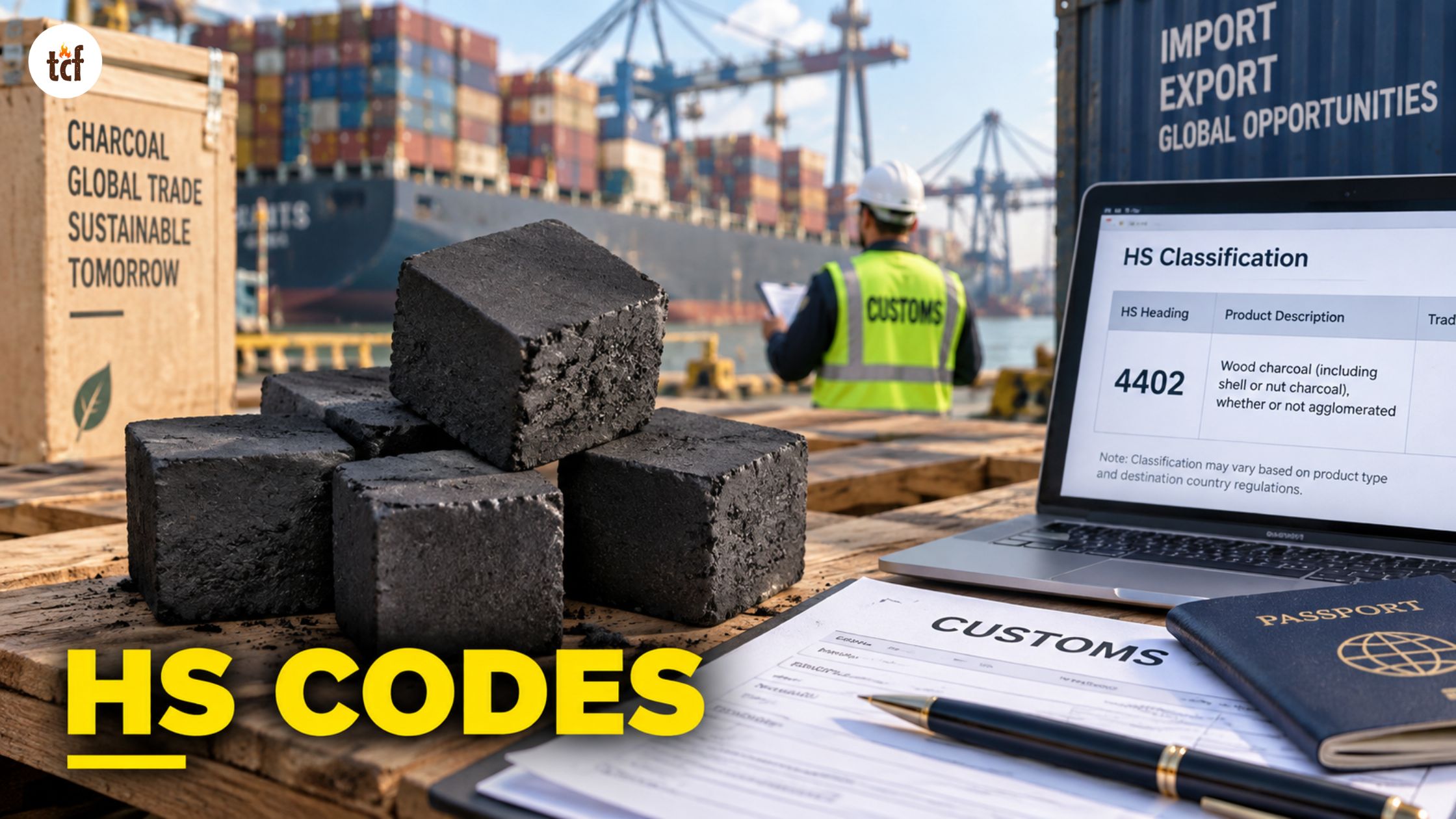
All charcoal, regardless of raw material, falls under HTS heading 4402. The 6-digit subheading depends on what it’s made from:
4402.10: bamboo charcoal
4402.20: coconut shell charcoal
4402.90: wood charcoal, including shell or nut charcoal not covered elsewhere, and the catch-all for “other”
A CBP ruling (N306942) specifically classified coconut charcoal briquettes agglomerated with tapioca binder under 4402.90.0000, describing the heading as covering wood charcoal “whether in the form of blocks, sticks, granules, powder, or agglomerated with tar or other substances in briquettes, tablets, balls.”
The first 6 digits are standardized worldwide. The US then adds 4 more digits, for a full 10-digit HTS number, used specifically for duty rate and statistical reporting on entries filed with CBP.
What’s the import duty on charcoal? – US Charcoal Import Requirements
Charcoal under HTS 4402 carries a 0% base duty rate from most trading partners under the standard US tariff schedule. That’s the baseline, not the full picture.
If you’re importing from China, check for Section 301 tariffs, which apply as additional duties layered on top of the base rate for specific Chinese-origin goods. These change periodically, so confirm the current rate against the active HTS revision rather than a number from a prior shipment.
Who is legally responsible for the import?
The Importer of Record (IOR) is legally responsible for the accuracy of every customs declaration, regardless of who physically files the paperwork.
US companies typically use their EIN (Employer Identification Number)
Individuals can use a Social Security Number, or apply for a CBP-assigned number
Foreign entities without a US presence apply for a CBP-assigned number through Form 5106
Step-by-step: how a charcoal shipment clears CBP
Step 1: Classify the product and confirm the HTS code
Use HTS 4402 and the correct subheading for your specific charcoal type. If the classification is genuinely ambiguous, for example, a blended-material briquette, you can request a free CBP Binding Ruling, a written determination that’s legally binding for future entries of that exact product.
Step 2: File the Importer Security Filing (ISF)
For ocean shipments, the ISF, commonly called “10+2,” must be transmitted electronically to CBP at least 24 hours before the cargo is loaded onto the vessel at the foreign port. It requires 10 data elements from the importer (seller, buyer, manufacturer, ship-to party, HTS code, country of origin, and others) and 2 from the carrier.
Missing or late ISF filings carry penalties of up to $10,000 per violation and can trigger a “do not load” order or additional exam scrutiny.
Step 3: Get your bill of lading
Your freight forwarder or carrier issues the bill of lading (ocean) or airway bill (air). This document serves as the contract of carriage and is required to file the formal entry and take possession of the cargo.
Step 4: File the formal entry within 15 days of arrival
Within 15 calendar days of the vessel’s arrival, the importer or their licensed customs broker must file CBP Entry Summary, Form 7501, declaring classification, value, country of origin, and duty calculation.
Step 5: Pay duties and fees
Duties are calculated on declared customs value multiplied by the HTS duty rate, plus:
Merchandise Processing Fee (MPF): 0.3464% of value, minimum $31.67, maximum $614.35 per formal entry
Harbor Maintenance Fee (HMF): 0.125% of value on ocean entries
Any applicable Section 301, 201, or 232 tariffs, or anti-dumping/countervailing duties
Step 6: File the Lacey Act declaration, if applicable
HTS 4402 has required a Lacey Act declaration since Phase III, effective October 1, 2009. If your entry is a formal entry (generally $2,500 or more in value), you must submit a Plant and Plant Product Declaration covering:
Scientific name (genus and species) of the wood or plant material
Country where the material was harvested
Quantity
Filing happens electronically through ACE (Automated Commercial Environment) or through APHIS’s own LAWGS portal, or on paper using PPQ Form 505.
Bamboo charcoal exception: a Lacey Act declaration isn’t required if the bamboo was cultivated, meaning planted specifically for commercial harvest. If it was wild-harvested, or you don’t know, the declaration is required.
De minimis exception: if plant material makes up 5% or less of the total product weight, and the total plant weight across the entry line doesn’t exceed 2.9 kg, you can claim the “G” disclaimer code instead of filing a full declaration. This rarely applies to pure charcoal, since charcoal itself is the plant material, but it matters for charcoal-containing composite products.
CBP uses risk-based targeting to select shipments for review:
Document review: paperwork checked, no physical inspection
Tailgate exam: CBP opens and inspects the container at the port
Intensive exam (CET): full unloading and inspection, can take several days, with exam fees typically running $800 to $2,500 or more, paid by the importer
Full documentation checklist
Document
Purpose
Commercial invoice
Declared value, HTS code, product description matching the code
Packing list
Quantities, weights, and packaging detail per shipment
Bill of lading/airway bill
Contract of carriage, required to take possession of cargo
Entry Summary (CBP Form 7501)
Formal customs declaration, filed within 15 days of arrival
Lacey Act declaration (PPQ 505 or ACE filing)
Required for formal entries under HTS 4402
Certificate of Origin
Confirms country of manufacture for duty and trade program eligibility
Certificate of Analysis (COA)
Third-party lab verification of product specs, often requested by buyers
MSDS
Safety data sheet, relevant given charcoal’s Dangerous Goods classification
Dangerous Goods Declaration
Required for ocean shipments under UN1361, Class 4.2
That last one matters more than it used to. Since IMDG Amendment 42-24, charcoal shipped by sea is classified as Dangerous Goods under UN1361, which adds its own weathering, temperature, and packaging documentation on top of the standard CBP paperwork.
Common mistakes that delay charcoal shipments
Misclassifying the subheading: labeling bamboo charcoal as generic “wood charcoal” under 4402.90 instead of 4402.10 can misalign duty treatment and trigger a classification review.
Skipping the Lacey Act declaration on formal entries: this isn’t optional paperwork; it’s tied directly to cargo release in ACE.
Late ISF filing: a 24-hour-before-loading deadline sounds generous until a supplier’s shipping schedule shifts without notice.
Missing weather and temperature documentation: not a CBP requirement directly, but customs holds tend to cluster around shipments that are already flagged for Dangerous Goods paperwork gaps.
Sourcing documentation that makes this easier
Most of this process runs smoothly when your supplier already tracks species origin, harvest country, and production dates as a standard part of manufacturing, not something assembled after a shipment is booked. Our charcoal manufacturing process page covers how we document raw material sourcing, and our earlier guide to charcoal HS codes breaks down classification in more depth if you’re sourcing multiple charcoal types across different HTS subheadings.
Frequently asked questions
What HTS code should I use for wood charcoal?
4402.90 covers wood charcoal generally, including shell or nut charcoal not classified elsewhere. Bamboo charcoal uses 4402.10, and coconut shell charcoal uses 4402.20.
Is there an import duty on charcoal into the US?
The base rate under HTS 4402 is 0% from most countries. China-origin shipments should be checked against current Section 301 tariff rates, which apply as an addition to the base rate.
Do I need a Lacey Act declaration to import charcoal?
Yes, for formal entries (generally $2,500 or more), since HTS 4402 has been on APHIS’s Lacey Act declaration list since October 2009. You’ll need the scientific name, harvest country, and quantity of the wood or plant material.
What’s the difference between a formal and informal entry?
Formal entries are generally valued at $2,500 or more and require a bond. Informal entries are typically under that threshold and usually don’t require a bond, though some product categories are restricted from informal entry regardless of value.
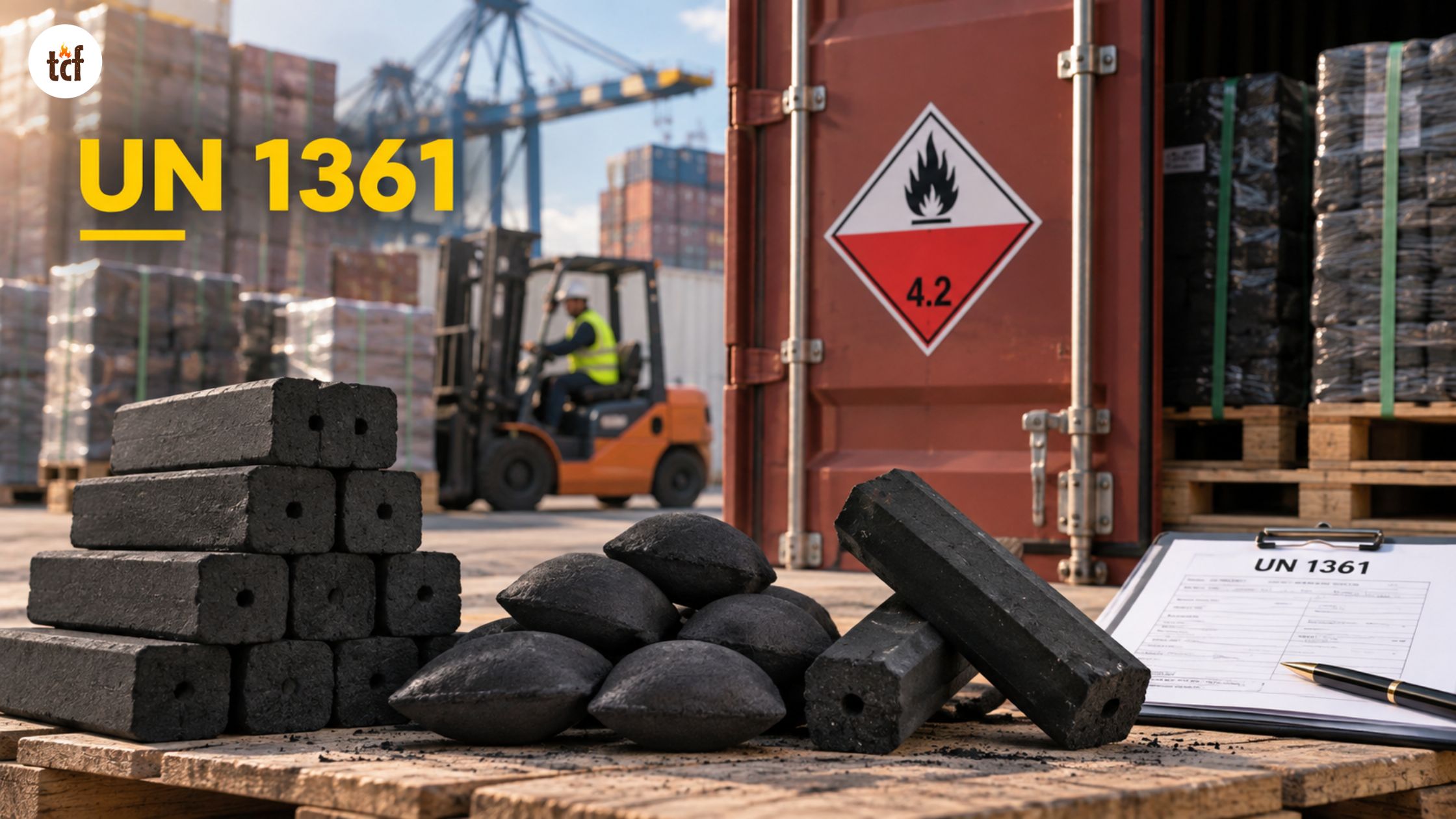
Charcoal dangerous goods shipping: Charcoal shipped by sea must now be declared as Dangerous Goods under UN1361, Class 4.2 (spontaneously combustible), regardless of prior “tested safe” exemptions. This comes from IMDG Amendment 42-24, voluntary from January 1, 2025, and mandatory from January 1, 2026.
Here’s what UN1361 actually requires, why the rule changed, and what it means for anyone importing or exporting charcoal.
Table of Contents
What is UN1361?
UN1361 is the UN shipping classification for “Carbon, animal or vegetable origin,” covering charcoal, charcoal briquettes, biochar, and similar carbon products. It falls under Class 4.2: substances liable to spontaneous combustion.
The classification isn’t new. What changed is how charcoal qualifies for it. Charcoal used to be testable out of Dangerous Goods status using the NH4 self-heating test. That exemption path is gone under the new rules.
Why the rule changed
Between 2015 and 2022, 68 container ship fires were directly linked to charcoal cargo. Charcoal can self-heat and ignite days after loading, deep inside a sealed container, well after the point where a pre-shipment test would have caught it.
Regulators concluded the old testing method wasn’t catching that risk. IMDG Amendment 42-24 replaces “test it and hope” with fixed process controls that apply to every shipment, with no exceptions based on prior test results.
SP978 is the specific rule set attached to UN1361 under the new amendment. It sets out 4 core requirements:
Weathering period: charcoal must be weathered for at least 14 days after production before packing, in covered, open storage. Alternatively, it can be packed under inert gas immediately after pyrolysis, followed by 24 hours of storage.
Temperature limit: the material’s temperature can’t exceed 40°C on the day it’s packed.
No unpackaged bulk containers: charcoal can no longer move in a container as loose bulk cargo with no packaging.
UN-approved packaging only: shipments must use certified packaging built for Class 4.2 goods.
What packaging is allowed
Charcoal must go into UN-approved and certified packaging rated for Class 4.2 substances. Certain packaging types are specifically excluded: 5H1, 5L1, and 5M1 bags are not allowed under the current rules.
If you’re currently using standard woven or plastic sacks without a UN certification code, they don’t qualify. Confirm your packaging supplier can provide UN marking and test certificates before you commit to a run.
Marking, labelling, and placarding
Every package needs the Class 4.2 hazard label and the correct UN number marking. At the container level, the Class 4.2 placard must be displayed on all 4 sides of the container.
What appears on the package itself depends on the packaging type. Single packaging (like UN-approved bags) needs full marking on each unit. The exact marking requirement should be confirmed against your packaging’s specific UN approval documentation, since it varies by format.
UN number and proper shipping name: UN1361 CARBON, animal or vegetable origin, Class 4.2
Packing group (typically PG III for charcoal)
Emergency Schedule (EmS) codes: F-A, S-J
Date of production
Date of packing into packaging
Temperature of the material on the day of packing
Emergency contact name and phone number
A production-to-packing timeline that doesn’t show at least 14 days of weathering, or a packing-day temperature above 40°C, is one of the fastest ways to get a shipment held or rejected before it even reaches the terminal.
Beyond packaging and paperwork, physical loading matters too. A minimum gap, commonly cited at 30 cm, needs to be left between the top of the cargo and the container roof to allow for heat dissipation. Overpacking a container tight to the ceiling increases self-heating risk and can trigger a rejection at the port.
Does this apply to bulk shipments?
Largely, no. The IMSBC Code, which governs solid bulk cargo, prohibits Class 4.2 self-heating substances from bulk carriage entirely. Since UN1361 charcoal is classified as self-heating, bulk shipment without packaging is not a workaround; it’s restricted under a separate code with the same underlying safety concern.
Unless a shipper can prove non-self-heating status through a specific technical test (ADR 2.2.42.1.7) and get that recognized by a competent authority, treat bulk charcoal shipping as effectively off the table under current guidance.
Timeline: when this became mandatory
January 1, 2025: voluntary compliance period began. Several major carriers, including Hapag-Lloyd, started enforcing the new requirements ahead of the deadline.
January 1, 2026: mandatory compliance under IMDG Amendment 42-24. Every charcoal shipment by sea must meet the full UN1361/SP978 requirements from this date, with no self-heating test exemption available.
Some carriers offered temporary relief during the transition. Hapag-Lloyd, for example, waived its Dangerous Goods Premium surcharge for UN1361 shipments between April 1 and December 31, 2025, though other DG-related fees still applied.
What this means for importers and factories
If you’re sourcing charcoal, especially coconut shell or wood charcoal for shisha, BBQ, or industrial use, this changes 3 things in your supply chain:
Cost: expect higher shipping costs from DG surcharges, certified packaging, and in some cases factory audit fees, since different carriers may require separate audits.
Lead time: the mandatory 14-day weathering period needs to be built into production scheduling, not treated as a formality.
Supplier documentation: you’ll want a factory that can consistently provide production dates, packing dates, and packing-day temperature records for every shipment, not just on request.
This is part of why sourcing from a factory with established weathering and temperature-control processes matters more now than it did before the amendment. Our charcoal manufacturing process page covers how we handle weathering and moisture control before packing, and our production facility page covers the storage and packing setup behind that documentation.
Frequently asked questions
Is all charcoal now classified as Dangerous Goods?
Yes, under IMDG Amendment 42-24, all charcoal of animal or vegetable origin shipped by sea falls under UN1361, Class 4.2, regardless of prior self-heating test results.
Can charcoal still be shipped in bulk without packaging?
No. The amendment specifically removes the option to ship charcoal as unpackaged bulk cargo in containers. Separately, the IMSBC Code prohibits the bulk carriage of Class 4.2 substances entirely.
What packing group does charcoal fall under?
Charcoal is typically assigned Packing Group III under UN1361, the lowest danger tier within Class 4.2, but it still requires full Dangerous Goods documentation and UN-approved packaging.
How long does charcoal need to weather before packing?
A minimum of 14 days in covered, open storage after production. An alternative path allows packing under inert gas immediately after pyrolysis, followed by 24 hours of storage.
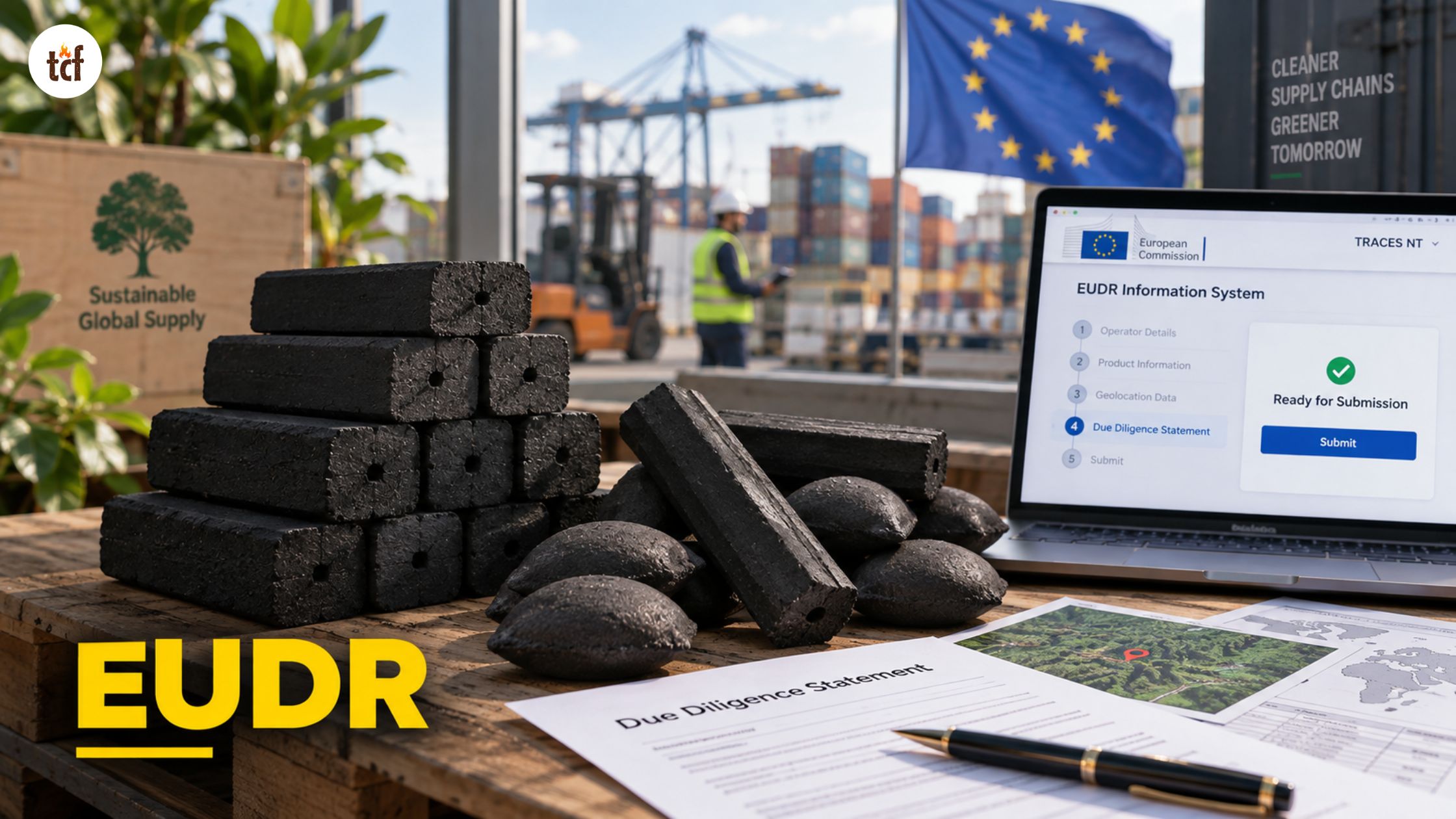
You submit an EUDR Due Diligence Statement (DDS) by logging into TRACES NT, creating or selecting your operator profile, filling in product and geolocation data, completing a risk assessment, and submitting the form to receive a DDS reference number. That reference number is what customs checks before your shipment can enter or leave the EU market.
Below is the full process, plus what trips people up and what the current deadlines actually are.
Table of Contents
What is a Due Diligence Statement under EUDR?
A Due Diligence Statement is a mandatory declaration confirming that a regulated commodity (wood, cocoa, coffee, palm oil, soy, rubber, cattle, or a product derived from them) is deforestation-free, legally produced, and backed by a documented risk assessment.
Without a valid DDS reference number, the product cannot legally be placed on or exported from the EU market. Wood charcoal and other wood-based products fall inside this scope, so any business supplying wood charcoal into the EU needs a valid DDS tied to each shipment.
What is TRACES NT?
TRACES NT (Trade Control and Expert System – New Technology) is the European Commission’s digital platform for submitting and managing DDS records. It’s an existing system originally built for plant and animal health, now extended to cover EUDR compliance.
TRACES NT does not run its own risk assessment or verify your data. It stores and processes what you submit. The accuracy of the DDS is entirely on the operator or trader submitting it.
Who needs to submit a DDS through TRACES NT?
Operators: companies placing regulated products on the EU market for the first time, or exporting them from the EU. Operators submit the full DDS.
Traders (non-SME): businesses further down the supply chain that sell products already placed on the market. Non-SME traders must submit their own DDS.
Downstream operators and SME traders: under the current rules, this group generally doesn’t submit a new DDS. Instead, they register in the system and reference the DDS number already issued upstream.
If you’re unsure which category applies, check your role for each specific transaction. A single company can be an operator for one product line and a trader for another.
What you need before you start
Gather these before opening TRACES NT, since going back and forth mid-submission is where most delays happen:
EORI number (Economic Operators Registration and Identification), required for any operator or trader involved in import or export activity
HS/CN commodity code for each product, matched precisely; incorrect codes are one of the most common rejection reasons
Product description and net mass, matching your commercial invoice and transport documents
Geolocation data for every plot of production, either as GPS coordinates (points) or polygon boundaries, in GeoJSON format
Country of production for each commodity
Risk assessment outcome and supporting evidence: certifications (FSC, PEFC, RSPO), supplier legality documents, or land-use records.
How to submit a DDS through TRACES NT: step-by-step
Step 1: Create an EU Login account
If you don’t already have one, TRACES NT access starts with an EU Login account. This is separate from the TRACES account itself and is a one-time setup.
Step 2: Create an account in the EUDR platform
Once your EU Login is active, register your account inside the EUDR section of TRACES NT. Select “EUDR” under Chapter or Activity, then choose the relevant Section.
Step 3: Request your role
Choose whether you’re registering as an Operator, Trader, or Representative. This determines what actions your account can perform later, so pick the role that matches the transaction, not just your general business type.
Step 4: Register or select your operator profile
Search for your company by country and name. If it’s already registered, request authorization to act on its behalf. If not, create a new operator profile and fill in every field marked with a red asterisk. Add your EORI number in the “Operator Identifiers” box if you import or export.
Step 5: Wait for authorization, then log back in
After submitting your registration request, log out and log back in. Your role should now be active. If it isn’t showing, check your profile page; this is where pending and approved roles are listed.
Step 6: Create a new DDS
From the EUDR homepage, click “Create.” You’ll be prompted for an internal reference number; if you skip it, the system assigns one automatically once you save.
Step 7: Fill in the DDS sections
The form is broken into sections, each building on the last:
Operator information: legal name, address, EORI, role declaration
Commodity and product details: HS code, product description, net mass, scientific name where relevant (this matters for distinguishing, say, sawn wood from wood charcoal)
Country and production place: where the commodity was grown, harvested, or produced
Geolocation: upload a prepared GeoJSON file, or use the built-in GeoEditor map tool to draw the production plot directly if you don’t have a file ready
Step 8: Complete the risk assessment declaration
Confirm that you’ve assessed the shipment as negligible risk of deforestation or illegality, and attach supporting evidence, certification documents, satellite verification reports, or supplier declarations. This evidence isn’t always visible on the final DDS PDF, but it must be available if a competent authority requests it.
Step 9: Submit and record the reference number
Once submitted, TRACES NT generates a unique DDS reference number and a separate security number known only to you and the competent authority. The reference number goes into the customs declaration’s supporting documents section. Keep both on file; they’re needed for 5 years.
Step 10: Share the reference number downstream
If a customer further down your supply chain needs to link their own DDS or declaration to yours, they’ll need this reference number. Build passing it along into your standard shipping paperwork so it doesn’t get missed.
Code doesn’t match the actual product description or Annex I classification
Invalid geolocation
Polygon overlaps, boundary spikes, or coordinates that land outside the stated country
Missing net mass
Required field left blank or mismatched against the invoice
EORI mismatch
Number doesn’t match the registered legal entity
Incomplete risk assessment
No supporting evidence attached for a “negligible risk” declaration
Fixing these before submission is faster than resubmitting after a shipment is already held at customs.
Current EUDR deadlines
Large and medium operators: full DDS required per shipment from December 30, 2026
Micro and small primary operators: extended deadline of June 30, 2027, with a simplified declaration option available in some low-risk sourcing cases
These dates reflect a 12-month delay confirmed under a 2025 amendment. Core obligations, geolocation, risk assessment, and TRACES submission haven’t changed; only the timeline has.
Where sourcing documentation fits in
A DDS is only as strong as the supply chain data behind it. Operators sourcing wood-based materials need supplier records showing legal harvest and plantation origin before a shipment ever reaches the DDS form. For a look at how that documentation gets built at the sourcing end, see our charcoal manufacturing process and production facility pages, which cover the raw material and traceability steps behind our own export-ready wood and bamboo charcoal.
Frequently asked questions
Do I need an EORI number to submit a DDS?
Yes, if you’re importing or exporting the product. Domestic-only transactions can sometimes use a VAT number instead, but EORI is the standard identifier TRACES NT expects for cross-border shipments.
Can I submit a DDS without geolocation data?
No. Geolocation, either coordinates or a polygon file, is a mandatory field for every production plot tied to the shipment. Missing or invalid geolocation data is one of the most common reasons a DDS gets rejected.
How long does TRACES NT registration take?
Account setup and EORI validation commonly take 1 to 3 weeks. Start registration well before you need to submit your first DDS, not the week a shipment is due.
What happens if my DDS is rejected?
The shipment can’t clear customs until a valid, accepted DDS reference number exists. Correct the flagged fields and resubmit. There’s no separate appeals process; it’s a resubmission.
Do traders need to submit their own DDS?
Non-SME traders generally do. Downstream operators and SME traders typically register in the system and reference the DDS number already submitted upstream, rather than filing a new one.
Importing charcoal from China typically takes 4 to 8 weeks in total from order placement to warehouse delivery, covering production, sea freight, customs clearance, and last-mile delivery. If your shipment is already in stock at the supplier’s end, that window narrows to 4 to 6 weeks, to Import Charcoal from China?.
Table of Contents
The Four Stages That Determine Your Total Lead Time
Most importers make the mistake of thinking “shipping time” is the whole picture. It isn’t. There are four distinct stages between placing your order and having charcoal in your warehouse.
Stage 1 — Order Confirmation and Production (15 to 30 days)
Once you place your order and pay a deposit, the factory schedules your run. For standard products like coconut charcoal briquettes or lump charcoal, production lead times typically run 15 to 30 days. Custom packaging, private label printing, or large volumes can push this closer to 35 to 40 days.
Stage 2 — Export Handling and Loading (3 to 7 days)
After production, goods are packed, loaded into containers, and transported to the port of departure — usually Shanghai, Shenzhen, or Ningbo. Documentation is prepared at this stage, including the commercial invoice, packing list, bill of lading, and certificate of origin.
Stage 3 — Sea Freight Transit (18 to 40 days)
This is the largest variable in your timeline. The destination determines the range.
Stage 4 — Customs Clearance and Local Delivery (5 to 12 days)
Once the container arrives at your destination port, it must clear customs before it reaches you. Straightforward shipments with clean documentation typically clear in 1 to 5 working days. Inspections, documentation errors, or busy port periods can extend this by a week or more. After clearance, add 2 to 5 days for trucking and last-mile delivery.
How Long Does Sea Freight Take by Destination?
Sea freight is the standard method for bulk charcoal imports. The transit time depends almost entirely on where you are.
Destination Region
Typical Port-to-Port Transit
Common Ports Used
UK (Felixstowe / Southampton)
28 to 36 days
Shanghai → Felixstowe
Western Europe (Rotterdam / Hamburg)
25 to 35 days
Shenzhen → Rotterdam
USA West Coast (LA / Long Beach)
15 to 20 days
Shanghai → Los Angeles
USA East Coast (New York / Savannah)
25 to 35 days
Ningbo → New York
Middle East (Dubai / Jeddah)
18 to 25 days
Shenzhen → Dubai
Australia (Sydney / Melbourne)
18 to 25 days
Shanghai → Sydney
For UK importers specifically, the most common route runs from Shanghai or Shenzhen through the Suez Canal to Felixstowe, with a typical port-to-port transit of 28 to 36 days.
If you are sourcing wholesale shisha charcoal or BBQ charcoal in bulk, ocean freight via FCL (Full Container Load) is almost always the right choice — cost per tonne drops significantly compared to LCL (Less than Container Load) for volumes above 10 to 12 tonnes.
Air freight from China to the UK or Europe typically takes 5 to 8 days port-to-port. Door-to-door, including collection and customs, adds another 3 to 5 days, so a realistic total is 8 to 13 days.
The trade-off is cost. Air freight rates run roughly 4 to 6 times higher per kilogram than sea freight. For a dense, heavy commodity like charcoal, air freight is rarely economical at commercial volumes. It is occasionally used for urgent, smaller top-up orders, but the economics rarely make sense for a full pallet or container.
Is There a Faster Option Between Air and Sea?
Rail freight via the China-Europe corridor (also called the New Silk Road) offers a middle-ground option. Transit from Chinese logistics hubs to European destinations typically takes 18 to 22 days — roughly 10 to 15 days faster than sea freight but slower than air.
Rail is not available for all destinations and has capacity limitations. For most charcoal importers in the UK or Western Europe, sea freight remains the dominant choice for cost and reliability.
What Is the Realistic Timeline? A Real Example
Here is how a typical charcoal import order plays out from our experience working with bulk buyers:
Day 1 to 3 — Order confirmed, deposit paid, production slot allocated at the factory.
Day 4 to 22 — Production completed (18 days in this case — a standard run with existing materials).
Day 23 to 28 — Export documentation prepared, container stuffed, trucked to Shenzhen port.
Day 29 to 62 — Sea transit, Shenzhen to Felixstowe via Suez Canal (34 days).
Day 63 to 68 — UK customs clearance (5 days, no inspection triggered).
Day 69 to 71 — Trucking from Felixstowe to the buyer’s warehouse.
Total: 71 days, just over 10 weeks.
This is a fairly smooth example. A delayed production run, a port inspection, or a vessel scheduling gap could easily add 7 to 14 days on top.
What Slows Down a Charcoal Import?
Several factors commonly delay charcoal shipments beyond the baseline estimates.
Customs inspections are the most unpredictable delay. Charcoal falls under HS Code 4402 (wood charcoal, whether or not agglomerated), and shipments are occasionally flagged for physical examination — particularly if documentation is inconsistent or this is a new importer relationship.
Port congestion, especially at major UK ports like Felixstowe and Southampton during peak retail seasons (pre-summer BBQ season, Q4), can add several days of dwell time before containers are even released from the terminal.
Chinese export bottlenecks around the Lunar New Year (typically January to February) and Golden Week (October) are significant. Factories slow down or stop, and port volumes spike before and after each holiday. Importers who don’t plan around these windows regularly face 2 to 4 week slippages.
Documentation errors are a common and avoidable delay. A mismatch between the commercial invoice, bill of lading, and packing list is one of the most frequent causes of customs holds.
What Documents Do You Need for a Charcoal Import from China?
Having your paperwork correct before the container departs significantly reduces clearance delays at the destination port.
Phytosanitary Certificate (required in many markets for wood-based charcoal)
MSDS / Safety Data Sheet (particularly important for shisha and hookah charcoal due to DG classification)
For buyers sourcing charcoal briquettes wholesale into the EU or UK, additional sustainability documentation is increasingly expected. The EU Deforestation Regulation (EUDR) now requires due diligence statements confirming the product is not linked to deforestation. FSC chain-of-custody documentation from your Chinese supplier is the most efficient way to satisfy this requirement.
If you are evaluating suppliers and want to know what to ask for, our charcoal supplier verification checklist covers the documentation standards to request before placing your first order.
How Does Shipping Method Affect Total Lead Time? A Summary
Shipping Method
Transit Only
Total Lead Time (Order to Warehouse)
Sea Freight (FCL)
18 to 40 days
45 to 75 days
Sea Freight (LCL)
25 to 45 days
50 to 80 days
Rail Freight
18 to 22 days
40 to 60 days
Air Freight
5 to 8 days
25 to 45 days
LCL adds time at both ends, consolidation before departure and deconsolidation after arrival, typically adding 3 to 7 days on each side compared to FCL.
How Should You Plan Your Charcoal Inventory Around These Timelines?
The practical answer from buyers who import regularly: maintain 3 to 4 months of forward stock and place your reorder well before your buffer stock runs out.
If you supply BBQ charcoal to retail or foodservice, your peak demand typically hits May through August. That means your spring shipments should be on the water by late February at the latest, which means orders placed no later than January. Buyers who leave this until March regularly face summer stockouts.
For restaurants and foodservice operators using charcoal year-round, a rolling 90-day reorder cycle with a confirmed freight forwarder relationship tends to work well in practice.
If you are scaling up and exploring private-label charcoal for supermarkets, additional lead time is needed for packaging design and approval, which typically adds 2 to 4 weeks to your first-order timeline.
How long does it take to import charcoal from China to the UK?
From order placement to UK warehouse delivery, the realistic timeline is 8 to 12 weeks. This includes 15 to 30 days of production, 28 to 36 days of sea transit, and 5 to 10 days for customs clearance and final delivery. Smooth shipments with clean documentation can be completed in around 70 days; complex or delayed ones can stretch to 90 days or more.
Can I get charcoal from China faster than sea freight?
Air freight can get goods to the UK in 8 to 13 days door-to-door, but the cost premium is rarely justifiable for charcoal at commercial volumes. Rail freight via the China-Europe corridor offers a faster alternative at 18 to 22 days transit, sitting between sea and air on both speed and cost.
What HS code is used for importing charcoal from China?
Charcoal is classified under HS Code 4402. The key sub-codes are 4402.10.00 for natural lump charcoal and 4402.90.00 for briquettes and other agglomerated forms. Using the correct sub-code is important — misclassification can trigger customs queries and delays at the destination port.
How much does it cost to import a container of charcoal from China?
Freight costs vary by origin port, destination, container size, and season. As a rough benchmark, sea freight for a 40HQ container from China to UK ports typically runs between £2,500 and £5,000 in normal market conditions, excluding port handling, customs clearance fees, and inland delivery. Peak seasons and route disruptions (such as the Suez Canal rerouting seen in 2024) can push rates significantly higher.Freight costs vary by origin port, destination, container size, and season. As a rough benchmark, sea freight for a 40HQ container from China to UK ports typically runs between £2,500 and £5,000 in normal market conditions, excluding port handling, customs clearance fees, and inland delivery. Peak seasons and route disruptions (such as the Suez Canal rerouting seen in 2024) can push rates significantly higher.
Coconut charcoal vs hardwood charcoal are both classified under HS 4402, both ship in 40HQ containers, and both serve the BBQ and commercial fuel markets. But from a wholesale import perspective, they are fundamentally different products, with different quality benchmarks, regulatory obligations, supply chains, and landed cost structures. This guide covers what actually matters when you are choosing between them at the container scale.
Table of Contents
What Is the Core Difference Between the Two Coconut Charcoal vs Hardwood Charcoal?
Hardwood lump charcoal is produced by carbonising dense hardwood timber species, including oak, acacia, halaban, tamarind, and mangrove in low-oxygen kilns. The output is irregular, natural-looking chunks that retain the organic structure of the original wood. Because the raw material is a forest resource, hardwood charcoal is subject to the full scope of forest risk commodity regulations in major import markets.
Coconut shell charcoal is produced by carbonising the shells left over from coconut processing, an agricultural byproduct, not a forest resource. The carbonised shell is then crushed and pressed with a natural binder (typically tapioca starch at 3–5% by weight) into uniform-shaped briquettes. The starting material is a waste stream; no additional trees are cut, no additional land is cleared, and no additional farming takes place to produce it.
This distinction between agricultural byproducts and forest resources is not just a sustainability narrative. It has direct and measurable consequences for how each product is regulated, documented, and priced in international trade.
How Do the Technical Specifications Compare?
The performance difference between the two products is real, consistent, and documented across independent laboratory testing. Buyers evaluating which product to import should start with these numbers.
Specification
Coconut Shell Charcoal
Hardwood Lump Charcoal
Fixed Carbon
75–85%
65–80% (species-dependent)
Moisture Content
≤5% (briquette)
≤8% (lump)
Ash Content
2–4%
5–10%
Calorific Value
7,000–7,500 kcal/kg
6,500–7,200 kcal/kg
Burn Time (approx.)
90–120 minutes per charge
45–75 minutes per charge
Smoke Output
Very low
Low to moderate (species-dependent)
Odour During Burn
Neutral
Natural wood aroma (species-dependent)
Shape Consistency
Uniform (compressed)
Irregular (natural)
Ignition Time
8–12 minutes
5–10 minutes (lump ignites faster)
The fixed carbon content figures above are industry benchmarks for premium-grade product from established exporters. Lower-grade material from either category will fall below these ranges, which is precisely why a Certificate of Analysis from a third-party lab is standard practice for every commercial shipment. Our charcoal grades explained guide covers what each specification means in practice.
Which Product Is Better for Which End Market?
Shisha and Hookah Markets
Coconut shell charcoal dominates the global shisha market with no serious competition. The reasons are specific and technical: shisha sessions run 45–90 minutes, requiring sustained, consistent heat without the need for frequent coal changes. The odour neutrality of coconut charcoal is essential, as any wood aroma from a hardwood product directly affects the flavour profile of the shisha tobacco, which is commercially unacceptable for premium lounges.
Low ash output is also critical in hookah settings. High ash production leads to heat management problems as ash accumulates on the foil, reducing airflow and forcing more frequent management. Coconut shell briquettes, generating just 2–4% ash by weight, largely eliminate this problem.
Middle Eastern markets, Saudi Arabia, UAE, Qatar, source almost exclusively from Indonesian coconut shell suppliers for exactly these reasons. This is also why wholesale shisha charcoal and wholesale hookah charcoal are dominated by coconut shell products rather than wood.
This is where the two products genuinely compete, and where buyer preference splits by application.
High-heat, fast-cooking applications, such as searing steaks, cooking at grill temperatures above 300°C, are where hardwood lump charcoal excels. Dense hardwood ignites faster than compressed briquettes, reaches peak temperature more quickly, and for operations that rotate product frequently, the faster burn cycle is not a drawback but a feature. The natural aroma from hardwoods like oak and halaban adds to the product profile when flavour is a selling point.
Long-session cooking, slow BBQ, restaurant kitchens running continuous service, and caterers typically favour coconut shell briquettes. The 30–50% longer burn time means fewer coal changes per service, lower per-service charcoal consumption, and more consistent temperature management throughout a session. Most operators report that despite coconut shell charcoal carrying a higher per-kg price, the extended burn time makes it more cost-effective per service hour in a commercial setting.
For bulk charcoal for restaurants, the decision between the two products typically comes down to service style and kitchen workflow rather than price alone.
Retail and Supermarket Channels
Retail packaging decisions tend to follow consumer behaviour in each market. UK and European retail consumers predominantly expect lump charcoal or standard briquettes in the BBQ category. The craft BBQ and premium outdoor cooking segment — which has grown significantly across Europe in the past decade is driving demand for premium hardwood lump from specific origins and species. Premium products from named species and origins command retail shelf prices significantly above commodity charcoal.
Coconut shell charcoal is increasingly appearing in European retail, particularly in the eco-conscious and natural food store segment, where its sustainability credentials, agricultural waste, no deforestation link, and clean burn align with consumer values. This is a growing category, but still secondary to hardwood in volume terms across most European markets.
How Does the Import Regulatory Picture Differ?
This is one of the most practically consequential differences between the two products, and it is under-discussed in most sourcing guides.
HS Code Classification
Coconut shell charcoal falls under HS 4402.20 Shell or nut charcoal. Hardwood lump charcoal falls under HS 4402.90 Other wood charcoal. Both carry a 0% import duty in the EU, UK, and US under standard MFN tariffs. The difference is not in the duty rate; it is in what the subheading triggers.
The EUDR Distinction Is Material
The EU Deforestation Regulation (EUDR), which takes effect for large operators on 30 December 2026, covers wood-derived products under HS 4402. Hardwood charcoal under 4402.90 is unambiguously in scope; it originates from forest timber, and importers will need to submit a Due Diligence Statement (DDS) via the EU’s TRACES platform confirming geolocated, deforestation-free sourcing before each shipment is cleared for the EU market.
Coconut shell charcoal classified correctly under 4402.20 has a defensible argument that it falls outside the EUDR’s core intent. Coconut (Cocos nucifera) is a plantation agricultural crop, not a forest tree, and coconut shells are an agricultural byproduct rather than a forest product. Operators importing coconut shell charcoal under 4402.20 are therefore in a stronger position to argue reduced EUDR compliance burden than those importing hardwood under 4402.90.
This distinction has real commercial consequences. Suppliers who cannot provide geolocated hardwood sourcing data will be unable to meet EUDR requirements and will lose EU market access. This is already creating pricing and sourcing pressure at the supplier level for hardwood charcoal. Coconut shell suppliers, by contrast, face a less burdensome compliance path — which is one reason European charcoal buyers have been shifting a greater share of their procurement toward coconut shell products ahead of 2026.
For more on the regulatory distinction between these two HS subheadings and what triggers EUDR obligations, see our charcoal HS codes guide.
Sourcing Traceability: Much Harder for Hardwood
A 2025 peer-reviewed study published in the Forest Products Journal examined the US lump charcoal market and found evidence of fraud and misrepresentation, including the presence of IUCN Red List species in products labelled as standard commercial hardwood. This is a documented risk in hardwood charcoal supply chains globally not just in the US and it underscores why traceability for hardwood lump charcoal is genuinely difficult and why FSC certification is meaningful rather than cosmetic.
Coconut shell charcoal has an inherently simpler traceability chain. The raw material is coconut shells from a specific processing facility a single-origin agricultural byproduct. The supply chain from farm to briquette factory is typically two steps, not the multi-tier, multi-origin chain that characterises hardwood sourcing from tropical forests.
This makes coconut shell charcoal significantly easier to certify, trace, and document — which is directly relevant to both EUDR compliance and the sourcing verification that sophisticated B2B buyers now conduct routinely.
How Do Import Prices Compare?
FOB price is the most common comparison point, but the landed cost picture is more complex than the raw per-ton figure suggests.
Product Type
FOB Price Range (2025–2026)
Key Pricing Drivers
Coconut shell briquettes (premium)
$1,200–$1,500/MT
Coconut shell raw material cost, shape complexity, certifications
Hardwood lump charcoal (standard)
$700–$1,100/MT
Species, origin, FSC status, kiln method
Hardwood lump charcoal (premium/FSC)
$900–$1,400/MT
Certified species, European market premium
Mixed wood briquettes (sawdust)
$500–$800/MT
Lower raw material cost, simpler production
Coconut shell charcoal consistently costs 15–30% more per kilogram at FOB than equivalent-grade hardwood products. However, comparing the two on FOB price per ton misses the operational cost picture entirely.
In commercial settings, restaurants, shisha lounges, and catering operations, coconut shell charcoal’s 30–50% longer burn time per charge means that the volume consumed per service hour is significantly lower. Most commercial operators sourcing both products on a trial basis report that the per-service cost of coconut shell charcoal is broadly comparable to hardwood, and often lower once labour for coal changes is factored in.
For retail buyers, price is more directly a consideration because consumers are comparing price on the shelf rather than cost per hour of heat. In this context, hardwood charcoal’s lower entry price per pack makes it an easier sell in volume retail, while premium coconut shell products find their market in speciality and eco-oriented retail channels.
Which Country Should You Source From?
Coconut Charcoal: Indonesia Dominates
Indonesia is the world’s largest coconut producer and the undisputed leading source for coconut shell charcoal. Central Java and Yogyakarta are the primary production hubs, with direct access to major export ports. Indonesian coconut shell briquettes set the global benchmark for this product category, with consistent fixed carbon above 75%, ash below 4%, and shape uniformity that meets the specifications of the most demanding shisha markets in the Middle East and Europe.
Our coconut charcoal briquettes wholesale range is built on this supply chain. For buyers sourcing at container scale, quality vetting is still essential — the Indonesian market includes everything from premium export-grade factories to smaller operations with inconsistent output.
Hardwood lump charcoal is sourced from a much broader range of origins. Indonesia produces quality hardwood lump from halaban and tamarind. Vietnam produces mangrove, longan, and fruitwood charcoal with a strong export infrastructure. Brazil, Paraguay, and Argentina supply European and US markets with dense hardwood products. Each origin has different species profiles, different production methods, and different FSC availability.
The quality range within hardwood lump charcoal is significantly wider than within coconut shell briquettes. Premium FSC-certified halaban from Indonesia is a fundamentally different product from a commodity mixed-wood lump from a lower-cost origin. For wholesale buyers, specifying the species, origin, and certification status not just “hardwood lump charcoal” is essential to consistent procurement. Our bulk lump charcoal range covers these distinctions in detail.
Many experienced wholesale buyers carry both product types in their range. The logic is straightforward: the two products serve meaningfully different segments, and buyers who carry both are better positioned across shisha, restaurant, and retail channels than those who specialise in one.
The most common structure among multi-product wholesale operations is to source coconut shell briquettes from Indonesia as the foundation of the shisha and premium commercial BBQ range, while sourcing hardwood lump from Indonesia or Vietnam for the restaurant grilling and retail BBQ range. This gives buyers origin diversity, product diversity, and a more resilient supply chain than relying on a single product from a single origin.
Buyers building a private label charcoal programme for retail often find that a two-product approach, coconut shell for the premium eco line and hardwood for the standard BBQ line, allows effective shelf segmentation and supports different price point strategies within the same brand.
Is coconut charcoal always more expensive than hardwood charcoal?
At FOB price per metric ton, yes, typically 15–30% more expensive. However, in operational settings, the longer burn time of coconut charcoal (30–50% more burn time per charge) means the per-session or per-service cost is often comparable to or lower than that of hardwood. Retail buyers face a more direct price sensitivity, where the lower entry price of hardwood lump is a genuine advantage in standard BBQ channels.
Can I use hardwood charcoal for shisha?
Technically, yes, but commercially, it is a poor fit. Hardwood charcoal even premium, odourless hardwood cannot consistently match the neutral burn profile, low ash output, and heat consistency that coconut shell briquettes deliver for shisha. Most shisha lounge operators who have trialled hardwood alternatives report customer complaints about flavour interference or inconsistent heat management. The shisha market has aligned on coconut shell charcoal for documented performance reasons, not marketing preference.
Which product is easier to certify for EU import under the EUDR?
Coconut shell charcoal (HS 4402.20) is in a substantially better regulatory position than hardwood charcoal (HS 4402.90) under the EUDR. Coconut shells are an agricultural byproduct, not a forest product, and operators can argue for reduced compliance burden. Hardwood charcoal requires full deforestation-free due diligence with geolocated sourcing data from each supplier. This is a real operational difference that is already influencing sourcing decisions among European buyers ahead of the December 2026 enforcement deadline.
Does hardwood charcoal taste different from coconut charcoal?
In BBQ applications, yes. Dense hardwoods — particularly oak, hickory, and halaban — impart a distinctive smoky aroma to food during cooking. This is a selling point in premium BBQ markets where flavour complexity is valued. Coconut shell charcoal burns with a neutral profile, allowing the natural flavours of the food to dominate. For shisha, the neutral profile is essential. For food service, the preference depends on cuisine and customer expectations.
Required documents for importing charcoal. Getting a charcoal shipment from a supplier to a warehouse involves more paperwork than most first-time buyers expect. A missing fumigation certificate has held containers at the port for days. A wrong product description on a commercial invoice has triggered customs inspections. A charcoal shipment declared without dangerous goods documentation has been rejected by carriers. This guide covers every document you need, what it is, why customs requires it, and what happens when it is missing.
Table of Contents
Why Is Charcoal Documentation More Complex Than Other Products?
Charcoal sits at the intersection of several overlapping regulatory frameworks. It is a plant-derived commodity, which means it is subject to phytosanitary rules. It is a self-heating substance under international maritime law, which means it carries dangerous goods classification requirements. It is a wood or biomass product, which brings it under deforestation compliance frameworks in major markets. And it is an internationally traded commodity with specific HS code classification requirements that affect duty rates and regulatory obligations.
Most products only touch one or two of these frameworks. Charcoal touches all of them simultaneously. Understanding each layer is what separates importers who clear customs smoothly from those whose containers sit on demurrage while documents are chased down.
What Are the Core Required Documents for Importing Charcoal for Every Charcoal Shipment?
Commercial Invoice
The commercial invoice is the primary financial and customs document for any shipment. For charcoal imports, it must include the full product description, not just “charcoal” but the specific type (e.g., “coconut shell charcoal briquettes, cube shape, 25mm, moisture content <5%”), the HS code, quantity, unit price, total value, currency, Incoterms, country of origin, and both buyer and seller details.
Vague descriptions are the single most common trigger for customs delays in the charcoal trade. Customs officers need to verify that the declared product matches the applicable duty rate and regulatory requirements. A description that does not align precisely with the HS code on the declaration creates an immediate flag.
Packing List
The packing list provides a physical inventory of the shipment — number of bags or cartons, gross and net weight per unit, total gross and net weight, and how the goods are packed inside the container. Customs use it to verify that what was declared matches what is physically present.
A critical operational point: the weights on the packing list must match the weights on the Bill of Lading exactly. Weight discrepancies between these two documents are one of the most common triggers for unnecessary physical inspections, which can delay a container by several days and generate significant port storage costs.
Proforma Invoice
The proforma invoice is issued before the final commercial invoice, typically at the point of order confirmation. It outlines the same core product details, quantity, pricing, and terms. Buyers use it to initiate payment, apply for import licences where required, open a Letter of Credit, or obtain pre-shipment approvals from relevant authorities. It is not a customs document in itself but is frequently requested by banks and regulatory bodies before a shipment begins.
Sales Contract
The signed sales contract between buyer and seller establishes the agreed terms, product specifications, quantity, price, Incoterms, payment terms, delivery timeline, and any quality or documentation guarantees. Customs authorities in some markets request the contract to verify that the declared invoice value reflects an arm’s-length commercial transaction. It is also the legal foundation for any dispute resolution if product quality or documentation falls short.
The Bill of Lading (B/L) is the most legally significant document in an international charcoal shipment. It serves three simultaneous functions: it is the carrier’s receipt confirming the cargo was loaded, the contract of carriage between shipper and carrier, and the document of title, meaning the original B/L must be presented to release the goods at the destination port.
For charcoal specifically, the B/L must accurately reflect the dangerous goods classification under the new IMDG Code requirements (see below). The cargo description on the B/L must match the dangerous goods transport document and cannot simply read “charcoal” without the required UN classification information.
Most bulk charcoal moves by sea in 20-foot or 40HQ containers. Sample shipments may occasionally use air freight, in which case an Airway Bill replaces the B/L, though air freight is rarely used for commercial charcoal orders due to the weight-to-value ratio.
What Regulatory and Compliance Documents Are Required?
Certificate of Origin (COO)
The Certificate of Origin officially declares where the charcoal was produced. It is required by customs authorities in virtually every importing country to determine applicable duty rates and whether preferential tariff treatment applies under any free trade agreements.
For charcoal, the COO also serves a traceability function. When buyers are demonstrating responsible sourcing to their own customers, certifiers, or regulators, the COO is the baseline document confirming origin. It is issued by the exporting country’s chamber of commerce or relevant government body.
In the EU context, the COO is a prerequisite document for EUDR due diligence. Without a confirmed origin, geolocated sourcing data cannot be assembled, and the due diligence statement cannot be submitted.
Phytosanitary Certificate
The phytosanitary certificate is issued by the National Plant Protection Organisation (NPPO) of the exporting country. It certifies that the charcoal shipment has been inspected and is free from regulated pests and plant diseases.
Many importing countries, including EU member states, the UK, the US, Australia, Japan, and Saudi Arabia, require a phytosanitary certificate for charcoal because it is derived from plant material. The specific requirements vary by destination. Australia has historically applied particularly stringent phytosanitary rules on charcoal imports, though requirements for the Australian market have been updated in recent years.
The phytosanitary certificate must be issued for each shipment by an authorised government official. It cannot be copied, reused, or applied to a different consignment. Buyers should confirm the specific pest-free declarations required by the destination country’s NPPO before the shipment is prepared.
Fumigation Certificate
The fumigation certificate confirms that the charcoal shipment and specifically any wooden packaging material (pallets, wooden dunnage) in the container has been treated to eliminate insects, larvae, and other pests.
Two distinct fumigation requirements apply to charcoal shipments:
The first is fumigation of the charcoal product itself, which some destination markets require as a condition of entry. The second and universally applicable is ISPM 15 compliance for any wooden packaging material used in the container. ISPM 15 (the International Standards for Phytosanitary Measures No. 15) requires that all wood packaging material used in international trade is heat-treated or methyl bromide-fumigated and bear the official IPPC mark. Major importing markets, including the US, EU, UK, Australia, Japan, and most others, enforce this requirement. A shipment arriving with non-compliant wooden pallets can be refused entry or quarantined at the importer’s expense.
In January 2026, APHIS reinstated the full ISPM 15 hyphen requirement for wood packaging material, meaning the IPPC mark must correctly format the country code and facility code with a hyphen a compliance detail that caused issues when enforcement was temporarily suspended in 2025.
Certificate of Analysis (COA)
The Certificate of Analysis is a third-party laboratory test report confirming the charcoal’s physical and chemical specifications, typically including fixed carbon content, moisture content, ash content, volatile matter, and calorific value. It is issued by an independent testing body such as SGS, Intertek, or Bureau Veritas.
The COA is not a statutory customs requirement in most markets, but it is functionally non-negotiable in the B2B charcoal trade. Wholesale buyers require it to verify that the product meets the specifications agreed in the contract, and it is the primary basis on which quality disputes are adjudicated. For buyers supplying food service, retail, or shisha markets, the COA is also the document most often requested by their end customers or brand compliance teams.
The COA must correspond to the specific production batch being shipped a COA from a previous order does not confirm the quality of the current consignment. Reputable manufacturers issue a batch-specific COA as part of every shipment’s documentation package. You can read more about what specifications matter in our charcoal grades explained guide.
Material Safety Data Sheet (MSDS)
The MSDS, sometimes called a Safety Data Sheet (SDS) provides standardised information on the material’s composition, physical and chemical properties, handling hazards, first aid measures, fire safety, storage requirements, and disposal guidance. It is required by port authorities, customs in some markets, and logistics providers when handling charcoal as a dangerous goods shipment.
With the IMDG Code Amendment 42-24 now mandatory from January 2026 (see below), the MSDS has become a more operationally critical document than it previously was. Carriers and freight forwarders will request it as part of the dangerous goods booking process.
What Is the Dangerous Goods Documentation Now Required for All Charcoal Shipments?
This is the most significant documentation change in the charcoal trade in recent years, and many importers have not yet fully adjusted.
IMDG Code Amendment 42-24 Mandatory from January 2026
The International Maritime Dangerous Goods (IMDG) Code Amendment 42-24 became mandatory for all sea freight as of 1 January 2026. Before this change, charcoal shipments could avoid full dangerous goods classification if they passed certain self-heating tests (under Special Provisions SP925 and SP223). Both of those exemptions have been removed.
Under the new regime, all charcoal, including bamboo charcoal, coconut shell briquettes, hardwood lump charcoal, and BBQ briquettes must be declared and transported as dangerous goods classified as UN 1361 CARBON, animal or vegetable origin, Class 4.2 (substances liable to spontaneous combustion). There are no exemptions, regardless of test results.
The new Special Provision SP 978 introduces specific requirements:
The charcoal must be weathered for a minimum of 14 days in covered, open-air storage after production before being packaged for transport. Alternatively, it may be steam-cooled after pyrolysis and packed under an inert gas atmosphere with a 24-hour storage period.
The decision to classify this way traces to a troubling pattern: between 2015 and 2022, at least 68 container fires were linked to charcoal, most starting days after loading due to self-heating. The previous “tested-safe” exemptions failed to prevent these incidents, which is why the IMO removed them entirely.
What Dangerous Goods Documentation Is Now Required?
Every sea freight charcoal shipment must include a Dangerous Goods Declaration (DGD), sometimes called a Shipper’s Declaration for Dangerous Goods. This document must specify: UN number (UN 1361), proper shipping name (CARBON, animal or vegetable origin), class (4.2), packing group (II or III, based on testing), packaging type and quantity, and net weight.
The DGD must be completed by the shipper and provided to the freight forwarder and carrier before booking is confirmed. Major carriers, including Hapag-Lloyd, introduced early enforcement from April 2025. Any charcoal shipment booked without compliant DG documentation will be rejected at the port.
The MSDS and Container Stuffing Certificate or Vehicle Packing Certificate are also part of the dangerous goods documentation package, confirming the container was packed correctly and safely in line with IMDG requirements.
What Additional Documents Are Required for Specific Markets?
European Union: EUDR Due Diligence Statement
From 30 December 2026, large and medium operators importing charcoal under HS 4402 into the EU must submit a Due Diligence Statement (DDS) through the EU’s TRACES platform before the goods are placed on the EU market. This is not a voluntary sustainability declaration; it is a customs clearance prerequisite. The reference number generated by the DDS filing must be included in the customs declaration. Without it, the shipment cannot be legally cleared.
The DDS requires geolocated origin data confirming the charcoal was produced on land not deforested after 31 December 2020, supply chain mapping identifying each link from forest to shipment, and a risk assessment confirming negligible deforestation risk. Non-compliance carries penalties of at least 4% of annual EU turnover, goods seizure, or suspension from EU market access.
FSC certification is not a substitute for EUDR compliance, but is one of the most practical tools to support a compliant DDS. FSC chain-of-custody certification provides the traceability documentation that underpins the sourcing data requirements of the regulation.
United States: CBP Entry Documentation and Importer Security Filing
US imports require formal customs entry documentation submitted through the Automated Commercial Environment (ACE) system, typically handled by a licensed customs broker. For commercial shipments over $2,500, a customs bond is required. The Importer Security Filing (ISF, also called 10+2) must be submitted at least 24 hours before the vessel departs the foreign port.
US buyers sourcing from China must additionally account for Section 301 tariff classification. The customs entry must correctly identify the Section 301 list applicable to the specific HTS subheading, as this determines the total duty assessed.
Australia: AQIS and Biosecurity Requirements
Australia applies strict biosecurity requirements to charcoal imports through the Department of Agriculture, Fisheries and Forestry (DAFF). Historical requirements for AQIS fumigation at the level of the Australian Fumigation Accreditation Scheme (AQIS-AFAS standard) applied per shipment at the port of departure. Requirements have been updated in recent years and buyers should verify current biosecurity conditions for their specific product type with their Australian customs broker before booking.
What Does a Complete Charcoal Import Document Set Look Like?
The following table summarises the standard document set for a commercial charcoal shipment, indicating which are universally required and which are market-specific:
Document
Purpose
Required By
Commercial Invoice
Customs valuation, duty calculation
All markets
Packing List
Physical inventory verification
All markets
Bill of Lading / Airway Bill
Title, contract of carriage
All markets
Certificate of Origin
Origin declaration, duty rate determination
All markets
Phytosanitary Certificate
Plant health compliance
Most markets (verify by destination)
Fumigation Certificate + ISPM 15
Wood packaging pest control
All markets using wood pallets
Certificate of Analysis (COA)
Quality verification
B2B standard (not statutory)
MSDS / SDS
Safety handling information
Required for DG shipments
Dangerous Goods Declaration (DGD)
IMDG UN 1361 Class 4.2 compliance
All sea freight from Jan 2026
Container Stuffing Certificate
DG packing compliance
All DG sea freight
FSC Certificate (supplier-level)
Responsible sourcing evidence
EU/UK retail, EUDR-linked
EUDR Due Diligence Statement
Deforestation-free compliance
EU market from Dec 2026
Proforma Invoice
Pre-order formalities, LC, permits
As required by buyer/bank
Sales Contract
Transaction terms reference
Market-specific, banking
What Are the Most Costly Documentation Mistakes in Charcoal Imports?
Mismatched weights. The weight on the packing list, Bill of Lading, and customs declaration must align. Even a minor discrepancy creates an audit flag that can delay clearance for days and generate port storage charges that quickly exceed the value of the documentation error itself.
Vague product descriptions. “Charcoal” on a commercial invoice is insufficient. Customs officers need to verify classification, and an ambiguous description leaves the door open for reclassification, inspection, and delay. Always specify the type, raw material, shape, size, and key quality parameters.
Missing or late dangerous goods documentation. Since January 2026, carriers have rejected charcoal bookings without compliant DG declarations. Late submission of the DGD after booking means the shipment misses the vessel, and the container goes into storage. This is now one of the most common first-order costs for buyers who have not updated their documentation processes.
COA from the wrong batch. A Certificate of Analysis issued for a previous production batch does not certify the current shipment. If a dispute arises about product quality, a COA that does not correspond to the specific production lot is not evidentially useful and may void contractual remedies.
ISPM 15 non-compliance on wooden pallets. Wooden pallets without the IPPC heat-treatment mark are a standard ground for quarantine detention in Australia, the US, and EU markets. This is a supplier-side obligation, but the importer bears the cost of detention and re-export. Always confirm with your supplier that all wooden packaging material carries the correct ISPM 15 mark before the container is loaded.
Frequently Asked Questions
Which document is most important for clearing charcoal at customs?
The commercial invoice and Bill of Lading are the two most operationally critical documents: the invoice for duty calculation and the B/L for cargo release. However, following IMDG Amendment 42-24, the Dangerous Goods Declaration has become equally critical because carriers will reject the booking without it, meaning the shipment never arrives at customs in the first place.
Is a Certificate of Analysis legally required to import charcoal?
A COA is not a statutory customs requirement in most markets. It is, however, a commercial standard in the B2B charcoal trade; virtually all wholesale buyers require it to verify product quality against specifications. Buyers should treat it as functionally mandatory even where it is not legally compulsory.
What changed about charcoal dangerous goods documentation in 2025 and 2026?
IMDG Code Amendment 42-24 removed the previous exemptions that allowed charcoal to ship without full dangerous goods classification if it passed self-heating tests. From January 2026, all charcoal, regardless of type or test results, must be declared as UN 1361 CARBON, Class 4.2 dangerous goods. This requires a Dangerous Goods Declaration, correctly completed, to be submitted to the carrier before booking. Major carriers began enforcing this from early to mid-2025.
Do I need an FSC certificate to import charcoal into the EU?
FSC certification is not a statutory customs requirement for EU charcoal imports. However, the EUDR Due Diligence Statement (required from December 2026) demands geolocated sourcing data and supply chain traceability and FSC chain-of-custody certification is one of the most practical ways to build a compliant evidence base. Retailers and supermarket buyers in Europe already treat FSC as a market entry requirement regardless of EUDR timelines.
What is the phytosanitary certificate, and who issues it?
A phytosanitary certificate is an official government document issued by the National Plant Protection Organisation (NPPO) of the exporting country. It certifies that the charcoal has been inspected and is free from regulated plant pests. It must be issued fresh for each shipment by an authorised government official it cannot be copied or reused from a prior order. Requirements vary by destination country.
Charcoal from China faces zero Customs Duties on imported charcoal from China in most major markets, but that headline figure tells only part of the story. Depending on where you are importing, additional tariff layers, deforestation regulations, and country-specific trade measures can significantly change the actual landed cost. This guide covers what buyers in every major importing region actually pay.
Table of Contents
Why Does Origin Matter So Much for Chinese Charcoal?
China is one of the world’s largest charcoal exporters, producing bamboo charcoal, machine-made wood briquettes, coconut shell briquettes, and shaped charcoal products on an industrial scale. Because Chinese charcoal competes in virtually every major wholesale market, its duty treatment has direct consequences for landed cost calculations and sourcing decisions.
The complication is that trade policy on Chinese goods has become layered and market-specific. Several major destinations apply standard zero tariffs on charcoal under HS 4402, but then stack additional trade measures on Chinese-origin goods specifically, changing the effective rate substantially. Understanding the difference between the base tariff and the total effective rate is what separates accurate sourcing cost modelling from expensive miscalculations.
What are the Standard Global Customs Duties on Imported Charcoal From China?
Before getting into China-specific treatment, it helps to understand the baseline. Under the WCO Harmonised System, charcoal falls under HS heading 4402, with three six-digit subheadings:
4402.10 Bamboo charcoal 4402.20 Shell or nut charcoal (including coconut shell) 4402.90 Other wood charcoal and briquettes
The standard Most Favoured Nation (MFN) duty rate for charcoal in most developed markets is 0%. This applies regardless of origin when no additional trade measures exist. China benefits from MFN status in most WTO member countries. The critical question for each market is whether additional measures are stacked on top of that zero base.
What Do US Importers Pay for Chinese Charcoal?
The Base MFN Duty
The base HTS duty on charcoal (HTS 4402) imported into the United States is 0% under the standard MFN rate. This applies to charcoal from any origin without preferential trade agreements.
Section 301 Tariffs: The Critical Additional Layer
This is where Chinese charcoal diverges sharply from products sourced elsewhere. Since 2018, the US has imposed Section 301 tariffs on Chinese imports across four lists of goods, covering approximately $370 billion in annual trade. These tariffs were imposed in response to findings that China’s trade practices related to intellectual property, technology transfer, and innovation are unfair and harmful to US commerce.
Charcoal under HS 4402 falls within the Section 301 framework, with List 3 goods subject to 25% and List 4A goods at 7.5%. Buyers importing Chinese charcoal need to verify which specific 10-digit HTS subheading their product falls under and confirm its list assignment via the USTR’s official tariff lookup tool before committing to a sourcing price.
Current Section 301 exclusions, a limited set of 178 active product-specific exclusions, are extended through November 10, 2026, under the US-China trade agreement reached in October 2025. Wood charcoal is not among the excluded categories, meaning the Section 301 surcharge applies in full to Chinese charcoal shipments.
US tariff policy on Chinese goods in 2026 operates in layers. A single Chinese shipment can attract four separate duty types: the base MFN rate, a fentanyl surcharge (reduced to 10% effective November 2025), a Section 301 surcharge, and in some cases a Section 232 duty on steel and aluminium-adjacent products.
For charcoal specifically, the realistic effective duty rate for a US importer sourcing from China is:
Duty Layer
Rate
Applies to Chinese Charcoal?
Base MFN Duty (HTS 4402)
0%
Yes — zero base rate
Section 301 Surcharge (List 3)
25%
Yes, for most charcoal HTS lines
Fentanyl Surcharge
10%
Yes — applies to all Chinese goods
Merchandise Processing Fee (MPF)
0.3464% (min/max apply)
Yes
Harbor Maintenance Fee (HMF)
0.125%
Yes
The total effective rate for a US importer of Chinese charcoal on List 3 runs to approximately 35% before MPF and HMF. This is a substantial cost differential compared to sourcing from Indonesia, Vietnam, or other origins where only the MFN rate (0%) applies.
The September 2025 Federal Circuit ruling upheld the legality of Section 301 tariffs on Lists 3 and 4A, confirming these duties are not temporary and are not subject to further legal challenge. US buyers should treat Section 301 duties as a permanent fixture of the landed cost model when sourcing Chinese charcoal.
What Does This Mean for US Buyers in Practice?
A US importer buying Chinese bamboo charcoal or machine-made wood briquettes at $900 per metric ton FOB effectively faces an additional $315+ per ton in Section 301 duties alone before freight, insurance, and other charges. This is why many US buyers have shifted to Indonesian or Latin American suppliers for standard BBQ charcoal, while retaining Chinese suppliers for speciality products, primarily bamboo charcoal, where no comparable alternative origin exists.
For buyers who still source from China, the landed cost model must incorporate the full duty stack from day one. Underestimating this figure is one of the most expensive errors in charcoal import planning.
What Do European Buyers Pay for Chinese Charcoal?
EU Standard Duty Rate
The EU import duty rate on charcoal under all 4402 subheadings is 0% under the standard TARIC tariff. There are no anti-dumping measures specific to charcoal from China currently in effect in the EU. This means European buyers do not face the same Section 301-style surcharge layer that US importers encounter.
VAT applies at national rates typically 20% in France, 19% in Germany, 22% in Italy, 21% in the Netherlands, assessed on the CIF value plus import charges. VAT-registered businesses recover this on their return, so it is a cash flow item rather than a permanent cost.
The EUDR Dimension
The cost and compliance picture for EU buyers of Chinese charcoal is changing materially through the EU Deforestation Regulation (EUDR). Following a second postponement, the legally binding start for EUDR market obligations is now 30 December 2026 for large and medium operators, and 30 June 2027 for micro and small operators.
HS heading 4402 is listed in EUDR Annex I, meaning Chinese charcoal importers into the EU will need to demonstrate deforestation-free sourcing through full due diligence statements (DDS), geolocated origin data, and supply chain traceability documentation. While this is not a tariff in the traditional sense, the compliance cost is real, and suppliers who cannot provide the required documentation will lose access to the EU market regardless of the zero duty rate.
On 4 May 2026, the European Commission presented a package of simplification measures, including updated guidance, a draft delegated act on product scope, and updates to the EUDR Information System. Buyers should monitor these developments closely, as adjustments to the product scope could affect which Chinese charcoal products face the full due diligence burden.
For Chinese bamboo charcoal specifically declared under 4402.10, the EUDR obligations apply in full, as bamboo is a wood-derived product under the regulation’s scope.
What Do UK Buyers Pay for Chinese Charcoal?
Post-Brexit, the UK operates its own tariff schedule independently of the EU. The UK Global Tariff duty rate on charcoal under heading 4402 is 0% from China. There are no UK-specific anti-dumping measures on Chinese charcoal currently in force.
UK importers pay UK customs duty (0% for charcoal) plus 20% import VAT, assessed on the CIF value. Post-Brexit, these charges apply to all commercial imports from China. VAT-registered UK businesses recover import VAT through Postponed VAT Accounting (PVA), so the effective additional cost is limited to the duty rate, which in charcoal’s case is zero.
UK buyers are not subject to EUDR, but the UK has its own forest risk commodity regulations under the Environment Act 2021, which require due diligence for forest risk commodities. Implementation timelines and scope for charcoal specifically should be monitored via the UK government’s official guidance.
The practical cost difference between a UK and US buyer sourcing Chinese charcoal is substantial. A UK buyer pays essentially the same duty on Chinese charcoal as on Indonesian or Vietnamese charcoal — zero. A US buyer on List 3 products pays 35%+ effective duties on the same container.
What Do Middle East Buyers Pay for Chinese Charcoal?
Gulf Cooperation Council (GCC) member states Saudi Arabia, UAE, Qatar, Kuwait, Bahrain, and Oman apply a 5% customs duty on charcoal imports under HS 4402 from all origins, including China. There are no additional China-specific tariff measures within the GCC.
The Middle East is one of the world’s largest charcoal import markets, driven almost entirely by shisha and hookah demand. Key flows include Indonesia to Saudi Arabia and Malaysia, with the Philippines and Vietnam supplying the UAE, Japan, and South Korea. China competes in the GCC market primarily on machine-made shisha charcoal shapes, where its production flexibility and private label capability give it an advantage over more commodity-oriented Indonesian suppliers.
For GCC buyers, the 5% duty applies equally to all origins, so there is no trade policy incentive to source from one country over another. The supplier decision is driven entirely by product quality, reliability, and price.
What Does China’s Own Export Policy Mean for Buyers?
This is a dimension of the Chinese charcoal trade that most buyers overlook entirely. China does not freely export all charcoal products. According to WTO records, China has maintained an export prohibition on certain categories of wood charcoal under HS 4402 since 2004.
The WTO-notified restriction, based on MOFCOM, GACC, and State Forestry Administration Joint Announcement 2004, No. 40 (effective 1 October 2004), covers wood charcoal under HS 4402 specifically wood charcoal not of bamboo, excluding shell or nut charcoal. China justifies this restriction under GATT Article XX(g) — the conservation of exhaustible natural resources in response to deforestation concerns from domestic hardwood charcoal production.
The practical implication is significant: China does not freely export hardwood lump charcoal in the conventional sense. The Chinese charcoal that reaches international markets is predominantly bamboo charcoal, coconut shell briquettes (using imported or coastal coconut shell), and machine-made wood briquettes from approved product types — not traditional hardwood lump charcoal from Chinese forest resources.
This explains why buyers who specifically need hardwood lump charcoal look to Indonesia, Vietnam, or other Southeast Asian origins — not China. It also means that a wholesale buyer seeking to understand why Chinese charcoal export volumes look lower than expected in hardwood categories now has their answer.
How Do Total Landed Costs Compare by Destination Market?
The table below summarises the effective duty position for a buyer importing standard Chinese charcoal (wood briquettes or bamboo charcoal, HS 4402.10 or 4402.90) in 2026:
Market
Base Duty
Additional China-Specific Measures
Effective Duty Rate
VAT / GST
United States
0%
Section 301 (~25%) + fentanyl surcharge (10%)
~35%
N/A federally
European Union
0%
None (EUDR compliance cost from Dec 2026)
0%
19–22% (recoverable)
United Kingdom
0%
None
0%
20% (recoverable)
Saudi Arabia / GCC
5%
None
5%
N/A
India
~10–15% basic
Social welfare surcharge + IGST
~30% effective total
0% GST on 4402
Australia
0%
None
0%
10% GST (recoverable)
Japan
0–3%
None
0–3%
10% consumption tax
Rates are indicative and subject to change. Always verify with a licensed customs broker before placing container-scale orders. The Section 301 rates in particular are subject to ongoing policy review.
What Should Buyers Do Before Importing Chinese Charcoal?
For buyers in any market, the recommended steps before placing a charcoal order from China are consistent and sequential.
Confirm the exact 10-digit HTS or commodity code for your specific product in the destination country. Do not rely on the six-digit HS subheading alone; the additional digits determine which specific measures apply. Consult a licensed customs broker or freight forwarder with China trade experience for the destination market. Verify Section 301 list assignment using the USTR’s official lookup tool (for US buyers). For EU buyers, begin preparing for EUDR documentation requirements from Chinese suppliers now, requesting geolocated sourcing data and traceability documentation before December 2026. Build the full duty stack base rate, additional measures, MPF/HMF where applicable, and any VAT into your landed cost model before calculating profitability at the product level.
Is there a zero duty rate on Chinese charcoal in the EU?
Yes. The standard EU TARIC duty rate on charcoal from China under all 4402 subheadings is 0%. There are no anti-dumping measures on Chinese charcoal currently in force in the EU. However, EUDR compliance requirements from December 2026 create a non-tariff cost that will affect all EU importers of Chinese wood charcoal.
How much Section 301 tariff apply to charcoal from China in the US?
Most wood charcoal from China falls under Section 301 List 3, which carries a 25% additional duty on top of the zero base MFN rate. The fentanyl surcharge adds another 10% (reduced from 20% in November 2025). Combined, this puts the effective duty rate for most Chinese charcoal entering the US at approximately 35% before port fees. Always verify the specific HTS subheading with a customs broker, as list assignment determines the exact applicable rate.
Does the Section 301 tariff apply to bamboo charcoal from China?
Bamboo charcoal (HTS 4402.10) from China is subject to the same Section 301 tariff framework as other Chinese charcoal products. US buyers of Chinese bamboo charcoal face the same duty stack as buyers of wood briquettes. Because no other country produces bamboo charcoal at comparable scale, some US buyers accept this cost as unavoidable for this specific product type.
Why does China not export much hardwood lump charcoal?
China has maintained an export prohibition on hardwood wood charcoal under HS 4402 since 2004, justified at the WTO under conservation grounds. Chinese charcoal exports are therefore concentrated in bamboo charcoal, coconut shell briquettes, and machine-made wood briquettes — not traditional hardwood lump charcoal. Buyers who specifically need hardwood lump charcoal source from Indonesia, Vietnam, or other origins.
Every international charcoal shipment requires charcoal HS codes. Use the wrong one, and you face customs delays, unexpected duties, regulatory investigations, and potentially losing eligibility for trade agreement benefits, all before a single bag reaches a customer. This guide covers every code you need, what it covers, and where the costly mistakes happen.
Table of Contents
What Is an HS Code and Why Does It Matter for Charcoal?
A charcoal HS code (Harmonized System code) is a globally standardised numerical classification used by customs authorities in over 200 countries to identify traded products. It determines the duty rate applied to your shipment, what regulations apply at import, and whether your goods qualify for preferential treatment under free trade agreements.
For charcoal specifically, the correct HS code does more than just clear customs. It determines whether your shipment triggers EUDR (EU Deforestation Regulation) due diligence obligations, whether you qualify for zero-duty rates in major markets, and how your goods are recorded in trade statistics used by buyers and governments to track supply chain activity.
Getting it wrong is not a minor paperwork issue. A misclassified container can be held at port, subjected to physical inspection, recoded with the correct and potentially higher duty rate, and flagged for future audit. The financial exposure on a single 40HQ container can run to tens of thousands of dollars before demurrage, re-inspection, and logistics delays are factored in.
What Is the Primary HS Code for Charcoal?
Heading 4402: The Universal Charcoal Code
All commercial charcoal wood, bamboo, coconut shell, nut shell, lump, and briquette fall under HS heading 4402. The full WCO description is:
4402 — Wood charcoal (including shell or nut charcoal), whether or not agglomerated
This heading sits within Chapter 44 of the Harmonized System, which covers wood and articles of wood. Despite bamboo and coconut shell not being “wood” in the conventional sense, both are explicitly included under this heading. The parenthetical “including shell or nut charcoal” was added precisely to capture these materials and remove any ambiguity.
The heading covers charcoal in all physical forms: loose lump, compressed briquettes, pellets, logs, and powder, as long as the material has been carbonised rather than simply dried or processed as fuel wood.
These three subheadings replaced an older two-subheading structure (4402.10 for bamboo, 4402.90 for everything else) in earlier HS editions. The addition of the dedicated 4402.20 subheading for shell and nut charcoal was a meaningful change — it separated coconut shell products from the general “other” bucket, which has regulatory consequences in markets like the EU.
Why the 4402.20 vs 4402.90 Distinction Matters in Europe
This is one of the most practically important distinctions in the charcoal trade. Coconut shell charcoal, correctly classified under 4402.20, can be argued as an agricultural byproduct from a plantation crop (Cocos nucifera) not a forest tree. This distinction matters significantly under the EU Deforestation Regulation (EUDR), which targets wood-derived products.
Charcoal incorrectly or ambiguously declared under 4402.90 (“Other”) signals to customs systems that the product is wood-derived, which triggers full EUDR traceability obligations, including geolocated sourcing data and third-party verification. Importers who declare coconut shell briquettes under the wrong subheading face a substantially heavier regulatory burden than those who use the correct 4402.20 classification.
How Do Countries Extend the Six-Digit Charcoal HS Code?
The six-digit HS code is the internationally standardised level that every country that uses the Harmonized System agrees on for the first six digits. Beyond that, countries add their own digits to meet domestic classification needs. This is where the code used on your invoice must match what the destination country’s customs system expects.
European Union: Eight-Digit CN Codes and Ten-Digit TARIC Codes
The EU uses the Combined Nomenclature (CN), which extends HS codes to eight digits. For import declarations, this is further expanded to a ten-digit TARIC code. For charcoal:
44021000 (bamboo charcoal) and 44022000 (shell or nut charcoal) are the eight-digit CN codes for export declarations. The ten-digit TARIC codes add further specificity for import declarations and determine whether additional measures apply, such as anti-dumping duties or EUDR-linked controls.
The EU import duty rate across all 4402 subheadings is 0% under the standard tariff. However, VAT applies at national rates, typically 20–22% in most EU member states, assessed on the CIF value plus charges.
United Kingdom: Commodity Codes
Post-Brexit, the UK uses its own tariff schedule derived from the EU CN but independently administered. Charcoal falls under the same 4402 heading structure. UK import duty on charcoal under 4402 is 0% from most origins. Buyers can verify current commodity codes and duty rates via the UK’s official Trade Tariff service at trade-tariff.service.gov.uk.
United States: Ten-Digit HTS Codes
The US Harmonized Tariff Schedule (HTS) extends classification to ten digits. US importers use the HTS for import declarations, while US exporters use the Schedule B system (also ten digits, same first six as HTS). The US import duty on charcoal under 4402 is 0% from most trading partners. US buyers sourcing from China need to factor in Section 301 tariffs, which apply to certain Chinese goods. Classification and tariff applicability should be confirmed with a licensed customs broker.
India: Eight-Digit HSN Codes
India uses the Harmonised System of Nomenclature (HSN), which extends to eight digits. For GST purposes, wood charcoal under HSN 4402 carries a 0% GST rate applicable uniformly across all sub-categories regardless of whether the product is bamboo, coconut shell, or hardwood. India applies a separate import duty on charcoal imports, bringing the total effective duty to approximately 30% when customs duty, social welfare surcharge, and IGST are combined. This makes India a significant manufacturing and re-export market rather than a pure consumption import market.
Saudi Arabia and GCC Markets
Saudi Arabia and the Gulf Cooperation Council (GCC) apply a 5% customs duty on charcoal imports under 4402. Given that the Middle East is one of the largest global markets for shisha and hookah charcoal, this tariff is a known landed cost factor that buyers in the region build into their pricing models.
Duty rates are subject to change and should be verified against the current tariff schedule of the destination country before each shipment.
What Other HS Codes Are Related to Charcoal?
Understanding adjacent codes is essential to avoid misclassification in either direction.
4401 — Fuel Wood and Wood Pellets (NOT Charcoal)
HS heading 4401 covers fuel wood, wood chips, sawdust, and wood waste, including wood pellets and similar products. This is the single most common misclassification error in the charcoal trade. Sawdust briquettes that have been carbonised belong under 4402. Sawdust briquettes that have been compressed but not carbonised, fuel pellets belong under 4401. The distinction is whether the carbonisation process has taken place. Getting this wrong in either direction creates customs disputes and potential duty recalculations.
Activated charcoal and activated carbon are not classified under 4402. They fall under HS heading 3802 (Activated carbon; activated natural mineral products; animal black). Activated charcoal has undergone an additional steam or chemical treatment to create a highly porous structure used in filtration and purification applications. It is a chemically distinct product from fuel or BBQ charcoal and carries different duty rates and regulations in most markets. Confusing the two is a significant compliance error.
9609 — Drawing Charcoal and Crayon Charcoal
Artist’s charcoal pencil-form charcoal sticks used for drawing is classified under HS heading 9609 rather than 4402. Charcoal mixed with incense and charcoal used as a medicament are also excluded from 4402 under the WCO classification notes. These exclusions are explicitly noted in the EU’s TARIC descriptions for 44029000.
How Does the EUDR Affect Charcoal HS Code Declarations?
This is the most significant regulatory development affecting charcoal trade into the EU in recent years.
The EU Deforestation Regulation (Regulation (EU) 2023/1115, amended by Regulation (EU) 2025/2650) requires operators placing covered products on the EU market to demonstrate that goods are deforestation-free, meaning produced on land not deforested after 31 December 2020. Wood is one of the seven commodities explicitly covered, and HS heading 4402 appears in the EUDR Annex I product list.
The enforcement deadline for large and medium operators is 30 December 2026. Micro and small enterprises have until 30 June 2027. The EU has published additional simplification measures in May 2026, clarifying due diligence obligations, though the fundamental requirement — deforestation-free proof via geolocated sourcing data and supply chain mapping — remains in place.
For charcoal importers, the practical implications are significant. Hardwood charcoal under 4402.90 is unambiguously within scope and will require full due diligence statements (DDS) with geolocated origin data from each supplier. Bamboo charcoal under 4402.10 is also wood-derived and subject to the same obligations. Coconut shell charcoal under 4402.20 may have a defensible argument for exclusion because coconut is a plantation agricultural crop rather than a forest product — but this position should be verified with a customs compliance specialist before relying on it commercially.
Buyers sourcing for European markets should begin requesting EUDR-compliant documentation from suppliers now. FSC certification — already discussed in our charcoal supplier verification checklist — is a meaningful step toward EUDR readiness, though FSC alone does not constitute a complete due diligence statement under the regulation.
What Are the Most Common HS Code Mistakes in Charcoal Trade?
Declaring Carbonised Products Under 4401
The most frequent error. Charcoal briquettes, even those made from sawdust or agricultural waste, are 4402 products once they have been carbonised. Declaring them as fuel wood or biomass pellets under 4401 is factually incorrect and creates liability if discovered at customs inspection.
Using 4402.90 for Coconut Shell Products
Coconut shell charcoal belongs under 4402.20. Declaring it under 4402.90 (Other) is a subheading error that, in the EU context, can trigger unnecessary EUDR obligations. It also produces inaccurate trade data, which affects your ability to demonstrate a consistent, compliant sourcing history if audited.
Confusing 4402 with 3802 for Activated Products
If your charcoal has undergone activation treatment for filtration use, it is no longer a 4402 product. Misclassifying activated charcoal under 4402 or vice versa creates duty rate errors and potential regulatory violations in markets where activated carbon faces additional controls.
Not Matching Country-Level Code Extensions
The six-digit WCO code is the baseline but the destination country requires more digits on customs declarations. Filing a six-digit code where a ten-digit code is required (such as in the US) creates processing errors. Filing an eight-digit CN code for EU import when a ten-digit TARIC code is needed creates incomplete declarations.
Not Verifying After HS Edition Updates
The WCO revises the Harmonized System every five years. The current edition is HS 2022 (effective 1 January 2022). If your business was using codes assigned under HS 2017 or earlier, verify that nothing changed for your specific product — the addition of the 4402.20 subheading for shell and nut charcoal was one such update. The next revision, HS 2027, will take effect 1 January 2027.
How Do I Find the Correct Code for My Specific Charcoal Product?
The decision tree is straightforward:
Start with the question: Has the material been carbonised? If no, it is not a 4402 product. If yes, move to the next question.
Is the raw material bamboo? If yes: 4402.10. Is the raw material a shell or nut (coconut shell, palm shell, olive pit, peach stone, walnut shell)? If yes: 4402.20. Is the raw material wood, fruitwood, hardwood, or mixed wood (including sawdust briquettes that have been carbonised)? If yes: 4402.90.
For products that combine materials — for example, a briquette made with both sawdust and coconut shell — the classification follows the predominant material by weight. When in genuine doubt, a binding tariff ruling from the destination country’s customs authority is the definitive answer and provides legal protection against reclassification.
What Documentation Should Accompany a Charcoal Shipment?
Correct HS code declaration is one part of a compliant shipment. The full document set required for most international charcoal consignments includes:
Commercial invoice (with HS code declared, description matching the code), packing list, Bill of Lading or Airway Bill, Certificate of Origin, Phytosanitary certificate (required by many import markets), Fumigation certificate, Certificate of Analysis (COA) from third-party lab, and MSDS (Material Safety Data Sheet).
For EU-destined shipments from December 2026 onwards, a completed Due Diligence Statement (DDS) under EUDR will be added to this list.
For charcoal classified under IMDG Class 4.2 (Substances liable to spontaneous combustion) which applies to certain charcoal types during shipping, additional Dangerous Goods declarations are required. Coconut shell charcoal briquettes that pass the weathering test may be exempt from Class 4.2 treatment; the correct determination depends on the specific product and test data, not on a general assumption.
Charcoal briquettes fall under HS heading 4402. The specific six-digit subheading depends on the raw material: bamboo briquettes are 4402.10, coconut shell briquettes are 4402.20, and wood or sawdust briquettes are 4402.90. All subheadings carry a 0% import duty rate in the EU, UK, and US under standard tariff schedules.
Is the HS code for charcoal the same in all countries?
The first six digits (the WCO subheading) are internationally standardised and identical across all countries using the Harmonized System. Beyond six digits, countries apply their own extensions — eight digits in the EU (CN codes), ten digits in the US (HTS), eight digits in India (HSN). Always use the digit length required by the destination country on customs declarations.
What is the difference between HS 4402 and HS 3802?
HS 4402 covers regular fuel and cooking charcoal — lump, briquettes, bamboo, and coconut shell. HS 3802 covers activated charcoal and activated carbon — products that have undergone a secondary steam or chemical activation process to create a porous structure used in filtration, purification, and industrial applications. They are different products with different duty rates and regulations. Never use 4402 for activated charcoal products.
Does the EUDR apply to coconut shell charcoal?
This is an evolving compliance question. HS heading 4402 is listed in EUDR Annex I, which technically brings all charcoal under its scope. However, coconut is a plantation agricultural crop (not a forest tree), and operators declaring coconut shell charcoal specifically under 4402.20 may have grounds to argue it falls outside the regulation’s intent. Buyers should seek specialist customs compliance advice before making commercial decisions based on this argument. The enforcement deadline is 30 December 2026 for large operators.
What is the import duty on charcoal in the UK?
The UK import duty rate on charcoal (HS 4402) is 0% under the standard UK Global Tariff. UK VAT of 20% applies on the full CIF-plus-charges value. Current rates can be verified on the official UK Trade Tariff at trade-tariff.service.gov.uk.
Charcoal import regulations in europe Union involve five regulatory layers that every buyer must understand: EU customs classification and tariff, the EU Deforestation Regulation (EUDR) on legal and deforestation-free sourcing, the EN 1860-2 product safety standard for BBQ and retail charcoal, EU packaging requirements, and the mandatory IMDG dangerous goods classification that applies to all sea freight. The stakes for non-compliance are significant; non-compliant shipments can be refused market access, seized, or trigger fines of at least 4% of annual turnover under the EUDR alone.
Table of Contents
How Is Charcoal Classified for EU Customs Purposes?
All charcoal entering the EU is classified under Combined Nomenclature (CN) heading 4402 “Wood charcoal (including shell or nut charcoal), whether or not agglomerated.” The EU uses a 10-digit TARIC code for import declarations, built on the 8-digit CN code, which itself extends the international 6-digit HS code.
The principal sub-classifications relevant to charcoal importers are 4402 10 for wood charcoal not including shell or nut charcoal, and 4402 20 for charcoal of shell or nut origin, which covers coconut shell charcoal briquettes for shisha and hookah. Agglomerated products with different binder content levels have further sub-headings within these codes.
Using the correct TARIC code is essential because tariff rates, EUDR obligations, and other trade measures are attached at this level. The EU’s TARIC database, updated daily by the European Commission, is the authoritative reference for current applicable rates and measures for each code. Importers can access it via taxation-customs.ec.europa.eu.
What Import Duty Applies to Charcoal Entering the EU?
Standard MFN Rate
The EU’s Most Favoured Nation (MFN) duty rate for charcoal under heading 4402 is 0% for most trading partners. This means buyers importing from Indonesia, Vietnam, the Philippines, and other major charcoal-exporting countries do not face a customs duty charge on the product itself under standard conditions.
GSP Preferential Rates
The EU’s Generalised Scheme of Preferences (GSP) provides additional preferential tariff access for eligible developing countries. For charcoal sourced from GSP-eligible countries, the duty rate is 0% provided the exporter issues a valid statement on origin on the commercial invoice or provides a REX (Registered Exporter) declaration. Importers should verify current GSP eligibility status for their source country via the EU’s Access2Markets platform, as eligibility can change.
VAT on EU Charcoal Imports
VAT applies to all commercial charcoal imports at the standard rate of the Member State of import. Standard VAT rates across EU countries typically range from 17% to 27%. In most EU member states, charcoal for commercial use is subject to the full standard rate. VAT-registered EU businesses can generally reclaim import VAT through their standard VAT return process.
EU Tariff Summary by Origin – Charcoal Import Regulations in Europe
Origin Country
MFN Duty Rate
GSP/Preferential Rate
Key Notes
Indonesia
0%
0% GSP (with origin statement)
Subject to EUDR for hardwood charcoal
Vietnam
0%
0% GSP (with origin statement)
Full EUDR compliance required from Dec 2026
Philippines
0%
0% GSP (with origin statement)
Coconut shell has lower EUDR risk
China
0%
No GSP preference
Full MFN rate; EUDR applies
Ukraine
0%
0% (DCFTA/ATM measures)
Significant hardwood lump charcoal exporter
Namibia / South Africa
0%
Check EPA/GSP status
Premium hardwood lump charcoal
Always verify current preferential rates and conditions through the EU’s Access2Markets portal or TARIC database before finalising supplier pricing agreements.
What Is the EU Deforestation Regulation and How Does It Affect Charcoal Imports?
The EU Deforestation Regulation (EUDR, Regulation (EU) 2023/1115) is the single most significant regulatory development for charcoal importers in Europe. Wood charcoal (HS 4402) is explicitly listed in Annex I of the EUDR, meaning it falls directly within its mandatory scope.
The EUDR replaces the older EU Timber Regulation (EUTR) and goes substantially further. Where EUTR required only that timber be legally harvested, the EUDR adds a second, stricter requirement: products must also be deforestation-free as of 31 December 2020, regardless of whether any deforestation was legal in the country of origin.
What Are the Current Enforcement Deadlines?
The EUDR has been postponed twice since its original December 2024 application date. The most recent amendment, Regulation (EU) 2025/2650, published in the EU’s Official Journal on 23 December 2025, set the following confirmed timeline: large and medium operators must comply from 30 December 2026, and micro and small operators from 30 June 2027 (unless they were previously subject to the EUTR, in which case the December 2026 date applies).
Importers should not treat these delays as an opportunity for inaction. The EU Deforestation Due Diligence Information System has been operational since December 2024, and major buyers and retailers in Europe are already building EUDR compliance into their supplier qualification processes ahead of the enforcement date.
What Does EUDR Compliance Require for Charcoal?
An EU importer placing charcoal on the market acts as an “operator” under the EUDR. Operators must complete a three-step due diligence process for every shipment.
The first step is information collection, gathering the product description, quantity, country of production, and geolocation coordinates of the plots of land where the wood was harvested. The second is risk assessment, evaluating the risk that the product is not deforestation-free or not legally produced, using factors including country risk benchmarks published by the European Commission. The third is risk mitigation, implementing measures to reduce any identified risk to “negligible” before placing the product on the market.
A Due Diligence Statement (DDS) must then be submitted through the EU’s TRACES NT information system before the product enters the EU market. The DDS reference must be included in the customs import declaration. Without a valid DDS reference, customs authorities cannot release the goods.
Non-compliance penalties include fines of at least 4% of total annual EU turnover, confiscation of the products concerned, confiscation of revenues generated from the transaction, and temporary exclusion from public procurement. National competent authorities in each EU Member State handle enforcement.
How Does EUDR Affect Different Charcoal Types?
The EUDR impact varies meaningfully depending on the product. Hardwood lump charcoal imported from tropical origins, Indonesia, Vietnam, and West Africa, faces the highest compliance burden because the wood source must be traceable to plot-level geolocation with deforestation-free evidence since December 2020.
Coconut shell charcoal briquettes occupy a more favourable position. Coconut shells are agricultural byproducts, and the EUDR focuses on deforestation linked to forest land. Importers of coconut shell products should confirm with their suppliers and legal advisers whether the specific product classification and sourcing method place it within or outside the operative scope of the regulation. There is ongoing EU guidance activity in this area.
Our overview of types of charcoal explains the sourcing and material differences across product categories that directly affect the EUDR risk profile. For a full walkthrough of supplier documentation, our charcoal supplier verification checklist covers what to request before placing a compliant EU import order.
What Is the EN 1860-2 Standard and Is It Required in Europe?
EN 1860-2:2023 is the European standard specifying requirements and test methods for barbecue charcoal and briquettes. Published by CEN in 2023, it supersedes the 2005 version and is adopted across all EU member states as the harmonised national standard under their respective national designations DIN EN 1860-2 in Germany, NF EN 1860-2 in France, and so on.
The standard specifies minimum fixed carbon content, maximum ash residue, total moisture limits, granulometry (particle size) requirements, and mandatory consumer marking and labelling. Products that are impregnated to aid ignition have additional requirements, and “just light the bag” or “easy light” product claims are also governed by the standard.
While EN 1860-2 is technically a voluntary standard at the EU level, its market position in practice is close to mandatory for any importer selling into organised retail. German buyers in particular, Germany is Europe’s largest charcoal importer, frequently require DINgeprüft or DINplus certification, which involves third-party testing against DIN EN 1860-2 by an accredited body such as DIN CERTCO. Failure to comply with EN 1860-2 criteria exposes importers to product recall, market withdrawal, and RAPEX safety alerts, EU-wide public notices that can cause significant reputational and commercial damage.
A December 2025 research publication from the European Commission’s environment team found that many charcoal products available in the EU do not meet EN 1860-2 standards for composition and pollutant emissions a clear signal that enforcement scrutiny is increasing. Buyers wanting to understand product specifications in depth can refer to our charcoal grades explained guide.
What Are the EU Packaging Requirements for Imported Charcoal?
Since February 2025, Regulation (EU) 2025/40 on Packaging and Packaging Waste sets binding requirements for all packaging placed on the EU market, including charcoal bags and sacks. Under Article 12 of the regulation, every piece of packaging — retail or industrial must carry visible, legible, and indelible information on material composition, weight, and reusability. Symbols must be at least 6mm high on retail packs and 10mm on larger sacks.
For charcoal specifically, packaging should include the botanical species of the wood used (for example, Acacia mangium or Shorea spp.), an origin declaration (such as “Made in Indonesia”), and the HS code 4402. These details should be printed directly on the bag rather than applied on a removable sticker.
Health and safety warnings must also be present on retail packaging. EN 1860-2 requires a flame icon crossed by a kitchen fork and text instructing consumers never to light charcoal indoors. In France, all safety instructions must be provided in French, regardless of whether English is also present. Importers selling across multiple EU markets should ensure their packaging meets the most demanding national language requirements of the countries they supply.
What Is the IMDG Dangerous Goods Requirement for Sea-Freight Charcoal?
Every charcoal shipment arriving at an EU port by sea is subject to IMDG Code Amendment 42-24, which became mandatory globally from 1 January 2026. Under this amendment, all charcoal without exception must be declared and transported as Dangerous Goods, classified as UN1361, Carbon of animal or vegetable origin, Class 4.2 (substances liable to spontaneous combustion).
Previous exemptions under Special Provisions SP223 and SP925, which had allowed charcoal to bypass dangerous goods classification if it passed self-heating tests, have been permanently removed. The change was driven by a documented record of 68 container fires linked to charcoal self-heating between 2015 and 2022, often occurring days after loading when the cargo appeared stable.
Under the new Special Provision SP978, charcoal must be weathered for a minimum of 14 days after production before packing, or packed under inert gas following pyrolysis with a subsequent 24-hour storage period. Material temperature must not exceed 40°C on the day of packing. Containerised bulk transport without packaging is no longer permitted.
Packaging must use UN-certified bags with correct Class 4.2 hazard labels and IMDG-compliant marks. Full container loads require Class 4.2 placards on all four sides. A Dangerous Goods Declaration (DGD) must accompany every shipment and be reflected on the Bill of Lading. Major carriers have also introduced Dangerous Goods Premium surcharges, typically USD 250 / EUR 210 per container, adding a direct cost increase to every sea freight shipment.
Importers must verify DG compliance with their supplier before booking freight. Non-compliant shipments are being rejected at the port of loading by major carriers, with consequential costs falling on the importer.
What Is ICS2, and What Does It Require for Charcoal Imports?
The EU’s Import Control System 2 (ICS2) is now fully mandatory across all transport modes, air, ocean, road, and rail, as of 1 September 2025. It replaced the older ICS1 system and applies to all goods entering or transiting through the EU customs territory, including Norway, Switzerland, and Northern Ireland.
ICS2 requires an Entry Summary Declaration (ENS) to be submitted before cargo arrives at the EU border. For ocean freight, this must be filed at least 24 hours before loading at the foreign port. The ENS must include a minimum 6-digit HS code (often the full 8- or 10-digit TARIC code is required), a valid EU EORI number for the importer, full party details, and an accurate goods description — vague terms such as “fuel” or “carbon products” are no longer accepted.
Every EU importer must hold an EORI number. If your business does not yet have one, it must be obtained from the customs authority of the EU member state in which you are established before any import can proceed.
Late, inaccurate, or missing ENS filings result in cargo holds at the EU border, customs inspection, and financial penalties. Working with a freight forwarder or customs broker who is ICS2-registered is strongly recommended for charcoal importers managing regular container-load shipments.
What Documentation Does an EU Charcoal Importer Need?
Document
Purpose
Who Provides It
Commercial invoice
Customs value and product description
Supplier
Packing list
Shipment verification
Supplier
Bill of Lading
Shipping contract, confirms DG classification
Freight carrier
Certificate of Origin
Origin for preferential tariff / GSP claim
Supplier / Chamber of Commerce
GSP / REX origin statement
Required for preferential 0% duty
Supplier
EUDR Due Diligence Statement (DDS)
Deforestation-free and legal sourcing proof
Importer (via TRACES NT)
Plot-level geolocation data
EUDR traceability requirement
Supplier
FSC / PEFC certificate
Supports EUDR risk mitigation
Supplier
DG Declaration (UN1361, Class 4.2)
IMDG dangerous goods compliance
Supplier / freight forwarder
EN 1860-2 test report
Product quality and safety compliance
Independent lab
ICS2 / ENS filing
Pre-arrival security declaration
Importer/customs broker
For buyers managing multiple EU market entries, building a standardised compliance pack from suppliers, covering EUDR geolocation data, FSC documentation, DG declarations, and EN 1860-2 test reports, before the first shipment is far more efficient than chasing documentation per order. Our how to choose the right charcoal supplier and bulk charcoal buying guide cover how to build supplier relationships that support this level of documentation.
Check out the product categories of The Charcoal Factory:
Are There Country-Specific Differences Within the EU?
The EU customs union means that tariff rules and EUDR obligations are uniform across all 27 member states. However, national market requirements for product standards and labelling create practical differences that importers supplying multiple EU countries need to manage.
Germany is Europe’s largest charcoal importer and sets the most demanding product standard requirements, with DINgeprüft or DINplus certification against DIN EN 1860-2, effectively a market-entry requirement for mainstream retail. German buyers also commonly specify a maximum ash content of 4% and a minimum fixed carbon of 80%, stricter than the EN 1860-2 standard floor.
France places equal emphasis on product quality and gastronomy-grade performance, with an additional requirement that all consumer safety information on packaging must appear in French. The French market has a strong preference for premium hardwood lump charcoal with specific flavour profiles for professional kitchen use.
The Netherlands and Belgium serve as major EU import hubs for charcoal. The ports of Rotterdam and Antwerp are primary entry points for container-load shipments from Southeast Asia and Africa, and buyers in these markets are experienced in documentation requirements. Compliance standards are consistently applied and well-enforced.
What is the import duty rate on charcoal entering the EU?
The standard MFN rate for charcoal (heading 4402) is 0% for most origins. GSP-eligible ountries including Indonesia and Vietnam can access a 0% preferential rate with a valid origin statement. VAT applies at the standard rate of the importing member state, typically 19–25% depending on the country. Always verify current rates via the EU TARIC database.
Does the EUDR apply to charcoal imported into Europe?
Yes. Wood charcoal (HS 4402) is explicitly listed in Annex I of the EUDR. EU importers acting as operators must conduct full due diligence, prove deforestation-free sourcing to plot level, and submit a Due Diligence Statement through TRACES NT before placing charcoal on the EU market. Large and medium operators must comply from 30 December 2026; micro and small operators from 30 June 2027.
Is EN 1860-2 certification mandatory for charcoal sold in the EU?
EN 1860-2:2023 is a harmonised European standard but technically voluntary at the EU level. In practice, it is close to mandatory for any importer supplying mainstream retail, particularly in Germany, where DINgeprüft or DINplus certification against DIN EN 1860-2 is the market-entry standard. Products that fail EN 1860-2 criteria risk RAPEX safety alerts and recall across EU markets.
What is ICS2, and does it apply to charcoal imports?
ICS2 is the EU’s mandatory pre-arrival safety and security declaration system, fully operational across all transport modes from September 2025. All charcoal shipments entering the EU by sea, air, road, or rail must be covered by a valid Entry Summary Declaration (ENS) submitted before arrival, containing a minimum 6-digit HS code, EORI number, and full goods and party details. Failure to file correctly results in cargo holds and penalties.
What does the IMDG Amendment 42-24 mean for charcoal shipped to Europe
From 1 January 2026, all charcoal shipped by sea must be declared as Dangerous Goods — UN1361, Class 4.2. Charcoal must be weathered at least 14 days after production before packing, packed in UN-certified bags, and accompanied by a Dangerous Goods Declaration. Container loads require Class 4.2 placards on all four sides. Suppliers who cannot provide DG-compliant shipments are being rejected by major carriers including Hapag-Lloyd and MSC.
Charcoal Import Regulations in the UK require compliance across four distinct regulatory areas: HMRC customs classification and duty, the UK Timber Regulations (UKTR) on legal sourcing, the BS EN 1860-2 product standard for BBQ and retail charcoal, and the IMDG Code’s mandatory dangerous goods classification that became enforceable from January 2026. There is also a critical tariff change on the horizon that every buyer sourcing from Indonesia needs to plan around.
Table of Contents
What Commodity Code Is Used for UK Charcoal Imports?
All charcoal imports into the UK are classified under heading 4402 of the UK Global Tariff “Wood charcoal (including shell or nut charcoal), whether or not agglomerated.”
The correct 10-digit commodity code depends on the product type. Lump wood charcoal falls under 4402.10 sub-headings, while coconut shell and nut charcoal, the dominant product for shisha and hookah imports, is classified under 4402.20.00.00. Briquettes and other agglomerated forms that do not fall under shell or nut charcoal use residual codes within 4402.90.
Using the correct sub-code matters. HMRC guidance published on GOV. The UK specifically states that wood charcoal obtained by carbonising wood is classified under heading 4402, and that misclassification, including using the residual 4402.90 code when a more specific sub-heading applies, can result in delays, incorrect duty charges, and UKTR compliance scrutiny. You can verify the correct code for your specific product using the HMRC Trade Tariff tool at gov.uk/trade-tariff.
What Import Duty and VAT Apply to Charcoal in the UK?
Duty Rates by Origin
The UK Global Tariff (UKGT) base rate for charcoal under heading 4402 is 0% for most trading partners. This means buyers importing from Indonesia, Vietnam, the Philippines, and other Southeast Asian suppliers do not currently face a customs duty charge on the product itself.
For goods originating in the EU and meeting rules of origin requirements under the UK-EU Trade and Cooperation Agreement (TCA), the 0% rate also applies, provided the supplier can issue a valid EUR.1 movement certificate or supplier declaration of origin
The DCTS Preferential Rate and Indonesia’s Graduation Timeline
Indonesia currently benefits from the UK’s Developing Countries Trading Scheme (DCTS), which provides preferential tariff access. For charcoal (HS 4402), the DCTS preferential rate is 0%, provided the exporter supplies a valid DCTS Origin Declaration on the commercial invoice.
However, UK importers sourcing from Indonesia need to plan carefully around two upcoming changes.
The first is the goods graduation notice published by the UK government in September 2025, which suspended DCTS Standard Preferences on specific product chapters from India and Indonesia from 1 January 2026 to 31 December 2028. Charcoal (Chapter 44) is not listed in the graduated categories for Indonesia — meaning Indonesian charcoal continues to benefit from DCTS preferences through 2026.
The second change is more significant. In January 2026, the UK government published guidance confirming that Indonesia will graduate entirely from the DCTS on 1 January 2027. Indonesia has been classified by the World Bank as an Upper Middle-Income Country for three consecutive years (2022, 2023, 2024), triggering full graduation under DCTS eligibility criteria. From 1 January 2027, Indonesian goods — including charcoal — will trade under the standard UK Global Tariff rather than the DCTS preferential rate.
The UK has applied an 18-month transition period. DCTS access for Indonesia ends on 31 December 2026 and full graduation takes effect from 1 January 2027. Importers building long-term sourcing agreements with Indonesian suppliers should factor this into pricing structures and contract terms.
VAT on Charcoal Imports
Import VAT is charged at the standard UK rate of 20% on commercial bulk charcoal imports. The reduced 5% rate for solid fuels applies only to domestic-use quantities below one metric ton — not to commercial container-load imports.
UK VAT-registered importers can use Postponed VAT Accounting (PVA) to account for import VAT on their VAT return rather than paying it upfront at the border, which provides a cashflow advantage on high-volume shipments.
UK Tariff Summary for Charcoal Imports – Charcoal Import Regulations in the UK: In 2026
Origin
UKGT Base Rate
Preferential Rate
VAT
Key Notes
Indonesia
0%
0% DCTS (with Origin Declaration)
20%
Graduates from DCTS 1 Jan 2027
Vietnam
0%
0% DCTS (with Origin Declaration)
20%
DCTS access continues
Philippines
0%
0%
20%
Check current DCTS eligibility
EU (meeting TCA rules of origin)
0%
0% (TCA)
20%
EUR.1 or supplier declaration required
China
0%
No preferential rate
20%
Full UKGT rate applies
Always verify current rates via the HMRC Trade Tariff tool before finalising pricing, as preference schemes can change with limited notice.
What Are the UK Timber Regulations (UKTR) and Do They Apply to Charcoal?
Yes, the UK Timber Regulations apply directly to charcoal importers, and this is one of the most important compliance obligations that buyers overlook.
The Timber and Timber Products (Placing on the Market) Regulations 2013, now operating as the UK Timber Regulation (UKTR) since January 2021 following Brexit, make it illegal to place illegally harvested timber or timber products — including charcoal — on the UK market. UKTR replaced the EU Timber Regulation (EUTR) in Great Britain and carries the same requirements.
The UKTR applies to anyone who first places timber or wood-derived products on the UK market, including importers. It requires operators to exercise due diligence, assessing and mitigating the risk that the product originates from illegal sources.
What Does UKTR Compliance Require?
Due diligence under the UKTR means gathering and retaining information about the product, including country of harvest, species of timber, quantity, supplier details, and evidence that the product complies with the legislation of the country of harvest. It also requires conducting a risk assessment and applying risk mitigation measures where the risk of illegal sourcing is non-negligible.
The most practical way to demonstrate UKTR compliance is through FSC or PEFC chain-of-custody certification, which the UK government recognises as Category A evidence under its Timber Procurement Policy. However, FSC certification does not exempt an importer from conducting its own due diligence it supports it.
For charcoal imported from Indonesia specifically, UKTR has an additional layer. Indonesia is the only country with which the UK has a FLEGT Voluntary Partnership Agreement (VPA). Timber imported from Indonesia under a FLEGT licence is accepted by the UK government as evidence of legal sourcing. Importers of Indonesian hardwood lump charcoal should confirm whether their supplier’s product qualifies for FLEGT documentation.
Enforcement of UKTR in the UK sits with the Office for Product Safety and Standards (OPSS) on behalf of DEFRA. Importers found to be placing illegally sourced timber products on the UK market face penalties including fines and seizure of goods. Retaining sourcing documentation for at least five years is strongly recommended.
Does the BS EN 1860-2 Standard Apply to Charcoal Sold in the UK?
For charcoal sold at retail or to the professional BBQ and catering market in the UK, BS EN 1860-2:2023 is the relevant product safety standard. It is the British adoption of the European EN 1860-2 standard, which specifies requirements and test methods for barbecue charcoal and briquettes used in BBQ appliances.
The standard covers product definitions (BBQ charcoal, table-grill charcoal, restaurant charcoal, briquettes, and impregnated products), safety requirements, fixed carbon and ash content criteria, granulometry specifications, moisture requirements, and mandatory consumer marking and instructions. The 2023 edition superseded the previous 2005 version.
While BS EN 1860-2 is a voluntary standard rather than a legal requirement in the UK, it is widely expected by major retailers, food-service buyers, and quality-focused distributors as evidence that the product meets recognised safety and performance benchmarks. Importers supplying supermarkets, garden centres, or professional catering accounts should expect to be asked for BS EN 1860-2 compliance evidence.
The standard also requires that packaging carries consumer information, including guidance on safe use. Impregnated products — those treated to aid ignition — have specific additional labelling requirements under the standard.
For buyers new to the UK market, our guide to the best charcoal suppliers UK covers what compliance evidence established UK buyers typically request.
What Is the IMDG UN1361 Dangerous Goods Requirement for Charcoal?
This is the most operationally significant regulatory change for charcoal importers since Brexit, and it applies to every shipment arriving in the UK by sea.
Under IMDG Code Amendment 42-24, all charcoal shipped by sea must be declared as Dangerous Goods UN1361, Carbon of animal or vegetable origin, Class 4.2 (substances liable to spontaneous combustion). The change became mandatory globally from 1 January 2026. Major carriers, including Hapag-Lloyd and MSC, began enforcing it earlier, from April and November 2026, respectively.
The reason for the change is well-documented. Between 2015 and 2022, at least 68 container fires were linked to charcoal self-heating, often starting days after loading. The previous exemptions under Special Provisions SP223 and SP925, which allowed some charcoal to ship without full dangerous goods classification if it passed self-heating tests, have been removed entirely.
Under the new Special Provision SP978, charcoal must be weathered for at least 14 days after production before packing, or packed under inert gas following pyrolysis with a 24-hour storage period. Material temperature must not exceed 40°C on the day of packing. Containerised bulk transport without packaging is no longer permitted.
Packaging must use UN-certified bags with correct hazard labels and marks. Full container loads must carry Class 4.2 placards on all four sides. All shipping documentation — including the Bill of Lading and Dangerous Goods Declaration — must reflect the UN1361 classification. Some carriers have also introduced a Dangerous Goods Premium surcharge, adding approximately USD 250 / EUR 210 per container to freight costs.
Importers should verify DG compliance with their supplier before booking freight. Non-compliant shipments are being rejected at the point of loading by major carriers, with costs falling on the importer.
What Standard Entry Documentation Is Required for UK Charcoal Imports?
Every charcoal shipment entering the UK requires a standard customs entry package submitted through HMRC’s Customs Declaration Service (CDS). From 31 January 2025, Entry Summary Declarations (ENS) are also required for goods imported from the EU, aligning EU imports with the existing requirements for rest-of-world shipments.
Importers need a GB EORI (Economic Operators Registration and Identification) number to file customs declarations and ENS submissions. Without a GB EORI number, goods cannot be cleared for import.
Core Documentation Checklist
Document
Purpose
Who Provides It
Commercial invoice
Customs value and product description
Supplier
Packing list
Shipment verification
Supplier
Bill of Lading
Shipping contract and proof of dispatch
Freight carrier
Certificate of Origin
Proof of origin for preferential tariff claims
Supplier / Chamber of Commerce
DCTS Origin Declaration
Required for preferential 0% DCTS rate
Supplier (on invoice)
UKTR due diligence records
Legal sourcing evidence
Importer (supported by supplier docs)
FSC / PEFC certificate
Timber legality evidence
Supplier
FLEGT licence (Indonesian hardwood only)
VPA-based legality verification
Supplier / Indonesian authority
DG Declaration (UN1361, Class 4.2)
IMDG dangerous goods compliance
Supplier / freight forwarder
Third-party lab test report
Product quality verification
Independent lab
The UKTR due diligence obligation sits with the UK importer, not the overseas supplier. Importers who rely solely on supplier declarations without conducting their own risk assessment are not considered compliant under the regulation.
Working with a licensed UK customs broker is strongly recommended for first-time charcoal importers. The combination of UKTR obligations, DCTS origin documentation, IMDG dangerous goods requirements, and CDS entry procedures creates a compliance workload where errors are costly.
What Should UK Buyers Know About Importing Different Charcoal Types?
The practical compliance picture varies depending on what product you are importing. Our overview of types of charcoal is a useful reference for understanding the product landscape.
Coconut shell briquettes imported for the shisha and hookah market — classified under 4402.20.00.00 — benefit from a relatively straightforward UKTR position since coconut shell is agricultural waste rather than a forest timber product. This reduces, though does not eliminate, the due diligence burden around illegal logging. Our wholesale shisha charcoal and wholesale hookah charcoal pages are relevant for buyers in this segment.
Hardwood lump charcoal imported from Indonesia or other tropical origins carries higher UKTR scrutiny. Buyers sourcing this product for the UK BBQ or restaurant market should ensure their suppliers hold FSC certification or FLEGT licences, and that origin traceability documentation is robust.
For buyers supplying the restaurant trade in bulk, our bulk charcoal for restaurants page covers product specifications and supply structure, and our charcoal bulk buying guide addresses how to structure compliant import agreements.
What is the import duty rate on charcoal in the UK?
The UK Global Tariff base rate for charcoal (heading 4402) is 0% for most origins. Indonesian and Vietnamese exporters can access a 0% DCTS preferential rate by providing a valid DCTS Origin Declaration on the commercial invoice. Indonesia’s DCTS access ends on 31 December 2026, after which Indonesian charcoal will be assessed at the full UK Global Tariff rate from 1 January 2027. Import VAT at 20% applies to all commercial charcoal imports.
Do the UK Timber Regulations apply to charcoal?
Yes. Charcoal is a timber-derived product and falls within the scope of the UKTR. UK importers who first place charcoal on the market must conduct due diligence to verify the product’s legal origin, maintain records of species, country of harvest, and supplier information, and retain that documentation for at least five years. FSC or PEFC chain-of-custody certification from the supplier supports compliance but does not replace the importer’s own due diligence obligation.
What is the BS EN 1860-2 standard and is it mandatory?
BS EN 1860-2:2023 is the British Standard specifying requirements and test methods for BBQ charcoal and briquettes. It is a voluntary standard rather than a legal requirement, but is widely expected by UK retailers, supermarkets, and professional catering buyers as evidence of product quality and safety. Importers selling into organised retail channels should expect to provide BS EN 1860-2 compliance evidence.
What is the IMDG UN1361 requirement and when did it take effect?
Under IMDG Code Amendment 42-24, all charcoal shipped by sea must be classified as Dangerous Goods — UN1361, Class 4.2 — from January 2026. This applies to all sea freight shipments arriving at UK ports. Charcoal must be weathered at least 14 days post-production before packing, packed in UN-certified packaging, and shipped with a valid Dangerous Goods Declaration. Suppliers who cannot provide DG-compliant shipments are being rejected by major carriers.
Charcoal import regulations in the USA. Importing charcoal into the United States involves more regulatory layers than most buyers expect. Beyond standard customs clearance, importers must comply with the Lacey Act for wood traceability, CPSC labelling requirements, the IMDG Code’s dangerous goods classification that became mandatory in January 2026, and, if sourcing from China, significantly elevated tariff rates under the current trade policy.
What HS Code Is Used for Charcoal Imports in the USA?
Every charcoal shipment entering the US must be classified under the correct Harmonised Tariff Schedule (HTS) code, the 10-digit US-specific extension of the international HS Code 4402.
The two primary sub-classifications relevant to charcoal importers are 4402.10.00 for natural lump charcoal and 4402.90.00 for charcoal briquettes and other agglomerated forms. Using the wrong sub-code is not a minor administrative issue it can trigger customs holds, duty reassessments, and penalties under 19 USC Section 1592 for failure to exercise reasonable care in classification.
The base import duty rate for charcoal (HTS 4402) entering the USA from most countries is 0%. However, the effective rate changes significantly depending on the country of origin, particularly for goods sourced from China. See the tariff section below for the current position.
What Are the Current Import Tariff Rates for Charcoal?
Standard Rate (Most Countries)
For charcoal imported from Indonesia, Vietnam, the Philippines, and most other trading partners, the standard MFN (Most Favoured Nation) tariff rate under HTS 4402 is 0%. This means buyers sourcing from Southeast Asian producers — currently the world’s dominant charcoal exporters — face no import duty on the product itself under normal trade conditions.
As of April 2025, however, a baseline 10% reciprocal tariff was introduced on imports from most countries under the IEEPA executive order. Specific country rates were subsequently suspended until July 9, 2025, but the situation remains subject to ongoing policy development. Buyers should verify current applicable rates with a licensed customs broker before committing to pricing agreements.
For charcoal sourced from China, the tariff picture is substantially different. Chinese goods are currently subject to additional duties that, when combined, amount to significantly elevated landed costs compared to other origins. The current IEEPA-based tariffs apply a 125% additional rate on Chinese goods, on top of any pre-existing Section 301 duties.
This is a major practical reason why China’s charcoal export volumes dropped 45.7% in 2024, and why buyers sourcing for the US market have increasingly shifted procurement to Indonesia, Vietnam, and other Southeast Asian origins. Our top countries exporting charcoal overview covers the sourcing landscape in full.
Tariff Rate Summary by Origin (2025)
Origin Country
Base HTS 4402 Duty
Additional Tariff
Effective Position
Indonesia
0%
10% baseline IEEPA*
Subject to policy updates
Vietnam
0%
10% baseline IEEPA*
Subject to policy updates
Philippines
0%
10% baseline IEEPA*
Subject to policy updates
China
0%
125% IEEPA + Section 301
Very high — verify with broker
EU (e.g. Poland)
0%
10% baseline IEEPA*
Subject to policy updates
*Country-specific rates suspended until July 9, 2025; the 10% baseline applies in the interim. Importers should confirm current rates with CBP or a licensed customs broker as this is an actively evolving trade policy area.
What Is the Lacey Act, and Does It Apply to Charcoal?
The Lacey Act is one of the most significant compliance obligations for any importer of wood-derived products into the USA, and charcoal falls squarely within its scope.
The Act makes it illegal to import any plant product — including charcoal — that was harvested or traded in violation of the laws of the United States or any foreign country. It was originally passed in 1900 and substantially expanded in 2008 to cover all plant and plant-derived products, including wood charcoal.
What Must Importers Declare?
At the time of import, the importer of record (or their licensed customs broker) must file a Lacey Act declaration through CBP’s Automated Commercial Environment (ACE) system. As of January 1, 2026, paper submissions are no longer accepted. All declarations must be filed electronically.
The declaration must include the scientific name (genus and species) of the plant material, the country of harvest, the quantity, and the value of the plant components. For charcoal specifically, this means identifying the tree species used, not just the finished product type. Declaring “hardwood charcoal” without identifying the specific genus and species is insufficient and can result in shipment holds.
The Lacey Act also requires importers to exercise “due care” — actively verifying that imported plant materials were legally harvested. Acceptable supporting documentation includes certificates of origin, FSC or PEFC chain-of-custody certificates, supplier declarations confirming legal harvest, and applicable export permits from the country of origin. Retaining this documentation for at least five years is strongly recommended.
Penalties for non-compliance are serious. Providing false or misleading information to CBP can result in civil and criminal actions, as well as seizure and forfeiture of merchandise.
What Are the CPSC Labelling Requirements for Retail Charcoal?
Any charcoal sold at retail level in the USA must comply with labelling requirements set by the Consumer Product Safety Commission (CPSC) under the Federal Hazardous Substances Act (FHSA).
Charcoal is specifically named in 16 C.F.R. § 1500.14 as a substance with special labelling requirements due to the carbon monoxide (CO) hazard it presents when burned in enclosed spaces. The CPSC has estimated that approximately 25–28 people die each year and hundreds are hospitalised from CO poisoning caused by burning charcoal in enclosed areas such as homes, campers, vehicles, and tents.
The required warning label must prominently communicate the carbon monoxide hazard, that CO is colourless and odourless, and that charcoal must never be burned indoors — including in tents or vehicles. The label must include a pictogram showing prohibited indoor environments, and must be legible to both English speakers and non-English speakers.
Importers selling charcoal at retail in the US are responsible for ensuring that packaging complies with CPSC requirements before the product reaches consumers. Products without the required labelling are subject to recall, enforcement action, and import detention by CBP.
This applies equally to imported charcoal — the compliance obligation sits with the US importer of record, not the overseas manufacturer.
What Is the New IMDG Dangerous Goods Requirement for Charcoal Shipments?
This is one of the most significant recent regulatory changes for charcoal importers, and it applies to every shipment arriving in the USA by sea.
From January 1, 2026, under IMDG Code Amendment 42-24, all charcoal shipped by sea must be declared as Dangerous Goods, classified as UN1361 Carbon, animal or vegetable origin, Class 4.2 (substances liable to spontaneous combustion). Major carriers, including Hapag-Lloyd, began enforcing this requirement from April 1, 2025, ahead of the mandatory global deadline.
Class 4.2 is the classification for substances that can self-ignite when exposed to air or heat a genuine risk with charcoal, which has been responsible for container fires when insufficiently cooled or packed too soon after production.
What Does This Mean Practically?
The new classification under Special Provision 978 requires that charcoal be weathered for at least 14 days after production before packing, or packed under an inert gas following pyrolysis, with a subsequent 24-hour storage period. The material temperature must not exceed 40°C on the day of packing. Containerised bulk transport without packaging is no longer permitted.
Packaging must use UN-certified bags with correct marks and labels. Full container loads must carry Class 4.2 placards on all four sides of the unit. All shipping documentation, including the Bill of Lading and Dangerous Goods Declaration, must reflect the UN1361 classification.
Suppliers who cannot provide DG-compliant packaging and documentation are being excluded from the market by major carriers. Importers should verify DG compliance with their supplier before booking freight, as non-compliant shipments are being rejected at the point of loading.
What Are the Standard CBP Entry Requirements for a Charcoal Import?
Beyond the product-specific requirements above, every charcoal shipment arriving in the USA by ocean freight must meet standard CBP entry requirements.
Importer Security Filing (ISF 10+2)
The ISF, also known as the 10+2 filing, must be submitted electronically to CBP at least 24 hours before the cargo is loaded onto the vessel at the foreign port. It is filed by the importer or their licensed customs broker through CBP’s Automated Commercial Environment.
The ISF requires 10 data elements from the importer (including seller, buyer, manufacturer, country of origin, HTS code, and container stuffing location) plus two elements from the carrier. Late, inaccurate, or incomplete ISF filings carry penalties of $5,000 per violation, with a maximum of $10,000 per filing. Cargo holds and examination costs are added on top.
A customs bond is required for all ISF filings. A continuous (annual) bond is recommended for importers shipping multiple times per year, as it covers both the ISF and the customs entry under a single instrument.
Standard Entry Documentation
For every charcoal import, the core entry documentation package consists of a commercial invoice (showing seller, buyer, description, value, country of origin, and HTS code), a packing list, a Bill of Lading, a Certificate of Origin, and the Lacey Act declaration filed through ACE. A customs bond must be in place, and any product-specific certificates, such as phytosanitary certificates where required, or FSC chain-of-custody certificates for Lacey Act compliance, should accompany the shipment.
Do Any Other US Agencies Regulate Charcoal Imports?
The primary agencies involved in charcoal imports are CBP (customs entry and enforcement), APHIS (Lacey Act declaration collection), and the CPSC (consumer product labelling). For most commercial charcoal importers, BBQ, restaurant, shisha, and retail, no additional agency permits are required beyond these.
Activated charcoal intended for food-grade, pharmaceutical, or water treatment applications may require additional FDA oversight, depending on the intended use. Importers should confirm the applicable regulatory pathway with a compliance specialist if the product has a food-contact or pharmaceutical application.
What Documents Should a Charcoal Supplier Provide for US Imports?
A supplier exporting charcoal to the USA should be able to provide all of the following without hesitation. Any reluctance to supply these documents is a significant red flag.
Document
Purpose
Who Provides It
Commercial invoice
Customs value declaration
Supplier
Packing list
Shipment verification
Supplier
Bill of Lading
Shipping contract and title
Freight carrier
Certificate of Origin
Country of origin verification
Supplier / Chamber of Commerce
Lacey Act species declaration
Plant species and harvest country
Supplier (importer files)
FSC or PEFC certificate
Legal harvest verification
Supplier
DG Declaration (UN1361)
IMDG dangerous goods compliance
Supplier / freight forwarder
Third-party lab report
Product quality verification
Independent lab
For buyers building a compliant import programme for the first time, working with a licensed US customs broker is strongly recommended. The combined requirements of the Lacey Act, IMDG dangerous goods classification, CPSC labelling, and current tariff complexity create a documentation workload that experienced brokers manage efficiently and the cost of errors far exceeds broker fees.
The standard MFN tariff rate for charcoal under HTS 4402 is 0% for most countries including Indonesia and Vietnam. However, as of April 2025, a 10% baseline IEEPA tariff applies across most origins, with significantly higher rates for China-origin goods. Tariff policy is actively evolving — importers should always verify current rates with a licensed customs broker before finalising pricing agreements.
Does the Lacey Act apply to charcoal imports?
Yes. Charcoal is classified as a plant product under the Lacey Act. Importers must file a declaration identifying the genus and species of the wood used, the country of harvest, and the quantity. Filing must be done electronically through CBP’s ACE system. Paper submissions are no longer accepted as of January 1, 2026.
What is the IMDG UN1361 requirement for charcoal?
Under IMDG Code Amendment 42-24, mandatory from January 1, 2026, all charcoal shipped by sea must be classified as Dangerous Goods UN1361, Class 4.2. This requires charcoal to be weathered for at least 14 days after production before packing, packed in UN-certified bags with correct labels, and shipped with a valid Dangerous Goods Declaration. Non-compliant shipments are being rejected by major carriers.
What CPSC labelling is required on charcoal sold in the USA?
Retail charcoal packaging must carry a CPSC-mandated carbon monoxide warning label as required under 16 C.F.R. § 1500.14. The label must warn that charcoal must never be burned indoors, include a pictogram showing prohibited environments (homes, tents, vehicles), and be comprehensible to non-English speakers. This obligation sits with the US importer of record.
China vs Indonesia Charcoal Manufacturing: For most wholesale buyers, the choice comes down to this: China offers manufacturing scale, product diversity, and vertically integrated supply chains, while Indonesia dominates coconut shell briquette production and leads the world in export volume. The right answer depends on what you are buying and who you are selling to.
Table of Contents
How Do China and Indonesia Compare as Charcoal Exporters?
Indonesia is the world’s largest charcoal exporter, accounting for roughly 23% of global charcoal exports and generating over $350 million in 2024, according to ITC Trade Map data. Its strength is focused and deep coconut shell charcoal briquettes for BBQ, shisha, and hookah markets, exported primarily to Saudi Arabia, China, and Malaysia.
China’s picture is more complex. It remains one of the largest charcoal manufacturing nations by output, with major industrial clusters in Zhejiang, Shanxi, and Liaoning provinces. However, China’s charcoal exports dropped sharply by 45.7% in 2024, a significant shift driven by growing domestic demand. China is now a net importer of charcoal, with import demand for BBQ-grade product alone exceeding $200 million annually.
This matters for buyers: China’s transition means Indonesian and other Southeast Asian exporters are filling a supply gap that continues to grow.
What Raw Materials Does Each Country Use?
China’s Raw Material Advantage: Diversity
China’s charcoal manufacturing benefits from significant regional diversity in raw materials. Provinces like Zhejiang and Guangdong produce bamboo charcoal using abundant local bamboo resources. Shanxi and Liaoning use hardwood biomass for machine-made briquettes and industrial-grade charcoal. Southern regions, including Guangxi, are known for coconut and fruit wood charcoal.
This diversity means Chinese manufacturers can supply a wide range of charcoal types from a single origin hardwood lump, bamboo briquettes, machine-made wood charcoal, and activated carbon, making China attractive for buyers who need variety across product lines. You can explore different charcoal types and their applications in our types of charcoal overview.
Indonesia’s Raw Material Advantage: Coconut Shell at Scale
Indonesia’s advantage is focused but formidable. As one of the world’s largest coconut-producing nations, it has access to an enormous and renewable supply of coconut shells, a byproduct of the coconut processing industry that would otherwise go to waste.
Coconut shell charcoal has naturally high fixed carbon content, produces minimal ash, and burns cleanly with low smoke — qualities that make it the preferred raw material for premium shisha and hookah charcoal. No other country can match Indonesia’s volume and cost structure in this specific segment. Our comparison of wood vs coconut charcoal explains the technical differences in detail.
How Does Manufacturing Technology Compare – China vs Indonesia Charcoal Manufacturing
China: Industrial Scale and Vertical Integration
Chinese manufacturers have invested heavily in modern kiln technologies, including retort kilns and continuous carbonisation systems, which allow for consistent, high-volume output. Facilities in Zhejiang, for example, operate on sites exceeding 10,000 m² with integrated supply chains covering raw material sourcing, kiln processing, briquetting, and containerised shipping under one roof.
This vertical integration reduces quality variance across batches and gives Chinese manufacturers strong control over lead times. Response times among established Chinese exporters are among the fastest in the global charcoal market, with some suppliers averaging under four hours a practical advantage for buyers managing tight procurement cycles.
Indonesia: Specialist Production with Fragmented Structure
Indonesian coconut charcoal manufacturing has evolved significantly, with investment in advanced carbonisation plants and emission control systems driving quality improvements in established factories. Certified Indonesian producers now consistently meet the benchmarks of fixed carbon above 75% and moisture below 10% the standard international buyers require.
However, Indonesia’s charcoal industry is more fragmented than China’s. A larger number of small and medium-scale producers operate alongside larger exporters, and quality consistency can vary between factories, particularly in hardwood lump charcoal, which is not Indonesia’s primary strength. Buyers sourcing at scale should verify supplier capacity carefully and request third-party lab reports per batch. Our charcoal supplier verification checklist is a useful starting point for this process.
How Does Product Range Compare Between the Two Countries?
Product Type
China
Indonesia
Hardwood lump charcoal
Strong
Moderate (variable quality)
Coconut shell briquettes (BBQ)
Available
World-leading
Coconut shell briquettes (shisha/hookah)
Available
World-leading
Bamboo charcoal
Strong (largest producer)
Limited
Machine-made wood briquettes
Strong
Moderate
Activated carbon
Major global supplier
Limited
Shaped/cube shisha briquettes
Available
Strong
For buyers supplying the hookah and shisha market specifically, Indonesia is the dominant source for cube and finger briquettes. Our wholesale shisha charcoal range and wholesale hookah charcoal pages cover what product specifications to look for in this segment.
What Are the Pricing Differences?
China: Competitive on Scale, Rising on Speciality
Chinese charcoal pricing has historically been competitive due to economies of scale and mature logistics networks. However, rising domestic demand, environmental regulation tightening production in certain provinces, and the sharp export decline in 2024 suggest that China’s era as a low-cost export-first producer is transitioning.
For bamboo charcoal and machine-made briquettes, China still offers strong pricing for buyers willing to work with established exporters. For coconut shell products specifically, Chinese pricing is generally less competitive than Indonesian equivalents when landed cost product plus freight plus duties is calculated.
Indonesia: Best Value for Coconut Shell at Volume
Indonesia’s cost structure for coconut shell briquettes remains unmatched globally. Low raw material costs (coconut shell is agricultural waste), established export infrastructure to Middle Eastern and Asian markets, and competitive labour costs combine to make Indonesian coconut charcoal the value benchmark for this product category.
As of 2024, lump charcoal is typically quoted at $800–$1,400 per metric ton on an FOB basis, depending on type and origin, with shipping from Southeast Asia to Europe or North America adding $200–$400 per ton. Buyers comparing China and Indonesia should always calculate landed cost, not FOB unit price, before making a sourcing decision.
China’s established port infrastructure and high container freight volumes mean shorter production lead times for established products — often 7 to 15 working days for a full container load from ready stock. The trade-off is that lead times can extend significantly during peak export periods or if orders require custom specifications.
Indonesian exporters typically quote 12 to 18 working days for full container loads, with small orders sometimes fulfilled in as little as 7 days. Indonesia’s main export ports — Tanjung Priok (Jakarta) and Surabaya — handle significant container volume, but transit times to European markets are generally similar to China given comparable geographic distances.
For buyers planning around seasonal peaks — particularly Ramadan for the hookah market or summer BBQ seasons — locking in orders well in advance is essential from both origins. The consequences of waiting are well documented: procurement delays can add 20% or more to total costs and cause buyers to miss peak trading windows entirely.
What About Certifications and Compliance?
This is an area where the two countries face different challenges in 2025 and beyond.
China’s Certification Landscape
Established Chinese exporters have invested heavily in international certification. ISO 9001 quality management certification is common among larger manufacturers. FSC certification is available through verified suppliers, particularly in provinces with managed forestry programmes. China-based suppliers exporting to the EU are increasingly familiar with EN 1860-2 compliance requirements for BBQ charcoal.
Indonesia’s Compliance Challenges
Indonesia faces a more complex compliance environment, primarily because of the EU Deforestation Regulation (EUDR), which came into enforcement in December 2025 for large and medium operators. The regulation requires exporters to prove that wood-derived products are deforestation-free and fully traceable to their forest origin.
Indonesia’s charcoal supply chain involves a mix of large plantation companies, community forests, and smallholder producers — making traceability and legality verification a significant administrative challenge. Buyers sourcing Indonesian hardwood lump charcoal for EU markets in particular need to work with suppliers who have already invested in compliance infrastructure and can provide plantation-level documentation.
For coconut shell charcoal — Indonesia’s main product — EUDR impact is lower because coconut shell is classified as agricultural waste rather than a primary forest product. This gives Indonesian coconut shell suppliers a structural compliance advantage over their hardwood competitors when targeting EU buyers.
Which Country Is Better for Private Label and Custom Packaging?
Both countries offer private label and OEM packaging options, but the nature of that flexibility differs.
Chinese manufacturers, due to vertical integration, tend to offer broader customisation — including shaped briquettes, custom sizing, mixed product pallets, and a wide range of packaging formats from retail cartons to industrial bulk bags. This makes China attractive for distributors building a multi-SKU product range under a single brand.
Indonesian suppliers are highly experienced in private label for their core coconut shell products, particularly for shisha and BBQ segments. Custom cube sizing, branded retail boxes, and white-label packaging for supermarket buyers are all well-established capabilities among larger Indonesian exporters. Our private label charcoal for supermarkets page outlines what the process involves for retail buyers.
Buyers needing a range, bamboo charcoal, and activated carbon
Buyers sourcing shisha, hookah, or coconut BBQ briquettes at scale
Which Country Should You Source From?
The answer is rarely one or the other it is usually both, matched to product type.
If your business supplies shisha lounges, hookah wholesalers, or BBQ distributors who specifically want coconut shell briquettes, Indonesia is the clear choice. The product quality, cost structure, and production infrastructure are without equal for this segment. See our coconut charcoal briquettes wholesale range for what is available.
If your business supplies a broader market retail charcoal, bamboo charcoal for health or food applications, or buyers who need multiple charcoal types, China’s product diversity and manufacturing depth make it a stronger single-origin source. Our bulk lump charcoal and wholesale bamboo charcoal pages are relevant starting points.
For buyers operating in the EU market, the EUDR compliance environment makes supplier verification from both origins essential but the risk profile is different. Coconut shell buyers sourcing from Indonesia face fewer complications than hardwood buyers, while Chinese suppliers with established FSC certification are generally well-positioned for EU requirements.
Experienced wholesale buyers often dual-source — pairing a high-capacity Chinese manufacturer for bamboo or machine-made products with an Indonesian specialist for coconut shell. This approach diversifies supply chain risk while ensuring the right product quality for each end market.
Frequently Asked Questions – China vs Indonesia Charcoal Manufacturing
Is Indonesia or China the world’s largest charcoal exporter?
Indonesia currently holds the top position, accounting for roughly 23% of global charcoal exports and over $350 million in export value in 2024. China’s charcoal exports declined sharply by 45.7% in 2024 as domestic demand increased, shifting China from a net exporter to a net importer of charcoal.
What type of charcoal is Indonesia best known for?
Indonesia is globally dominant in coconut shell charcoal briquettes, particularly for the shisha, hookah, and BBQ segments. Its position is built on access to abundant coconut shell raw material, competitive production costs, and well-established export infrastructure.
Is Chinese charcoal of good quality?
Yes established Chinese manufacturers produce high-quality charcoal across multiple product types, including bamboo charcoal, machine-made wood briquettes, and activated carbon. Key quality markers to verify include fixed carbon content above 75%, ash residue below 5%, and moisture below 10%, backed by third-party lab reports.
Does the EU Deforestation Regulation affect charcoal sourced from Indonesia?
It depends on the product. Coconut shell charcoal, Indonesia’s main export, is classified as agricultural waste and faces fewer EUDR complications. Indonesian hardwood lump charcoal, however, is more directly affected, as buyers must verify deforestation-free sourcing and full traceability. Buyers importing any wood-derived charcoal to the EU should confirm supplier compliance status before placing orders.
certifications, reliable logistics, and the ability to scale are what separate a long-term partner from a one-order vendor. Here is what serious buyers actually check before signing a contract.
Table of Contents
Why Does Supplier Selection Matter More Than Product Selection?
A great product from an unreliable supplier is still a business risk. Quality problems in charcoal wholesale do not just ruin one order; they damage brand reputation, inflate logistics costs, and create warranty claims that compound over time.
Buyers sourcing bulk charcoal at container scale cannot afford supplier mistakes. The cost of a failed shipment far exceeds any savings made by choosing the cheapest quote.
What Wholesale Buyers Look for in a Charcoal Supplier?
Fixed Carbon, Moisture, and Ash Content
These three metrics form the core of any charcoal specification sheet. Buyers request a Certificate of Analysis (COA) from a third-party lab before committing to volume orders.
The widely accepted benchmarks serious buyers use as minimum thresholds are:
Parameter
Lump Charcoal
Briquettes
Fixed Carbon
≥75%
≥65%
Moisture Content
≤8%
≤6%
Ash Content
≤5%
≤8%
Volatile Matter
≤15%
≤20%
Buyers serving professional kitchens and restaurant groups apply tighter tolerances. A moisture level above 10% is a common ground for rejecting an entire shipment.
Lab figures alone are not enough. Experienced buyers test samples by igniting a fixed weight (typically 1 kg) in a chimney starter and timing ignition, steady-state burn duration, and heat output at intervals. Consistent performance across multiple bags, not just one test piece, is what signals a reliable production process.
For buyers sourcing BBQ charcoal wholesale, burn time and heat consistency directly affect their end customers’ experience and repeat purchase rate.
Which Certifications Do Buyers Require?
The Non-Negotiable Documents
Most international wholesale buyers will not proceed without a core document set. The standard expectation across B2B platforms and importer communities includes:
SGS or equivalent third-party test report, ISO certification, Certificate of Analysis (COA), Material Safety Data Sheet (MSDS), Fumigation certificate, Phytosanitary certificate, and Certificate of Origin.
FSC Certification Is Now an Entry Requirement for Many Markets
FSC (Forest Stewardship Council) certification confirms that wood used in production comes from responsibly managed forests. In Europe and the UK, many wholesale buyers, especially supermarkets and retail chains, now treat FSC as a baseline requirement, not a premium add-on.
European wholesale buyers often require conformity with DIN EN 1860-2, the standard governing untreated barbecue charcoal and briquettes. The DIN mark acts as a market access gateway; many wholesalers exclusively purchase charcoal carrying this certification.
Buyers ask direct questions: Can this supplier fill a 40HQ container every month? Can they scale to three containers if demand rises? Suppliers with transparent production capacity data and a track record of hitting lead times earn preference.
A standard commercial MOQ is one 40HQ container (approximately 18–26 metric tons). Buyers with seasonal demand spikes, particularly in Q2 and Q3, need suppliers who can absorb that volume without quality slippage.
Trade History and Export Track Record
Before a first order, smart buyers ask for recent Bills of Lading or basic client references. A supplier who has successfully shipped to your region before carries significantly less risk than one attempting it for the first time. This is not a matter of trust — it is proof of execution.
Buyers on major B2B platforms specifically filter for suppliers with response times under two hours. Slow communication is treated as a proxy for slow production management. A supplier who takes three days to answer a specification question is unlikely to handle a logistics emergency well.
Does Packaging Affect the Buying Decision?
Yes — significantly. Poor packaging is one of the most common causes of charcoal quality degradation in transit. Buyers look for moisture-resistant PP woven bags, secure sealing, and correct weight labelling.
For retail and private label programmes, UN-certified carton boxes with full-colour printing are standard. Buyers supplying supermarket chains or branded retail channels expect the supplier to handle custom bag design and labelling as part of the service.
Packaging requirements also vary by product type. Buyers sourcing wholesale shisha charcoal typically expect foil-lined inner packaging to protect against humidity, while bulk lump charcoal buyers prioritise tear-resistant outer bags that survive port handling.
What Pricing Structure Do Buyers Expect Transparency On?
Incoterms Matter More Than the Unit Price
Experienced buyers always request quotes across multiple Incoterms: FOB, CIF, and DDP to calculate the true landed cost. A lower FOB price can become an expensive CIF equivalent once freight, insurance, and port handling are added.
As a reference point, lump charcoal in 2024–2025 was priced broadly between $800–$1,400 per metric ton on an FOB basis, depending on origin and specification. Shipping from Southeast Asia to Europe or North America adds $200–$400 per ton on top of that.
Seasonal Price Movements
Buyers who understand the market time their orders strategically. Demand and, therefore, pricing typically spike in Q2 and Q3 (the grilling season in the Northern Hemisphere). Placing orders in Q4 or Q1 frequently yields better pricing and shorter lead times.
Increasingly, yes. Wholesale buyers supplying supermarkets, food service chains, and eco-conscious retail brands are under pressure from their own customers to demonstrate responsible sourcing. FSC certification addresses the forestry side, but buyers also look at production methods and raw material origin.
Buyers in this category often show a preference for bamboo charcoal and coconut shell briquettes as inherently more sustainable alternatives to hardwood-only products. Understanding the difference between raw material types covered in our wood vs coconut charcoal comparison helps buyers make sourcing decisions that align with their brand positioning.
What Do Buyers in Different Segments Prioritise?
Different buyer types weigh these factors differently. Based on patterns observed across wholesale enquiries:
Restaurant and foodservice buyers prioritise consistent piece size, burn time, and low ash. They need charcoal that performs identically in every service. See our dedicated page for bulk charcoal for restaurants.
Retail distributors and supermarket chains lead with packaging, private label capability, and FSC certification. Product performance matters, but shelf appeal and compliance come first.
Shisha and hookah lounges focus almost entirely on low smoke, odourless burn, and a specific shape and size. Our wholesale hookah charcoal page outlines what this segment typically specifies.
Industrial and export traders prioritise volume capacity, competitive FOB pricing, and documentation completeness for customs clearance.
Frequently Asked Questions
What is the most important thing wholesale buyers check first in a charcoal supplier?
Most buyers start with certifications, particularly SGS test reports, a COA, and an FSC certification. These documents answer quality and compliance questions immediately and filter out unsuitable suppliers before any samples are requested.
What certifications should a charcoal supplier have for the European market?
For Europe, FSC certification is effectively mandatory for most retail channels. DIN EN 1860-2 compliance is important for Germany and neighbouring markets. Standard export documents, including COA, fumigation certificate, and phytosanitary certificate, are required for customs clearance.
How do buyers verify charcoal quality before placing a large order?
Buyers request a sample batch and test it independently — measuring moisture content, ignition time, burn duration, and ash output. They also ask for a third-party lab COA and cross-check the supplier’s production photos or a virtual factory tour.
What is a typical MOQ for wholesale charcoal orders?
The standard commercial MOQ is one 40HQ container, which holds roughly 18–26 metric tons depending on charcoal type and packaging. Some suppliers offer LCL (Less than Container Load) for trial orders, but the per-ton cost is considerably higher.
Can wholesale buyers request custom or private label packaging?
Yes. Established manufacturers typically offer private label services, including custom bag design, branding, and retail-ready formatting. This is especially common among buyers supplying supermarket chains or building their own BBQ brand.
How to import charcoal from China? To import charcoal from China, you need to: identify the right charcoal type for your market, find a verified Chinese manufacturer, agree on FOB or CIF pricing, prepare the required import documents (Commercial Invoice, Packing List, Bill of Lading, Phytosanitary Certificate, Fumigation Certificate, and Certificate of Origin), use the correct HS code (4402.90 for most wood charcoal, 4402.10 for bamboo charcoal), and clear customs through a licensed broker. Most wood charcoal enters the USA, UK, and EU duty-free or at minimal tariff rates. A standard 40HQ container holds 18–26 tons and costs approximately $15,000–$25,000 landed, depending on destination and charcoal type.
Table of Contents
Why Import Charcoal from China?
China is the world’s largest charcoal exporter, supplying BBQ brands, wholesale distributors, supermarket chains, shisha lounges, and industrial buyers across the globe. The scale, material diversity, and manufacturing capability available in China is unmatched — from coconut charcoal briquettes produced from Southern China’s coconut belt to dense hardwood lump charcoal from Northern China’s oak and elm forests.
For importers in the USA, UK, and Europe, sourcing charcoal from China offers:
Competitive FOB pricing across all charcoal types
Large-scale production capacity for consistent, reliable supply
Full private label and custom packaging capability
International certifications, including CE, ISO, SGS, and FSC
Step 1: Choose the Right Charcoal Type for Your Market
Before initiating any supplier contact, be clear on what charcoal type your end market actually demands. Different markets have very different preferences.
USA: Buyers prioritize high-heat lump charcoal for grilling and BBQ competition use. FDA-compliant packaging and country of origin labelling are required. Wholesale BBQ charcoal in bag formats (8lb, 10lb, 20lb) is the retail standard.
UK: Strong demand for both BBQ briquettes and shisha/hookah charcoal, driven by a large Middle Eastern diaspora and vibrant shisha café culture. Wholesale hookah charcoal and coconut shell briquettes perform particularly well.
Europe (Germany, Netherlands, France): FSC certification and EUDR (EU Deforestation Regulation) compliance are increasingly mandatory. Eco-labelled, smokeless charcoal is preferred. Bamboo and coconut variants are gaining strong retail traction.
Step 2: Find a Verified Chinese Charcoal Manufacturer
Always source directly from manufacturers — not trading companies. Traders typically add 15–30% markup without improving quality or documentation. A legitimate Chinese charcoal manufacturer will provide:
Product specifications: fixed carbon %, moisture %, ash content %, and burn time
Third-party test reports (SGS, Intertek, or equivalent)
Factory photos and warehouse images
Export documentation support (all certificates)
Flexible MOQs and custom packaging capability
What to look for in a Chinese charcoal manufacturer:
Verified export track record to your target market (USA, UK, or EU)
Relevant certifications for your destination (CE for Europe, FSC for EU EUDR compliance)
Capacity to handle your volume — at least 10–20 containers per month for serious buyers
Private label or white label support if you’re building a retail brand
Once you’ve identified your supplier, request a formal quotation. The two most common trade terms for charcoal imports from China are:
FOB (Free On Board): The supplier delivers the goods to the named Chinese port. You arrange and pay for international freight, insurance, and import customs. FOB gives you more control over shipping costs and carrier choice.
CIF (Cost, Insurance & Freight): The supplier arranges and pays for freight and insurance to your destination port. You handle customs clearance and last-mile delivery. CIF is more convenient for first-time importers but less transparent on shipping costs.
Standard payment terms from Chinese charcoal manufacturers:
30% deposit on order confirmation
70% balance before container is released / after Bill of Lading issued
Payment via T/T (Telegraphic Transfer) is standard; Letter of Credit (L/C) available for larger orders
What to confirm in your quotation:
MOQ — typically 1 x 40HQ container (18–26 tons depending on product and packaging)
Lead time — usually 15–30 days from deposit receipt
Packaging format — bag weight, material (kraft paper, woven polypropylene, vacuum sealed), branding options
Step 4: Understand the HS Codes for Charcoal Imports
Getting the Harmonized System (HS) code right is critical. It determines your import duty rate and the documentation your customs broker will require. Using the wrong code can cause delays, fines, or reclassification at the border.
Most bulk charcoal imported from China falls under HS 4402.90 or 4402.10, both of which enter the USA, UK, and EU at 0% import duty. This is a major advantage compared to many other commodity imports.
Important note for USA importers (post-2025 tariff landscape): Always verify current US tariff schedules with your customs broker, as additional Section 301 tariffs on Chinese goods have affected some product categories. Wood charcoal under HS 4402 has historically been low-impact, but confirm with a licensed customs broker before finalizing your order.
Step 5: Prepare Your Import Documentation
This is where most first-time importers run into delays. Every document listed below serves a specific customs or regulatory purpose. Missing even one can hold your container at port, costing you demurrage fees of $100–$300 per day.
Documents Your Chinese Supplier Provides:
Commercial Invoice — Details the buyer, seller, product description, quantity, unit price, and total value. Used by customs to assess the shipment value.
Packing List — Line-by-line breakdown of what is inside every carton and pallet in the container. Must match the Commercial Invoice exactly.
Bill of Lading (B/L) — Issued by the shipping line. This is the title document for your goods — you need the original B/L to take possession of the container at the destination port.
Certificate of Origin (CO) — Confirms the goods were manufactured in China. Required by customs in most destinations.
Phytosanitary Certificate — Issued by China’s General Administration of Customs. Certifies the charcoal is free from pests and plant diseases. Required in the USA, UK, and EU for all wood-derived products including charcoal.
Fumigation Certificate — Confirms wooden pallets and packaging comply with ISPM-15 international phytosanitary standards (heat treatment or methyl bromide treatment). Without this, your container can be rejected at the port of entry.
SGS or Third-Party Test Report — Independent quality verification showing fixed carbon content, moisture, ash, and other product parameters. Not always mandatory at customs but increasingly required by retail buyers and restaurant chains.
Documents You Prepare on Your End:
Customs Entry / Import Declaration — Filed by your licensed customs broker in your country
Import Bond (USA) — Required by US Customs and Border Protection (CBP) for commercial imports
VAT/GST Registration (UK & EU) — You will pay import VAT at the port; ensure you are registered to reclaim it
Step 6: Arrange Sea Freight from China
Sea freight is the only practical option for bulk charcoal imports. Air freight is cost-prohibitive at commercial volumes.
Container Options:
20ft container: Holds approximately 10–14 tons of charcoal. Suitable for trial orders or smaller importers.
40HQ (High Cube) container: Holds approximately 18–26 tons depending on charcoal type and packaging density. This is the standard commercial import unit and gives you the best cost per ton.
Estimated Sea Freight Costs from China (2025):
Destination
Transit Time
Estimated Freight (40HQ)
Los Angeles / Long Beach (USA)
18–24 days
$2,500–$4,500
New York / East Coast USA
25–35 days
$3,500–$5,500
Felixstowe / Southampton (UK)
25–32 days
$2,500–$4,000
Rotterdam (Netherlands)
25–32 days
$2,500–$4,000
Hamburg (Germany)
28–35 days
$2,800–$4,200
Antwerp (Belgium)
26–33 days
$2,600–$4,000
Freight rates fluctuate with global shipping market conditions. Always get live quotes from your freight forwarder at the time of booking.
Work with a freight forwarder experienced in Chinese commodity exports. They will handle the booking, container collection from the factory, export customs in China, and delivery to the destination port.
Step 7: Clear Customs and Take Delivery
Once your container arrives at the destination port, your customs broker will:
File the import declaration using the Bill of Lading, Commercial Invoice, Packing List, and Phytosanitary Certificate
Pay any applicable import duties (typically 0% for charcoal under HS 4402) and import VAT
Obtain customs release — typically 2–5 business days in the USA and UK, 3–7 days in the EU
Arrange port pickup and delivery to your warehouse
Customs tips for each market:
USA: Ensure your Commercial Invoice clearly states the country of origin (China) and product description (e.g., “Wood charcoal, not agglomerated, HS 4402.90”). CBP may request additional information on the manufacturing process.
UK: Post-Brexit, all imports from China require a UK customs declaration. HMRC’s CHIEF/CDS system is used. Confirm that your supplier’s Certificate of Origin is stamped by the China Council for the Promotion of International Trade (CCPIT).
EU: The EU Deforestation Regulation (EUDR) requires importers to demonstrate that charcoal was not produced from illegally deforested land. FSC-certified charcoal simplifies compliance significantly. Request FSC chain-of-custody documentation from your supplier.
Full Cost Breakdown: Importing One 40HQ Container of Charcoal from China
Here is a realistic landed cost estimate for importing a full 40HQ container of charcoal briquettes (22 tons) from China to three key destinations:
Cost Item
To USA (West Coast)
To UK (Felixstowe)
To EU (Rotterdam)
Charcoal – 22 tons @ $650/ton
$14,300
$14,300
$14,300
Sea freight (40HQ)
$3,000–$4,000
$2,500–$3,500
$2,500–$3,500
Origin charges (China)
$300–$500
$300–$500
$300–$500
Insurance (~0.3% of cargo value)
$45–$55
$45–$55
$45–$55
Import duty (HS 4402.90)
0%
0%
0%
Customs clearance
$400–$700
$350–$600
$400–$700
Port handling & local delivery
$600–$1,200
$500–$900
$500–$900
TOTAL LANDED COST
$18,645–$20,755
$17,995–$19,855
$18,045–$19,955
Cost per kg (landed)
$0.85–$0.94/kg
$0.82–$0.90/kg
$0.82–$0.91/kg
At a landed cost of $0.82–$0.94/kg, charcoal briquettes typically retail between $1.80–$3.50/kg in Western markets, giving distributors and importers healthy margins. Shisha and hookah charcoal commands a premium over standard BBQ briquettes, often retailing at $3–$6/kg in the UK and European markets.
Import duty: 0% (confirm current Section 301 status with your broker)
Required documents: Commercial Invoice, Packing List, Bill of Lading, Phytosanitary Certificate, Fumigation Certificate (ISPM-15 pallets), Certificate of Origin
Labelling requirements: Country of origin (“Made in China”) must appear on retail packaging; net weight in US customary units (lbs); FDA-compliant food-contact labelling for BBQ charcoal
Key agency: US Customs and Border Protection (CBP)
No import licence required for standard wood charcoal
Importing Charcoal into the UK
HS Code: 4402.90 / 4402.10 (same as international standards post-Brexit)
Import duty: 0% under UK Global Tariff for HS 4402
Import VAT: 20% (reclaimable if VAT-registered)
Required documents: All standard documents plus UK customs declaration via HMRC CDS
EUDR equivalent: The UK is developing its own Forest Risk Commodities regulation — FSC certification is strongly recommended to future-proof your supply chain
Labelling requirements: English-language labelling, net weight in metric, country of origin
Import duty: 0% under EU Common External Tariff for HS 4402
Import VAT: Varies by country (19–25%); reclaimable for VAT-registered businesses
EUDR Compliance (mandatory from 2025): Charcoal is listed as a regulated commodity under the EU Deforestation Regulation. Importers must submit a due diligence statement confirming products are not linked to deforestation. FSC-certified charcoal is the most practical route to compliance.
Required documents: All standard documents plus EUDR due diligence statement; EUR.1 or Generalized Scheme of Preferences certificate may be required depending on origin
Key entry ports: Rotterdam, Hamburg, Antwerp, Felixstowe (if routing through the UK)
Key agency: European Customs (varies by member state), EUDR enforcement authority
Common Mistakes When Importing Charcoal from China
1. Skipping sample orders. Always request product samples before committing to a container. A $50–$100 sample shipment can prevent a $20,000 quality disaster. Test moisture content, burn time, ash output, and packaging durability.
2. Using the wrong HS code. Bamboo charcoal (4402.10) and wood charcoal (4402.90) have the same 0% duty in most markets, but the codes affect customs documentation and statistical records. Activated charcoal (3802.10) is classified entirely differently and attracts higher duty rates. Confirm with your broker.
3. Missing the Fumigation Certificate. All wooden pallets used in Chinese exports must comply with ISPM-15 (either heat-treated or methyl bromide fumigated). Missing this certificate means your container can be held, fumigated at your expense at the destination port, or rejected.
4. Overlooking EUDR requirements. EU importers who ignore the EU Deforestation Regulation face significant fines and container seizures. If you’re importing into the EU, only work with suppliers who can provide FSC certification and EUDR-compatible traceability documentation.
5. Choosing a trading company over a manufacturer. Many Chinese suppliers presented on B2B platforms are trading intermediaries who source from third-party factories. This adds cost, reduces quality control, and complicates certification. Always verify you are dealing directly with a manufacturer.
6. Not specifying the moisture content in the contract. Charcoal with moisture above 5–7% will perform poorly in BBQ and shisha applications and may develop mould in transit. Specify maximum moisture in your purchase contract and require moisture test reports from SGS or equivalent.
7. Ignoring packaging requirements for your market. UK and EU retailers have specific labelling laws. US retailers require imperial weight labelling. Confirm all packaging specifications — language, weight units, certifications displayed, barcode format — with your supplier before production begins. Private label charcoal programmes handle this by default.
Charcoal Import Checklist for USA, UK & Europe
Use this before placing your first container order:
Charcoal type and specification confirmed (fixed carbon %, moisture %, ash %)
HS code verified with customs broker (4402.10, 4402.90, or 3802.10)
Supplier verified — manufacturer, not trader; export track record confirmed
Samples received and tested
FOB or CIF pricing agreed; payment terms confirmed
FSC certification confirmed (essential for EU; strongly recommended for UK)
Packaging format, language, and labelling confirmed for target market
Freight forwarder and customs broker appointed
Import VAT/bond arranged
EUDR due diligence statement prepared (EU importers)
Warehouse space confirmed for container receipt
Frequently Asked Questions
Do I need a licence to import charcoal from China into the USA?
No specific import licence is required for wood charcoal (HS 4402) in the USA. You need standard customs registration, a licensed customs broker, and a US importer of record bond. Some states may have additional retail or wholesale business licensing requirements.
Do I need a licence to import charcoal into the UK?
No specific licence is required for standard wood charcoal imports into the UK. You need a UK EORI number to file customs declarations and must register for import VAT if your business is VAT-registered.
What is the minimum order quantity (MOQ) for importing charcoal from China?
One 40HQ container (approximately 18–26 tons) is the standard commercial MOQ. Some suppliers offer LCL (Less than Container Load) shipments for trial orders, but the per-ton cost is significantly higher. For first-time importers, one full container is the recommended starting point to properly test quality and market demand.
How long does it take to import charcoal from China?
Total lead time from order to warehouse delivery is typically 6–10 weeks: 15–30 days production lead time + 18–35 days sea transit + 3–7 days customs clearance + 2–5 days local delivery. Plan inventory accordingly — most established importers maintain 3–4 months of forward stock.
Is FSC certification mandatory for importing charcoal into the EU?
FSC certification is not legally mandatory, but the EU Deforestation Regulation (EUDR) requires importers to provide a due diligence statement confirming the charcoal is not linked to deforestation. In practice, FSC chain-of-custody documentation from your Chinese supplier is the most efficient way to satisfy this requirement.
Can I import charcoal from China under my own brand?