

All Blogs

Hookah Charcoal Manufacturing Plant Cost

Hookah Charcoal Manufacturing Plant Cost: Setup, Process

Hookah Charcoal Manufacturing Plant Cost? Hookah charcoal is one of the most specific and demanding products in the entire charcoal industry. It needs to do something that no other charcoal product is asked to do: burn at a precise, steady temperature for 45 to 90 minutes, produce absolutely no smell or flavor of its own, generate minimal ash, never spark, and light either instantly or within a few seconds on a stovetop coil. All of this, in a tablet the size of a large coin, used by someone sitting a few inches away from it in an enclosed hookah lounge.

That set of requirements- invisible heat, zero interference, total reliability, Charcoal grades, is why hookah charcoal manufacturing is a distinct specialization within the charcoal industry, not simply a variation of BBQ charcoal production. The raw material choices, the binder chemistry, the forming technology, and the quality control standards are all shaped by an end application where the user will immediately know if something is wrong.

This article (Hookah Charcoal Manufacturing Plant Cost)covers the complete manufacturing process, the real economics of setting up a plant, what differentiates natural charcoal from quick-light products, and why India is emerging as one of the most strategically positioned countries in the world for hookah charcoal export.

The Two Worlds of Hookah Charcoal

Before going into manufacturing, it’s essential to understand that “hookah charcoal” is not a single product. There are two fundamentally different types, made by different processes, from different raw materials, for different customers, and they are increasingly competing directly for the same market.

Quick-light charcoal is the product that most casual hookah users encounter first. It comes in rolls of ten tablets wrapped in foil, lights with a standard lighter in three to five seconds, and is ready to use in about a minute. It is convenient, inexpensive, and widely distributed. The reason it lights so quickly is the presence of an oxidizer, typically potassium nitrate coated on or mixed into the tablet. This oxidizer releases oxygen as it decomposes, sustaining rapid combustion without the need for a stovetop or torch lighter.

The tradeoff is a chemical smell at ignition that experienced hookah users find unpleasant, and a flavor contamination that persists briefly even after the tablet appears fully lit. Every serious hookah community forum in the world has threads debating how long you need to wait after lighting a quick-light tablet before placing it on the bowl. Answers typically range from 90 seconds to three minutes. That wait time is the potassium nitrate combustion products dissipating.

Natural charcoal tablets — almost always made from coconut shell charcoal have become the dominant choice among dedicated hookah users and the universal standard in hookah cafés and lounges. They contain no oxidizer and must be lit on an electric coil lighter or gas stovetop burner for four to six minutes until fully ashed over on all sides. Once properly lit, they burn at a higher temperature, last significantly longer, produce a fraction of the ash, and have no chemical character whatsoever. The smoke the user tastes is purely the shisha tobacco and whatever flavor it carries.

The shift in the premium hookah market from quick-light to natural coconut charcoal has been one of the defining trends of the past decade. A hookah lounge that used quick-light charcoal five years ago and still does today is, in the eyes of its core customers, signaling that it doesn’t take its product seriously.
Hookah Charcoal Manufacturing Plant Cost

Why Coconut Shell Is the Dominant Raw Material

Of all the possible feedstocks for natural hookah charcoal, coconut shell has become the overwhelming industry standard, and it earned that position on genuine performance merits rather than marketing.

Coconut shell is unusually dense for an agricultural byproduct, denser, in fact, than most of the hardwoods commonly used in lump charcoal production. This density comes from the multi-layered fiber structure of the endocarp, the hard shell surrounding the coconut meat. The cells in mature coconut shells are tightly packed, heavily lignified, and oriented in a complex interlocking pattern that gives the raw shell its remarkable hardness. When carbonized, this dense structure produces charcoal with a fixed carbon content of 78–88% among the highest of any natural feedstock and an extremely fine micropore network.

For hookah charcoal, the practical consequences of this structure are significant. High fixed carbon means more energy per gram, which means tablets can be made smaller and lighter while still delivering adequate heat. The micropore structure means combustion is more controlled, and the tablet burns from the outside in at a steady rate rather than having hot spots and cold spots. The very low ash content of coconut shell charcoal (typically 2–5%) means less residue on the bowl and less interference with heat management during the session.

The economics work in the coconut shell’s favor as well. The global coconut processing industry, primarily copra production for coconut oil generates enormous quantities of shell waste. In India, Indonesia, the Philippines, and Sri Lanka combined, an estimated 60–70 billion coconuts are processed annually. The shells, which have no food value, have historically been burned as waste or used as low-grade cooking fuel. The hookah charcoal industry transformed this waste stream into a valuable commodity, creating a supply chain where both the coconut processor and the charcoal manufacturer benefit.

Also read – bamboo charcoal market​

The Manufacturing Process: Natural Coconut Shell Hookah Charcoal

Carbonizing the Shell

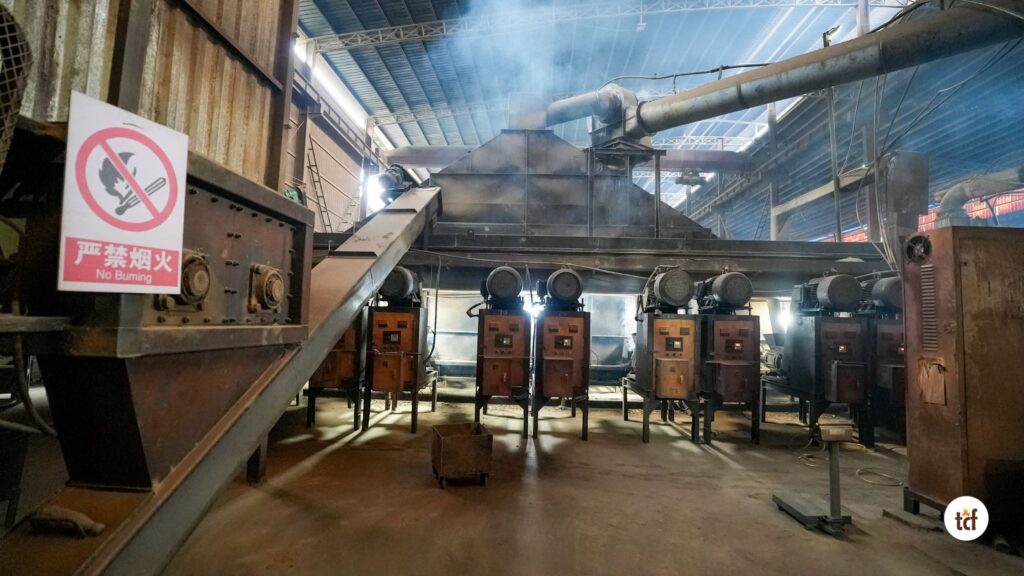
Everything begins in the carbonization unit. Coconut shells are loaded into a retort kiln or rotary furnace and carbonized at 600–700°C. The target is charcoal with a fixed carbon content of at least 78%, moisture below 5%, and ash content below 6%. These are tighter specifications than BBQ charcoal because any deviation from these targets shows up immediately in the finished tablet’s burn performance.

The carbonization process for coconut shell follows the same pyrolysis chemistry as wood moisture evaporation, then hemicellulose decomposition, then rapid cellulose breakdown, then carbon consolidation, but the dense, non-cellular structure of the shell means the process proceeds more evenly, and the yield is higher. A well-run coconut shell carbonization unit achieves yields of 28–35%, meaning 280–350 kilograms of charcoal from every metric ton of dry shell.

Quality control at this stage is critical and non-negotiable. Batches that don’t meet the fixed carbon specification will produce tablets that burn at the wrong temperature or run out too quickly. Batches with excessive ash content will produce tablets that ash unevenly, requiring constant management by the user. Every production batch should be tested before it advances to the grinding stage.

Grinding to Specification

The carbonized coconut shell comes out of the kiln as irregular fragments, some of the original shell shape, some broken into smaller pieces, all coated in the fine crumbles from the carbonization process. This material needs to be reduced to a very fine, uniform powder before it can be pressed into tablets.

The grinding process typically runs in two or three stages. A jaw crusher or hammer mill first reduces large fragments to pieces a centimeter or two across. A secondary hammer mill brings this down to the millimeter scale. Then a ball mill or Raymond mill grinds the material to the final target particle size, typically 150 to 250 mesh, or 60 to 100 micrometers. At this fineness, the charcoal powder has a silky texture and flows almost like a liquid when poured.

The reason for grinding this fine is tablet strength. The finer the particles, the more contact surface area between adjacent particles when the tablet is compressed, and the stronger the bond the binder can form between them. Tablets made from coarser charcoal are more porous, which sounds advantageous for burning but actually produces tablets that crumble during handling and may break apart on the hookah bowl.

Must read – charcoal supplier verification checklist

Preparing the Binder

The binder for natural hookah charcoal is invariably a starch, typically tapioca, cassava, or cornstarch, cooked to a gel in hot water. The cooking process is the same as described for briquettes: starch is mixed into cold water, heated to 75–85°C with constant stirring until gelatinization occurs, and the resulting paste is cooled to 40–50°C before use.

For hookah charcoal, the binder ratio runs at 8–12% of dry mixture weight, somewhat tighter than briquette production. Too little binder and the tablets crumble; too much and they are too hard and dense to burn evenly, or the drying time increases to the point of impracticality.

The most critical parameter is binder concentration consistency across batches. A deviation of 1–2% in binder content might be tolerable in BBQ briquettes, where users have low sensitivity to slight performance variation. In hookah charcoal, a 2% variation in binder content produces a measurable change in burn time and heat output that an experienced user will notice immediately.

Mixing

The cooked binder paste and charcoal powder are combined in a sigma blade mixer or double-arm kneader equipment borrowed directly from the food manufacturing and pharmaceutical industries. These mixers work the mixture intensively, ensuring every particle of charcoal is evenly coated with binder rather than leaving dry pockets or binder-rich clumps.

The mixing temperature and duration both matter. Mixing at 35–50°C keeps the starch fluid enough to distribute properly. Less than fifteen minutes of mixing typically produces uneven distribution; more than thirty begins to degrade the binder’s adhesive performance through mechanical shear. Most hookah charcoal manufacturers run mixing cycles of 15–25 minutes.

The finished mixture has the consistency of very stiff, slightly sticky dough. It should hold its shape when pressed in the palm but release cleanly from the surface without excessive sticking. If it’s crumbly, the binder is too dry or too little. If it sticks like clay to every surface, there is too much water.

Explore other Hookah charcoal:

Machine-Made Shisha Charcoal

Shaped Shisha Charcoal

Tablet Pressing: The Defining Step

This is where hookah charcoal manufacturing diverges most clearly from briquette production. Hookah charcoal tablets are pressed on rotary tablet presses, almost identical to those used in pharmaceutical pill manufacturing. This technology allows extraordinary precision in tablet weight, dimensions, and density, with production rates of 5,000 to 30,000 tablets per hour depending on machine size and configuration.

A rotary tablet press works by continuously cycling a set of punch-and-die assemblies through a filling, compression, and ejection sequence. The die cavity is filled with a precise volume of charcoal mixture by a dosing mechanism. Upper and lower punches converge and compress the mixture under a controlled force, typically 8 to 15 kilonewtons for hookah charcoal. The punches withdraw, the tablet is ejected onto a conveyor, and the cycle repeats with the next die station.

The compression force setting is one of the most consequential parameters in hookah charcoal manufacturing. Compress too lightly and the tablet is fragile, crumbles during handling, and may fracture on the hookah bowl. Compress too heavily and the tablet is so dense that airflow through it is restricted, causing uneven burning where the outer surfaces glow but the center never properly ignites. The optimal pressure for a given formulation must be determined empirically and maintained precisely throughout a production run.

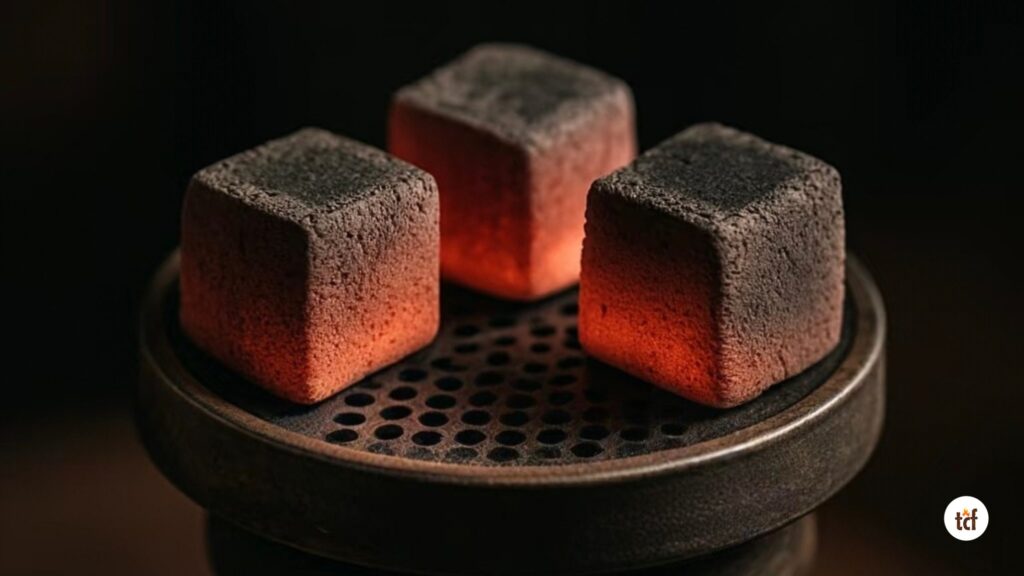
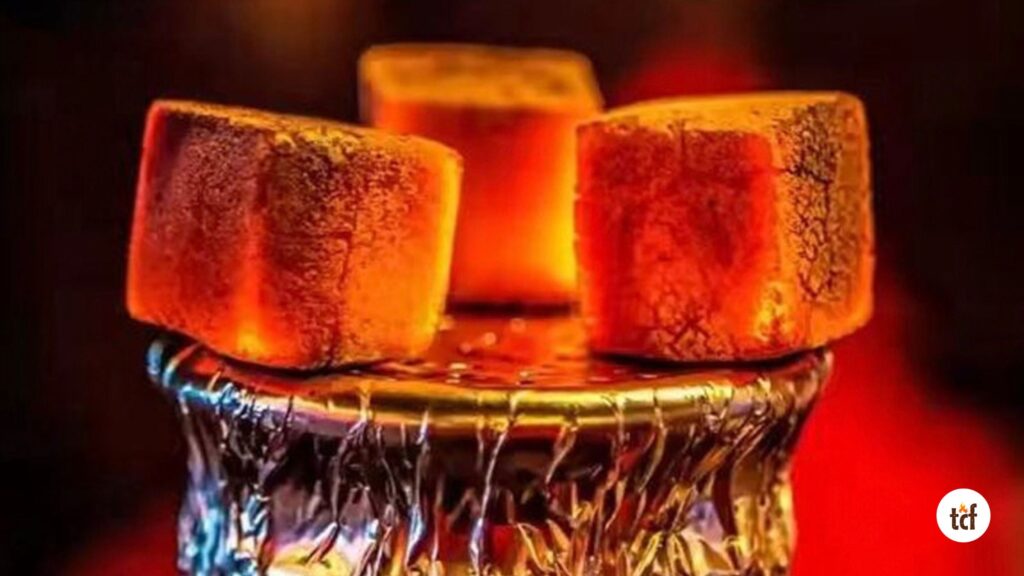
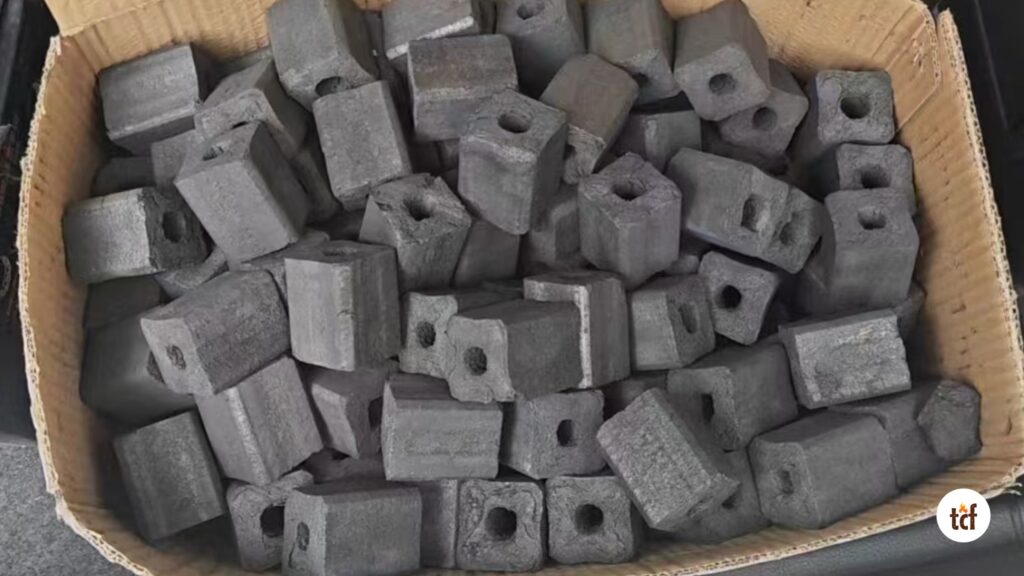
Most hookah charcoal is produced in one of three standard formats: round tablets of 33 millimeters diameter weighing 6–8 grams (the global standard for quick-light rolls), round tablets of 40 millimeters diameter weighing 10–14 grams (preferred in Middle Eastern markets and for natural charcoal), or cube format 25×25×25 millimeter squares weighing 20–25 grams which has gained popularity because its shape allows heat management by partial removal from the bowl without the piece rolling off.

Drying: Patience Is the Differentiator In Hookah Charcoal Manufacturing Plant

Freshly pressed hookah charcoal tablets are extremely fragile; the starch binder has not yet dried and hardened, and the tablet is essentially still wet dough compressed into a disk shape. Rough handling at this stage means crumbled tablets and wasted production. The tablets must be moved carefully to drying equipment, ideally on mesh conveyor belts that support the full tablet surface rather than gripping only the edges.

Drying temperature must be controlled carefully. At temperatures above 120°C, the outer surface of the tablet dries rapidly and forms a hard skin before the interior has had a chance to dry, which creates internal stress that produces cracking sometimes visible immediately, sometimes only apparent when the tablet is placed on a heat source during use. Industrial hookah charcoal dryers typically operate at 70–100°C with controlled airflow, achieving a target moisture of 3–5% in four to ten hours.

The economics of drying are significant. Drying is the most energy-intensive step in the process, and the time it takes directly constrains production throughput. Manufacturers who want to increase output without proportionally expanding their dryer capacity are tempted to raise temperatures, and this shortcut produces the cracked tablets that appear in low-quality products. The best hookah charcoal manufacturers treat their drying parameters as core intellectual property and monitor them as carefully as any other production variable.

Hookah Charcoal Manufacturing Plant Cost

Quality Testing Before Packaging

Before any batch of hookah charcoal goes into packaging, it should be tested against a minimum set of specifications. This is not bureaucratic box-ticking; it is the practical gatekeeping that separates consistent products from variable ones.

The most important tests are moisture content (above 5% and the tablet produces excessive smoke during lighting), weight consistency (variation above ±5% across a batch indicates pressing inconsistency), drop fragility (tablets should survive a one-meter drop onto a hard surface with less than 2% breakage rate), burn time (tested under controlled air flow conditions natural tablets should burn for at least 60 minutes, quick-light at least 30), ash structure (the ash should form a coherent, gray-white ring around the tablet rather than collapsing into powder, which indicates structural integrity), and absence of chemical odor (particularly critical for natural tablets any chemical smell indicates contamination from a previous production run or a binder quality issue).

Also read – What Is Lump Charcoal Made Of

Setting Up a Hookah Charcoal Manufacturing Plant Cost: The Real Numbers

The investment required to set up a hookah charcoal manufacturing operation depends primarily on production scale, level of automation, and whether carbonization is done in-house or outsourced.

The Entry-Level Operation

The smallest viable commercial operation producing roughly 100 to 300 kilograms of tablets per day, roughly 50,000 to 150,000 tablets, can be started with a relatively modest capital investment. You need a grinding system (a hammer mill and ball mill combination runs USD 5,000–15,000), a starch cooking vessel and paddle mixer (USD 2,000–6,000), a semi-automatic or manually loaded rotary tablet press (USD 8,000–25,000), a tray or batch dryer (USD 3,000–10,000), a packaging machine (USD 2,000–8,000), and a working capital reserve for raw materials, typically one to two months of production.

If you are sourcing finished coconut shell charcoal rather than carbonizing your own shells, total capital investment at this scale runs USD 25,000–70,000. If you include a small carbonization unit to process your own shells, add another USD 15,000–40,000. This is accessible territory for a serious entrepreneur, particularly in India or Southeast Asia, where coconut shell charcoal is locally available at competitive prices.

The Commercial Operation

A medium-scale plant producing one to three metric tons of finished tablets per day, roughly 300,000 to 1,000,000 tablets, requires a substantially larger investment but begins to unlock the economies of scale that make export-oriented business viable. You need an industrial rotary kiln or continuous carbonization furnace (USD 40,000–120,000), a multi-stage grinding system with classification (USD 15,000–40,000), an industrial sigma blade mixer (USD 8,000–20,000), a high-speed multi-punch rotary tablet press (USD 30,000–80,000), a mesh belt conveyor dryer (USD 15,000–40,000), and an automated packaging line (USD 20,000–60,000).

Total capital investment at this scale runs USD 150,000–400,000 for the manufacturing equipment, plus land, building, utilities, and working capital. In India, where industrial land in manufacturing zones is available at reasonable lease rates and labor costs are competitive, the all-in investment to reach commercial production might be USD 250,000–600,000, depending on location and specifications.

The Operating Economics

What makes hookah charcoal financially attractive is the margin structure, particularly for export. The raw material, coconut shell charcoal powder, costs INR 30–55 per kilogram in India’s producing states (Kerala, Tamil Nadu, Andhra Pradesh). Starch binder adds another INR 4–8 per kilogram of product. Energy, labor, packaging, and overhead bring the total cost of production to roughly INR 90–150 per kilogram of finished tablets, depending on scale and location.

Export selling prices to Middle Eastern, European, and North American distributors range from INR 350 to 700 per kilogram (USD 4.20–8.50/kg), depending on quality tier, tablet format, and buyer relationship. The gross margin on well-run export operations is 40–60%, substantially above what most manufacturing businesses achieve.

The Middle East alone imports several hundred thousand metric tons of hookah charcoal annually. Saudi Arabia, the UAE, and Egypt are the three largest markets, collectively importing hundreds of millions of dollars in hookah charcoal each year. India is well-positioned to serve these markets from a cost, logistics, and raw material standpoint, and exports have grown significantly over the past decade.

The Quick-Light Product: A Different Manufacturing Logic

Quick-light hookah charcoal is manufactured through a largely similar process, but with several important differences in formulation and handling that are worth understanding separately.

The defining ingredient in quick-light charcoal is the oxidizer, almost universally potassium nitrate (KNO₃), sometimes supplemented with aluminum powder in small quantities. Potassium nitrate is a strong oxidizer that lowers the ignition temperature of the charcoal mixture and sustains combustion even with minimal external oxygen. This is what allows a tablet to be lit by a regular lighter rather than requiring a stovetop coil.

Potassium nitrate is incorporated into the tablet mixture at 5–10% by weight, either mixed uniformly throughout the charcoal powder before pressing or applied as a surface coating after pressing by spraying or dipping in a KNO₃ solution. Surface coating produces more predictable lighting behavior; the oxidizer is concentrated at the surface where the flame first contacts the tablet, but requires a separate coating step and careful drying of the coated tablet.

The critical safety consideration that separates quick-light manufacturing from natural charcoal production is the presence of an oxidizer in the production environment. Potassium nitrate mixed with carbon is, by definition, a reactive mixture — it is the chemical basis of black powder. The concentrations used in hookah charcoal are too low to create explosion risk under normal conditions, but the production area must be maintained meticulously free of ignition sources, grounded against static discharge, and operated with fire suppression equipment close at hand. Batch sizes of the mixed material should be kept small. Storage of KNO₃ and mixed charcoal must comply with hazardous materials regulations, which vary by country and jurisdiction.

Also read – Top countries exporting charcoal

Hookah Charcoal Manufacturing Plant Cost

What to Know Before You Start

The hookah charcoal market looks attractive on paper, with high margins, growing global demand, and abundant raw material in South Asia. But the people who succeed in this business consistently point to a few factors that aren’t obvious from the outside.

Quality consistency is everything. The hookah market, particularly in the export segment, runs on repeat business from cafés and distributors who will switch suppliers the moment quality becomes unreliable. A single bad batch of crumbling tablets, variable burn times, and unexpected chemical smell can cost a supplier a relationship that took years to build. The investment in quality control equipment and laboratory testing is not optional.

Regulatory compliance for export markets is more demanding than it appears. European markets require compliance with REACH chemical regulations, which means documentation of every ingredient and its chemical profile. Some Middle Eastern markets require country-specific certifications. The US market has its own import documentation requirements. Building relationships with an export compliance specialist before your first shipment is cheaper than discovering problems after it arrives.

The move toward natural coconut shell charcoal is structural and unlikely to reverse. Entrepreneurs entering this market today who are building quick-light production capacity are swimming against a tide of consumer preference. The capital investment required for natural charcoal production is not dramatically higher than for quick-light, and the market positioning is substantially better.

FAQs – Hookah Charcoal Manufacturing Plant Cost

What is a hookah charcoal manufacturing plant?

A hookah charcoal manufacturing plant is a production facility that converts raw materials such as coconut shells, bamboo, hardwood, or other biomass into hookah charcoal briquettes through processes including carbonization, crushing, mixing, molding, drying, and packaging.

How is hookah charcoal manufactured?

Hookah charcoal is manufactured by carbonizing raw materials, grinding the charcoal into powder, mixing it with a food-grade binder, compressing it into briquettes, drying the briquettes, and packaging them for distribution.

What raw materials are used to make hookah charcoal?

The most common raw materials include coconut shells, bamboo, hardwood, fruitwood, and other biomass materials. Coconut shell charcoal is generally preferred because it burns longer, produces less ash, and has a higher heat output.

What machines are required for a hookah charcoal manufacturing plant?

A typical hookah charcoal production line includes a carbonization furnace, crusher, wheel mill mixer, briquette machine, drying machine, screening equipment, and packaging machine.

How much does it cost to set up a hookah charcoal manufacturing plant?

The investment depends on plant capacity, automation level, and location. Small-scale plants may require tens of thousands of dollars, while fully automated industrial facilities can require significantly higher investments.
Charcoal Grades Explained: A, B, and C, When Each One Is the Right Choice

Charcoal Grades Explained: A, B, and C, When Each One Is the Right Choice

When you receive a charcoal quote and see “A grade,” “B grade,” and a price difference between them, what are you actually being told? This guide explains what each charcoal grade means in measurable terms, how the spec difference translates into real performance and pricing outcomes, and how to choose the right grade for your specific channel, market, and margin target.

Every charcoal supplier uses grade A, B, and C charcoal grades. Almost none of them define what those labels mean in a way that’s useful to a buyer. You’ll see “A grade” on quotes from suppliers across China, Indonesia, Vietnam, and beyond, but there is no international standard that defines what A-grade charcoal must contain. One supplier’s A grade is another supplier’s B grade. That absence of a universal standard is the source of most grade-related disputes between buyers and suppliers.

The result is that “grade” in charcoal is a relative label until you define it in spec terms. This guide gives you the framework to do that, for both bamboo charcoal and wood charcoal, across the five key specifications that determine how charcoal actually performs. It then maps those grades to real markets, real channels, and the margin implications of choosing the wrong grade in either direction.

At The Charcoal Factory, when we say A grade, B grade, and C grade, we mean specific, measurable numbers verified by SGS laboratory testing. We’ll use our own specifications throughout this guide as the reference point, and then explain how to use those same benchmarks when evaluating any supplier’s claim about their product grade.

What the five key charcoal specifications actually measure

What the five key charcoal specifications actually measure

Before Charcoal Grades make sense, the underlying specs need to be clear. A charcoal specification sheet lists five core measurements. Each one tells you something specific about how the product will perform in use.

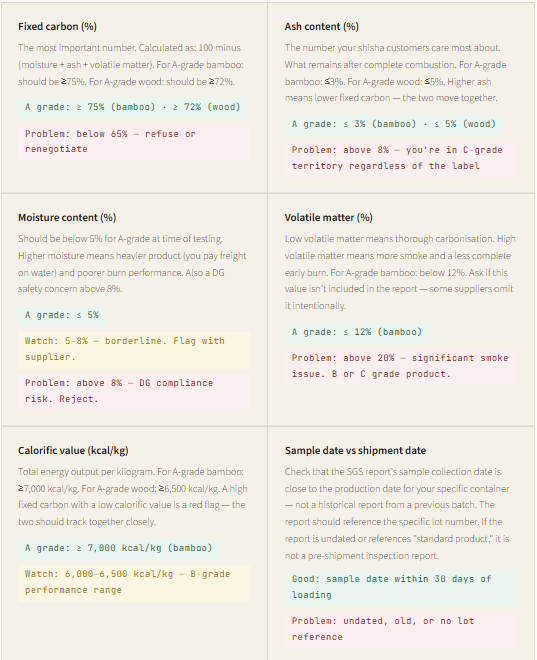
1. Fixed carbon (%)

This is the most important single number on a spec sheet. Fixed carbon is the percentage of pure carbon remaining in the charcoal after moisture and volatile compounds have been removed it represents the actual fuel content of the product. Higher fixed carbon means more energy per kilogram, longer burn time, hotter and more stable heat, and less smoke. For shisha charcoal, high fixed carbon is what gives you the sustained, even heat that keeps the tobacco cooking consistently throughout a session. For BBQ charcoal, it’s what keeps temperatures stable during a long cook without constant reloading. A good quality A-grade bamboo charcoal from TCF has a fixed charcoal carbon content of 75% or above. Below 65%, and the product starts to behave like a lower-grade industrial fuel, not a premium cooking or shisha product.

2. Ash content (%)

Ash is what remains after the charcoal has finished burning, the inert mineral residue that doesn’t combust. Low ash content means cleaner use, less residue to manage, and a more efficient fuel. For shisha charcoal, ash content is the specification your customers are most sensitive to. A hookah lounge operator running 30 tables a night will notice ash fallout from coals with ash content above 3%, it lands on the bowl, on the table, and in the smoke. A-grade shisha charcoal with ash under 3% is what the UAE and GCC professional market specifies as standard. For BBQ charcoal, slightly higher ash is acceptable because it doesn’t directly affect the cooking experience in the same way, but ash above 8% creates noticeable cleanup and affects airflow in the grill bed.

3. Moisture content (%)

Moisture content is the percentage of water retained in the charcoal at the time of packing. Higher moisture means heavier product (you’re paying freight on water), reduced burn efficiency (the charcoal has to drive off water before it starts burning cleanly), more initial smoke, and, critically, increased risk of self-heating during sea freight (which is the reason charcoal is classified as DG Class 4.2 under the IMDG Code). Good A-grade charcoal should test at under 5% moisture before packing. If moisture is above 8%, you’re likely looking at an underdried product that either came from a rushed production cycle or was stored in humid conditions.

4. Calorific value (kcal/kg)

Calorific value measures the total heat energy the charcoal produces per kilogram when burned completely. It’s directly related to fixed carbon; higher fixed carbon content means higher calorific value. A-grade bamboo charcoal from TCF tests at 7,000–8,000 kcal/kg. For context, good hardwood lump charcoal runs 6,500–7,200 kcal/kg. Standard coal runs 7,000–8,000 kcal/kg. The calorific value tells you how hard the charcoal works per unit weight. It matters more for professional kitchens and industrial applications than for casual BBQ use.

5. Volatile matter (%)

Volatile matter is everything that evaporates when charcoal is heated, such as tars, residual organic compounds, and gases driven off during early combustion. High volatile matter means more smoke on lighting, more initial flavour impact (relevant for shisha use), and a less clean burn overall. Low volatile matter is a product of thorough carbonisation at the right temperature. A-grade charcoal should have volatile matter below 12–15%. Very high volatile matter (above 25%) indicates incomplete carbonisation; the charcoal was not heated long enough or at high enough temperature during production.

Also read – Charcoal Bulk Buying Guide

Bulk Charcoal Supply for Global Buyers

A, B, and C grades are defined in numbers, not descriptions

These are The Charcoal Factory’s grade specifications for bamboo charcoal. These are what we guarantee with our SGS lab reports. When evaluating other suppliers, use these benchmarks as your reference point and ask for lab reports that verify each number.

A Grade

The highest specification. Everything that professional lounge operators, restaurant kitchens, and premium retail buyers specify. A-grade is not merely “good quality”, it is measurably the highest performing charcoal by fixed carbon, ash, and calorific value. The UAE shisha market specification. The European premium BBQ shelf position. If your customers are experienced and quality-sensitive, this is the only Charcoal Grade they will accept long-term.

  • Fixed carbon≥ 75%
  • Ash content≤ 3%
  • Moisture≤ 5%
  • Calorific value≥ 7,000 kcal/kg
  • Volatile matter≤ 12%
  • Burn time (25mm cube)2.0–2.5 hrs
  • B Grade
  • Mid-tier retail household, value distribution

Solid, usable charcoal for markets where the end consumer prioritises price over maximum performance. B-grade burns adequately for household BBQ and casual shisha use, but will not satisfy a professional lounge operator whose customers can tell the difference. The right product for supermarket value charcoal ranges, household shisha retail packs in price-sensitive markets, and wholesale redistribution where margin pressure is high.

Fixed carbon70–75%

  • Ash content3–5%
  • Moisture≤ 6%
  • Calorific value≥ 6,500 kcal/kg
  • Volatile matter12–18%
  • Burn time (25mm cube)1.5–2.0 hrs
  • C Grade
  • Value industrial, catering at scale, bulk redistribution

Lower specification charcoal for cost-sensitive applications where performance thresholds are lower. C-grade is not “bad” charcoal it burns reliably and generates heat, but it produces noticeably more ash, burns less consistently, and performs at a level that professional end-users would find unacceptable. The right product for large-volume industrial or commercial fuel buyers, and for redistribution markets where the buyer’s end customers are primarily price-driven. But also, irrespective of any grade, you must go through the charcoal supplier verification checklist before buying the charcoal.

  • Fixed carbon60–70%
  • Ash content5–8%
  • Moisture≤ 8%
  • Calorific value≥ 6,000 kcal/kg
  • Volatile matter18–25%
  • Burn time (25mm cube)1.0–1.5 hrs

Why grade specs differ between bamboo and wood charcoal

The specifications above are for bamboo charcoal. Wood charcoal has different absolute numbers for the same relative grades because the raw material carbonises differently. A-grade shaped wood charcoal from TCF runs fixed carbon above 72% (vs 75% for bamboo), and ash content is acceptable up to 5% at A-grade (vs 3% for bamboo). Bamboo charcoal achieves higher purity numbers because of bamboo’s higher cellulose density and the controlled machine-made production process.

When comparing a bamboo charcoal spec to a wood charcoal spec, you cannot use the same absolute benchmarks you need to compare like-for-like within each material type. A wood charcoal with 73% fixed carbon and 4.5% ash is an A-grade wood product. The same numbers on a bamboo charcoal would make it a B-grade bamboo product.

Charcoal Grades benchmark for wood charcoal TCF specifications

SpecificationA GradeB GradeNotes
Fixed carbon≥ 72%65–72%C grade: 55–65%
Ash content≤ 5%5–8%C grade: 8–12%
Moisture content≤ 6%≤ 8%C grade: ≤ 10%
Calorific value≥ 6,500 kcal/kg≥ 6,000 kcal/kgC grade: ≥ 5,500 kcal/kg
Volatile matter≤ 15%15–22%C grade: 22–30%
Burn time1.5–2.5 hrs1.0–1.5 hrsC grade: 0.75–1.0 hrs
Forms availablePillow, hex, BBQ shapedPillow, shapedC grade: bulk/shaped

Which grade for which market is the decision that actually matters

Which grade for which market is the decision that actually matters

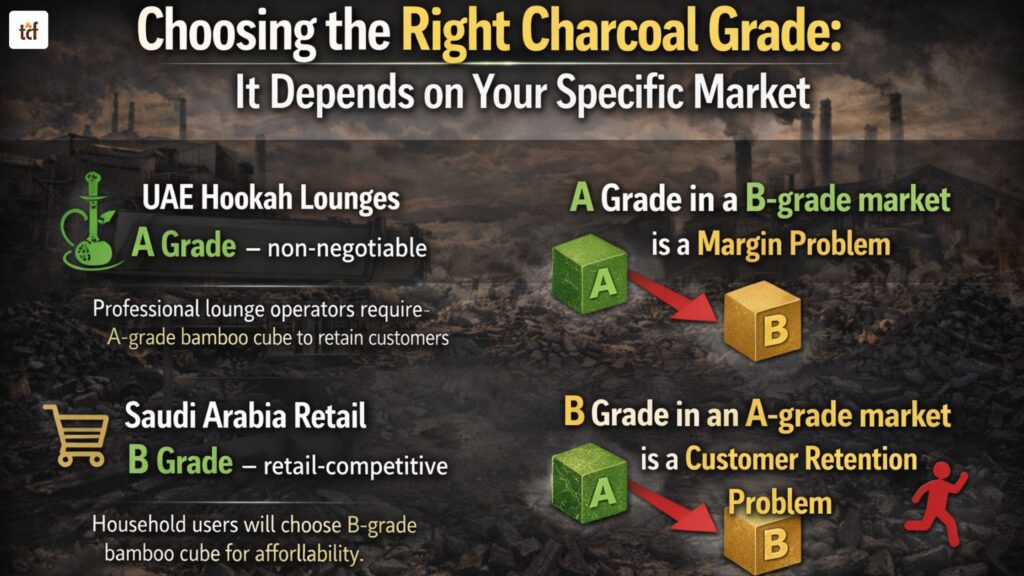
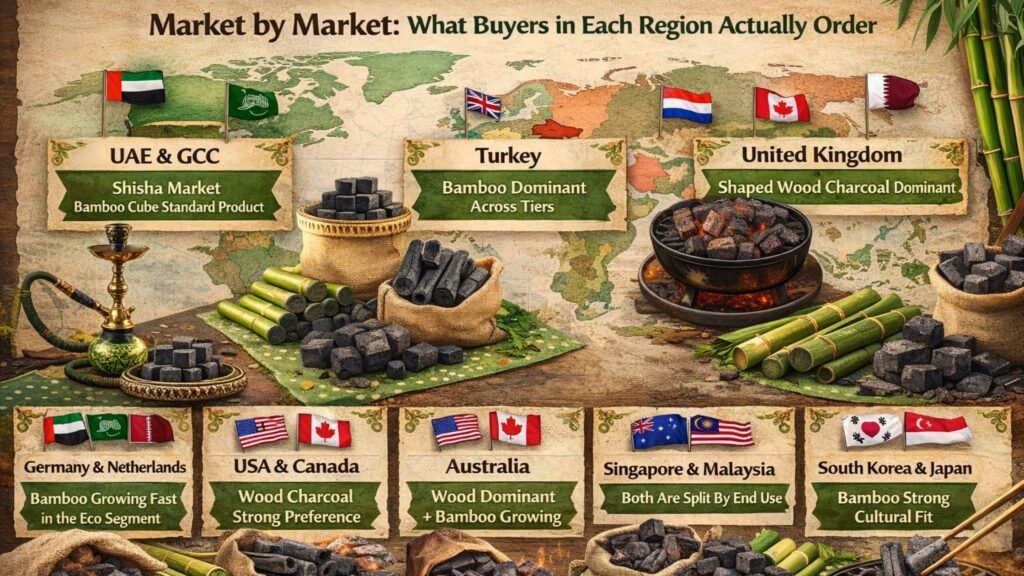
The Charcoal Grades you need is not determined by which one is technically best. It’s determined by what your specific market channel will pay, what your end users will accept, and what margin the price differential creates for your business. A-grade charcoal at A-grade pricing in a B-grade market is a margin problem. B-grade charcoal at B-grade pricing in an A-grade market is a customer retention problem. Getting this right is the whole point. And for each grade, you must know about the bamboo charcoal market​ first.

Also read – types of charcoal

UAE hookah lounge operators

A Grade — non-negotiable

Professional lounge operators in Dubai and Abu Dhabi running 20–40 tables per night require an A-grade bamboo cube. Their customers notice ash fallout and burn time variation immediately. Any distributor who supplies B-grade to a professional lounge expecting A-grade will lose the account within one delivery cycle. The price difference between A and B grades per container is justified by not losing the customer.

Saudi Arabia retail — household shisha

B Grade — retail-competitive

Saudi Arabia has a split market. High-end lounges and premium venues want A-grade. The mass retail segment, supermarkets, convenience stores, and household use, is more price-sensitive. B-grade bamboo cube in 1kg retail boxes is commercially viable in the Saudi retail channel because the price point is lower, and the household user’s tolerance for slightly higher ash content is greater than a professional lounge’s tolerance.

Must read – What Is Lump Charcoal Made Of?

Germany eco-retail — bamboo BBQ charcoal

A Grade — premium positioning required

The German eco-charcoal segment is premium-positioned. If you’re selling bamboo BBQ charcoal in a German supermarket’s sustainability range at a price premium over standard wood charcoal, an A-grade specification is what justifies that premium. A B-grade product receiving negative reviews for ash content or burn time on a premium shelf slot undermines the entire positioning strategy.

UK BBQ retail — shaped wood charcoal

A Grade for premium · B for value shelf

UK BBQ retail has two tiers. The premium shelf (garden centres, speciality outdoor stores, higher-end supermarkets) expects A-grade. The value shelf (discount grocery, petrol station, impulse buy) can accommodate B-grade at a lower price point. The key is not mixing them — B-grade product in premium packaging on a premium shelf creates reviews that destroy the brand.

Also read – charcoal ash content moisture specs

Wholesale redistribution — bulk buyers

B or C Grade — margin driven

Pure wholesale redistribution buyers- traders who buy charcoal by the container and sell to sub-distributors or traders who repackage at destination- are typically the most price-sensitive buyers in the market. B-grade charcoal gives them a usable product at a lower FOB cost. C-grade serves specific industrial or high-volume catering applications. The key question is: what does the end of their supply chain require? A B-grade buyer supplying A-grade customers downstream will create problems that they then bring back to you.

Restaurant & food service

A Grade — kitchen performance

Professional kitchens care about consistent heat for service. A restaurant that discovers its charcoal burns inconsistently mid-service has an operational problem, not a product preference. A-grade’s higher fixed carbon and lower volatile matter means a more stable cooking temperature throughout the evening. The cost difference between A and B grades per container is typically less than the cost of one service disruption caused by inferior charcoal.

Amazon & e-commerce sellers

A Grade — review risk management

On Amazon, a product with 4.2 stars outperforms one with 3.8 stars in search ranking and conversion. The difference between A-grade and B-grade charcoal in customer reviews is predictable: B-grade generates complaints about ash, smoke, and short burn time that are difficult to recover from once they accumulate. For an online seller building a charcoal brand, A-grade is the correct starting point — the marginal cost of better charcoal is lower than the brand cost of poor reviews.

Jordan & Levant value retail

B Grade — price sensitivity high

Jordan and its re-export markets (Iraq, West Bank) have a significant price-sensitive retail segment alongside professional lounge supply. B-grade bamboo cube is commercially viable for the household and budget lounge segment in this region. The professional lounge segment in Amman still specifies A-grade, so a Jordan distributor serving multiple customer tiers will typically stock both grades.

Must read – cost to import charcoal from China

Bulk Charcoal Supply for Global Buyers

Grade inflation: what it looks like and how to spot it

Grade inflation is the most common quality problem in charcoal supply, and it is almost entirely invisible until you receive the container and run a lab test. It works like this: a supplier labels their standard production as “A grade” in their marketing and quotation. The actual product tests at a B-grade or low-B-grade specification. The buyer, trusting the label, imports and distributes. Their customers, who have experience with genuine A-grade products, notice the difference. The buyer faces complaints they cannot explain, because from their perspective, they ordered an A-grade.

“A-grade is a claim. An SGS lab report is evidence. Never take a supplier’s grade label at face value until you have independent laboratory verification of the specific container being shipped.”

Grade inflation is most common in two scenarios. First, when a supplier is producing a large order and runs out of their highest-quality raw material mid-production, rather than stopping and disclosing the issue, they continue with lower-quality input and ship the container as A-grade. Second, when a supplier has set their internal “A-grade” threshold below what buyers in the professional market actually expect, their A-grade is genuinely what they call A-grade, but it would be classified as B-grade by an independent standard.

The practical defence against Charcoal Grades inflation is to require an SGS pre-shipment inspection report for every container, not just the first sample order. An SGS report is issued for the specific lot being shipped; it’s not a historical report on what the factory produced previously. If the fixed carbon on the SGS report for your container comes in at 71% when you specified 75%+, you have documentation to reject the shipment or renegotiate the price before you’ve paid the balance.

The cost of getting a charcoal grade wrong in both directions

Most buyers think of grade selection as a one-way risk, ordering too low a grade and disappointing customers. The less-discussed risk is ordering too high a grade for your market and paying for performance that your customers neither notice nor pay for. Both directions have real costs.

Grade mismatch — what it actually costs

Grade mismatch — what it actually costs

Ordering A-grade for a B-grade market: A distributor supplying value retail in a price-sensitive market orders A-grade bamboo cube to be safe. The FOB premium of A over B is approximately 12–18% per MT. On a 20GP container carrying 18MT of 1kg retail boxes, that’s roughly $1,400–2,500 in additional FOB cost. If the retail price point in that market doesn’t support A-grade pricing and the distributor can’t charge a premium, those dollars come out of margin. Multiply this across 10 containers per year and the over-specification costs $14,000–25,000 in unnecessary FOB spend.

Ordering B-grade for an A-grade market: A new distributor ordering their first container for UAE lounge supply saves money by ordering B-grade. Their lounge customers, used to A-grade from their previous supplier, notice the ash content difference within the first week. Complaints come in. The distributor offers to replace the product, but the replacement is also B-grade. The lounge operator switches back to their previous supplier after two deliveries. The cost: the loss of a customer worth 2–5 containers per year in future business, plus the reputational cost of the failed first supply relationship.

Receiving lower grade than ordered: A distributor orders A-grade, receives B-grade (grade inflation by supplier). They distribute without testing. Their customers complain. The distributor returns to the supplier, who denies the issue. Without an SGS report on the actual container shipped, the distributor has no leverage. The cost: direct complaints, customer relationship damage, and no recourse against the supplier. With an SGS report: immediate documented basis to reject the shipment or claim a price reduction.

How to specify grade correctly when placing an order

Most buyers make the mistake of specifying grade in words only: “Please supply A-grade bamboo charcoal.” This leaves the definition of “A-grade” entirely up to the supplier, which is where grade inflation lives.

The correct approach is to specify the grade by the underlying numbers, not just the label. A purchase order or specification sheet that says:

  • Fixed carbon: minimum 75%
  • Ash content: maximum 3%
  • Moisture content: maximum 5%
  • Calorific value: minimum 7,000 kcal/kg
  • Verified by the SGS pre-shipment inspection report for this specific lot

…is a specification that a supplier cannot grade-inflate without producing a falsified lab report, which carries legal consequences well beyond a commercial dispute. A specification that says “A-grade” alone is a specification that can be silently downgraded to whatever the supplier calls A-grade on a given day.

At The Charcoal Factory, we provide SGS pre-shipment inspection reports for every container as a standard part of our export documentation, not as an optional add-on. The report references the specific lot number and loading date. Every grade we supply is defined by the spec numbers above, not by a label applied without measurement. If you’d like to see a sample SGS report format from a recent TCF container, email our sales team, and we’ll send one.

For Further Reading:

charcoal exporting countries
how is bamboo charcoal made​
Charcoal HS Codes
lump charcoal vs briquettes

Quick reference grade by use case

Use caseMaterialRecommended gradeReason
UAE / GCC hookah lounge supplyBamboo cubeA GradeProfessional standard. Ash fallout visible to customers above 3%.
Saudi Arabia retail — household shishaBamboo cubeB GradePrice-sensitive retail. B-grade acceptable for household use.
European eco BBQ retailBamboo shapedA GradePremium shelf position. B-grade reviews will undermine positioning.
UK / US premium BBQ retailWood shapedA GradePremium channel. Consistent burn performance expected.
Value BBQ retail — discount / mass marketWood shapedB GradePrice competition. B-grade adequate for casual consumer use.
Restaurant & professional kitchenBamboo or woodA GradeService stability requires consistent heat. B-grade creates variance.
Value BBQ retail — discount/mass marketBamboo or woodA GradeReview management. B-grade ash and burn complaints accumulate fast.
Wholesale redistributionBamboo or woodB or C GradeMargin pressure. Match grade to the end channel being supplied.
Industrial / catering at scaleWoodB or C GradeHeat output prioritised over ash and smoke performance.
Bamboo Charcoal Market Size, Share, Trends & Forecast (2025–2035)

Bamboo Charcoal Market Size, Share, Trends & Forecast (2025–2035)

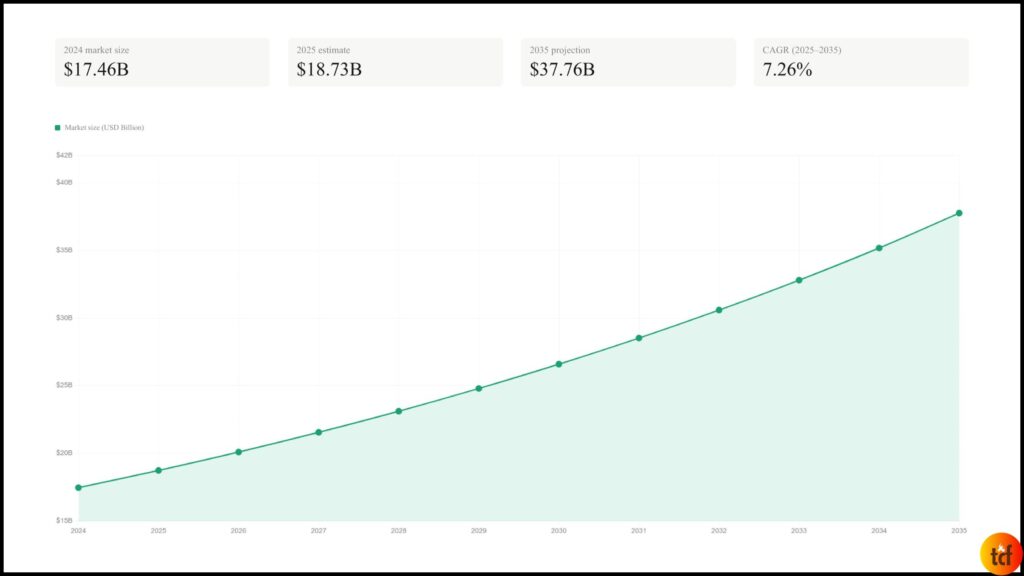
The global bamboo charcoal market is on a clear upward trajectory, valued at $17.46 billion in 2024 and projected to reach $37.76 billion by 2035, growing at a CAGR of 7.26% over the forecast period. What’s driving this growth isn’t a single factor but a convergence of sustainability momentum, expanding health consciousness, and a rapid broadening of industrial applications across sectors as varied as pharmaceuticals, agriculture, and personal care.

This report covers everything analysts, investors, product developers, and market researchers need to understand about where the bamboo charcoal market stands today and where it is headed.

Key market highlights at a glance

Key market highlights at a glance
  • The bamboo charcoal market was valued at $17.46 billion in 2024, rising to $18.73 billion in 2025
  • Projected to reach $37.76 billion by 2035 at a 7.26% CAGR
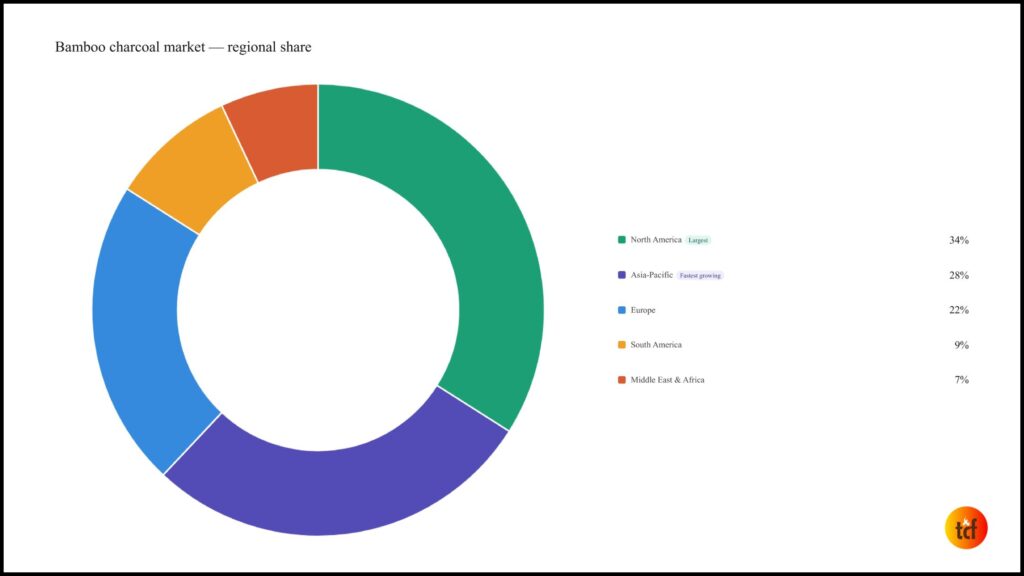
  • North America holds the largest regional market share, driven by strong consumer preference for sustainable products
  • Asia-Pacific is the fastest-growing region, propelled by rising health and wellness awareness
  • Moso Bamboo dominates the raw material supply; Phyllostachys Pubescens is emerging rapidly due to its fast growth rate
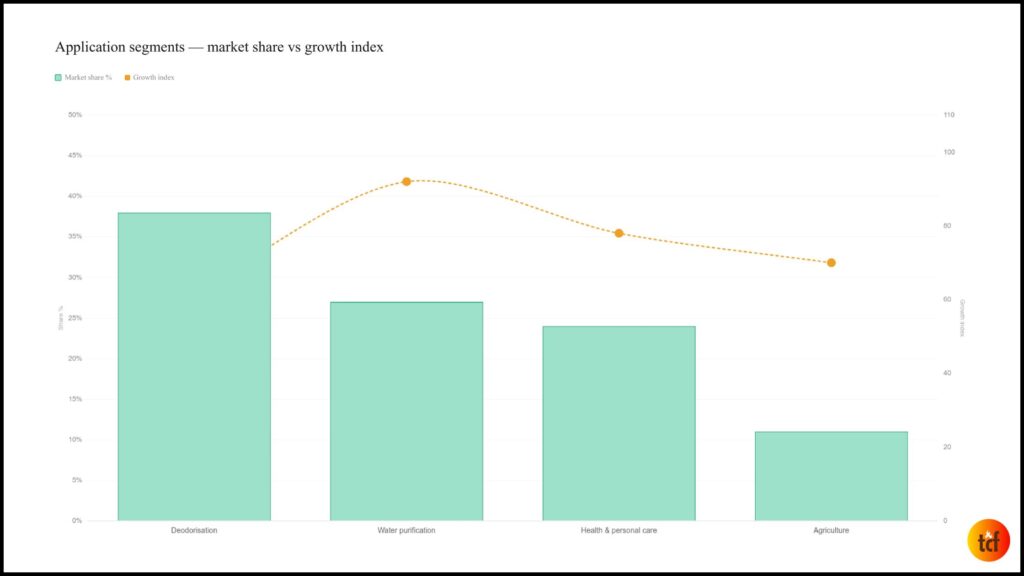
  • Deodorisation is the largest application segment; Water Purification is the fastest-growing
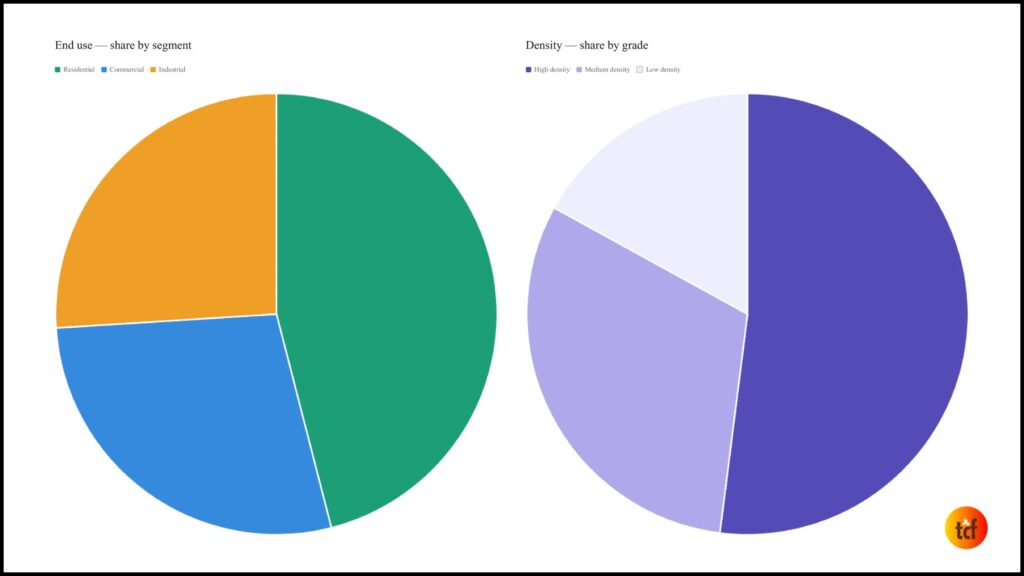
  • Residential end use leads in volume; Industrial is the fastest-growing end-use category
  • High-Density bamboo charcoal holds the largest density segment share; Low-Density is growing fastest
  • Key market drivers: sustainability initiatives, health consciousness, e-commerce expansion, and regulatory support for eco-friendly materials

Bamboo charcoal market size and forecast (2024–2035)

Bamboo charcoal market size and forecast (2024–2035)

According to Market Research Future analysis, the bamboo charcoal market has entered a sustained growth phase that is expected to hold through the next decade. The numbers tell a clear story:

YearMarket Size
2024$17.46 billion
2025$18.73 billion
2035$37.76 billion
CAGR (2025–2035)7.26%

This near-doubling of market value over ten years is underpinned by structural demand shifts not cyclical consumption spikes, which gives the forecast a high degree of confidence among analysts tracking sustainability-driven materials markets.

Bulk Charcoal Supply
for Global Buyers

The bamboo charcoal market is currently undergoing a notable transformation, driven by increasing consumer awareness regarding sustainability and eco-friendly products. This shift in consumer behaviour is influencing multiple sectors simultaneously, such as personal care, food and beverage, home goods, agriculture, and industrial manufacturing.

Sustainability at the centre

Consumers are actively seeking eco-friendly charcoal products, and bamboo charcoal occupies a uniquely favourable position in that landscape. Its raw material, bamboo, is fast-growing, renewable, and requires no replanting after harvest. This alignment with environmental values makes bamboo charcoal a default beneficiary of the broader sustainable consumption movement. As regulations across North America, Europe, and parts of Asia-Pacific tighten around carbon emissions and single-use synthetics, bamboo charcoal stands to gain further tailwinds from policy as well as consumer demand.

Diverse application expansion

One of the defining characteristics of the current market phase is the broadening of bamboo charcoal’s application base. Beyond its traditional uses in deodorisation and water filtration, bamboo charcoal manufacturers are actively exploring its integration into textiles, food additives, pharmaceutical formulations, agricultural soil amendments, and biodegradable packaging. Each new application category that bamboo charcoal successfully penetrates expands the total addressable market and opens new revenue streams for producers.

Also read – how long does it take to make charcoal

Health and wellness as a structural demand driver

The global wellness economy has grown consistently for over a decade, and bamboo charcoal has found a durable home within it. Its detoxifying and purifying properties in both air and water applications, and in personal care formulations, resonate powerfully with consumers who prioritise natural alternatives to synthetic ingredients. The rising interest in holistic living is not a short-term trend; it is a generational shift in purchasing philosophy that continues to structurally support bamboo charcoal demand.

Key market drivers

Sustainability initiatives

The bamboo charcoal market is experiencing a surge in demand due to increasing sustainability initiatives across various sectors. As consumers grow more environmentally conscious, the preference for sustainable products has intensified. Bamboo, being a fast-growing and renewable resource, aligns perfectly with these initiatives. Companies across personal care, home goods like charcoal for BBQ, and industrial manufacturing are incorporating bamboo charcoal in bulk into their product lines in response to both consumer pressure and corporate ESG commitments, thereby expanding the market’s reach significantly.

Health consciousness

Rising health consciousness among consumers is significantly influencing bamboo charcoal demand. As individuals become more aware of the impact of their consumption choices on health and well-being, interest in natural and organic products continues to accelerate. Bamboo charcoal is recognised for its detoxifying properties, purifying air, filtering water, and promoting skin health, and the demand for it in health-related applications such as dietary supplements, detox products, and wellness routines is rising as a result.

Regulatory support

Regulatory support for sustainable materials is becoming increasingly prevalent globally, creating a positive structural environment for the bamboo charcoal market. Governments and organisations are implementing policies that encourage the use of eco-friendly products and incentivise companies utilising renewable resources. Certifications related to sustainability and organic products are also gaining traction, further legitimising bamboo charcoal as a viable mainstream option. As regulatory frameworks continue to evolve in favour of sustainable practices, the bamboo charcoal market is likely to see enhanced growth opportunities across both consumer and industrial segments.

E-commerce expansion

The rapid expansion of e-commerce platforms has transformed the route to market for bamboo charcoal by providing greater access to a wider consumer base. Online shopping has become a preferred method for purchasing across product categories, including bamboo charcoal. This shift is particularly beneficial for niche and sustainability-focused brands, as it allows them to reach engaged audiences without the constraints of traditional retail shelf space. The convenience of online purchasing, coupled with the ability to compare products and access consumer reviews, continues to drive growth — especially among younger, health-conscious demographics.

Innovative product development

Innovation plays a crucial role in the current market expansion phase. Manufacturers are continuously exploring new applications and formulations for air purifiers, skincare items, food additives, bamboo charcoal-infused textiles, and industrial filtration systems, among others. The personal care segment, in particular, is experiencing notable growth, with bamboo charcoal incorporated into facial masks, cleansers, and toothpastes. As companies invest in research and development, the pipeline of innovative bamboo charcoal products catering to diverse consumer needs continues to grow.

Must read – Charcoal Bulk Buying Guide

Market segmentation insights

By raw material: Moso Bamboo vs. Phyllostachys Pubescens

The raw material segment is primarily composed of Moso Bamboo, Phyllostachys Pubescens, and a range of other bamboo species.

Moso Bamboo (dominant): Moso Bamboo holds a significant majority of market share due to its abundance and superior quality for charcoal production. Its high density and ideal carbon content translate into superior burn quality and utility across diverse applications from cooking and air purification to industrial filtration. Its widespread availability across China, Japan, and Vietnam ensures a reliable and scalable supply chain that producers depend on.

Phyllostachys Pubescens (fastest-growing): While it does not yet surpass Moso Bamboo in volume, Phyllostachys Pubescens is gaining meaningful traction. Its rapid growth rate and unique characteristics make it increasingly attractive for specialised applications, and its growing recognition among manufacturers and consumers signals a promising trajectory. Sustainability trends and innovative processing techniques are both contributing to its rise as an emerging contender in the raw material segment.

By application: Deodorisation, Water Purification, Health & Personal Care, Agriculture

By application: Deodorisation, Water Purification, Health & Personal Care, Agriculture

Deodorisation (dominant): Deodorisation is firmly established as the largest application segment. Bamboo charcoal’s effectiveness in absorbing odours and harmful substances from the environment has been proven across a wide range of products, from air purifiers and refrigerator sachets to car deodorisers and shoe inserts. Its biodegradable nature strengthens its appeal to environmentally conscious consumers, and its strong presence in both residential and commercial markets reinforces its leadership.

Water Purification (fastest-growing): The water purification segment is rising rapidly as consumers and industrial users alike seek natural methods to ensure water quality. Heightened global awareness about clean water access, increasing pollution concerns, and a shift towards natural filtration methods are all driving this expansion. Bamboo charcoal’s effectiveness as a filtration agent for impurities, including heavy metals, chlorine, and other contaminants, positions it competitively in both consumer (pitcher filters, Binchotan sticks) and industrial water treatment applications.

Health & Personal Care: The health and personal care application is one of the market’s most dynamic segments. Activated bamboo charcoal is now a recognised ingredient across toothpastes, facial masks, body scrubs, soaps, and wellness supplements. This segment benefits from high brand premiums and strong consumer storytelling around natural ingredients, making it an attractive area for product innovation and margin expansion.

Agriculture: Agriculture represents an emerging but increasingly significant application for bamboo charcoal. Used as a soil amendment often referred to as biochar, it improves water retention, enhances nutrient absorption, and supports microbial activity in soil. As sustainable and precision agriculture practices scale globally, bamboo charcoal biochar is being evaluated both as a performance-enhancing soil input and as a carbon sequestration tool aligned with climate commitments.

By density: High Density, Medium Density, Low Density

By density: High Density, Medium Density, Low Density

High Density (dominant): High-density bamboo charcoal is the largest segment by market share. Its superior adsorption capabilities and durability make it the preferred choice for industrial applications and long-life air purification systems. It is well-established in applications that demand long-lasting, high-performance results from heavy industrial filtration to premium air purification units.

Medium Density (emerging): Medium-density bamboo charcoal is gaining meaningful traction as an attractive option for consumers seeking a balance between cost and performance. It is increasingly finding its place in the consumer goods space, particularly in home care and personal care products and is growing as a niche among environmentally conscious consumers who want effective, affordable, eco-friendly solutions.

Low Density (fastest-growing): While the smallest segment currently, low-density bamboo charcoal is growing rapidly, particularly within the health and wellness product category. Its lighter format suits certain packaging requirements and product formulation applications, and growing consumer interest in wellness-oriented bamboo charcoal products is accelerating its adoption.

Read before buying the charcoal – charcoal supplier verification checklist

By end use: Residential, Commercial, Industrial

Residential (dominant): The residential segment holds the largest share of the bamboo charcoal market. Increasing consumer awareness about sustainability and eco-friendly products, combined with the rising trend of home gardening and eco-conscious living, has driven strong household adoption of bamboo charcoal in air purifiers, deodorisers, personal care items, and garden applications. As sustainable living shifts from aspiration to mainstream behaviour, residential demand continues to compound year-on-year.

Commercial: The commercial segment represents a significant and growing application base for bamboo charcoal, spanning hospitality, retail, food service, and office environments. Commercial buyers are increasingly incorporating bamboo charcoal in air purification systems, cleaning products, and building materials as part of broader sustainability and indoor air quality commitments. Charcoals such as A grade charcoal and B grade charcoal.

Industrial (fastest-growing): The industrial segment, though emerging relative to residential, is the fastest-growing end-use category. Manufacturers across food processing, pharmaceuticals, and general manufacturing are incorporating bamboo charcoal into filtration systems, energy-efficient solutions, and green manufacturing processes. The growth of this segment is fuelled by corporate sustainability mandates, tightening environmental regulations, and heightened consumer awareness about the environmental impact of industrial production.

Also read – Charcoal grades

Regional insights

Regional insights

North America the largest market

North America is the largest bamboo charcoal market by value. The United States holds approximately 60% of the regional share, with Canada contributing around 25%. Strong consumer demand for sustainable and organic products, a mature e-commerce ecosystem, and regulatory incentives for green materials have collectively made North America the global market leader. Product innovation is particularly active in this region, with bamboo charcoal-infused personal care items and home goods are expanding rapidly, driven by both established brands and a growing startup ecosystem. Key players active in this market include Bamboo Charcoal Products (US) alongside several specialist enterprises focused on niche consumer segments.

Europe’s eco-innovation hub

Europe is emerging as a significant player in the bamboo charcoal market, with a strong orientation towards sustainability and eco-friendly product development. Germany and the UK are the largest European markets, collectively holding around 55% of the regional share. The European Union’s stringent regulations on carbon emissions and waste management are functioning as structural demand drivers, aligning bamboo charcoal with legislative priorities. France and the Netherlands are also contributing meaningfully to regional growth. Companies including Eco Bamboo (CN) and Bamboo Essence (MY) are actively expanding their European presence through local distribution partnerships. The cosmetics and home care categories are particularly active in driving European market innovation.

Asia-Pacific fastest-growing region

Asia-Pacific is the fastest-growing regional market, driven by increasing urbanisation, rising disposable incomes, and a growing awareness of bamboo charcoal’s health and wellness benefits. China and India are the largest markets within the region, accounting for approximately 70% of the Asia-Pacific share. Government initiatives promoting sustainable agriculture and forestry practices are acting as additional catalysts for expansion. The region benefits from a structural supply advantage, as home to the world’s major bamboo-producing nations, local production capabilities are deep and well-established. Key players, including Bamboo Village (VN) and Bamboo Naturals (IN) are leading regional market development, supported by a mix of established producers and innovative startups focused on new product development and direct-to-consumer strategies.

Middle East and Africa are an untapped opportunity

The Middle East and Africa region presents the most significant untapped opportunity in the global bamboo charcoal market. South Africa and the UAE are the leading markets, collectively holding around 50% of the regional share. Rising awareness of sustainable products, growing interest in natural air purifiers, and government initiatives promoting green products are the primary growth catalysts. Countries including Kenya and Nigeria are emerging as meaningful growth markets, particularly in cosmetics and home care applications. The competitive landscape in MEA is still forming, as international brands are beginning to enter through distribution partnerships, and local players are scaling. This combination of low current penetration and strong structural demand drivers makes MEA one of the most compelling growth vectors for the next decade.

Competitive landscape

Competitive landscape

The bamboo charcoal market is moderately concentrated, with a few leading players accounting for a significant share of global revenue. The competitive dynamic is characterised by intense rivalry in product innovation, pricing, and distribution reach.

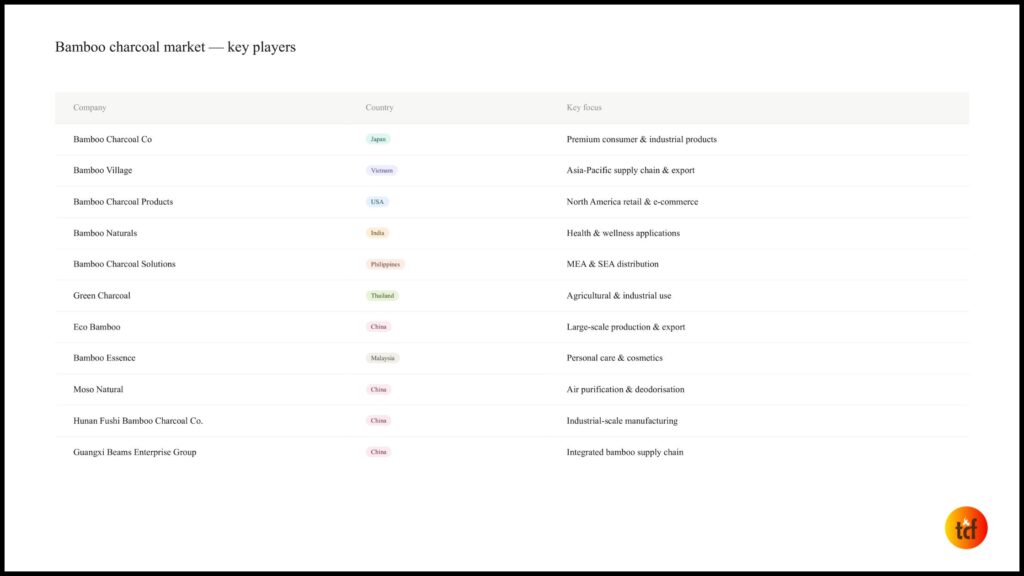
Key companies profiled in the global bamboo charcoal market include:

  • Bamboo Charcoal Co (Japan)
  • Bamboo Village (Vietnam)
  • Bamboo Charcoal Products (US)
  • Bamboo Naturals (India)
  • Bamboo Charcoal Solutions (Philippines)
  • Green Charcoal (Thailand)
  • Eco Bamboo (China)
  • Bamboo Essence (Malaysia)
  • Moso Natural
  • Hunan Fushi Bamboo Charcoal Co., Ltd.
  • Guangxi Beams Enterprise Group Co., Ltd.

Leading players are focused on developing new and improved product formulations, investing in marketing and brand awareness, expanding geographic reach through new production facilities and distribution channels in emerging markets, and forming strategic partnerships to gain a competitive advantage. The market is expected to see continued consolidation and innovation as demand from end-use industries scales.

Industry developments

The bamboo charcoal market is registering steady momentum driven by several concurrent industry developments. Technological advancements in charcoal production techniques, particularly improvements in pyrolysis efficiency and quality consistency, are expanding output capacity and improving the performance characteristics of finished products. Strategic partnerships and collaborations between manufacturers and distributors are actively being formed to enhance market reach and accelerate product innovation. The Asia-Pacific region, in particular, is expected to witness significant industry development activity, driven by the presence of major bamboo-producing countries and increasing adoption of bamboo charcoal across industrial end uses.

Bulk Charcoal Supply for Global Buyers

Future outlook

The bamboo charcoal market is projected to grow at a 7.26% CAGR from 2025 to 2035, reaching $37.76 billion, roughly doubling in size over the forecast period. This trajectory is underpinned by durable structural drivers that are unlikely to reverse: tightening environmental policy, the expanding global wellness economy, and accelerating industrial adoption.

Key growth opportunities identified through 2035 include:

  • Biodegradable packaging solutions incorporating bamboo charcoal as a sustainable alternative to petroleum-derived materials
  • Bamboo charcoal-based air purification systems for both residential and commercial markets
  • Partnerships with wellness brands to develop health-oriented product lines positioned around bamboo charcoal’s natural credentials
  • Agricultural biochar programmes aligned with global carbon sequestration and sustainable farming initiatives

By 2035, the bamboo charcoal market is expected to achieve both substantial growth in volume and meaningful diversification across application, end-use, and regional segments — transitioning from a market dominated by consumer deodorisation products into a broad industrial and wellness materials category.

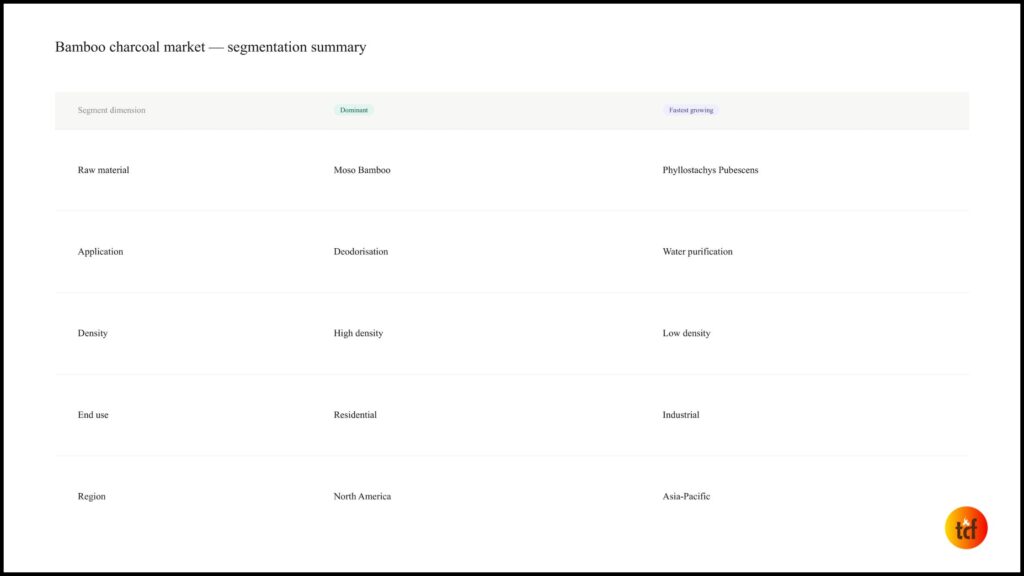
Market segmentation summary

DimensionLargest SegmentFastest-Growing Segment
Raw MaterialMoso BambooPhyllostachys Pubescens
ApplicationDeodorisationWater Purification
DensityHigh DensityLow Density
End UseResidentialIndustrial
RegionNorth AmericaAsia-Pacific

Frequently asked questions

What is the size of the bamboo charcoal market in 2024?

The global bamboo charcoal market was valued at $17.46 billion in 2024, according to Market Research Future analysis.

What will the bamboo charcoal market be worth by 2035?

The market is projected to reach $37.76 billion by 2035, growing at a CAGR of 7.26% from 2025 to 2035.

Which region leads the bamboo charcoal market?

North America is the largest market, with the US accounting for approximately 60% of the regional share. Asia-Pacific is the fastest-growing region, led by China and India.

Which application segment is the largest in the bamboo charcoal market?

Deodorisation is the largest application segment, owing to its widespread use across residential and commercial air purification and odour control products. Water purification is the fastest-growing application.

Charcoal Supplier Verification Checklist: A Practical Guide

Charcoal Supplier Verification Checklist: A Practical Guide

In the charcoal trade, most problems don’t start at the port; they start at the supplier selection stage. A supplier might look professional on the surface, offer attractive pricing, and even send decent samples. But without proper verification, the risk of inconsistent quality, delayed shipments, or compliance issues increases significantly.

This charcoal supplier verification checklist keeps things simple and real, even before you search for how to source charcoal bulk. It follows the same structure most experienced importers use, but with added clarity, examples, and context so you actually understand what to check and why it matters.

Business & Legal Verification

Before looking at the product, ensure the entity is legitimate and compliant with international trade laws. This step is often ignored, but it’s where many sourcing mistakes begin. And all these are presented in this charcoal supplier verification checklist blog.

  • A genuine supplier should be able to provide a valid business license and tax registration details. This confirms you are dealing with an officially registered company, not an individual trader operating without accountability. If a supplier hesitates or delays sharing these documents, it’s usually a sign to proceed carefully.
  • You should also verify their export licenses. Charcoal export is regulated in many countries due to environmental concerns, especially around illegal logging. A supplier without proper export permits may still offer you a shipment, but it can get stuck at customs or rejected before loading.
  • Another important factor is FSC certification (Forest Stewardship Council). This certification indicates that the wood used for charcoal is sourced from responsibly managed forests. Today, many international buyers, especially in Europe and the Middle East, prefer or require FSC-certified charcoal. If a supplier cannot provide this, it raises questions about their sourcing practices.
  • Finally, check their trade history. Ask for recent Bills of Lading (B/L) or a basic client reference. This is not about trust, it’s about proof. A supplier who has successfully shipped to your region before is far less risky than one who hasn’t.

Must read – Charcoal grades

2. Product Quality & Specifications

Product Quality & Specifications

Once the business is verified, the next step is understanding the actual product quality. This is where many buyers rely too much on images or assumptions instead of real data.

  • Always ask for a laboratory analysis report (COA). This document gives you measurable values that define how the charcoal will perform.
  • The most important parameter is fixed carbon content, which should ideally be between 75% and 85% for high-quality lump charcoal or briquettes. This directly affects heat strength and burn duration. Lower carbon content usually means weaker performance and faster consumption.
  • Moisture content should be below 8%. This is critical but often overlooked. High moisture makes charcoal harder to ignite and increases its weight—meaning you end up paying for water instead of usable fuel. In real scenarios, shipments with high moisture often lead to customer complaints about slow ignition.
  • Ash content should remain between 3% and 5%. Higher ash not only reduces heat efficiency but also creates more residue, which becomes a problem for restaurants and commercial users who need consistent performance.
  • Volatile matter should stay below 15%. If it’s higher, the charcoal tends to produce more smoke and odor, which is unacceptable for applications like shisha or indoor grilling.
  • You should also check the calorific value, which indicates the heat output. While numbers matter, performance matters more, so always combine this with a practical check.
  • Finally, verify the burning time. Don’t rely only on reports. Ask for a burn test video or, ideally, order a sample and test it yourself, as this is important for the charcoal supplier verification checklist. This is one of the simplest ways to identify quality differences before placing a bulk order.

3. Production & Scalability

Production & Scalability

A supplier might present themselves as a manufacturer, but in many cases, they are traders sourcing from multiple factories. This doesn’t always mean poor quality, but it does increase the risk of inconsistency. And this is one of the most important point in the charcoal supplier verification checklist.

  • Start by understanding the raw material source. Whether it’s hardwood like oak or beech, or agricultural waste like coconut shells, each type serves a different purpose. For example, coconut shell charcoal is widely preferred for shisha due to its low ash and clean burn, while hardwood charcoal is commonly used for BBQ due to its strong heat.
  • Next, assess their production capacity. It’s not just about whether they can supply your current requirement, but whether they can maintain quality as volume increases. A supplier who handles 2–3 containers per month may struggle when you scale to 10 or more.
  • Storage facilities also play a bigger role than most buyers realize. Charcoal naturally absorbs moisture from the environment. If it is stored in open or humid conditions, the quality can drop even before it is packed. Asking for warehouse photos or videos is a simple but effective step here.
  • Lastly, look at packaging options. If you are building a brand, the ability to offer custom packaging or private labeling becomes important. Suppliers who only deal in bulk bags may limit your flexibility in the long term.

4. Logistics & Shipping

Logistics & Shipping

As per the charcoal supplier verification checklist, even if everything else is perfect, poor handling of logistics can completely disrupt your shipment.

  • Charcoal is classified as Dangerous Goods (UN 1361) by many shipping lines because it can self-heat if not processed correctly. This makes documentation and handling extremely important.
  • The most critical requirement is the Self-Heating Test (SHT) certificate. This document confirms that the charcoal is stable and safe for transport. Without it, shipping lines may refuse to load your cargo, leading to delays and additional costs.
  • Another key factor is the weathering process. After production, charcoal must be cooled and aired for at least 14 days before packing. If this step is rushed, residual heat inside the charcoal can create risks during transit.
  • You should also ask about a vanning survey, where a third-party inspection agency like SGS or Intertek monitors the container loading process. This ensures that the right product, quantity, and packaging are being loaded as agreed. It adds an extra layer of security, especially for large orders.

Work with a Verified Charcoal Manufacturer

For the charcoal supplier verification checklist, once you’ve gone through the supplier checklist, the next step is choosing a partner that already meets these standards, without the risk of trial and error.

At The Charcoal Factory, we supply export-grade bamboo and wood charcoal with verified specifications, consistent grading, and full compliance documentation, so you don’t have to second-guess quality or logistics.

You can explore our bamboo charcoal range for shisha and premium applications:

We also offer wood charcoal products for BBQ and commercial use:

All products are available in bulk with COA reports, export documentation, and private-label packaging options, aligned with the exact checkpoints covered above.

Quick Red Flags

In the charcoal supplier verification checklist, some warning signs should not be ignored, even if the pricing looks attractive.

If a supplier refuses to provide FSC certification, it may indicate sourcing from illegal or unregulated forests. Prices that are significantly below the market average often point to poor carbonization or contamination with dust, stones, or excess moisture.

The absence of an SHT certificate is another major risk. Without it, your shipment may never leave the port, regardless of how good the product is.

Final Thoughts

A reliable charcoal supplier is not defined by price alone, but by consistency, transparency, and compliance. Most issues in charcoal sourcing are preventable if the right checks are done early.

This charcoal supplier verification checklist is not about making the process complicated; it’s about making it controlled. When you verify the business, confirm the product data, understand the production, and secure the logistics, you significantly reduce the chances of failure.

In a market where one bad shipment can impact your entire business, taking the time to verify your supplier properly is not just a step; it’s a strategy.

Frequently Asked Questions

What is the difference between “Lump Charcoal” and “Briquettes”?

Lump Charcoal: Made directly from hardwood pieces. It burns hotter and faster, contains no additives, and is preferred by professionals for flavor.
Briquettes: Made from charcoal dust mixed with a binder (like starch). They burn longer and more consistently but at a lower temperature.

Why is “Moisture Content” so important?

High moisture (above 10%) means you are paying for water weight. It also makes the charcoal difficult to ignite and causes it to “spit” or spark excessively during burning.

What does “Fixed Carbon” tell me?

This is the measure of the actual fuel content. High-quality charcoal typically has 75% to 85% fixed carbon. Anything lower usually indicates the wood wasn’t fully carbonized (burnt properly).

Is charcoal considered a “Dangerous Good”?

Yes. Under international maritime law, charcoal is classified as UN 1361 (Carbon, animal or vegetable origin). It is prone to spontaneous combustion if not handled correctly.

What is a “Self-Heating Test” (SHT)?

It is a mandatory lab test where a sample is kept in an oven at a specific temperature for 24 hours. If the sample doesn’t catch fire or exceed a certain temperature, it is cleared for shipping. No SHT = No Shipping.

Charcoal Bulk Buying Guide: How to Source Smart?

Charcoal Bulk Buying Guide: How to Source Smart?

The global demand for charcoal is no longer seasonal. From shisha lounges across the Middle East to BBQ chains in Europe and North America, the need for consistent, high-quality charcoal supply has turned bulk procurement into a serious business function. And yet, most first-time buyers walk into it underprepared.

Buying charcoal in bulk is not simply finding a “charcoal factory near me” and placing an order. It requires understanding product types, evaluating supplier credibility, navigating international logistics, and managing pricing dynamics that shift with the seasons. Do it right, and bulk buying delivers better margins, reliable supply, and a competitive edge. Do it wrong, and you’re sitting on a container of substandard product with no recourse.

This Charcoal Bulk Buying Guide covers everything you need to know, from selecting the right charcoal type to placing your first full-container order with confidence. And if you’re looking for a manufacturer you can trust from day one, we’ll introduce you to The Charcoal Factory, a wholesale charcoal manufacturer based in Anhui, China, supplying importers and distributors across 60+ countries. But also, before buying, you must go through the charcoal supplier verification checklist.

1. Why Bulk Buying Charcoal Is Growing Globally

Why Bulk Buying Charcoal Is Growing Globally

The charcoal industry has undergone a quiet transformation over the past decade. What was once a seasonal commodity tied to backyard grilling has evolved into a year-round, high-volume global trade category driven by several converging forces.

The shisha (hookah) industry has exploded across the Middle East, Europe, and Southeast Asia, creating consistent year-round demand for premium charcoal briquettes that burn long, produce minimal smoke, and deliver a clean profile. At the same time, the restaurant and hospitality sector has increasingly turned to charcoal for grilling and live-fire cooking, further driving demand.

On the supply side, the rise of bamboo charcoal manufactured from a fast-growing, renewable raw material has addressed sustainability concerns while improving production consistency. This has made large-scale manufacturing more feasible and export-grade quality more achievable across key origins, including China, Vietnam, and Indonesia.

For importers and distributors, bulk procurement is no longer just a cost-saving strategy. It’s a supply chain imperative. Buying in volume locks in pricing, ensures product consistency, and gives businesses the inventory depth to serve clients reliably through peak demand periods like Ramadan and summer grilling season. And don’t forget to check the charcoal grades.

2. Types of Charcoal Available in Bulk

Types of Charcoal Available in Bulk

Not all charcoal is suited to every market or application. The type you choose will affect burn quality, container efficiency, price point, and how well the product performs for your end customer. Understanding the difference is the foundation of smart bulk buying.

Bamboo Charcoal

Bamboo charcoal has become one of the most sought-after formats in global bulk trade, particularly for shisha and premium BBQ applications. Manufactured from carbonised bamboo shell, it delivers a notably cleaner burn profile: low ash content, longer burn time, and no chemical additives. These characteristics make it especially well-suited to indoor shisha environments where smoke and residue are deal-breakers for customers.

What sets bamboo charcoal apart is also its raw material advantage. Bamboo is harvestable every 3 to 5 years without killing the root system, making it a genuinely renewable feedstock compared to hardwood trees that require decades to mature. For buyers in the EU and North American markets where sustainability credentials matter to end consumers, bamboo charcoal offers a real differentiation story.

Bamboo charcoal comes in two primary forms for bulk buyers:

Machine-made bamboo charcoal is produced using automated pressing and carbonisation, resulting in uniform shapes, typically hexagonal or cylindrical, that are ideal for consistent shisha performance and efficient container loading.

Shaped bamboo charcoal refers to custom-formed pieces tailored for specific applications or private-label product lines. If you’re building a branded charcoal product, shaped bamboo gives you control over the visual identity of the product.

Wood Charcoal

Wood charcoal is manufactured by carbonising selected hardwood in controlled kiln environments. It produces high heat output with stable burn performance, making it a strong choice for restaurants, professional BBQ operators, and grilling-focused retail products.

Like bamboo, wood charcoal is available in machine-made wood charcoal and shaped formats. For bulk buyers, the key advantage of shaped wood charcoal is size consistency, critical for retail packaging where visual uniformity matters at the point of sale.

Wood charcoal commands a premium price point compared to bamboo, which can work in your favour when targeting markets where the natural hardwood origin story resonates with buyers.

How to Choose Between Bamboo and Wood for Bulk Orders

FeatureBamboo CharcoalWood Charcoal
Burn consistencyHigh, uniform ash, clean burnHigh, stable heat output
Best applicationShisha, premium retail, private labelBBQ, restaurants, grilling retail
SustainabilityRenewable (3–5 yr harvest cycle)Requires tree felling
Price at scaleHighly competitiveSlight premium
Private label supportWidely availableWidely available
Available gradesA, B, CA, B, C

3. How to Choose the Right Charcoal Bulk Supplier

The instinct to search “charcoal suppliers near me” is understandable but limiting. For serious bulk buyers, geography is rarely the most important variable. A well-established charcoal manufacturer in China with proven export infrastructure, full documentation capabilities, and thousands of tons of annual output is almost always a better partner than a domestic broker with no factory of their own.

Here’s what to evaluate before committing to any supplier relationship:

1. Production capacity and export track record

A reliable charcoal manufacturer should be producing at scale and have documented experience shipping to international markets. Ask for references, shipping records, or evidence of prior export activity. A supplier who has never shipped internationally will struggle with the documentation requirements your customs authority expects. Look for manufacturers with a clearly stated customer reach supplying 60+ countries, for example, which signals a well-established export operation.

2. Grade transparency

One of the most overlooked supplier qualities is clear, documented grading. A credible charcoal manufacturer should offer A, B, and C-grade products that are consistently defined and maintained across production runs. You should know exactly what grade you’re buying and what specifications of ash content, moisture, and burn time that grade guarantees. A Certificate of Analysis should be available for every A-Grade shipment.

3. Certifications and compliance documentation

At minimum, require the following: a phytosanitary certificate, Certificate of Origin, Certificate of Analysis (COA), commercial invoice, packing list, and bill of lading. These aren’t bureaucratic extras; they’re the documents that determine whether your shipment clears customs or sits in a bonded warehouse at your expense.

4. Private label and OEM capability

If you’re building a brand or distributing charcoal under your own label, packaging customisation is essential. Confirm that the supplier can handle your bag design, print your branding, support multiple packaging formats (bulk sacks, export cartons, retail bags, custom-printed boxes), and meet any regional compliance labelling requirements.

5. Factory verification before any deposit

Never transfer a deposit without first verifying that you’re dealing with a real manufacturer. Request a live video walkthrough of the facility. Legitimate charcoal factories will accommodate this without hesitation. If a supplier deflects this request, treat it as a serious red flag.

A critical warning: many online listings for “charcoal distributors” and “charcoal bulk suppliers” are brokers and agents, not factories. They add margin to every transaction, slow down communication, and have zero control over production quality or shipment timelines. Always verify direct factory access before making any financial commitment.

4. Packaging, Palletisation & MOQ Explained

Packaging, Palletisation & MOQ Explained

How your charcoal is packaged, stacked, and loaded onto a container has a direct impact on product safety during transit, container utilisation efficiency, and ultimately, the landed cost per kilogram. Buyers who ignore these details often discover the problem after the container arrives.

1. Packaging formats

Established charcoal manufacturers offer flexible packaging options to serve different market channels: bulk sacks for industrial buyers, export cartons for distributors, and retail bags for supermarket and e-commerce supply. For private-label buyers, the full range of custom-printed boxes, branded poly bags, and language-specific labelling should be available as standard.

If you’re doing a bulk buy for retail distribution, printed packaging is almost always the right choice, as it allows your product to go directly to the shelf without repackaging at your end.

2. Container loading

A standard 20-foot container (20GP) is the typical minimum order benchmark for serious bulk buyers and the industry-standard MOQ with reputable manufacturers. A 40-foot high-cube container accommodates significantly more volume. Ask your supplier for a container loading diagram with every quote. It tells you exactly how pallets are configured, how many bags per pallet, and the total weight per container.

3. Minimum order quantities

The MOQ for most established charcoal factories starts at one 20GP container. For long-term clients or recurring orders, production planning should be available to ensure a continuous supply without delays or stock shortages.

Explore Reliable Bulk Charcoal Supply

If you’re now evaluating suppliers, it’s important to choose a manufacturer that offers both product variety and consistent quality at scale.

At The Charcoal Factory, we are bamboo charcoal suppliers and manufacturers, providing a complete range of bamboo charcoal products for global buyers, including:

Alongside this, we also offer wood charcoal solutions for BBQ and restaurant use:

  • Machine-Made Wood Charcoal
  • Shaped Wood Charcoal

All products are available in bulk quantities with custom packaging, clear grade specifications, and export-ready documentation, making them suitable for distributors, importers, and private-label brands.

If you’re planning your first order or scaling supply, you can explore the full range and choose the right product based on your market needs.

5. What Affects the Wholesale Price of Charcoal

 What Affects the Wholesale Price of Charcoal

When you receive a charcoal wholesale price quote, the number reflects a complex set of upstream and downstream variables. Understanding what drives cost makes you a more effective negotiator and helps you avoid the trap of comparing incomparable quotes.

1. Raw material source

Bamboo charcoal is generally more economical than hardwood alternatives because bamboo grows faster, requires less land, and is harvested without replanting. Hardwood charcoal requires sourcing, processing, and burning of solid trees, which adds labour and cost at every stage. When evaluating quotes, always confirm the exact raw material type.

2. Grade and quality specifications

A-grade charcoal with high fixed carbon, low ash content, and precise size uniformity costs more to produce than B or C grade. Achieving these specifications requires better machines, tighter process controls, and consistent raw material sourcing. If a quote looks unusually low, check whether the product grade matches your requirements before assuming it’s a better deal.

3. Order volume

Full-container-load (FCL) orders give buyers significantly more negotiating leverage than smaller, consolidated shipments. If you’re currently buying below a full container, exploring whether you can consolidate orders either by product type or across SKUs can meaningfully reduce your unit cost.

4. Seasonality

Charcoal prices move with demand. The Middle Eastern market sees consistent price pressure ahead of Ramadan, when shisha consumption spikes. Western markets follow a similar pattern ahead of summer BBQ season. Buyers who plan inventory by placing orders in the off-season or building buffer stock consistently secure better pricing than those who buy reactively during peak periods.

5. Incoterms and total landed cost

An FOB price and a DDP price are not comparable on face value. Always request a full landed cost breakdown, including freight, insurance, port handling fees, customs duties, and last-mile delivery, before evaluating suppliers against each other. The lowest headline price is rarely the lowest total cost.

6. Logistics & Customs: FOB, CIF, DDP Explained

Logistics & Customs: FOB, CIF, DDP Explained

International shipping is often where first-time importers encounter the most friction. Understanding the three most common Incoterms used in the bulk charcoal trade removes most of the confusion before it becomes a problem.

1. FOB — Free On Board

Under FOB terms, the supplier is responsible for the product until it is loaded onto the vessel at the origin port. From that point, risk and cost transfer to the buyer. This is the preferred arrangement for experienced importers who have freight forwarding relationships in place and want full control over their shipping costs and carrier selection.

2. CIF — Cost, Insurance & Freight

With CIF, the supplier arranges and pays for ocean freight and marine insurance to the buyer’s destination port. The buyer takes responsibility once the shipment arrives at the port. This is a practical option for mid-scale importers who want the supplier to handle origin logistics without committing to the full-service DDP arrangement.

3. DDP — Delivered Duty Paid

DDP is the most hands-off option for the buyer. The supplier manages everything, freight, insurance, customs clearance, import duties, and delivery to the buyer’s warehouse. It’s the most convenient arrangement for first-time importers, but it comes at a cost premium and reduces your visibility into logistics expenses over time.

4. Documentation requirements

Regardless of the Incoterms you choose, your supplier should provide a complete documentation package with every shipment: phytosanitary certificate, Certificate of Origin, COA, MSDS, bill of lading, commercial invoice, and a detailed packing list. Missing any one of these documents can result in customs holds, demurrage fees, or outright rejection at the destination port.

Plan for lead times of 15 to 35 days from production completion to delivery, depending on origin and destination region. For seasonal orders, build a 4 to 6 week buffer into your procurement calendar.

7. Common Mistakes to Avoid When Bulk Buying Charcoal

Common Mistakes to Avoid When Bulk Buying Charcoal

Most sourcing failures in the charcoal trade are not caused by bad luck. They’re caused by predictable, avoidable mistakes.

1. Working with brokers who present themselves as factories

This is the single most common and costly mistake in bulk charcoal sourcing. Numerous online listings for charcoal suppliers are operated by intermediaries with no manufacturing capability of their own. They add margin, introduce communication delays, and cannot intervene when quality or shipment timelines go wrong. Always verify direct factory access before transferring any money.

2. Placing a full order without testing samples

No sales pitch substitutes for physically testing the product. Before committing to a container, request a sample of the exact product SKU you plan to order, same grade, same packaging, same specification. Test it for burn duration, smoke output, ash content, and physical consistency. Reputable manufacturers will ship samples readily.

3. Overlooking grade documentation

Not all charcoal sold as “A grade” meets the same standard. Insist on a Certificate of Analysis for every A-grade shipment that quantifies fixed carbon percentage, ash content, moisture level, and size uniformity. This protects you from receiving a product that was graded generously on the supplier’s end.

4. Ignoring seasonal pricing dynamics

Buyers who place reactive orders during peak demand periods consistently pay more. Build your procurement calendar around known demand events, Ramadan, summer BBQ season and place orders with enough lead time to avoid both price premiums and supply shortfalls.

5. Comparing quotes without aligning on Incoterms

Receiving three supplier quotes and choosing the lowest number is a mistake when the quotes are on different Incoterms. Always ask every supplier for the same basis, or request a full landed cost breakdown to your destination, so comparisons are meaningful.

8. Why The Charcoal Factory Is the Right Bulk Partner

If this guide has made one thing clear, it’s that bulk charcoal sourcing rewards buyers who work with manufacturers, not traders, not brokers, and not intermediaries, adding cost without adding value.

The Charcoal Factory is a wholesale charcoal manufacturer based in Anhui, China, operating a fully integrated production facility that covers everything from raw material sourcing to container loading and export documentation. Here’s why buyers across 60+ countries choose to work with them:

1. Two product lines. One reliable supply.

The Charcoal Factory produces both bamboo charcoal and wood charcoal, machine-made and shaped across A, B, and C grades. This gives buyers flexibility to serve multiple market segments from a single manufacturer relationship, rather than managing multiple supplier relationships for different SKUs.

Their bamboo charcoal range is particularly strong for shisha and premium retail buyers. Low ash content, long burn time, and clean combustion make it a top performer in demanding markets. The wood charcoal range delivers the high heat and stable performance that restaurant and BBQ-focused buyers require.

2. Grade transparency is built into every order

Every shipment from The Charcoal Factory comes with clearly documented grade specifications. A-grade orders include a Certificate of Analysis as standard, giving you a verifiable, documented record of what you purchased — and what your customers are receiving.

3. Full export documentation as standard

Every shipment includes a phytosanitary certificate, Certificate of Origin, commercial invoice, packing list, and bill of lading. No chasing paperwork, no customs surprises, no missing documentation on arrival.

4. Private label and custom packaging

Whether you’re building a retail brand for supermarkets, creating a private-label product for e-commerce, or supplying a wholesale channel under your own name, The Charcoal Factory handles the full packaging solution from bulk sacks to custom-printed retail boxes. Your brand, your artwork, their production infrastructure.

Sustainability credentials for buyers with ESG commitments

Bamboo grows from the same root system after harvest, no replanting required, no deforestation. For buyers in the EU and North American markets, where supply chain sustainability is increasingly a buyer expectation or regulatory requirement, bamboo charcoal from The Charcoal Factory comes with plantation sourcing documentation available on request.

MOQ starting at one 20GP container

The Charcoal Factory’s minimum order is one 20GP container, a practical, accessible entry point for new buyers who want to test product quality and build a supplier relationship before scaling to larger volumes.

10 years. 60+ countries. 1,000+ retail partners.

The Charcoal Factory has been manufacturing and exporting for over a decade, supplying importers, distributors, and retail chains across every major market. That track record is the clearest signal of what any bulk buyer needs most: a manufacturer that will still be there for the second order, the third, and the tenth.

9. Final Checklist Before Placing Your First Bulk Order

Why The Charcoal Factory Is the Right Bulk Partner

Use this checklist to confirm you’re operationally ready to move from supplier evaluation to purchase:

  • Product type confirmed — You’ve decided between bamboo charcoal and wood charcoal, and the specific grade (A, B, or C) required for your end market
  • Samples tested and approved — Your team has evaluated burn consistency, smoke output, ash content, and packaging quality from the actual supplier
  • Supplier verified as a factory — You’ve confirmed direct manufacturing capability through a live video walkthrough, not just marketing materials
  • Grade documentation in hand — COA is available and matches the specifications you agreed on at the quote stage
  • Full export documentation confirmed — Phytosanitary certificate, Certificate of Origin, packing list, and bill of lading are included as standard with every shipment
  • Full landed cost calculated — You’ve requested cost breakdowns on the same Incoterms basis across all shortlisted suppliers
  • Packaging and labelling approved — Custom branding, language requirements, and regional compliance labels are confirmed before production starts
  • MOQ and payment terms agreed — You understand the minimum order requirement, deposit structure, and balance payment terms
  • Lead time and inventory buffer planned — Your order timeline accounts for production, transit, customs, and a seasonal demand buffer

Conclusion: Bulk Buying Charcoal the Smart Way

Buying charcoal in bulk is a meaningful business investment. When approached with the right framework, it delivers better unit economics, consistent product quality, and the supply chain depth to serve clients reliably through high-demand periods. When approached carelessly, it leads to costly lessons.

The buyers who succeed long-term are those who treat supplier selection as a strategic decision, not a price comparison exercise. They verify factories before paying deposits, test products before committing to containers, and plan procurement calendars around real demand patterns rather than reacting to them.

Whether you’re placing your first container order or managing a multi-container annual supply agreement, the fundamentals don’t change: know your product, know your supplier, and know your total landed cost. And this is what this Charcoal Bulk Buying Guide is all about.

If you’re ready to source from a manufacturer that takes all three seriously.

FAQs About Charcoal Business & Usage

Is charcoal a profitable business?

Yes, charcoal can be a highly profitable business if managed correctly. Demand is consistent across industries like BBQ restaurants, shisha lounges, and households. Profitability depends on sourcing cost, quality control, logistics, and finding reliable bulk buyers. Export markets, especially in the Middle East and Europe, often offer higher margins.

What are the 5 types of charcoal?

The main types of charcoal include lump charcoal, briquettes, coconut shell charcoal, bamboo charcoal, and hardwood charcoal. Lump charcoal is natural and burns hot, briquettes are uniform and long-lasting, coconut shell charcoal is popular for shisha, bamboo charcoal is eco-friendly, and hardwood charcoal is widely used for grilling due to its steady heat.

How long does 1kg of charcoal last?

1kg of charcoal typically lasts between 2 to 4 hours, depending on the type and usage. Lump charcoal burns faster with higher heat, while briquettes and coconut charcoal burn longer and more consistently, making them ideal for extended cooking or shisha use.

What factors affect charcoal burn time and quality?

Burn time and performance depend on moisture content, density, raw material, and airflow. High-quality charcoal with low moisture and high density burns longer, produces less ash, and maintains consistent heat, which is crucial for both commercial and personal use.

How to Choose the Right Charcoal Size & Packaging for Export

How to Choose the Right Charcoal Size & Packaging for Export

The packaging decision you make before your first container ships will affect your landed cost per ton, your container fill rate, your shelf sell-through, and — in 2026 — whether your shipment gets accepted by the shipping line at all. This is the guide that covers what the other ones skip.

Most guides on charcoal export packaging tell you about four bag types and call it a day. PP woven, kraft paper, plastic bags, carton boxes — here’s what each one is, pick the right one. Done.

That’s not wrong, but it’s not what makes or breaks an export order. The decisions that actually matter are: which size hits the container fill rate sweet spot for your destination market, whether your packaging format will survive a 30-day sea voyage in 2026’s regulatory environment, how your packaging labels affect customs clearance on arrival, and whether the per-ton cost of your packaging makes your price competitive on shelf or kills your margin before the distributor adds their cut.

We’ve been shipping charcoal from our factory in Hefei, China to distributors, supermarkets, and lounge operators across 40 countries. What follows is what we’ve actually learned — including a few things that cost our buyers money before they figured them out the hard way.

Choosing the wrong bag size for your target market is one of the most expensive mistakes a first-time charcoal importer makes. You can’t repack a container in transit. And by the time you find out your 10kg bags don’t move in a market that expects 5kg, you’ve already paid the freight.

Start here: what determines the right packaging decision

Before we get into specific sizes and formats, it helps to understand that charcoal packaging is really four separate decisions that interact with each other:

  1. Product type â€” Shisha cube charcoal, BBQ lump charcoal, and coconut shell briquettes each have default packaging norms in their respective markets. Deviating from these norms requires a strong commercial reason.
  2. Destination market â€” A 5kg bag is the right choice for European supermarkets. The same bag is a slow seller in Middle East wholesale. Getting this wrong means your distributor is sitting on inventory.
  3. Sales channel â€” Retail shelf, food service, lounge supply, online marketplace, and wholesale redistribution each have different pack sizes, label requirements, and handling conditions.
  4. Container economics â€” The packaging you choose determines how much product fits in a container. A small difference in bag size can mean 1–2 metric tons more or less per container. At $400–600 per ton FOB, that’s real money.

None of these can be answered in isolation. The right packaging for A-grade bamboo shisha cube charcoal going to a UAE wholesale distributor is completely different from the right packaging for the same product going to a German supermarket chain. Same charcoal. Completely different packaging decision.

Market-by-market sizing guide

The fastest way to get this wrong is to copy what a competing exporter does without understanding why they chose that format. Here’s what actually sells in each major charcoal import market, and the commercial logic behind the size.

Middle East (UAE, Saudi Arabia, Jordan, Kuwait)

The Middle East is the world’s largest shisha charcoal market by volume, and the packaging norms here are very specific. The standard retail unit for shisha charcoal is a 1kg retail box containing 72 to 96 cubes, depending on cube size (25mm cubes give you 96 per kg; 33mm cubes give you around 72). This format has become so standard across UAE convenience stores and supermarkets that buyers who land with anything else spend months trying to educate their retail partners before the product starts moving.

For wholesale supply to hookah lounges, the format shifts. Lounge operators buying 50–200kg per week don’t want retail boxes — they want 10kg bulk bags or loose-fill master cartons that minimise packaging cost and packaging waste per session. A lounge running 30 tables a night goes through 3–5kg of charcoal per hour. They’re weighing out portions, not opening retail boxes.

For BBQ charcoal sold in the GCC for family outdoor use, the dominant retail size is 3kg and 5kg bags. Eid gatherings and weekend family BBQs are the main demand occasions — consumers want enough charcoal for the event without a large bag taking up pantry space. The 10kg+ sizes move in food service and hotel/resort supply, not in retail.

ChannelProductRecommended sizeWhy
Supermarket retailShisha cube1kg box (72–96 cubes)Category standard — buyers expect this format on shelf
Convenience storeShisha cube500g boxImpulse purchase format; lower price point for single-session use
Hookah lounge supplyShisha cube / flat10kg bulk bagReduces packaging cost; lounges portion themselves
BBQ retailWood lump / coconut3kg or 5kg bagFamily BBQ occasion; shelf density and price point
Restaurant / hotelAny grade10kg or 25kg sackFood service purchasing; cost per kg prioritised over retail presentation

Europe (Germany, Netherlands, UK, France)

European BBQ retail is dominated by one size: 3kg and 5kg bags. The 5kg bag is the volume leader — it fits a standard supermarket shelf slot, the weight is manageable for a consumer, and it contains enough fuel for two solid weekend BBQs without the household needing to store half a bag. German and Dutch category buyers have told us repeatedly that the 5kg format gives them the best combination of shelf turns and margin per linear metre.

The UK market leans slightly smaller — 3kg is the strongest seller at petrol stations and convenience retail, while 5kg and 10kg move at garden centres and outdoor retail stores. The difference is channel: UK consumers buy BBQ charcoal for a specific occasion more than as a pantry staple, so the smaller format reduces perceived risk at the point of purchase.

For eco-positioned products (bamboo briquette, FSC-certified hardwood), the packaging material matters as much as the size. European supermarkets — especially German discounters and Dutch lifestyle retailers — have been pushing suppliers toward paper kraft bags with minimal plastic as part of their own sustainability commitments. A PP woven bag is difficult to recycle and increasingly unwelcome on shelf in Germany and the Netherlands. This is not a regulation yet, but it functions like one in practice if you’re pitching a sustainability angle.

For foodservice and restaurant supply in Europe, the standard format is 10kg and 15kg paper sacks. Professional kitchens buy on cost per kg and don’t want the overhead of managing small retail packaging. Michelin-starred restaurants occasionally specify something premium (lump charcoal in individual bags with species identification), but most commercial kitchen purchasing is purely functional.

SA and Canada

The American BBQ market has different size norms from Europe, and getting them wrong costs buyers shelf space. US consumers buy charcoal in larger quantities than their European counterparts. The dominant retail sizes are 8lb (3.6kg), 16lb (7.3kg), and the category staple: 20lb (9kg). The 20lb bag is what most American consumers picture when they think of charcoal — it’s been the standard in US retail for decades.

For premium lump charcoal targeting the serious BBQ market (competition BBQ enthusiasts, restaurant supply, specialty retailers), the 20lb and 40lb bags are standard. The 40lb bag is almost exclusively a warehouse club or restaurant supply format in the US.

There’s an important labelling consideration for US imports: weight must be displayed in both metric and imperial units on the package, and the country of origin declaration must be prominent. US Customs Border Protection is particular about this for wood-derived products. If your packaging says “5kg” but not “11 lbs,” your distributor may face labelling compliance issues at import. This is a detail that doesn’t come up in most packaging guides — but it comes up in real imports.

Australia

Australia runs a summer BBQ season from October to March (Southern Hemisphere summer), and the dominant retail format is 4kg and 10kg bags. The 4kg format is the strongest supermarket seller — similar logic to the European 5kg. The 10kg moves well through hardware chains (Bunnings is the dominant DIY/hardware retailer and sells a significant volume of BBQ charcoal).

Australia has timber biosecurity requirements that affect charcoal imports — heat treatment certification is required for wood charcoal and some bamboo products to meet Australian biosecurity standards. This is handled at the phytosanitary certificate level, but it also affects what you can state on the packaging about the raw material. If your packaging makes claims about the wood source that can’t be verified against the phytosanitary documentation, customs can hold the container. We handle this for all Australian shipments as a standard part of export documentation, but it’s worth knowing before you finalise your packaging copy.

How packaging size affects your container fill rate — the numbers no one publishes

This is the section that makes or breaks the economics of an export order, and almost no charcoal supplier publishes the actual numbers. Here’s the reality: the packaging format you choose determines how many metric tons of product you can fit in a container, which directly determines your cost per ton shipped.

A standard 20GP container has an internal volume of roughly 33 cubic metres and a maximum payload of around 21–22 metric tons (the actual legal limit depends on your port and truck route, but 21MT is a safe working number for most routes out of China). The challenge is that charcoal is relatively low density — it fills volume before it hits weight limits. So the packaging shape and void space matter enormously.

Packaging formatApprox. load (MT)Units per containerNotes
1kg retail boxes (10-box master carton)16–18 MT16,000–18,000 boxesCarton air space reduces density. Heaviest cost per ton to ship.
10kg bulk bags19–21 MT1,900–2,100 bagsBetter fill rate than retail cartons. Standard wholesale format.
Loose fill (PP master bags)21–23 MT—Maximum fill rate. No retail presentation. Used by lounges who repack.
5kg retail bags17–19 MT3,400–3,800 bagsMiddle ground. Good for retail. About 4% better fill than 1kg cartons due to bag flexibility.
25kg catering sacks20–22 MT800–880 sacksNear-optimal fill rate. Right format for restaurant/foodservice supply.

What this table shows is that choosing 1kg retail boxes over 10kg bulk bags costs you roughly 2–3 metric tons per container. At $450 per ton FOB, that’s $900–$1,350 lost per container — just in container utilisation. Over 10 containers a year, that’s over $10,000 in shipping efficiency lost to packaging choice. This is the calculation most buyers don’t do, and it’s why we always ask new buyers about their end-channel before recommending a packaging format.

The landed cost calculation

Before committing to a packaging format, work through this sequence: FOB price per ton Ã— estimated tons per container = container product cost. Add sea freight, destination port charges, customs duty, and inland delivery. Divide by the number of retail units you’re actually shipping. That’s your landed cost per retail unit. A packaging choice that looks cost-neutral at the FOB stage can add $0.15–$0.30 per retail unit when you account for lower container utilisation and higher packaging material cost. On a 5kg bag retailing at $8, that margin difference is decisive.

The IMDG 2026 change that will get your container rejected if you’re not aware of it

This is the section that almost no charcoal packaging guide covers. It’s also the most important thing that changed in the past 12 months for charcoal exporters.

Between 2015 and 2022, 68 container fires aboard vessels were attributed to charcoal shipments. Charcoal is a self-heating material — under certain conditions of moisture and temperature, it can spontaneously combust in an enclosed container. The International Maritime Organization responded by progressively tightening the rules, and in 2026 they completed the final stage: every exemption that previously allowed charcoal to ship without a Dangerous Goods declaration is now gone.

The two exemptions that most China-origin charcoal shipments relied on — Special Provision SP 925 and SP 223 â€” have been eliminated from the IMDG Code. Before 2026, charcoal that passed the UN N.4 self-heating test could be declared as non-DG cargo, avoiding the additional documentation, packaging requirements, and shipping line surcharges that DG cargo attracts. That route is now closed.

What this means for your 2026 shipment

Every container of charcoal leaving China is now classified as Dangerous Goods, Class 4.2 (self-heating substances), UN 1361 or UN 1362.

This triggers four specific requirements that affect your packaging directly:

1. UN-approved packaging only. Packing instruction P002 applies. Regular PP woven bags without UN certification are no longer acceptable. You need bags or cartons with a UN packaging approval mark. Your supplier needs to be using certified packaging material — if they’re not, your container can be refused at port.

2. Moisture content must be below 5% before packing. This isn’t new as a quality standard, but it’s now a documented safety requirement. Your pre-shipment SGS report should include moisture content as a matter of course. If it doesn’t, ask for it specifically.

3. A thermal vacuum jacket is now mandatory for every container. This is a foil liner system that goes around the interior of the container and prevents condensation and external heat from triggering self-heating in the cargo. Cost is approximately $280–$400 per container. Suppliers who tell you this isn’t required are either unaware of the 2026 changes or are hoping you won’t ask. We install thermal jackets as standard on all our containers.

4. The 1.5-metre stowage height limit. Under the new rules, charcoal bags cannot be stacked higher than 1.5 metres inside the container (with a minimum 30cm headspace). This reduces the effective loading height from the full container interior height and is one reason why container fill rates are slightly lower in 2026 than they were in previous years.

The practical implication for buyers is this: if you’re comparing quotes from multiple suppliers and one is significantly cheaper, it’s worth asking whether they are compliant with IMDG Class 4.2 requirements. A supplier who is cutting corners on DG documentation is saving money that you’ll pay in one of three ways — a container rejection at the origin port, a mis-declaration fine (which can reach $15,000+), or in the worst case, a container fire at sea with all the liability that comes with it.

At The Charcoal Factory, every container we ship is DG-compliant. We use UN-certified packaging, issue a full Dangerous Goods Declaration with every Bill of Lading, and install a thermal jacket as standard. We work with shipping lines that regularly handle Class 4.2 cargo. None of this is optional, and it should be a baseline expectation from any charcoal supplier you work with in 2026.

Packaging types — what each one actually does and doesn’t do

Now that the strategic decisions are clear, here’s a practical rundown of the packaging materials themselves. Most guides list these without explaining the real trade-offs.

Kraft paper three-ply bags

This is the material of choice for retail BBQ charcoal in Europe. Three-ply kraft (paper/PE liner/paper) gives you moisture resistance on the inside, printability on the outside, and an eco-credible material story that European retailers actually value. The downside is cost — kraft three-ply is more expensive per unit than PP woven, and it’s slightly more vulnerable to physical damage in transit if bags are handled roughly at the destination port. For European supermarket supply, the sustainability credential and the print quality make it worth the premium. For Middle East wholesale distribution, it’s usually unnecessary.

PP woven bags

The workhorse of charcoal bulk packaging. Cheap, strong, tear-resistant, and available in a wide range of sizes. PP woven is the default for Middle East wholesale, Asian redistribution, and any format where retail presentation is not the primary concern. The challenge in 2026 is that standard PP woven bags without UN packaging certification are no longer compliant for sea freight of DG Class 4.2 cargo. Make sure your supplier is using UN-certified PP woven if you’re shipping post-2025. The bags look identical — the difference is in the certification documentation.

Retail carton boxes (shisha charcoal)

The standard format for shisha charcoal sold at retail in the Middle East and East Asia. A full packaging stack for shisha charcoal typically has three layers: an inner plastic bag (PE) that protects the charcoal from moisture and holds the cubes together, an inner retail box (duplex or corrugated e-flute) with your branding, and a master carton (double-wall corrugated) that holds typically 10 inner boxes. The inner plastic bag can be printed with branding — this is what your end customer actually handles when they open the retail box. The print run minimum for inner plastic bags is typically 10,000 units, which is relevant for small first orders.

The inner box is where most of the branding budget goes. A well-designed inner box with embossing, spot UV, or metallic finish can add $80–$120 per ton to your packaging cost but significantly improves shelf presence. For premium positioning in the UAE or Saudi retail market, this investment usually pays back in the margin your distributor can hold. For budget retail, a plain duplex box with two-colour printing is the cost-effective route.

Jumbo bags (FIBC / big bags)

1,000kg flexible intermediate bulk containers are used for charcoal that will be repacked at the destination. This is a specialist format — you see it in industrial charcoal supply and in operations where the importer runs their own packaging facility and wants to minimise packaging material from the origin. Not relevant for retail or food service supply, but worth knowing exists if you’re building a distribution business that eventually wants to control more of the value chain at destination.

What your packaging label says affects your customs clearance

This is a connection that almost no charcoal packaging guide makes, and it catches buyers out regularly.

When your container arrives at the destination port, customs officers compare the physical goods against the documents. The commercial invoice describes the product. The packing list describes the packaging. The Certificate of Origin confirms where it was made. And your product packaging — the label on the bag — is treated as a declaration about the product inside.

Here’s where it goes wrong. If your product label says “hardwood charcoal” but your phytosanitary certificate describes the product as “bamboo charcoal”, you have a document mismatch. UAE customs, in particular, can hold a container on this basis. If your label says “made from natural wood” but your SGS lab report identifies bamboo as the raw material (bamboo is technically a grass, not a wood), a sharp customs inspector can classify this as a mislabelling issue.

The rule we give every buyer is simple: whatever your packaging says, your export documentation must say the same thing, in the same terms. If your bag says “A-grade bamboo shisha charcoal cube, 25×25×25mm, net weight 1kg,” your commercial invoice and packing list should describe the product in exactly those terms. The country of origin on the packaging must match the Certificate of Origin. The net weight must match the packing list. The raw material claim must be consistent with the phytosanitary certificate.

This sounds obvious when stated directly, but it’s genuinely common for packaging artwork to be designed by a marketing person and export documents to be written by a trade person, with no one cross-checking the two. We review both together as part of our pre-shipment process.

Private label charcoal packaging — what the MOQs actually look like

Most packaging guides either don’t cover private label at all, or give a vague “MOQ varies by supplier” answer. Here are the actual numbers from how we work, which reflect fairly standard practice among Chinese charcoal manufacturers.

Packaging typeTypical MOQLead time (packaging)Notes
PP woven retail bags (branded, gravure print)1 container (from TCF)10–15 daysBrand name, logo, weight, barcode. 6–8 colour gravure print.
Kraft paper retail bags (branded)1 container12–18 daysSuitable for European eco-positioned charcoal. Paper + PE liner.
Shisha inner retail box (duplex, 2-colour)10,000 boxes15–20 daysBudget inner box option. 1–2 colour offset print.
Shisha inner retail box (full colour, laminated)5,000 boxes20–25 daysPremium presentation. Embossing, spot UV available from 10,000+.
Shisha inner PE plastic bag (printed)10,000 units15–20 daysRequires separate print plate setup. One-time plate cost applies.
Master carton (printed)500 cartons7–10 days1–2 colour flexo print on corrugated. Low minimum.

The practical implication here is that if you’re placing your first order with a shisha charcoal brand and you want the full three-layer packaging (inner plastic + inner box + master carton), you need to order enough charcoal to consume 5,000–10,000 inner boxes in one go. At 1kg per box, that’s 5–10 metric tons minimum to run through your packaging. With typical container loads of 16–18MT for 1kg retail cartons, a single container is usually enough to justify the print run.

For buyers who want private label packaging but aren’t yet ready for the full print run minimum, there are two practical options. First, plain packaging with a label sticker â€” less professional, but allows you to test the market with a small order before committing to a print run. Second, share the print run with another buyer at the same factory who’s ordering the same packaging size but a different brand. Some factories offer this; we can facilitate it for buyers who ask.

Charcoal packaging for Amazon and e-commerce — the requirements most buyers miss

This is a growing channel that has its own specific packaging requirements, and they’re different from traditional retail in ways that catch first-time sellers out.

Amazon FBA (Fulfilled by Amazon) has detailed requirements for product packaging that must be met before goods are accepted at an Amazon fulfilment centre. For charcoal specifically:

  • Bags must be self-standing or box-shaped â€” floppy bags that can’t be placed on a shelf without falling over are rejected at intake. Flat-bottom bags or box-style packaging is required for charcoal on Amazon FBA.
  • FNSKU barcode must be on the outside of the retail unit, scannable without opening the master carton. This means your private label packaging needs to include the FNSKU barcode from the start — you can’t add it with a sticker at the warehouse without additional cost.
  • Moisture-resistant packaging is effectively required for charcoal, because fulfilment centres aren’t climate-controlled and charcoal in non-moisture-resistant packaging will absorb humidity, degrade in performance, and generate negative reviews. A PE liner inside the bag is the minimum.
  • Weight declaration in the selling country’s primary units â€” for USA Amazon, this means US customary units (lbs/oz) must be prominent. For UK Amazon, grams and kg.

Beyond FBA, online-direct charcoal sellers (Shopify, their own website, regional marketplaces) have slightly more flexibility — but the practical reality is that what protects charcoal in a sea container also protects it in a courier network. Bags that can’t handle 30 days in a container definitely can’t handle a courier throwing them in a van. The moisture protection and structural integrity requirements are, if anything, higher for e-commerce than for retail.

A practical checklist before you finalise your packaging decision

Running through these questions before you confirm your order will catch most of the expensive mistakes.

  1. Does your end channel have a standard format? Shisha retail, BBQ retail, food service, and wholesale all have defaults. Start with the default and only deviate if you have a specific commercial reason.
  2. What’s the container fill rate for your chosen packaging? Ask your supplier for the estimated metric tons per 20GP container for your specific packaging format. If they can’t give you a number, they’re not tracking this and you’re guessing on your economics.
  3. Is the packaging UN-certified for DG Class 4.2? After 2025, this is non-negotiable. Ask for the UN packaging certification reference number. It should be on the bag itself.
  4. Is a thermal jacket included in the freight quote? If your supplier is quoting you FOB without mentioning a thermal jacket, ask whether it’s included. If it’s not, add $280–$400 per container to your cost calculation.
  5. Does your packaging label match your export documents? Cross-check product name, raw material description, weight, and country of origin between the packaging artwork and the commercial invoice, packing list, and Certificate of Origin.
  6. What are the labelling requirements in your destination market? Weight in local units, language requirements (Arabic for Middle East retail, bilingual for USA), regulatory markings for food-contact or fire safety. These vary by market and need to be confirmed before artwork is finalised.
  7. What’s the minimum print run for your private label? Confirm whether your order size meets the packaging MOQ, or negotiate a smaller first run using sticker labelling.

Working with a manufacturer who handles this end-to-end

One thing that doesn’t get said enough in export guides: the packaging decision is significantly easier when you’re working directly with the manufacturer rather than a trading company. A manufacturer controls the production process, the packaging line, and the export documentation. They can confirm container fill rates from actual loading data, not estimates. They can cross-check the packaging artwork against the documentation before it goes to print. And when something needs to change — a different bag size for a new market, a label update for compliance — they can execute it without going back to a third party.

The Charcoal Factory is a manufacturer, not a trader. We make bamboo charcoal, wood charcoal, shisha charcoal, and coconut shell briquettes at our facility in Hefei, China. We handle private label packaging from one container minimum, produce Arabic-language packaging for Middle East markets, and manage full DG export documentation for every shipment. If you’re at the stage of working out what packaging makes sense for your market, the fastest way to get a concrete answer is to send us your end channel, destination country, and approximate quantity — we’ll come back with a packaging recommendation, container fill estimate, and FOB price within 24 hours.

The packaging decision you make before your first container ships is harder to undo than most buyers expect. Getting it right from the start, on format, size, compliance, and labelling, is the difference between a product that moves and a container that comes back to haunt you six months later.

Check out the products

wholesale hookah charcoal
wholesale BBQ charcoal
Charcoal Supplier for Distributors
bulk charcoal for restaurants
private label charcoal for supermarkets

Wood vs Coconut Charcoal: How to Choose the Right Product for Your Market

Wood vs Coconut Charcoal: How to Choose the Right Product for Your Market

Most comparisons of wood vs coconut charcoal are written for people deciding what to put on their grill. This one is written for importers and distributors deciding what to put in a container and why that decision is not as obvious as it looks. The answer changes depending on your market, your channel, and which product your end buyers actually ask for.

The Charcoal Factory makes two things: wood charcoal and bamboo charcoal. Both sell. Both have buyers who order them regularly and build their distribution businesses around them. But the businesses that do best are the ones that matched the right product to their specific market before placing the first container, not the ones that ordered the cheaper option and hoped the market would accept it.

The typical comparison article on wood versus bamboo charcoal walks through burn time, ash content, and which one is more eco-friendly, and then concludes with something like “it depends on your needs.” That’s not useful if you’re trying to decide what to import for distribution in Germany, or what to supply to hookah lounges in Dubai, or what to put on a supermarket shelf in Australia.

This post works through the actual commercial decision. What are the two products really like, not just in performance, but in how they behave in different markets? Where does each one win, and where does each one create problems for the buyer who chose the wrong one? And what does the pricing differential actually look like in 2026, because the gap between wood and bamboo charcoal at FOB affects every margin calculation you make downstream?

What wood charcoal and bamboo charcoal actually are and how they’re made

What wood charcoal and bamboo charcoal actually are and how they're made

Before the market analysis, it helps to be clear about what each product is. A lot of confusion in buyer decisions comes from treating “charcoal” as a single category when the two materials have meaningfully different production processes, characteristics, and end-use profiles.

Wood charcoal – Machine-made & shaped wood charcoal

Made from selected hardwoods, fruitwood, acacia, and mixed hardwoods are most common in Chinese production. The wood is carbonised in kilns, then either sold as natural lump or processed into shaped forms (pillow briquette, hex rod, square rod) through compression. Shaped wood charcoal from TCF uses compressed wood charcoal powder formed into consistent shapes, which gives more predictable burn performance than natural, irregular lump. The result is a product with a mild smoky character and high heat output that lights readily and burns hot.

Wood charcoal is the default BBQ fuel in most of the world’s largest grilling markets, the UK, USA, Germany, Australia, and South Africa. The “campfire” association is cultural as much as it is about performance.

  • Fixed carbon (A-grade)> 72%
  • Ash content (A-grade)≤ 5%
  • Calorific value 6,500–7,200 kcal/kg
  • Burn time 1.5–2.5 hrs (shaped)
  • Flavour influence: Mild smoky present
  • Forms available: Pillow, hex, shaped, BBQ
Charcoal in bulk

Bamboo charcoal – Machine-made & shaped bamboo charcoal

Made from bamboo — a fast-growing grass that carbonises differently from hardwood due to its higher silica content and denser cell structure. Bamboo charcoal is almost always compressed and shaped rather than used as a natural lump, because bamboo doesn’t produce useful irregular chunks the way wood does. Machine-made bamboo charcoal from TCF is extruded from compressed bamboo powder and carbonised at 800°C–1,000°C, producing extremely uniform density and shape. This uniformity is one of bamboo’s core commercial advantages: automated packing lines, consistent burn profiles, and no irregular sizing issues.

Bamboo charcoal burns more cleanly than wood, with less smoke on lighting, no woody flavour influence on food or tobacco. This is why it’s the dominant shisha charcoal material in the Middle East and a growing BBQ fuel in eco-conscious markets.

  • Fixed carbon (A-grade)≥ 80%
  • Ash content (A-grade)≤ 3%
  • Calorific value 7,000–8,000 kcal/kg
  • Burn time2–3 hrs
  • Flavour influence Neutral minimal
  • Forms available: Cube, hex, flat, square rod

The spec comparison between Wood vs Coconut Charcoal shows bamboo with better numbers on fixed carbon, ash content, calorific value, and burn time. That’s accurate. A-grade bamboo charcoal is technically a superior fuel by these measures. But “technically superior” doesn’t automatically translate into “commercially better for your market.” There are large markets where wood charcoal is the right product even though bamboo would outperform it on every spec metric, because the buyer preference, price expectation, and channel norms are built around wood. Understanding why that is the case is what this guide is for.

The question most buyers ask, and the better one they should ask

The question buyers usually ask when comparing these two products is: which one is better?

The better question is: which one does my specific market already buy, at what price, through what channel — and can I enter that market at a price that makes commercial sense?

The product that performs better on a spec sheet and the product that performs better in your P&L are not always the same one. In charcoal, they’re often different depending on the geography.

Here’s the commercial reality. Wood charcoal has been the BBQ fuel of record in the UK, USA, Germany, and Australia for decades. Consumer habits, retail planograms, and trade relationships are built around it. A distributor going into those markets with bamboo charcoal is not selling a better product; they’re selling a product that requires market education, repositioning, and a price story that makes the change worthwhile for the retail buyer and the end consumer. That’s a harder sell than it looks.

Bamboo charcoal, on the other hand, is the default shisha fuel across the Middle East, not because every lounge operator evaluated it scientifically, but because Chinese bamboo charcoal factories built the supply chain into that market 15 years ago, and the product became the norm. A distributor entering the GCC shisha market without a bamboo charcoal offer isn’t competing at a disadvantage; they’re not competing at all, because their product isn’t what lounge operators stock.

Neither market preference is irrational. Both are historically established and commercially entrenched. The task for a buyer is to figure out which market they’re in, which product that market expects, and then order accordingly.

Use case breakdown: which product wins, where and why

Shisha & hookah lounge supply

Flavour neutrality is everything in shisha; the charcoal must not influence the tobacco taste. Bamboo’s near-neutral burn profile makes it the industry standard. Wood charcoal smokes too visibly on light and introduces a woody character that experienced shisha smokers notice immediately. This is not a preference that can be overcome with marketing.

BBQ retail UK, USA, Australia

These are lump-and-briquette markets with an entrenched wood charcoal culture. The “real charcoal” narrative in UK BBQ media specifically frames lump hardwood as authentic. Bamboo exists as a niche eco product in these markets, but does not approach wood charcoal’s volume. Wood is the right entry point for any importer going into the UK, US, or Australian BBQ retail.

European eco retail (DE, NL, Nordics)

Germany and the Netherlands, in particular, are shifting toward plant-based, sustainable BBQ fuels. Bamboo’s story fastest-growing plant on earth, no trees felled, harvested without replanting, lower production emissions, resonates strongly with European eco-product buyers. Bamboo charcoal, positioned as the sustainable BBQ alternative to wood, commands a shelf price premium and meets retailer sustainability sourcing requirements that wood charcoal cannot.

Restaurant & food service high heat

A-grade wood charcoal delivers excellent high heat for searing and grilling in professional kitchens. A-grade bamboo does too, and burns longer and cleaner. For restaurants where charcoal taste influence is a desired outcome (smoky ribs, campfire chicken), wood is often preferred. For restaurants where flavour neutrality matters, Japanese robatayaki, Middle Eastern grilling, bamboo is the better choice.

Supermarket retail private label

For general BBQ charcoal shelf space in most markets, shaped wood charcoal in retail bags is the standard format. For eco-positioned own-brand ranges in European supermarkets, bamboo gives a stronger sustainability story. The decision for a private label buyer is essentially: which story does my retail partner want to tell: “premium BBQ charcoal” (wood) or “sustainable plant-based fuel” (bamboo)?

Wholesale redistribution to bulk buyers

For importers who simply need the highest volume of charcoal per dollar spent, redistributors, industrial fuel buyers, catering supply at scale, wood charcoal’s lower price point typically wins. It provides good calorific value per ton at a lower FOB cost. Bamboo is the right choice when a premium justification exists at the end channel. Without that, wood’s better cost-per-ton usually prevails.

Market by market, what buyers in each region actually order

Market by market, what buyers in each region actually order

Geography shapes product preference more strongly in charcoal than in almost any commodity. Here’s what experience shipping to 40+ countries tells us about which product moves in which market.

UAE & GCC (shisha market) – Bamboo cube standard product

Bamboo cube charcoal is the volume product for shisha distribution across the UAE, Saudi Arabia, Jordan, and Kuwait. It has been the norm here for over a decade. The product your lounge operator customers already buy, already stock, and already know how to use. Any distributor entering this market needs an A-grade bamboo cube as the core product. Wood charcoal has no meaningful role in the GCC shisha market.

Turkey – Bamboo dominant across tiers

Turkey is a large shisha market with significant domestic production, but Chinese bamboo charcoal imports are substantial. Budget venues use a B-grade bamboo cube. Mid-tier venues use A-grade bamboo cube. Premium venues occasionally specify higher-spec bamboo. Wood charcoal plays a minor role in Turkish shisha supply bamboo is the established format across all price points.

United Kingdom – Shaped wood charcoal dominant

The UK BBQ market is driven by lump and shaped hardwood charcoal. “Natural hardwood charcoal” is a strong brand concept in the UK — there’s significant food media influence here (TV chefs, outdoor cooking culture) pushing toward what’s perceived as authentic charcoal. Bamboo exists in a small eco-niche but does not compete with wood on volume. An importer entering UK BBQ retail starts with wood.

Germany & Netherlands – Bamboo growing fast in the eco segment

This is where the market is shifting most visibly. German and Dutch supermarkets and outdoor retailers have been replacing standard wood briquettes with eco-positioned alternatives. Bamboo charcoal, marketed as sustainable, plant-based, and deforestation-free, is picking up real shelf space. For buyers targeting eco-product ranges in Germany or the Netherlands, bamboo is now the stronger commercial bet.

USA & Canada – Wood charcoal strong preference

The US BBQ market has deep cultural roots in wood-based charcoal. Hardwood lump is the premium format; compressed wood briquettes (Kingsford-style) dominate the commodity segment. Bamboo is a speciality product in the USA, interesting for eco-niche or Asian food concepts, but not a mainstream import play. Wood-shaped charcoal for the premium import segment is the right entry product.

Australia – Wood dominant + bamboo growing

Australia follows a UK-similar preference pattern, with wood charcoal being the BBQ standard, with hardware retailers (Bunnings) as the dominant channel. But the sustainability trend is accelerating, and bamboo eco-charcoal is gaining genuine shelf space. A buyer entering Australia with only wood is well-positioned now but should be watching the bamboo eco segment closely for the next 2–3 years.

Singapore & Malaysia – Both are split by end use

Singapore and Malaysia serve as redistribution hubs as well as domestic markets. The shisha segment (Singapore has a visible shisha café culture) takes a bamboo cube. The BBQ and satay charcoal market takes wood charcoal — Malaysian satay charcoal specifically is a well-defined product category using shaped hardwood. A distributor here can often serve both segments.

South Korea & Japan – Bamboo strong cultural fit

Both markets have existing relationships with bamboo as a material. Japanese BBQ culture includes binchotan (white charcoal) and bamboo charcoal as premium categories. South Korean BBQ restaurants often specify bamboo charcoal for clean heat without smoke in ventilated restaurant settings. These are specialist markets requiring premium product documentation and quality control, but bamboo charcoal is the right product category for both.

Also read – Bamboo charcoal market

The pricing gap and what it means for your margin

Bamboo charcoal costs more than wood charcoal at the FOB level. That is a fact. What it means for your margins depends entirely on what your market will pay for each product at the retail or wholesale level — and the answer is not the same in every channel.

ProductGradeFOB price range (USD/MT)vs A-grade wood
Shaped wood charcoal — BBQA$360–$460Baseline
Shaped wood charcoal — BBQB$280–$360−20 to −25%
Machine-made bamboo charcoalA$420–$520+12 to +18%
Machine-made bamboo charcoalB$330–$420−5 to +10%
Bamboo shisha charcoal cubeA$440–$540+18 to +22%
Bamboo shisha charcoal cubeB$350–$440−5 to +8%
Shaped bamboo charcoal — BBQ ecoA$410–$510+10 to +16%

The bamboo premium is real but not enormous, roughly 12–22% more for A-grade bamboo versus A-grade wood, depending on product type. The shisha cube format carries the largest premium because it requires more precise sizing, consistent density for uniform burn in a hookah bowl, and typically better raw material specifications.

What matters more than the FOB gap is the retail price differential in your specific market. In Germany’s eco-product segment, A-grade bamboo BBQ charcoal in branded kraft bags can retail at 25–35% more than a comparable wood charcoal product. If the FOB cost is 15% higher but the retail price is 30% higher, your margin percentage on bamboo is actually better than on wood, despite the higher absolute cost.

The margin calculation that most buyers skip

Here’s a rough comparison for a European retail buyer, 5kg bag format, before freight and duty:

Wood charcoal A-grade: FOB ~$410/MT → landed ~$680/MT → $3.40 per 5kg bag. Retail Germany: €6.50 (~$7.10). Gross margin: ~52%.

Bamboo eco charcoal A-grade: FOB ~$470/MT → landed ~$740/MT → $3.70 per 5kg bag. Retail Germany eco range: €9.99 (~$10.90). Gross margin: ~66%.

The bamboo product costs $0.30 more per bag to land. It sells for $3.80 more per bag. The higher FOB cost of bamboo disappears the moment your retail channel supports the sustainability premium. The calculation only breaks the other way if you try to sell bamboo at wood charcoal pricing — which is a positioning mistake, not a product problem.

The bamboo charcoal sustainability story and why it matters commercially, not just ethically

Bamboo is the fastest-growing plant on earth. Moso bamboo the variety most commonly used for charcoal in China can grow 90cm in a single day under optimal conditions. It reaches harvestable maturity in four to five years, compared to 20–80 years for the hardwoods used in wood charcoal production. And when bamboo is harvested, the root system remains intact, and the plant regenerates you don’t replant, you simply wait for the next cycle.

This is not just an environmental credential. In an export context, it is a commercial argument that matters in specific markets and channels.

European supermarket buyers particularly in Germany, the Netherlands, Sweden, and the UK’s premium grocery segment have sustainability sourcing requirements that are increasingly applied to every product category, including charcoal. Some require FSC certification (Forest Stewardship Council). Others have internal policies against products associated with deforestation. Wood charcoal, even from certified sources, carries a deforestation association that requires active documentation to overcome. Bamboo charcoal arrives with a clean story by default.

Amazon’s EU marketplace has seen growing listings for “sustainable charcoal” and “eco BBQ charcoal” where bamboo charcoal consistently outperforms wood charcoal on review sentiment partly because of the sustainability framing and partly because bamboo’s cleaner burn produces fewer negative reviews about smoke and ash.

None of this means bamboo is the right product for every eco-positioning play. The sustainability story has to connect with your specific channel and buyer. But for buyers targeting European supermarket eco ranges, premium online channels, or markets where a retailer needs to justify their charcoal category to a sustainability auditor, bamboo charcoal gives you something to say that wood charcoal cannot match.

Charcoal in bulk

For Further Readings:

What happens when buyers order the wrong product

This section is less about theory and more about the pattern of mistakes we see. They tend to cluster around a few recurring scenarios.

Common ordering mistakes — and what they cost

Scenario 1: Wood charcoal into a shisha-dominant market. A general charcoal importer adds wood charcoal to their product line and ships a container to a market they serve for shisha supply. The product is A-grade, well-made, and performs well for BBQ. But their customers are lounge operators and shisha distributors who want bamboo cube. Wood charcoal for shisha produces too much smoke on lighting, leaves visible ash on the bowl, and critically changes the flavour of the tobacco. The container moves slowly and the importer discounts to clear it, destroying the margin on the first order.

Scenario 2: Bamboo shisha cube into a pure BBQ market. A buyer orders A-grade bamboo shisha cube for a UK BBQ retail customer, drawn by the better spec numbers. The retailer’s customers expect lump-style wood charcoal in familiar rough shapes the uniform bamboo cubes look strange to them and the product doesn’t communicate “BBQ” on the shelf. The retailer reduces the order on the second cycle.

Scenario 3: Bamboo at wood charcoal pricing. A buyer imports A-grade bamboo eco charcoal for the European market but prices it at the same level as their existing wood charcoal line to move volume faster. This strips out the margin premium that bamboo requires to make the FOB cost worthwhile. The product sells but at thin margin, and the buyer can’t justify reordering at the higher FOB because the numbers don’t work at commodity pricing.

The common thread in all three scenarios: a product choice made without first confirming what the end channel specifically expects and what it will pay. None of these outcomes are caused by product quality problems — they’re caused by mismatched product-market fit.

Machine-made vs shaped: the format distinction that matters inside each material

Within both wood and bamboo charcoal, TCF wood charcoal supplier and bamboo charcoal supplier produce two format types: machine-made and shaped. This distinction matters for buyers and is worth understanding before ordering.

Machine-made charcoal is produced by extruding compressed charcoal powder through a mould. This is the process that creates the very uniform hex rods, square rods, and other geometric shapes you see in bamboo charcoal catalogues. The uniformity is extreme: every piece is the same diameter, the same length, the same density. This makes machine-made charcoal ideal for automated packing lines (the pieces stack predictably), for shisha use (consistent heat output per piece), and for markets where the visual uniformity reads as quality and precision on retail packaging.

Shaped charcoal â€” particularly shaped wood charcoal refers to charcoal that has been formed into specific shapes (pillow briquette, flat cake, BBQ block) but retains more of the natural character of the source material. Shaped wood charcoal has a slight variation from piece to piece, which many BBQ buyers associate with natural authenticity. It lights more intuitively than a dense machine-made cylinder and behaves more like the hardwood charcoal consumers are familiar with.

For shisha use, machine-made bamboo is almost always the right format. The shisha cube (25×25×25mm or 26×26×26mm) is a machine-made format by definition. For BBQ retail, the choice between machine-made and shaped is partly a market norms question and partly a price question. Shaped formats tend to be slightly more cost-effective for equivalent BBQ performance.

Why does sourcing from one factory change the conversation

Charcoal in bulk

The Charcoal Factory makes both wood charcoal and bamboo charcoal from the same facility in Hefei, China. This is less common than it sounds. Most Chinese charcoal manufacturers specialise in one material or the other because the raw material sourcing, kiln setup, and processing equipment differ between the two. You can even check the Charcoal grades.

For a buyer, sourcing both products from a single manufacturer changes several things. You have one relationship, one set of export documentation procedures, one QC standard, and one contact for any issues that arise. If you’re serving multiple markets say, a shisha distribution business in the Middle East and a BBQ retail business in Europe you can often put both products in the same shipment conversation without managing two supplier relationships in parallel.

It also means the advice you get on product selection comes from someone who has commercial relationships with both product lines and no interest in pushing you toward bamboo when wood is the better fit, or vice versa. A supplier who only makes bamboo charcoal has a structural incentive to tell you that bamboo is the right product for every market. We don’t have that bias because we’re selling you both products and we’d rather you order the right one, come back for more, and scale your business than order the wrong one and not reorder.

If you’re not sure which product is right for your specific situation, the fastest way to find out is to send us your destination market, your sales channel (lounge supply, retail, food service, online), and your rough price target. We’ll tell you what we’d recommend and why and we’ll send you

Get a Quick Quote