

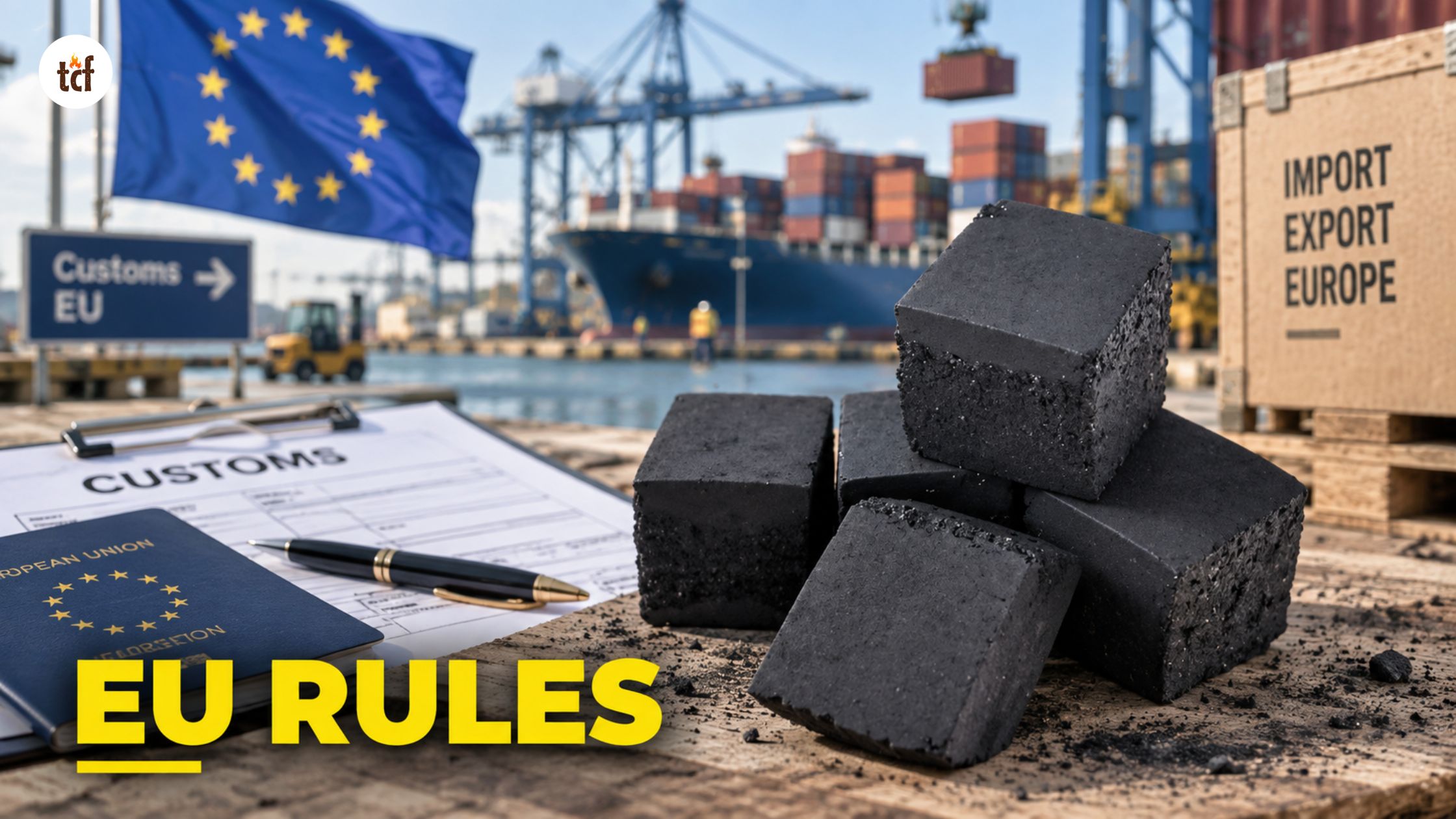
Charcoal import regulations in europe Union involve five regulatory layers that every buyer must understand: EU customs classification and tariff, the EU Deforestation Regulation (EUDR) on legal and deforestation-free sourcing, the EN 1860-2 product safety standard for BBQ and retail charcoal, EU packaging requirements, and the mandatory IMDG dangerous goods classification that applies to all sea freight. The stakes for non-compliance are significant; non-compliant shipments can be refused market access, seized, or trigger fines of at least 4% of annual turnover under the EUDR alone.
Table of Contents
How Is Charcoal Classified for EU Customs Purposes?
All charcoal entering the EU is classified under Combined Nomenclature (CN) heading 4402 “Wood charcoal (including shell or nut charcoal), whether or not agglomerated.” The EU uses a 10-digit TARIC code for import declarations, built on the 8-digit CN code, which itself extends the international 6-digit HS code.
The principal sub-classifications relevant to charcoal importers are 4402 10 for wood charcoal not including shell or nut charcoal, and 4402 20 for charcoal of shell or nut origin, which covers coconut shell charcoal briquettes for shisha and hookah. Agglomerated products with different binder content levels have further sub-headings within these codes.
Using the correct TARIC code is essential because tariff rates, EUDR obligations, and other trade measures are attached at this level. The EU’s TARIC database, updated daily by the European Commission, is the authoritative reference for current applicable rates and measures for each code. Importers can access it via taxation-customs.ec.europa.eu.
What Import Duty Applies to Charcoal Entering the EU?
Standard MFN Rate
The EU’s Most Favoured Nation (MFN) duty rate for charcoal under heading 4402 is 0% for most trading partners. This means buyers importing from Indonesia, Vietnam, the Philippines, and other major charcoal-exporting countries do not face a customs duty charge on the product itself under standard conditions.
GSP Preferential Rates
The EU’s Generalised Scheme of Preferences (GSP) provides additional preferential tariff access for eligible developing countries. For charcoal sourced from GSP-eligible countries, the duty rate is 0% provided the exporter issues a valid statement on origin on the commercial invoice or provides a REX (Registered Exporter) declaration. Importers should verify current GSP eligibility status for their source country via the EU’s Access2Markets platform, as eligibility can change.
VAT on EU Charcoal Imports
VAT applies to all commercial charcoal imports at the standard rate of the Member State of import. Standard VAT rates across EU countries typically range from 17% to 27%. In most EU member states, charcoal for commercial use is subject to the full standard rate. VAT-registered EU businesses can generally reclaim import VAT through their standard VAT return process.
EU Tariff Summary by Origin – Charcoal Import Regulations in Europe
| Origin Country | MFN Duty Rate | GSP/Preferential Rate | Key Notes |
| Indonesia | 0% | 0% GSP (with origin statement) | Subject to EUDR for hardwood charcoal |
| Vietnam | 0% | 0% GSP (with origin statement) | Full EUDR compliance required from Dec 2026 |
| Philippines | 0% | 0% GSP (with origin statement) | Coconut shell has lower EUDR risk |
| China | 0% | No GSP preference | Full MFN rate; EUDR applies |
| Ukraine | 0% | 0% (DCFTA/ATM measures) | Significant hardwood lump charcoal exporter |
| Namibia / South Africa | 0% | Check EPA/GSP status | Premium hardwood lump charcoal |
Always verify current preferential rates and conditions through the EU’s Access2Markets portal or TARIC database before finalising supplier pricing agreements.
What Is the EU Deforestation Regulation and How Does It Affect Charcoal Imports?
The EU Deforestation Regulation (EUDR, Regulation (EU) 2023/1115) is the single most significant regulatory development for charcoal importers in Europe. Wood charcoal (HS 4402) is explicitly listed in Annex I of the EUDR, meaning it falls directly within its mandatory scope.
The EUDR replaces the older EU Timber Regulation (EUTR) and goes substantially further. Where EUTR required only that timber be legally harvested, the EUDR adds a second, stricter requirement: products must also be deforestation-free as of 31 December 2020, regardless of whether any deforestation was legal in the country of origin.
What Are the Current Enforcement Deadlines?
The EUDR has been postponed twice since its original December 2024 application date. The most recent amendment, Regulation (EU) 2025/2650, published in the EU’s Official Journal on 23 December 2025, set the following confirmed timeline: large and medium operators must comply from 30 December 2026, and micro and small operators from 30 June 2027 (unless they were previously subject to the EUTR, in which case the December 2026 date applies).
Importers should not treat these delays as an opportunity for inaction. The EU Deforestation Due Diligence Information System has been operational since December 2024, and major buyers and retailers in Europe are already building EUDR compliance into their supplier qualification processes ahead of the enforcement date.
What Does EUDR Compliance Require for Charcoal?
An EU importer placing charcoal on the market acts as an “operator” under the EUDR. Operators must complete a three-step due diligence process for every shipment.
The first step is information collection, gathering the product description, quantity, country of production, and geolocation coordinates of the plots of land where the wood was harvested. The second is risk assessment, evaluating the risk that the product is not deforestation-free or not legally produced, using factors including country risk benchmarks published by the European Commission. The third is risk mitigation, implementing measures to reduce any identified risk to “negligible” before placing the product on the market.
A Due Diligence Statement (DDS) must then be submitted through the EU’s TRACES NT information system before the product enters the EU market. The DDS reference must be included in the customs import declaration. Without a valid DDS reference, customs authorities cannot release the goods.
Non-compliance penalties include fines of at least 4% of total annual EU turnover, confiscation of the products concerned, confiscation of revenues generated from the transaction, and temporary exclusion from public procurement. National competent authorities in each EU Member State handle enforcement.
How Does EUDR Affect Different Charcoal Types?
The EUDR impact varies meaningfully depending on the product. Hardwood lump charcoal imported from tropical origins, Indonesia, Vietnam, and West Africa, faces the highest compliance burden because the wood source must be traceable to plot-level geolocation with deforestation-free evidence since December 2020.
Coconut shell charcoal briquettes occupy a more favourable position. Coconut shells are agricultural byproducts, and the EUDR focuses on deforestation linked to forest land. Importers of coconut shell products should confirm with their suppliers and legal advisers whether the specific product classification and sourcing method place it within or outside the operative scope of the regulation. There is ongoing EU guidance activity in this area.
Our overview of types of charcoal explains the sourcing and material differences across product categories that directly affect the EUDR risk profile. For a full walkthrough of supplier documentation, our charcoal supplier verification checklist covers what to request before placing a compliant EU import order.
Also read – Charcoal Import Regulations in the UK
What Is the EN 1860-2 Standard and Is It Required in Europe?
EN 1860-2:2023 is the European standard specifying requirements and test methods for barbecue charcoal and briquettes. Published by CEN in 2023, it supersedes the 2005 version and is adopted across all EU member states as the harmonised national standard under their respective national designations DIN EN 1860-2 in Germany, NF EN 1860-2 in France, and so on.
The standard specifies minimum fixed carbon content, maximum ash residue, total moisture limits, granulometry (particle size) requirements, and mandatory consumer marking and labelling. Products that are impregnated to aid ignition have additional requirements, and “just light the bag” or “easy light” product claims are also governed by the standard.
While EN 1860-2 is technically a voluntary standard at the EU level, its market position in practice is close to mandatory for any importer selling into organised retail. German buyers in particular, Germany is Europe’s largest charcoal importer, frequently require DINgeprüft or DINplus certification, which involves third-party testing against DIN EN 1860-2 by an accredited body such as DIN CERTCO. Failure to comply with EN 1860-2 criteria exposes importers to product recall, market withdrawal, and RAPEX safety alerts, EU-wide public notices that can cause significant reputational and commercial damage.
A December 2025 research publication from the European Commission’s environment team found that many charcoal products available in the EU do not meet EN 1860-2 standards for composition and pollutant emissions a clear signal that enforcement scrutiny is increasing. Buyers wanting to understand product specifications in depth can refer to our charcoal grades explained guide.
What Are the EU Packaging Requirements for Imported Charcoal?
Since February 2025, Regulation (EU) 2025/40 on Packaging and Packaging Waste sets binding requirements for all packaging placed on the EU market, including charcoal bags and sacks. Under Article 12 of the regulation, every piece of packaging — retail or industrial must carry visible, legible, and indelible information on material composition, weight, and reusability. Symbols must be at least 6mm high on retail packs and 10mm on larger sacks.
For charcoal specifically, packaging should include the botanical species of the wood used (for example, Acacia mangium or Shorea spp.), an origin declaration (such as “Made in Indonesia”), and the HS code 4402. These details should be printed directly on the bag rather than applied on a removable sticker.
Health and safety warnings must also be present on retail packaging. EN 1860-2 requires a flame icon crossed by a kitchen fork and text instructing consumers never to light charcoal indoors. In France, all safety instructions must be provided in French, regardless of whether English is also present. Importers selling across multiple EU markets should ensure their packaging meets the most demanding national language requirements of the countries they supply.
What Is the IMDG Dangerous Goods Requirement for Sea-Freight Charcoal?
Every charcoal shipment arriving at an EU port by sea is subject to IMDG Code Amendment 42-24, which became mandatory globally from 1 January 2026. Under this amendment, all charcoal without exception must be declared and transported as Dangerous Goods, classified as UN1361, Carbon of animal or vegetable origin, Class 4.2 (substances liable to spontaneous combustion).
Previous exemptions under Special Provisions SP223 and SP925, which had allowed charcoal to bypass dangerous goods classification if it passed self-heating tests, have been permanently removed. The change was driven by a documented record of 68 container fires linked to charcoal self-heating between 2015 and 2022, often occurring days after loading when the cargo appeared stable.
Under the new Special Provision SP978, charcoal must be weathered for a minimum of 14 days after production before packing, or packed under inert gas following pyrolysis with a subsequent 24-hour storage period. Material temperature must not exceed 40°C on the day of packing. Containerised bulk transport without packaging is no longer permitted.
Packaging must use UN-certified bags with correct Class 4.2 hazard labels and IMDG-compliant marks. Full container loads require Class 4.2 placards on all four sides. A Dangerous Goods Declaration (DGD) must accompany every shipment and be reflected on the Bill of Lading. Major carriers have also introduced Dangerous Goods Premium surcharges, typically USD 250 / EUR 210 per container, adding a direct cost increase to every sea freight shipment.
Importers must verify DG compliance with their supplier before booking freight. Non-compliant shipments are being rejected at the port of loading by major carriers, with consequential costs falling on the importer.
What Is ICS2, and What Does It Require for Charcoal Imports?
The EU’s Import Control System 2 (ICS2) is now fully mandatory across all transport modes, air, ocean, road, and rail, as of 1 September 2025. It replaced the older ICS1 system and applies to all goods entering or transiting through the EU customs territory, including Norway, Switzerland, and Northern Ireland.
ICS2 requires an Entry Summary Declaration (ENS) to be submitted before cargo arrives at the EU border. For ocean freight, this must be filed at least 24 hours before loading at the foreign port. The ENS must include a minimum 6-digit HS code (often the full 8- or 10-digit TARIC code is required), a valid EU EORI number for the importer, full party details, and an accurate goods description — vague terms such as “fuel” or “carbon products” are no longer accepted.
Every EU importer must hold an EORI number. If your business does not yet have one, it must be obtained from the customs authority of the EU member state in which you are established before any import can proceed.
Late, inaccurate, or missing ENS filings result in cargo holds at the EU border, customs inspection, and financial penalties. Working with a freight forwarder or customs broker who is ICS2-registered is strongly recommended for charcoal importers managing regular container-load shipments.
Also read – Charcoal Import Regulations in the USA
What Documentation Does an EU Charcoal Importer Need?
| Document | Purpose | Who Provides It |
| Commercial invoice | Customs value and product description | Supplier |
| Packing list | Shipment verification | Supplier |
| Bill of Lading | Shipping contract, confirms DG classification | Freight carrier |
| Certificate of Origin | Origin for preferential tariff / GSP claim | Supplier / Chamber of Commerce |
| GSP / REX origin statement | Required for preferential 0% duty | Supplier |
| EUDR Due Diligence Statement (DDS) | Deforestation-free and legal sourcing proof | Importer (via TRACES NT) |
| Plot-level geolocation data | EUDR traceability requirement | Supplier |
| FSC / PEFC certificate | Supports EUDR risk mitigation | Supplier |
| DG Declaration (UN1361, Class 4.2) | IMDG dangerous goods compliance | Supplier / freight forwarder |
| EN 1860-2 test report | Product quality and safety compliance | Independent lab |
| ICS2 / ENS filing | Pre-arrival security declaration | Importer/customs broker |
For buyers managing multiple EU market entries, building a standardised compliance pack from suppliers, covering EUDR geolocation data, FSC documentation, DG declarations, and EN 1860-2 test reports, before the first shipment is far more efficient than chasing documentation per order. Our how to choose the right charcoal supplier and bulk charcoal buying guide cover how to build supplier relationships that support this level of documentation.
Check out the product categories of The Charcoal Factory:
wholesale hookah charcoal
wholesale BBQ charcoal
Charcoal Supplier for Distributors
bulk charcoal for restaurants
private label charcoal for supermarkets
Are There Country-Specific Differences Within the EU?
The EU customs union means that tariff rules and EUDR obligations are uniform across all 27 member states. However, national market requirements for product standards and labelling create practical differences that importers supplying multiple EU countries need to manage.
Germany is Europe’s largest charcoal importer and sets the most demanding product standard requirements, with DINgeprüft or DINplus certification against DIN EN 1860-2, effectively a market-entry requirement for mainstream retail. German buyers also commonly specify a maximum ash content of 4% and a minimum fixed carbon of 80%, stricter than the EN 1860-2 standard floor.
France places equal emphasis on product quality and gastronomy-grade performance, with an additional requirement that all consumer safety information on packaging must appear in French. The French market has a strong preference for premium hardwood lump charcoal with specific flavour profiles for professional kitchen use.
The Netherlands and Belgium serve as major EU import hubs for charcoal. The ports of Rotterdam and Antwerp are primary entry points for container-load shipments from Southeast Asia and Africa, and buyers in these markets are experienced in documentation requirements. Compliance standards are consistently applied and well-enforced.
For buyers supplying the shisha and hookah market across European cities, our wholesale shisha charcoal range and coconut charcoal briquettes wholesale pages cover available product specifications and supply options.
External references: EU TARIC Database — European Commission | EUDR Regulation (EU) 2023/1115 — EUR-Lex
Frequently Asked Questions
What is the import duty rate on charcoal entering the EU?
The standard MFN rate for charcoal (heading 4402) is 0% for most origins. GSP-eligible ountries including Indonesia and Vietnam can access a 0% preferential rate with a valid origin statement. VAT applies at the standard rate of the importing member state, typically 19–25% depending on the country. Always verify current rates via the EU TARIC database.
Does the EUDR apply to charcoal imported into Europe?
Yes. Wood charcoal (HS 4402) is explicitly listed in Annex I of the EUDR. EU importers acting as operators must conduct full due diligence, prove deforestation-free sourcing to plot level, and submit a Due Diligence Statement through TRACES NT before placing charcoal on the EU market. Large and medium operators must comply from 30 December 2026; micro and small operators from 30 June 2027.
Is EN 1860-2 certification mandatory for charcoal sold in the EU?
EN 1860-2:2023 is a harmonised European standard but technically voluntary at the EU level. In practice, it is close to mandatory for any importer supplying mainstream retail, particularly in Germany, where DINgeprüft or DINplus certification against DIN EN 1860-2 is the market-entry standard. Products that fail EN 1860-2 criteria risk RAPEX safety alerts and recall across EU markets.
What is ICS2, and does it apply to charcoal imports?
ICS2 is the EU’s mandatory pre-arrival safety and security declaration system, fully operational across all transport modes from September 2025. All charcoal shipments entering the EU by sea, air, road, or rail must be covered by a valid Entry Summary Declaration (ENS) submitted before arrival, containing a minimum 6-digit HS code, EORI number, and full goods and party details. Failure to file correctly results in cargo holds and penalties.
What does the IMDG Amendment 42-24 mean for charcoal shipped to Europe
From 1 January 2026, all charcoal shipped by sea must be declared as Dangerous Goods — UN1361, Class 4.2. Charcoal must be weathered at least 14 days after production before packing, packed in UN-certified bags, and accompanied by a Dangerous Goods Declaration. Container loads require Class 4.2 placards on all four sides. Suppliers who cannot provide DG-compliant shipments are being rejected by major carriers including Hapag-Lloyd and MSC.