

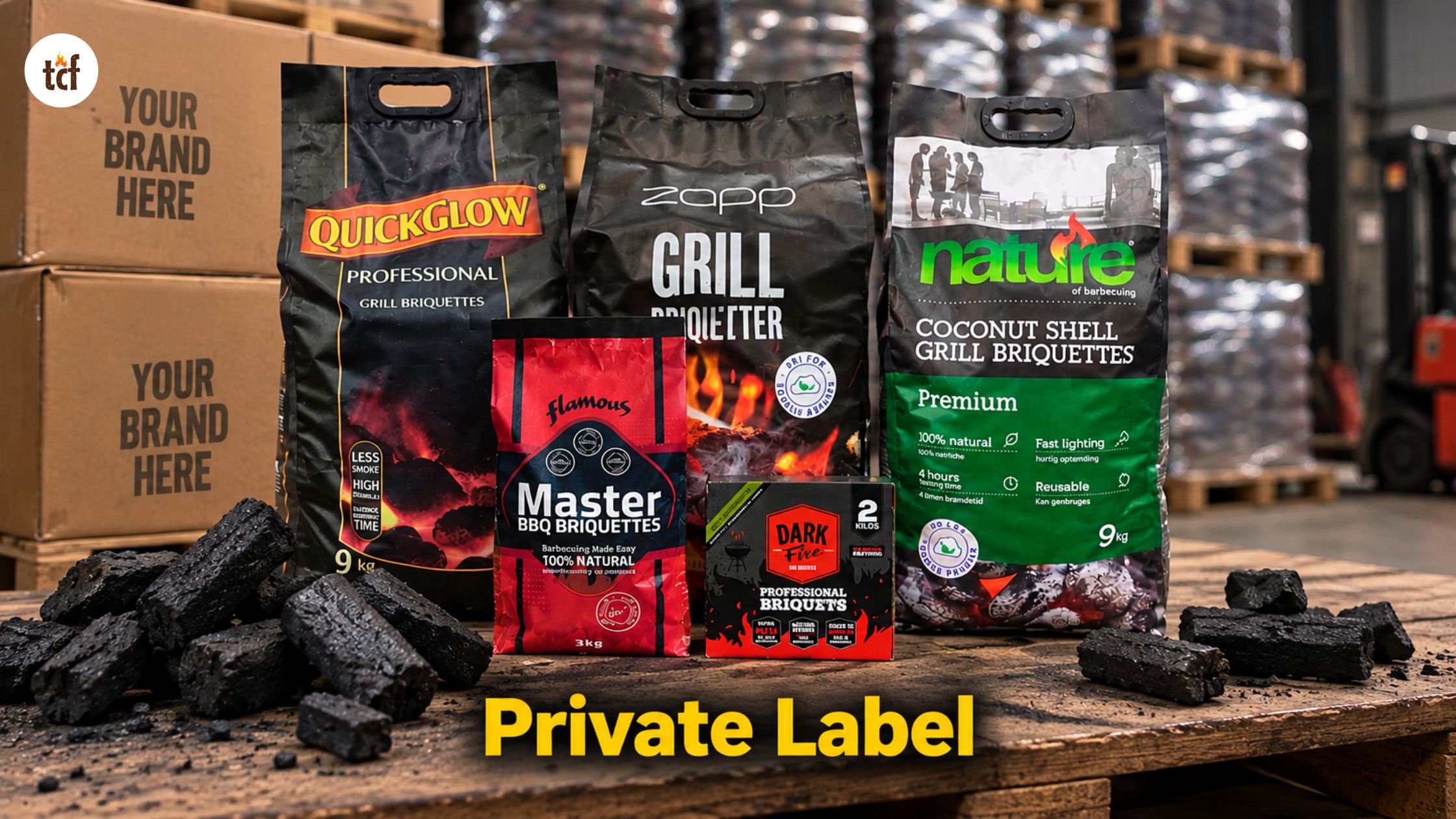
Private label charcoal packaging means a manufacturer produces charcoal under your own brand name, logo, and custom packaging design, rather than their generic packaging. Minimum order quantities typically run 18 to 26 tons, tied to container size, and full lead time from artwork approval to vessel departure usually takes 4 to 6 weeks.
Here’s the full process, what drives the MOQ, and where the timeline actually goes if you’re planning a launch date.
Table of Contents
Private label vs white label: what’s the difference?
Private label means the product formulation and packaging are customized specifically for your brand, often with input on packaging materials, bag or box format, and sometimes product spec. White label means you’re applying your logo to an existing, unchanged product the manufacturer already produces for multiple customers.
Most charcoal manufacturers offering “private label” are really offering a hybrid: your branding and packaging design applied to their existing product line and specs. True custom formulation (a unique blend, binder, or shape developed only for you) is less common and usually requires higher minimum order quantities.
How the process actually works
Step 1: Inquiry and NDA
Most manufacturers will sign a mutual NDA before sharing detailed specs, pricing breakdowns, or production capacity, especially if you’re discussing a custom formulation rather than a standard product with new packaging.
Step 2: Product and packaging selection
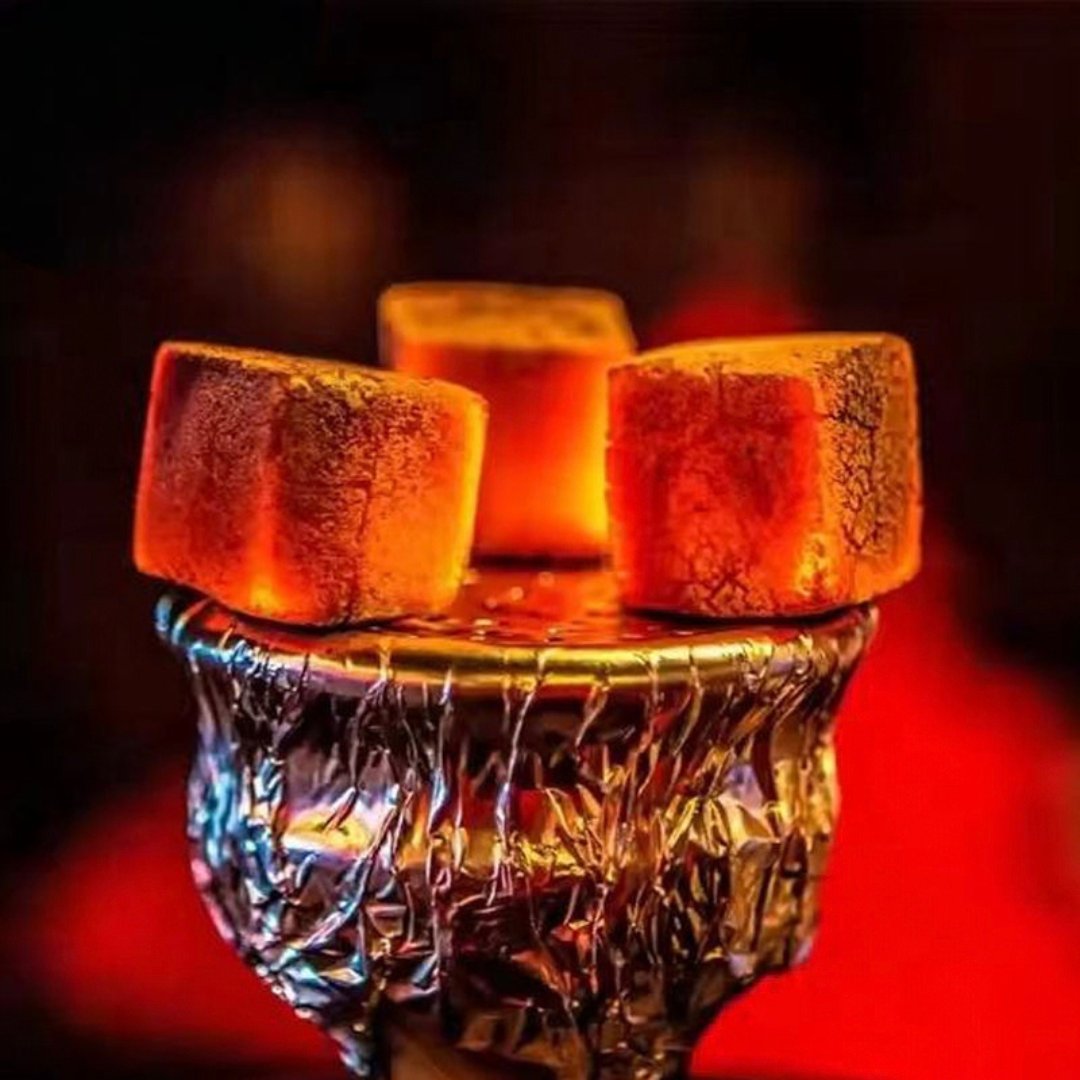
You choose the charcoal type (lump, briquette, coconut shell cube, shisha hexagon) and the packaging format (kraft bags, printed woven PP bags, retail boxes, jars for cube-format charcoal). Each format has its own MOQ and lead time, so lock this down before requesting a final quote.
Step 3: Artwork and design approval
You provide your logo and brand assets, or the manufacturer’s design team builds packaging artwork from your brief. This stage typically takes 1 to 2 weeks, longer if you’re iterating on multiple design rounds or need multilingual packaging for a specific export market, Arabic labeling for Middle East distribution, for example.
Step 4: Sample production and approval
The factory produces a physical sample run in your actual packaging before committing to full production. This step matters more than it seems; it’s your last checkpoint to catch a packaging or print issue before it’s replicated across tons of product.
Step 5: Mass production
Once the sample is approved, full production begins. This is where charcoal-specific timing enters the picture: product needs to complete its weathering period (commonly a minimum of 14 days) before it can be packed, since charcoal ships as Dangerous Goods under UN1361, Class 4.2.
Step 6: Compliance documentation and quality inspection
A pre-shipment inspection, along with the Dangerous Goods Declaration, weathering records, and packing-day temperature documentation, gets prepared before the container is booked.
Step 7: Container loading and shipment
The finished, packed product loads into the container and departs.
Also read – What Is a Pre-Shipment Inspection
What drives the MOQ
MOQ for private label charcoal is driven by container economics more than packaging minimums. Manufacturers price and produce around full container loads (FCL) because partial containers cost more per ton and complicate compliance documentation for Dangerous Goods shipments.
Typical figures cited by charcoal manufacturers:
- Shisha or coconut shell charcoal: around 18 tons per 20ft container
- BBQ or wood charcoal: around 26 tons per 40ft container
One Indonesian OEM manufacturer lists an MOQ of 18 tons for private label orders under full confidentiality and NDA terms. A separate briquette manufacturer quotes 18 tons for a 20ft shisha charcoal container and 26 tons for a 40ft BBQ charcoal container, consistent with the container-driven MOQ pattern across the industry.
If you can’t meet a full container MOQ on your first order, ask whether the manufacturer allows LCL (less than container load) private label runs; some do, generally at a per-ton premium, or offer a lower-MOQ “starter” packaging format to test a market before committing to a full container.
Lead time: what the 4 to 6 week estimate actually includes
A single “4 to 6 weeks” quote usually bundles together phases that are worth understanding separately, since delays tend to happen in specific stages, not evenly across the whole timeline:
| Phase | Typical duration |
| Artwork and design approval | 1 to 2 weeks |
| Sample production and approval | 1 to 2 weeks |
| Weathering period (before packing) | Minimum 14 days |
| Mass production and packing | 1 to 3 weeks, depending on order size |
| Pre-shipment inspection and documentation | 5 to 7 business days, can run parallel to packing |
These phases overlap in a well-run factory, weathering happens during production, and inspection scheduling starts before packing finishes. That’s why total lead time usually lands around 4 to 6 weeks rather than the full sum of every phase run sequentially.
Payment terms you should expect
Private label charcoal orders commonly follow a 50% deposit, 50% balance structure: 50% paid by Telegraphic Transfer (T/T) after signing the sales contract or purchase order, with the remaining 50% due shortly before container loading, often around 5 days ahead of the loading schedule.
What’s often excluded from the quoted price
Read your quote carefully for what’s excluded, not just what’s included. Two charges commonly billed separately from the base private label price:
- Self-Heating Test (SHT): a test some carriers or destination markets require to confirm the charcoal’s self-heating classification, separate from the standard export price
- Vanning weathering costs: additional charges tied to the mandatory weathering period before container packing, sometimes billed as a separate line item rather than folded into the base rate
Ask specifically whether these are included before comparing quotes between manufacturers; a lower headline price that excludes compliance costs isn’t actually the cheaper option once they’re added back in.
Packaging format considerations for private label
- Kraft or recycled paper bags: increasingly requested for sustainability positioning, generally at a moderate cost premium over standard woven PP bags
- Printed woven PP bags: the most common format for bulk and mid-size retail bags, cost-efficient at scale
- Retail boxes and jars: used for cube-format shisha or premium BBQ charcoal, typically the highest per-unit cost and often the longest lead time due to die-cut tooling and box assembly
- Multilingual labeling: required for many export markets; factor extra design and proofing time if you’re printing in more than one language on the same package
Also read – Bulk Charcoal Supply Contracts
Questions to ask before committing to a private label run
- What’s the MOQ for this specific packaging format, not just the bulk product MOQ?
- Does the quoted lead time include weathering and inspection, or are those additional?
- Is the Self-Heating Test included, and is it required for my destination market?
- How many design revision rounds are included before additional design fees apply?
- What happens to unused custom packaging inventory if I need to change suppliers later?
Frequently asked questions
What’s a typical MOQ for private label charcoal?
Commonly 18 tons for a 20ft container (shisha or coconut shell charcoal) and around 26 tons for a 40ft container (BBQ or wood charcoal), since pricing and production are structured around full container loads.
How long does private label charcoal packaging take from order to shipment?
Typically 4 to 6 weeks, covering artwork approval, sample production, the mandatory weathering period, mass production, and pre-shipment compliance documentation.
Can I order less than a full container for a private label run?
Some manufacturers allow LCL (less-than-container-load) orders, usually at a higher per-ton cost. Ask directly, since it’s not always advertised as a standard option.
Are compliance costs included in a private label quote?
Not always. Self-Heating Test fees and weathering-related charges are sometimes billed separately from the base product and packaging price. Confirm this before comparing quotes.