


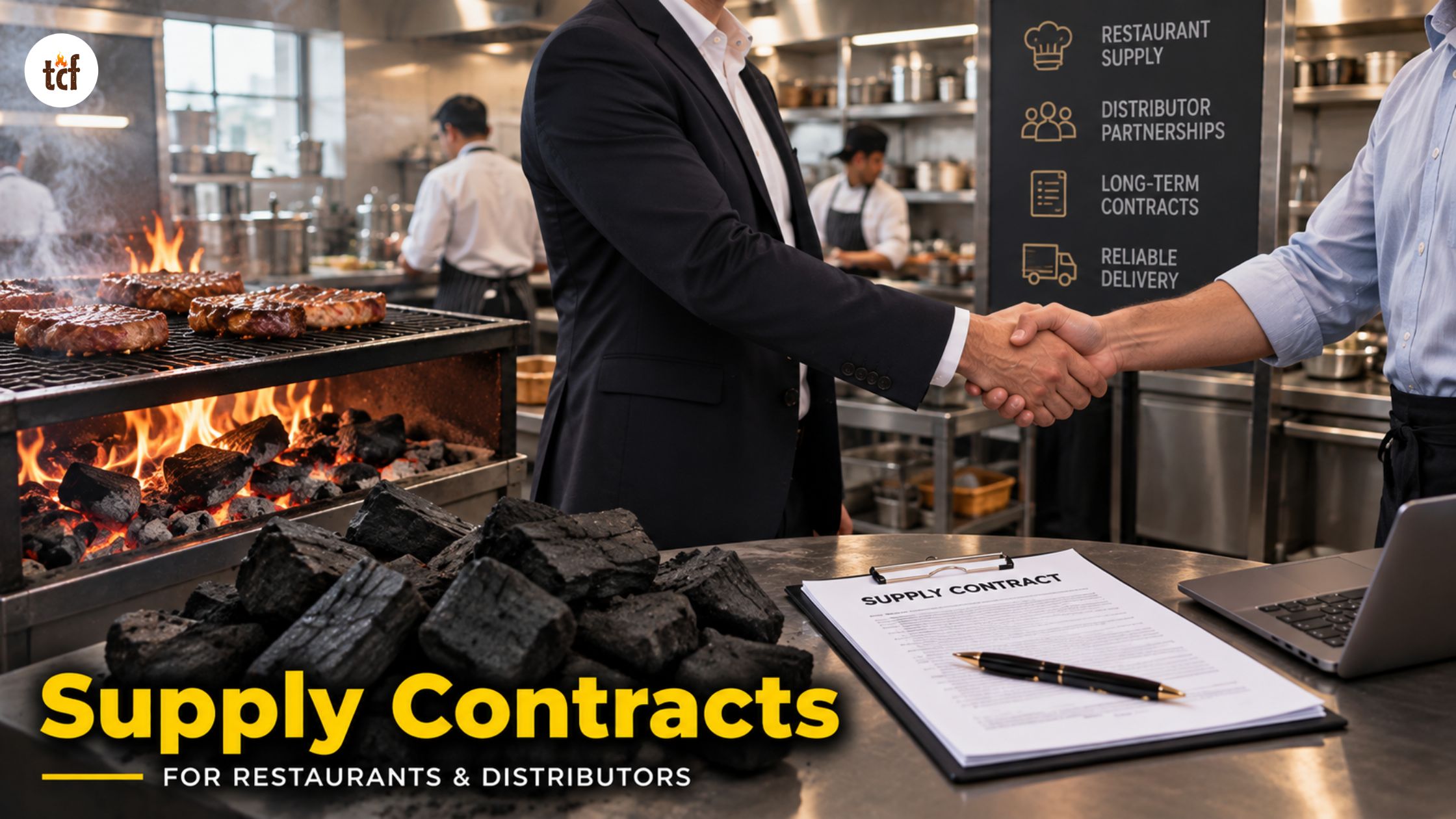
A bulk charcoal supply contracts should lock down 6 things: pricing mechanism, quality specifications, volume commitments, delivery penalties, payment terms, and force majeure conditions. Miss any one of these, and you’re exposed to a price spike, a quality drop, or a stockout with no contractual recourse.
Here’s what to negotiate in each category, and why suppliers often prefer you don’t ask.
Table of Contents
Why a purchase order isn’t enough
A one-off purchase order covers a single shipment. It doesn’t protect you against next quarter’s price increase, a quality slip after the relationship gets comfortable, or a supplier prioritizing a bigger customer during a supply crunch.
A supply contract is what gives you leverage across multiple shipments instead of renegotiating from scratch every time. For restaurant chains and distributors ordering regularly, that difference is worth the extra negotiation upfront.

1. Pricing mechanism
Raw charcoal material costs move with wood and coconut shell availability, seasonal harvest cycles, and fuel costs for transport. A fixed price for 12 months protects you from increases but exposes the supplier to their own cost risk, which is exactly why most suppliers resist it.
What to negotiate instead:
- Fixed price with a review window: lock the price for 3 to 6 months, with a defined renegotiation date rather than an open-ended contract that either side can reprice anytime.
- Price cap with index adjustment: tie adjustments to a named reference, like a regional wood price index, with a maximum percentage move per quarter. This protects both sides from wild swings while still letting cost pass through.
- Volume-tiered pricing: negotiate a lower per-ton rate at defined order thresholds, so scaling your order size has a built-in payoff instead of requiring a fresh negotiation.
Get the exact adjustment formula in writing. “Subject to market conditions” is not a pricing mechanism; it’s a blank check.
Must-read – Charcoal Container Loading Guide
2. Quality specifications
This is where verbal assurances cost distributors the most money. “Consistent quality” isn’t enforceable. Specific numbers are.
Put these in the contract, not just the product spec sheet:
- Moisture content maximum (commonly under 8 to 12% for export-grade charcoal, confirm the number for your specific product type)
- Ash content maximum
- Fixed carbon percentage minimum
- Calorific value range (in kcal/kg)
- Size and shape tolerance, especially for briquettes where uniformity affects burn time
- Acceptance testing method: specify whether a Certificate of Analysis (COA) from a named third-party lab is required per shipment, or only on request
Then negotiate what happens when a shipment fails spec. A rejection clause without a resolution path just means a dispute. Better contracts define a tolerance band (product within X% of spec is accepted at a price adjustment) and a hard reject threshold (product beyond that triggers replacement or refund, not renegotiation after the fact).
3. Volume commitments
Suppliers want predictability. You want flexibility. The contract needs to reconcile both.
- Minimum order quantity (MOQ) per shipment: usually tied to container size, a 20ft or 40ft container load, since partial containers cost more per ton and most charcoal ships FCL only.
- Minimum annual volume: what you’re committing to across the full contract term, often with a lower-than-expected penalty if you fall short, and a rebate or price break if you exceed it.
- Forecast flexibility: negotiate the ability to adjust order volume within a defined range (say, plus or minus 15%) per shipment without renegotiating the whole contract, since restaurant demand isn’t perfectly flat month to month.
Distributors serving multiple restaurant locations should push for volume commitments calculated annually, not shipment by shipment. A single slow month shouldn’t put you in breach of a rigid per-shipment minimum.
Also read – lump charcoal vs briquettes
4. Delivery timelines and penalties
Late charcoal delivery isn’t just an inconvenience for a restaurant chain running weekly service; it’s a direct hit to operations. The contract should specify:
- Lead time from order confirmation to vessel departure, separate from ocean transit time, since production and packing delays are the part actually within the supplier’s control
- Penalty clause for late departure, commonly a percentage credit per day of delay beyond an agreed grace period
- Force majeure carve-out, covering genuine disruptions (port strikes, extreme weather, regulatory holds) that shouldn’t trigger a penalty, but defined narrowly enough that it doesn’t become a blanket excuse
Charcoal ships as Dangerous Goods under UN1361, which means weathering time, packaging compliance, and carrier booking all sit upstream of the vessel departure date. Ask your supplier to build their standard compliance timeline into the lead time they quote you, not treat it as a separate delay that shows up later.
5. Payment terms
Payment structure is where new supplier relationships carry the most risk, and where established relationships have room to improve terms.
- New supplier relationships: expect a deposit (commonly 30%) against a Telegraphic Transfer (T/T), with the balance due against shipping documents or a Letter of Credit (LC). An LC gives you more protection since a bank confirms document compliance before releasing payment, but it costs more to set up and adds processing time.
- Established relationships: negotiate toward open account terms (net 30 or net 60 after delivery) once a track record of consistent quality and on-time shipment exists. This is usually a 12 to 24 month progression, not a first-contract ask.
- Currency and exchange risk: specify which currency the contract is priced in, and who absorbs exchange rate movement between order and payment if it’s not USD.
Don’t negotiate payment terms in isolation from pricing. A supplier offering a lower per-ton price but demanding 100% upfront T/T is shifting risk onto you in a way that isn’t reflected in the headline number.
6. Force majeure and supply disruption
A generic force majeure clause copied from a template contract usually favors whoever wrote it. Push for specifics:
- Named events: port closures, natural disasters, government export restrictions, not just “unforeseen circumstances”
- Notice requirement: how many days the supplier has to notify you once a force majeure event affects your order
- Alternative sourcing rights: whether you’re contractually free to source from a backup supplier during a prolonged disruption without breaching exclusivity, if your contract has one
- Duration threshold: define how long a force majeure event has to run before either party can cancel the affected order without penalty
Exclusivity: think before you sign it
Suppliers sometimes push for exclusivity in exchange for better pricing. Before agreeing, weigh what you’re giving up: negotiating leverage on future price reviews, and your ability to dual-source during a compliance issue or quality dispute with that one supplier.
If you do agree to exclusivity, tie it to volume performance; exclusivity holds only if you meet your committed annual volume, not indefinitely regardless of order size.
Private label and OEM terms
If you’re buying under your own brand, the contract needs a separate section covering:
- Packaging design ownership and confidentiality
- Minimum order quantity specific to custom packaging (usually higher than bulk packaging, since custom printing has its own minimums)
- Lead time for first-run custom packaging versus repeat orders
- What happens to unused custom packaging inventory if the contract ends
A short negotiation checklist
- [ ] Pricing mechanism with a defined adjustment formula, not “market conditions”
- [ ] Quality specs with numeric tolerances and a named testing method
- [ ] Volume commitment calculated annually, with forecast flexibility per shipment
- [ ] Delivery lead time that accounts for Dangerous Goods compliance, plus a late-delivery penalty
- [ ] Payment terms matched to your relationship stage, not accepted at face value
- [ ] Force majeure clause with named events and a cancellation threshold
- [ ] Exclusivity, if any, tied to volume performance
Frequently asked questions
What’s a reasonable minimum order quantity for a bulk charcoal contract?
Usually tied to a full container load, commonly 10 to 20 tons for a 20ft container depending on product density. Distributors ordering below that threshold typically pay a per-ton premium or need to consolidate orders with other buyers.
Should I ask for a fixed price or an indexed price?
Fixed price protects you short term but rarely lasts more than 3 to 6 months before a supplier pushes back. An indexed price with a capped adjustment percentage tends to be more sustainable for both sides over a longer contract term.
How do I protect against a quality drop after the relationship is established?
Put numeric specs (moisture, ash, fixed carbon, calorific value) directly in the contract, not just the initial product spec sheet, and require a Certificate of Analysis per shipment or at defined intervals.
Is exclusivity worth agreeing to for a better price?
Only if it’s tied to your own volume performance and you’ve already vetted the supplier’s reliability. Unconditional exclusivity removes your ability to dual-source during a dispute or disruption.