

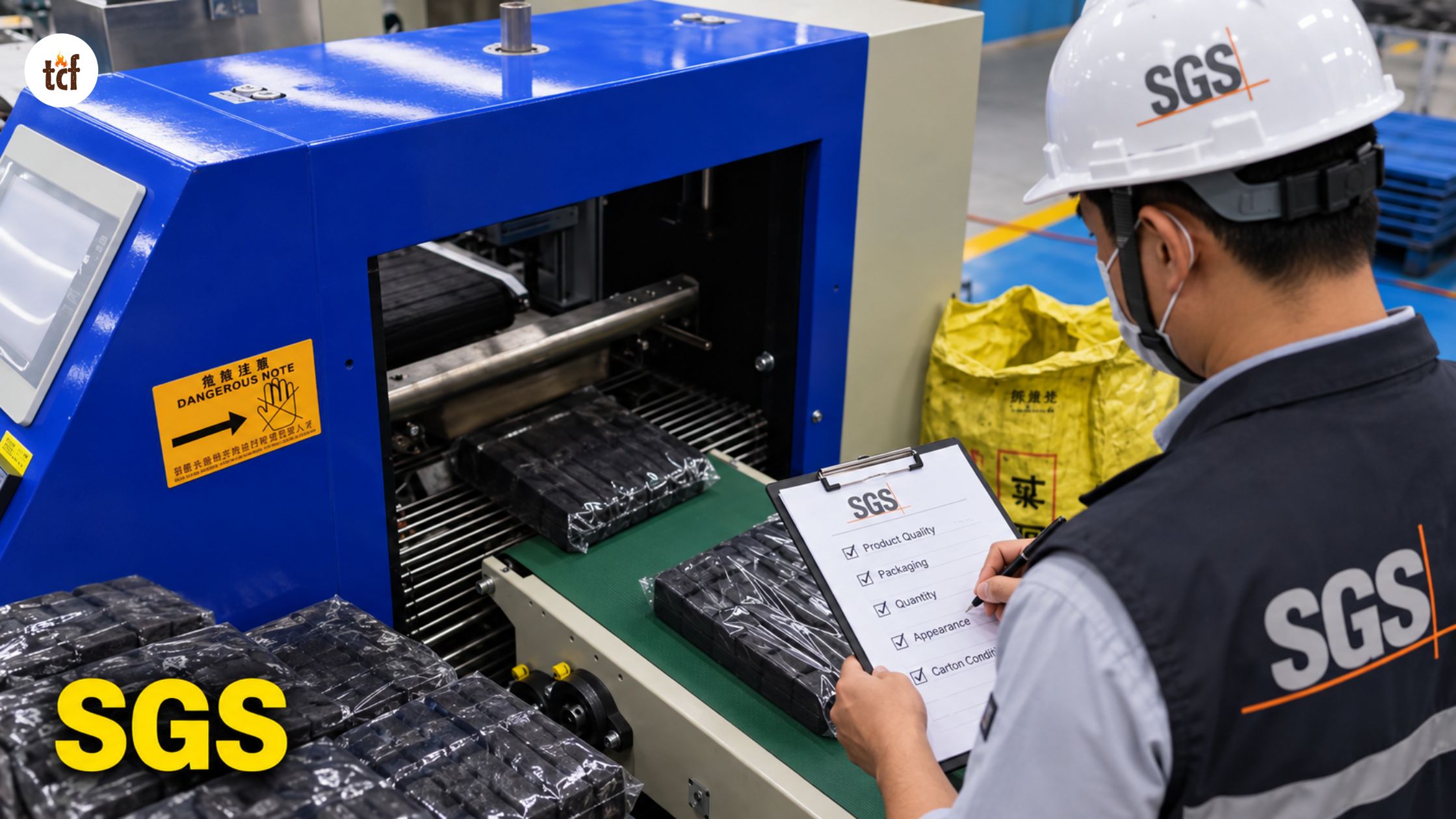
A pre-shipment inspection for charcoal is an independent, third-party check of your charcoal’s quality and quantity before it leaves the factory, done by an inspection company like SGS, Bureau Veritas, or Intertek. It confirms the container actually holds what the contract says it should, in the amount and grade agreed, before you release final payment.
Here’s what it actually checks, how the process works, and why skipping it costs buyers more than the inspection fee itself.
Table of Contents
What is SGS?
SGS (Société Générale de Surveillance) is the world’s largest inspection, testing, and certification company, founded in 1878 and operating in 140+ countries. In the charcoal trade, SGS acts as a neutral third party between buyer and seller, testing the actual product against the specification in the sales contract rather than relying on the supplier’s own internal report.
SGS isn’t the only option. Bureau Veritas, Intertek, and country-specific labs like Vinacontrol in Vietnam offer comparable services. “SGS” gets used generically in trade conversations the way “Xerox” got used for photocopiers; the process matters more than the specific inspection brand, as long as the lab is independently accredited.
What does a pre-shipment inspection for charcoal actually check?
Quantity verification
- Bag or box count against the packing list
- Weight verification, sample weighing against declared net weight
- Container loading confirmation, matching what’s physically loaded to what’s on the shipping documents
Quality testing
- Moisture content: typically specified under 8 to 12% depending on charcoal type, tested by drying a sample and measuring weight loss
- Ash content: lower is generally better, since high ash reduces airflow and clogs grills
- Fixed carbon: the percentage of carbon remaining after volatile matter burns off, a core driver of burn duration
- Volatile matter: higher volatile matter generally means more smoke and a less clean burn
- Calorific value: heat output, measured in kcal/kg, calculated using standard methods like ASTM D5865 or ISO 1928
Packaging and condition
- Bag or box integrity, checking for damage that could let moisture in during transit
- Labeling accuracy, confirming country of origin, net weight, and any required Dangerous Goods marking match the actual shipment
- Palletizing or stacking condition if applicable
Documentation cross-check
- Confirming the Certificate of Analysis, packing list, and commercial invoice all describe the same shipment consistently
Also read – Bulk Charcoal Supply Contracts
How the inspection process actually works
- Booking: the buyer, seller, or both jointly request the inspection once production is complete and the shipment is ready, usually a few days before container loading.
- Sampling: an inspector takes samples from multiple bags or pallets across the shipment, not just from the top layer or the bags nearest the door, since that’s where quality substitution is easiest to hide.
- Lab testing: samples go to an accredited lab, commonly ISO 17025 certified, for moisture, ash, fixed carbon, and calorific value testing.
- Loading supervision (optional but recommended): an inspector can physically witness the container being loaded and sealed, confirming the tested lot is what actually goes into the container, not a different batch swapped in afterward.
- Report issuance: the inspection company issues a report referencing the specific lot number, loading date, and container or seal number. Turnaround is typically 5 to 7 business days from sampling to final report.
That lot-specific detail matters more than it sounds. A report tied to a specific lot and loading date is evidence about the container actually being shipped, not a general quality claim about what the factory can produce under good conditions.
Why this matters: the actual failure modes it prevents
Grade inflation. A supplier quotes and samples A-grade charcoal, then ships B-grade in the actual container. Without an SGS report on that specific shipment, a buyer has no documented basis to reject it or renegotiate, and no leverage once the goods have left port.
Short shipment. The packing list says 20 tons, the container holds 18. Quantity verification during loading supervision catches this before the container is sealed, not after it arrives and the shortfall is already the buyer’s problem.
Golden samples. Some suppliers send an excellent sample for approval, then ship ordinary production stock in the actual order. Independent sampling directly from the shipment being loaded, not from a pre-approved sample set aside earlier, is the specific defense against this.
Payment disputes under a Letter of Credit. For LC transactions, banks often require inspection certificates as a condition of releasing payment. Without one, payment can stall even when the shipment itself is fine, simply because the documentation requirement wasn’t met.
What it costs, and who pays
Inspection costs typically run in the range of a few hundred to around two thousand dollars per container, a small fraction of a shipment’s total value. Buyer and seller commonly split this cost or negotiate who pays as part of the supply contract itself, along with who has the right to request one and on what timeline.
If you’re negotiating a supply contract, this is worth locking in explicitly rather than assuming it’s covered. A contract that requires an SGS or equivalent report for every container, not just the first sample order, closes the exact gap that lets grade inflation happen after a relationship becomes comfortable.
Also read – Charcoal Container Loading Guide
A real warning: fake certificates exist
Inspection certificate fraud is a known problem in commodity trade, not a rare edge case. A fraudulent seller can produce a certificate using a real company’s logo and formatting with a fabricated certificate number.
Always verify a certificate directly with the inspection company before relying on it for payment release or cargo acceptance; don’t take the PDF at face value just because it looks official. Most inspection companies offer a certificate verification service or a direct contact for exactly this purpose.
Frequently asked questions
Is a pre-shipment inspection mandatory for charcoal imports?
Not by law in most cases, but it’s commonly required contractually, especially for Letter of Credit transactions where banks need documented proof of quality and quantity before releasing payment.
How long does a charcoal pre-shipment inspection take?
Typically 5 to 7 business days from sampling to final report, though this can vary depending on the lab’s schedule and whether loading supervision is included.
What’s the difference between a sample test and loading supervision?
A sample test checks quality against your specification. Loading supervision adds a physical witness to the container being loaded and sealed, confirming the tested lot is what actually ships, not a substituted batch.
Who typically pays for the inspection, buyer or seller?
It varies by contract. Some buyers pay directly to keep the inspection fully independent, others split the cost with the seller. This should be defined explicitly in the supply contract rather than assumed.