

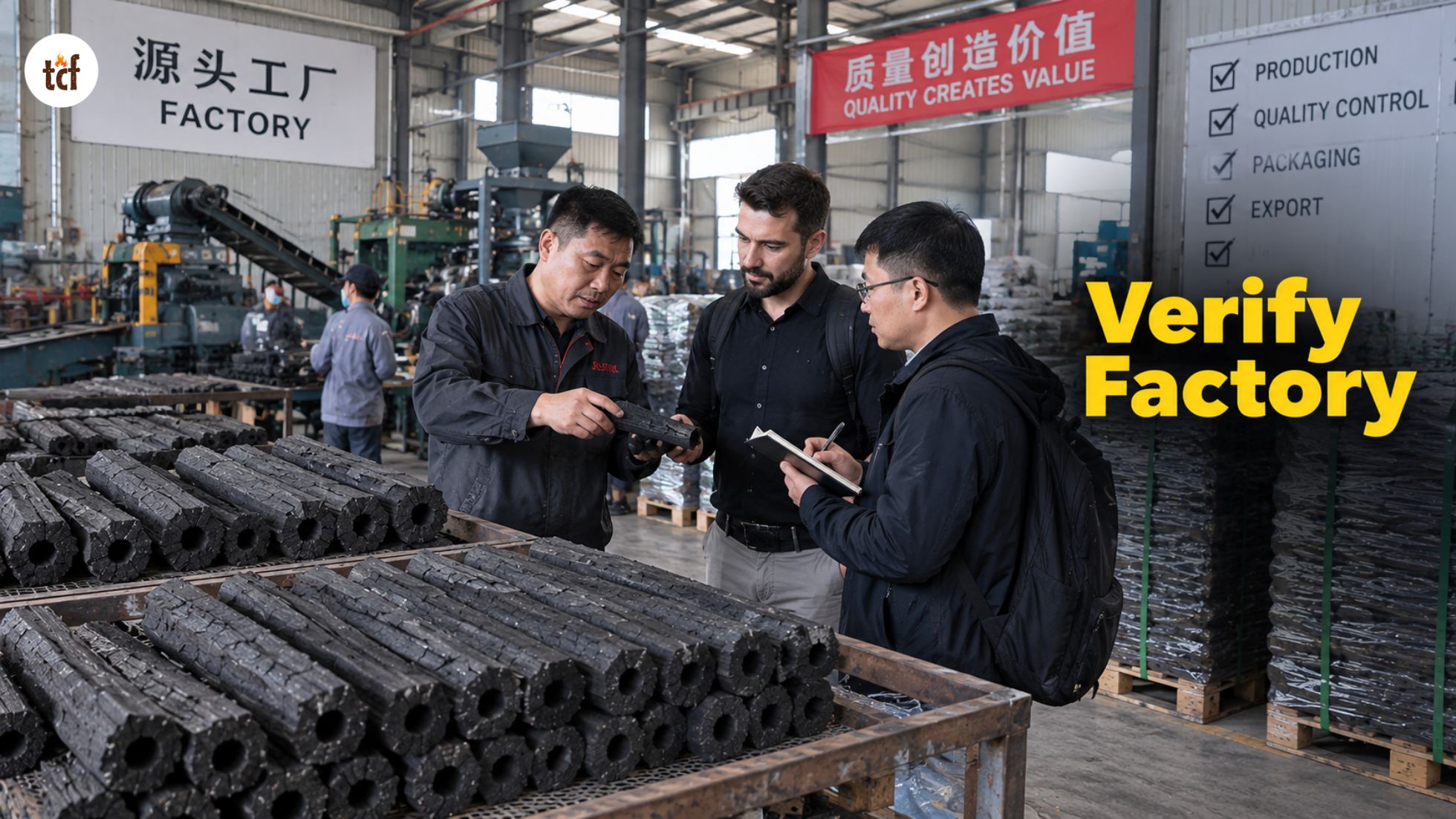
How to verify that a charcoal factory in China is real: Check the supplier’s business scope on China’s official registry (gsxt.gov.cn), it should say “manufacturing” or “production,” not “wholesale” or “import-export.” Then request a live video call of the actual production line, weathering yard, and raw material stockpile, not a pre-recorded tour. A real charcoal factory will show you both without hesitation. A trading company will stall, deflect, or offer to “arrange a visit later.”
Here’s the full verification process, adapted specifically for charcoal, not generic sourcing advice with “charcoal” swapped in.
Table of Contents
Why This Matters More for Charcoal Than Most Products
Working with a trading company isn’t automatically bad; some buyers genuinely want the flexibility a trader offers on smaller orders. The problem is not knowing which one you’re dealing with. A trading company marking up a factory’s price by 15 to 30% while presenting itself as the manufacturer means you’re paying a hidden margin with no negotiating leverage to remove it.
For charcoal specifically, there’s an added risk beyond price: quality control and compliance documentation. A trading company sourcing from multiple uncontrolled kilns can’t guarantee consistent moisture, ash, and fixed carbon across shipments the way a single factory with its own weathering and quality process can. And when it comes to UN1361 Dangerous Goods compliance, weathering records, packing-day temperature, and correct packaging, a trader reselling another factory’s output often can’t produce the documentation with the same reliability as the factory that actually controlled the process.
Step 1: Check the Business Scope on China’s Official Registry
Every legally registered Chinese company has a business scope filed with the National Enterprise Credit Information Publicity System (GSXT), the government’s own registry, not a paid third-party lookup tool. This is the single most reliable low-effort check, because a supplier can Photoshop a business license PDF, but they can’t fake what’s on file with the government.
Look for terms translating to manufacturing, processing, or production (生产, 加工, 制造) in the registered business scope, ideally with wording specific to charcoal or carbonization. If the scope only shows wholesale or import-export (批发, 进出口), you’re dealing with a trading entity, regardless of what their website or Alibaba listing claims.
Step 2: Request a Live Video Call, not a Recorded Tour
Ask for a real-time video call where you direct what gets shown, not a polished video the supplier already has ready to send. For charcoal specifically, ask to see:
- The actual carbonization kilns in operation
- The weathering yard, the covered, open storage area where charcoal sits for a minimum of 14 days before packing, required under current Dangerous Goods regulations. This is a charcoal-specific detail most generic sourcing guides won’t tell you to check, and it’s hard for a trading company without its own production site to fake convincingly
- Raw material stockpiles matching their claimed product: bamboo culm or dust for bamboo charcoal, coconut shells for coconut shell charcoal, not a generic materials pile that doesn’t match what they’re quoting you
A genuine factory will walk you through this without hesitation. A trading company will often make excuses, claim the “factory is busy,” or try to reschedule indefinitely.
Step 3: Ask Precise Production Questions
Real manufacturers answer specific operational questions quickly and consistently. Traders tend to give vague or inconsistent answers, or need to “check with the factory and get back to you.”
Useful charcoal-specific questions:
- What carbonization temperature do you run for this product? (Machine-made bamboo charcoal commonly carbonizes in the 800 to 1,000°C range, a factory should know their own process cold.)
- What’s your daily production capacity in tons?
- Do you source your own raw material, or purchase dust and shell from third parties?
- How long is your standard weathering period before packing?
A factory owner or production manager answers these immediately and specifically. A sales rep at a trading company often can’t, because they’re relaying a factory’s claims secondhand.
Step 4: Reverse Image Search their Product Photos
Search their product and factory photos using a reverse image tool. If the same images show up across a dozen unrelated supplier listings, you’re looking at stock photos or a trading company using a factory’s marketing material without being that factory.
Also read – Charcoal import regulations by country
Step 5: Test MOQ Flexibility
Real factories generally have less negotiable minimum order quantities, since a full production run and container booking cost roughly the same regardless of order size; running a smaller batch just loses them money. Trading companies are often more willing to negotiate MOQ down, because they’re not the ones actually bearing production cost.
If a supplier quotes MOQ well below what’s typical for the container-driven economics of charcoal export, commonly 18 tons for a 20ft container, treat that flexibility as a signal worth investigating, not just a selling point.
Step 6: Ask for a VAT Invoice Tied to Production
A specific, effective test, documented in supplier-verification research from inspection professionals: tell the supplier you have a partner in China who can help process an export tax rebate, and ask them to issue a standard VAT invoice. Genuine manufacturers, who are the ones eligible for export tax rebates on their own production, are generally comfortable with this. Trading companies, or very small operations reselling under someone else’s name, often hesitate or decline, since they’re not the actual manufacturing entity of record.
Step 7: Check Certifications Against the Exact Legal Entity Name
If a supplier presents FSC, ISO 9001, or another certification, confirm the certified entity name matches the company you’re actually contracting with, not a related or partner company. Trading companies sometimes present a partner factory’s certificate as if it were their own. A mismatch between the certificate’s legal entity and your contract’s counterparty is a direct red flag.
Step 8: For larger Orders, commission a third-party Factory Audit
Once you’re moving beyond a sample order into meaningful volume, a factory audit from an inspection company like SGS, Bureau Veritas, or a similar accredited firm is worth the cost. Auditors verify equipment, worker count, and physical production capacity in person, confirming what a video call can only suggest.
A Quick Checklist Before you Commit
- [ ] Business scope on GSXT shows manufacturing or production, not wholesale or trading
- [ ] Live video call shown, including kilns, weathering yard, and matching raw material stock
- [ ] Specific production questions answered precisely and consistently
- [ ] Product photos don’t appear identically across unrelated supplier listings
- [ ] MOQ aligns with realistic container-driven charcoal export economics
- [ ] Certification entity name matches your actual contracting counterparty
- [ ] Third-party factory audit completed for larger or first-time orders
Where to go From Here
Once you’ve confirmed you’re dealing with an actual manufacturer, the next step is verifying their documentation standards. Our charcoal supplier verification checklist covers what to request beyond factory status, export licenses, FSC certification, and trade history. Our charcoal manufacturing process page shows what a transparent, verifiable production process actually looks like end to end.
This article is for general informational purposes. Verification methods and government registry tools can change; confirm current procedures before relying on any single method as definitive proof of factory status.
Frequently Asked Questions
Is it always bad to work with a trading company instead of a factory?
Not necessarily; trading companies can be a reasonable choice for smaller orders or first-time buyers who want flexibility. The real problem is not knowing which one you’re actually dealing with, since that affects pricing, quality consistency, and how reliably compliance documentation gets produced.
What’s the fastest way to check if a Chinese charcoal supplier is a real manufacturer?
Checking the business scope on GSXT (China’s official enterprise registry) takes a few minutes and is hard for a supplier to fake, since it’s public government data, not something they control.
Why does the weathering yard matter as a verification signal specifically for charcoal?
Because charcoal ships as Dangerous Goods under UN1361, and a mandatory weathering period before packing is a real, physical part of the production process. A trading company without its own production site generally can’t convincingly show this during a live video call, making it a charcoal-specific tell that doesn’t apply to most other product categories.
Should I ask for a factory audit before every order?
For a first sample order, usually not necessary. For a full container order or an ongoing supply relationship, a third-party audit is a reasonable cost relative to the order value and catches things a video call alone can miss.