



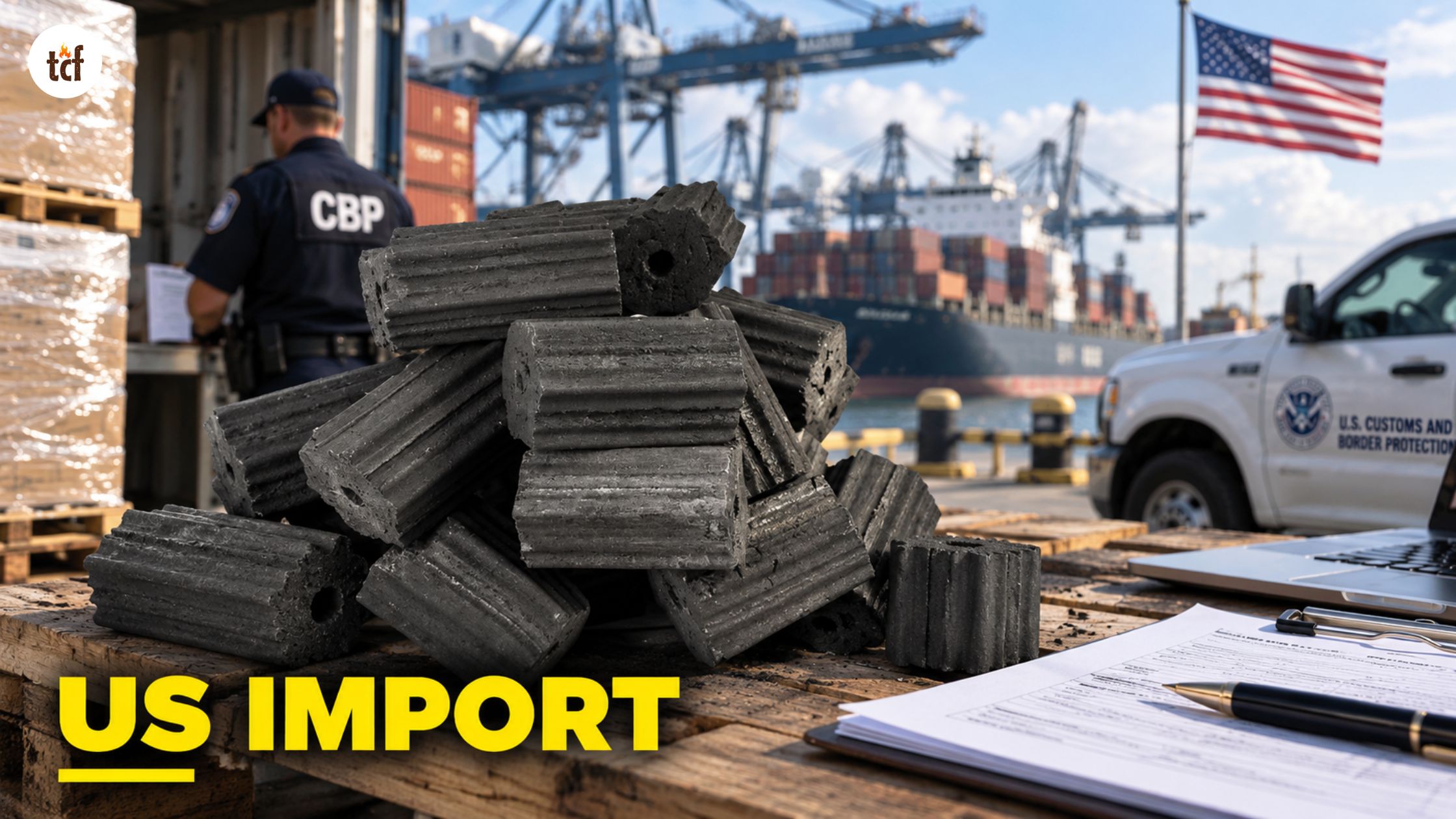
US Charcoal Import Requirements: Charcoal imported into the US is classified under HTS 4402 and generally carries a 0% duty rate from most countries. Clearing customs also requires a Lacey Act declaration for formal entries, since wood charcoal has been on APHIS’s declaration list since 2009.
Here’s the full picture: the correct code, what CBP checks at entry, and every document you need before your shipment reaches a US port.
Table of Contents
What HTS code does charcoal fall under?
All charcoal, regardless of raw material, falls under HTS heading 4402. The 6-digit subheading depends on what it’s made from:
- 4402.10: bamboo charcoal
- 4402.20: coconut shell charcoal
- 4402.90: wood charcoal, including shell or nut charcoal not covered elsewhere, and the catch-all for “other”
A CBP ruling (N306942) specifically classified coconut charcoal briquettes agglomerated with tapioca binder under 4402.90.0000, describing the heading as covering wood charcoal “whether in the form of blocks, sticks, granules, powder, or agglomerated with tar or other substances in briquettes, tablets, balls.”
The first 6 digits are standardized worldwide. The US then adds 4 more digits, for a full 10-digit HTS number, used specifically for duty rate and statistical reporting on entries filed with CBP.
What’s the import duty on charcoal? – US Charcoal Import Requirements
Charcoal under HTS 4402 carries a 0% base duty rate from most trading partners under the standard US tariff schedule. That’s the baseline, not the full picture.
If you’re importing from China, check for Section 301 tariffs, which apply as additional duties layered on top of the base rate for specific Chinese-origin goods. These change periodically, so confirm the current rate against the active HTS revision rather than a number from a prior shipment.
Who is legally responsible for the import?
The Importer of Record (IOR) is legally responsible for the accuracy of every customs declaration, regardless of who physically files the paperwork.
- US companies typically use their EIN (Employer Identification Number)
- Individuals can use a Social Security Number, or apply for a CBP-assigned number
- Foreign entities without a US presence apply for a CBP-assigned number through Form 5106
Step-by-step: how a charcoal shipment clears CBP
Step 1: Classify the product and confirm the HTS code
Use HTS 4402 and the correct subheading for your specific charcoal type. If the classification is genuinely ambiguous, for example, a blended-material briquette, you can request a free CBP Binding Ruling, a written determination that’s legally binding for future entries of that exact product.
Step 2: File the Importer Security Filing (ISF)
For ocean shipments, the ISF, commonly called “10+2,” must be transmitted electronically to CBP at least 24 hours before the cargo is loaded onto the vessel at the foreign port. It requires 10 data elements from the importer (seller, buyer, manufacturer, ship-to party, HTS code, country of origin, and others) and 2 from the carrier.
Missing or late ISF filings carry penalties of up to $10,000 per violation and can trigger a “do not load” order or additional exam scrutiny.
Step 3: Get your bill of lading
Your freight forwarder or carrier issues the bill of lading (ocean) or airway bill (air). This document serves as the contract of carriage and is required to file the formal entry and take possession of the cargo.
Step 4: File the formal entry within 15 days of arrival
Within 15 calendar days of the vessel’s arrival, the importer or their licensed customs broker must file CBP Entry Summary, Form 7501, declaring classification, value, country of origin, and duty calculation.
Step 5: Pay duties and fees
Duties are calculated on declared customs value multiplied by the HTS duty rate, plus:
- Merchandise Processing Fee (MPF): 0.3464% of value, minimum $31.67, maximum $614.35 per formal entry
- Harbor Maintenance Fee (HMF): 0.125% of value on ocean entries
- Any applicable Section 301, 201, or 232 tariffs, or anti-dumping/countervailing duties
Step 6: File the Lacey Act declaration, if applicable
HTS 4402 has required a Lacey Act declaration since Phase III, effective October 1, 2009. If your entry is a formal entry (generally $2,500 or more in value), you must submit a Plant and Plant Product Declaration covering:
- Scientific name (genus and species) of the wood or plant material
- Country where the material was harvested
- Quantity
Filing happens electronically through ACE (Automated Commercial Environment) or through APHIS’s own LAWGS portal, or on paper using PPQ Form 505.
Bamboo charcoal exception: a Lacey Act declaration isn’t required if the bamboo was cultivated, meaning planted specifically for commercial harvest. If it was wild-harvested, or you don’t know, the declaration is required.
De minimis exception: if plant material makes up 5% or less of the total product weight, and the total plant weight across the entry line doesn’t exceed 2.9 kg, you can claim the “G” disclaimer code instead of filing a full declaration. This rarely applies to pure charcoal, since charcoal itself is the plant material, but it matters for charcoal-containing composite products.
Also read – Charcoal Dangerous Goods Shipping
Step 7: Prepare for possible CBP examination
CBP uses risk-based targeting to select shipments for review:
- Document review: paperwork checked, no physical inspection
- Tailgate exam: CBP opens and inspects the container at the port
- Intensive exam (CET): full unloading and inspection, can take several days, with exam fees typically running $800 to $2,500 or more, paid by the importer
Full documentation checklist
| Document | Purpose |
| Commercial invoice | Declared value, HTS code, product description matching the code |
| Packing list | Quantities, weights, and packaging detail per shipment |
| Bill of lading/airway bill | Contract of carriage, required to take possession of cargo |
| Entry Summary (CBP Form 7501) | Formal customs declaration, filed within 15 days of arrival |
| Lacey Act declaration (PPQ 505 or ACE filing) | Required for formal entries under HTS 4402 |
| Certificate of Origin | Confirms country of manufacture for duty and trade program eligibility |
| Certificate of Analysis (COA) | Third-party lab verification of product specs, often requested by buyers |
| MSDS | Safety data sheet, relevant given charcoal’s Dangerous Goods classification |
| Dangerous Goods Declaration | Required for ocean shipments under UN1361, Class 4.2 |
That last one matters more than it used to. Since IMDG Amendment 42-24, charcoal shipped by sea is classified as Dangerous Goods under UN1361, which adds its own weathering, temperature, and packaging documentation on top of the standard CBP paperwork.
Common mistakes that delay charcoal shipments
- Misclassifying the subheading: labeling bamboo charcoal as generic “wood charcoal” under 4402.90 instead of 4402.10 can misalign duty treatment and trigger a classification review.
- Skipping the Lacey Act declaration on formal entries: this isn’t optional paperwork; it’s tied directly to cargo release in ACE.
- Late ISF filing: a 24-hour-before-loading deadline sounds generous until a supplier’s shipping schedule shifts without notice.
- Missing weather and temperature documentation: not a CBP requirement directly, but customs holds tend to cluster around shipments that are already flagged for Dangerous Goods paperwork gaps.
Sourcing documentation that makes this easier
Most of this process runs smoothly when your supplier already tracks species origin, harvest country, and production dates as a standard part of manufacturing, not something assembled after a shipment is booked. Our charcoal manufacturing process page covers how we document raw material sourcing, and our earlier guide to charcoal HS codes breaks down classification in more depth if you’re sourcing multiple charcoal types across different HTS subheadings.
Frequently asked questions
What HTS code should I use for wood charcoal?
4402.90 covers wood charcoal generally, including shell or nut charcoal not classified elsewhere. Bamboo charcoal uses 4402.10, and coconut shell charcoal uses 4402.20.
Is there an import duty on charcoal into the US?
The base rate under HTS 4402 is 0% from most countries. China-origin shipments should be checked against current Section 301 tariff rates, which apply as an addition to the base rate.
Do I need a Lacey Act declaration to import charcoal?
Yes, for formal entries (generally $2,500 or more), since HTS 4402 has been on APHIS’s Lacey Act declaration list since October 2009. You’ll need the scientific name, harvest country, and quantity of the wood or plant material.
What’s the difference between a formal and informal entry?
Formal entries are generally valued at $2,500 or more and require a bond. Informal entries are typically under that threshold and usually don’t require a bond, though some product categories are restricted from informal entry regardless of value.