

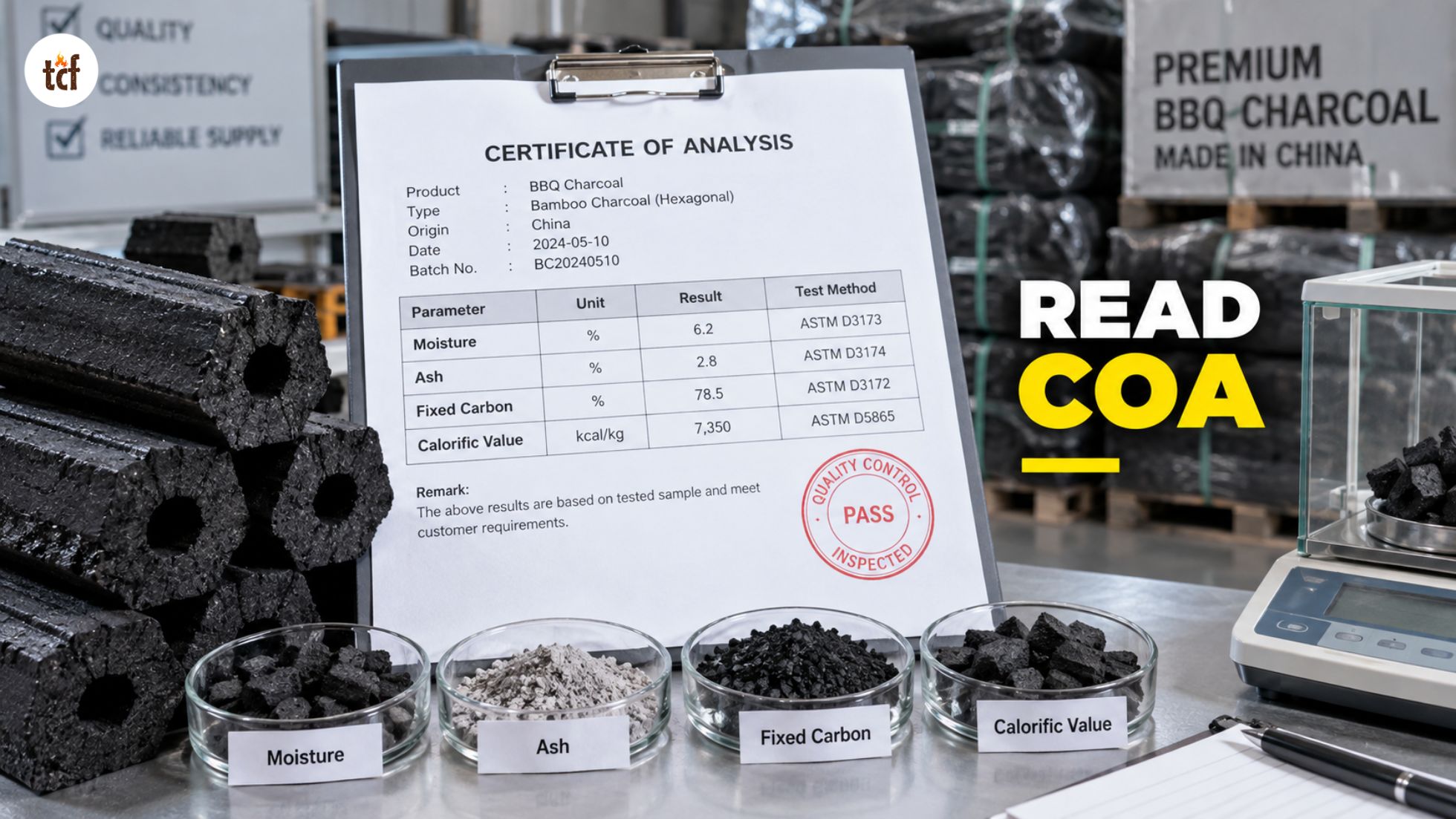
How to read a Certificate of Analysis for charcoal? A Certificate of Analysis (COA) reports 4 core numbers for charcoal: moisture, ash, fixed carbon, and calorific value. Moisture and ash should be as low as the spec allows, fixed carbon should be as high as possible, and the calorific value should match or exceed the contract specification. If any number sits outside the range your supplier quoted you before ordering, that’s your leverage point, not something to sort out after the container’s already at sea.
Here’s how to actually read the document, not just skim the summary line.
Table of Contents
What a COA is, and what it isn’t
A COA is a lab report confirming what’s actually in a specific batch or shipment of charcoal, tested by either the manufacturer’s in-house lab or an independent inspection company. It’s evidence about one batch, tied to a lot number and test date, not a general claim about what the factory is capable of producing under ideal conditions.
If you’re unfamiliar with how COAs fit into the broader inspection process, our guide on pre-shipment inspection (SGS) for charcoal covers who issues them and when.
The 4 numbers, and how they relate to each other
These 4 figures aren’t independent measurements taken in isolation; they’re mathematically connected through what’s called a proximate analysis:
Moisture (%): water content in the sample, measured by drying a weighed sample and recording the weight loss. Higher moisture means you’re paying for water weight and getting a slower, less predictable ignition.
Ash (%): the inorganic residue left after the sample is fully combusted. Ash doesn’t burn; it’s dead weight that reduces airflow and increases cleanup. Lower is better, full stop.
Volatile matter (%): gases released when the sample is heated, not always listed as its own line on every COA, but it’s part of the underlying calculation.
Fixed carbon (%): this is the number that actually drives heat output and burn quality. It’s typically calculated by difference:
Fixed carbon = 100 − moisture − ash − volatile matter
This is why a COA showing high fixed carbon but also high moisture should raise a question: if fixed carbon is calculated by subtracting moisture from 100, an unusually high fixed carbon number paired with high moisture doesn’t add up cleanly, and it’s worth asking the lab or supplier to clarify which basis (as-received vs. dry basis) the numbers are reported on.
Calorific value (kcal/kg or MJ/kg): the actual heat energy released during combustion, measured directly using a bomb calorimeter rather than calculated from the other 3 figures. This is the number that most directly answers “how hot does this actually burn?”
Also read – Restaurant-grade charcoal specifications
A worked example
Here’s what a real coconut shell charcoal COA might report:
| Parameter | Result | Test method |
| Moisture | 4.5% | ASTM D1762 |
| Ash content | 3.2% | ASTM D1762 |
| Fixed carbon | 78% | ASTM D1762 (by difference) |
| Volatile matter | 14.3% | ASTM D1762 |
| Calorific value | 7,800 kcal/kg | ASTM D5865 |
Reading this: moisture is low (good), ash is low (good), fixed carbon at 78% is high for coconut shell charcoal (very good, premium coconut shell product commonly runs 75%+), and calorific value at 7,800 kcal/kg is a strong result, consistent with what you’d expect given the low moisture and ash. The numbers agree with each other, which is itself a signal the report is internally consistent and credible.
What test methods you should actually see referenced
A COA without a stated test method is close to meaningless; it’s a number with no way to verify how it was produced. Look for references to:
- ASTM D1762: the standard method for chemical analysis of wood charcoal, covering moisture, volatile matter, ash, and fixed carbon
- ASTM D5865: standard test method for gross calorific value, typically via bomb calorimeter
- ISO 18122 / ISO 18123 / ISO 18125: the equivalent international standards for ash content, volatile matter, and calorific value respectively, common on COAs from Asian and European labs
If a COA doesn’t cite a method, or cites a method that doesn’t match what’s actually being measured, treat that as a reason to ask questions before treating the numbers as reliable. The FAO’s technical reference on charcoal quality control notes that charcoal testing standards are largely adapted from coal and coke testing methods, with modifications that should be explicitly stated in the analysis report- another reason a method citation matters, not just a results table.
Red flags to watch for
- No lot number or loading date: without this, the COA can’t be tied to your specific shipment; it could be a report from an entirely different batch
- Numbers that don’t reconcile: fixed carbon should roughly equal 100 minus moisture, ash, and volatile matter; if the math is obviously off, ask why
- No stated test method: a number with no method behind it isn’t verifiable
- Results suspiciously close to the exact spec threshold, every time: real lab results have natural variation. A supplier whose COAs always land at exactly 8.0% ash on an 8% maximum spec, batch after batch, is worth a harder look
- A lab you can’t verify: check that the testing lab or inspection company is real and reachable; certificate fraud using real inspection company branding is a documented risk in commodity trade
Also read – Shisha charcoal burn time and heat comparison
How to use this when comparing suppliers
Don’t just compare headline fixed carbon numbers between 2 suppliers’ COAs. Check:
- Whether the results are reported on the same basis (as-received vs. dry basis), comparing mismatched bases isn’t a fair comparison
- Whether both labs used the same test method; ASTM and ISO methods can produce slightly different results for the same material
- Whether the COA is tied to an actual shipment lot, or a general product spec sheet dressed up to look like a batch-specific report
Our guide on charcoal grades covers how these same numbers map to A, B, and C grade classifications, useful once you’re comfortable reading the raw figures and want to translate them into a purchasing decision. Our ash content and moisture specs guide goes deeper on what ideal ranges look like for different end uses.
Putting COA requirements into your contract
A COA is only useful if you’ve actually required one, at the right frequency, before you agreed to buy. Our guide on bulk charcoal supply contracts covers how to write a quality clause that requires a COA per shipment, not just the first sample order, with a defined tolerance band and a resolution path if a batch falls outside it.
Frequently asked questions
What’s a good fixed carbon percentage for charcoal?
It depends on the material. Premium coconut shell charcoal commonly runs 75% or higher, while wood charcoal grades are often benchmarked slightly lower, around 72% or higher for A-grade product. Compare within the same raw material type, not across different charcoal types.
Why do moisture and ash matter if fixed carbon is high?
Because fixed carbon is calculated by subtracting moisture, ash, and volatile matter from 100. High moisture or ash can only be offset by a genuinely strong sample, and both directly hurt real-world burn performance regardless of what the fixed carbon percentage shows.
What test method should a legitimate charcoal COA reference?
Commonly ASTM D1762 for proximate analysis (moisture, ash, volatile matter, fixed carbon) and ASTM D5865 for calorific value, or the equivalent ISO 18122/18123/18125 series. A COA with no stated method is difficult to verify.
Can I trust a COA a new supplier sends me?
Verify it independently where possible, confirm the lot number matches your actual shipment, and don’t hesitate to request a fresh third-party inspection rather than relying solely on the supplier’s own lab report, especially for a first order.