



How to Test the Moisture Content of BBQ Charcoal? You can screen BBQ charcoal for moisture in about 3 seconds by tapping two pieces together, breaking one open and comparing its weight with a known dry piece. To get an actual moisture percentage, weigh a sample, dry it in an oven at 105°C and weigh it again.
The quick checks tell you whether charcoal is probably dry or probably wet. The oven test tells you the number you can put in a contract or compare against a lab report.
Key takeaways
- Quick checks screen, they don’t measure. Sound, fracture and feel catch obviously damp charcoal in seconds.
- Pin moisture meters mislead on charcoal. They are built for wood, and well-fired charcoal conducts electricity on its own.
- The oven-dry test is the accurate method. It follows the same principle as ASTM D1762: moisture is the weight lost at 105°C.
- Agree on a number in writing. Moisture limits differ by product and buyer, so put yours on the purchase order.
- Dry at the factory is not dry on arrival. Charcoal absorbs moisture in storage and transit, so test on receipt too.
Table of Contents
What are the 3-second checks for wet charcoal?
Five checks each take a few seconds and need no equipment. Use them together, because each one alone can be fooled.
- Check the bag first. Look for condensation on the inside of the bag, damp patches on cartons, or fines that have clumped together. Any of these means moisture got in after packing.
- Tap two pieces together. Dry, well-carbonized charcoal gives a clear, almost metallic ring. Damp charcoal gives a dull thud. A dull sound can also mean under-carbonized charcoal, so treat it as a warning, not a diagnosis.
- Break a piece open. A dry piece snaps cleanly and shows an even, glossy black surface. A damp piece crumbles or feels soft, and the inside may look darker than the outside.
- Feel and compare weight. Damp charcoal feels cool and slightly clammy and leaves wet-looking dust on your fingers. Compare weight only against a known dry piece of the same product and size. A heavier piece of the same size is likely holding water.
- Light a test piece. Dry charcoal catches evenly. Damp charcoal is slow to catch, may hiss or crackle, and can give off visible steam before it settles into a glow.
These checks are good for a warehouse floor or a sample box. They will not tell you whether a lot is at 6% or 10% moisture. For that, you need the oven test below.
The tap and fracture checks also reveal carbonization quality, which affects burn time as much as moisture does. Our guide to bamboo charcoal quality covers those checks in more detail.
Do moisture meters work on charcoal?
Not reliably. Handheld pin moisture meters are designed for wood, and charcoal does not behave like wood electrically.
A pin meter passes a small current between its two pins and measures the resistance. It relies on the fact that water conducts electricity while dry wood does not, so less resistance means more moisture (Bessemeter).
Charcoal breaks that assumption. As carbonization temperature rises, charcoal itself becomes a conductor. Research on carbonized plant material found its electrical conductivity rose by three orders of magnitude as the carbonization temperature went from 600 to 900°C (ScienceDirect).
In practice, this means:
- Well-fired charcoal can read as wet because the carbon is carrying the current, not the water.
- Readings can’t be compared across products. A low-temperature charcoal and a high-temperature charcoal at the same moisture can give very different numbers.
- The meter’s wood settings don’t apply. Species corrections are calibrated for wood, not carbon.
We have not found a published study testing wood moisture meters on charcoal, so treat a meter reading as unverified until you have checked it against an oven test on the same sample. If you already own a meter, the most it can do is flag a change between batches of the same product.
How do you measure charcoal moisture accurately?
Weigh a sample, dry it at 105°C until its weight stops changing, and weigh it again. The weight lost is the water. This is the same principle used in ASTM D1762, the standard test method for wood charcoal, which determines moisture as the loss in weight in a drying oven at 105°C (ASTM).
You need a digital scale that reads to 0.1 g, an oven that holds a steady low temperature, a metal tray and an airtight container or zip bag.
- Take a representative sample. Pick pieces from several bags, not just the top of one. Break them into pieces of roughly 1 to 2 cm.
- Weigh the tray empty, then add at least 100 g of charcoal and weigh again. The difference is your starting weight, A.
- Dry at 105°C for 2 hours. Set the oven to 105 to 110°C (220 to 230°F). Higher temperatures can start to drive off other compounds and overstate the moisture.
- Cool in a sealed container. Dry charcoal pulls moisture from the air quickly, so let it cool in an airtight box or zip bag before weighing.
- Weigh again. This is the dry weight, B.
- Check it is fully dry. Return the sample to the oven for another hour and reweigh. If the weight changes by less than about 0.1%, it is done. If not, repeat.
- Calculate the moisture.
Moisture % = (A − B) ÷ A × 100
For example, if 200.0 g of charcoal weighs 187.0 g after drying, it lost 13.0 g of water. That is 13.0 ÷ 200.0 × 100 = 6.5% moisture.
Two safety notes. Charcoal at 105°C is far below its ignition temperature, but keep the oven door closed and don’t leave it unattended. Never use a microwave: charcoal conducts electricity and can arc and catch fire.
For contract disputes or export documentation, send samples to an accredited third-party laboratory, which will report moisture alongside ash, volatile matter and fixed carbon.
How much moisture is acceptable in BBQ charcoal?
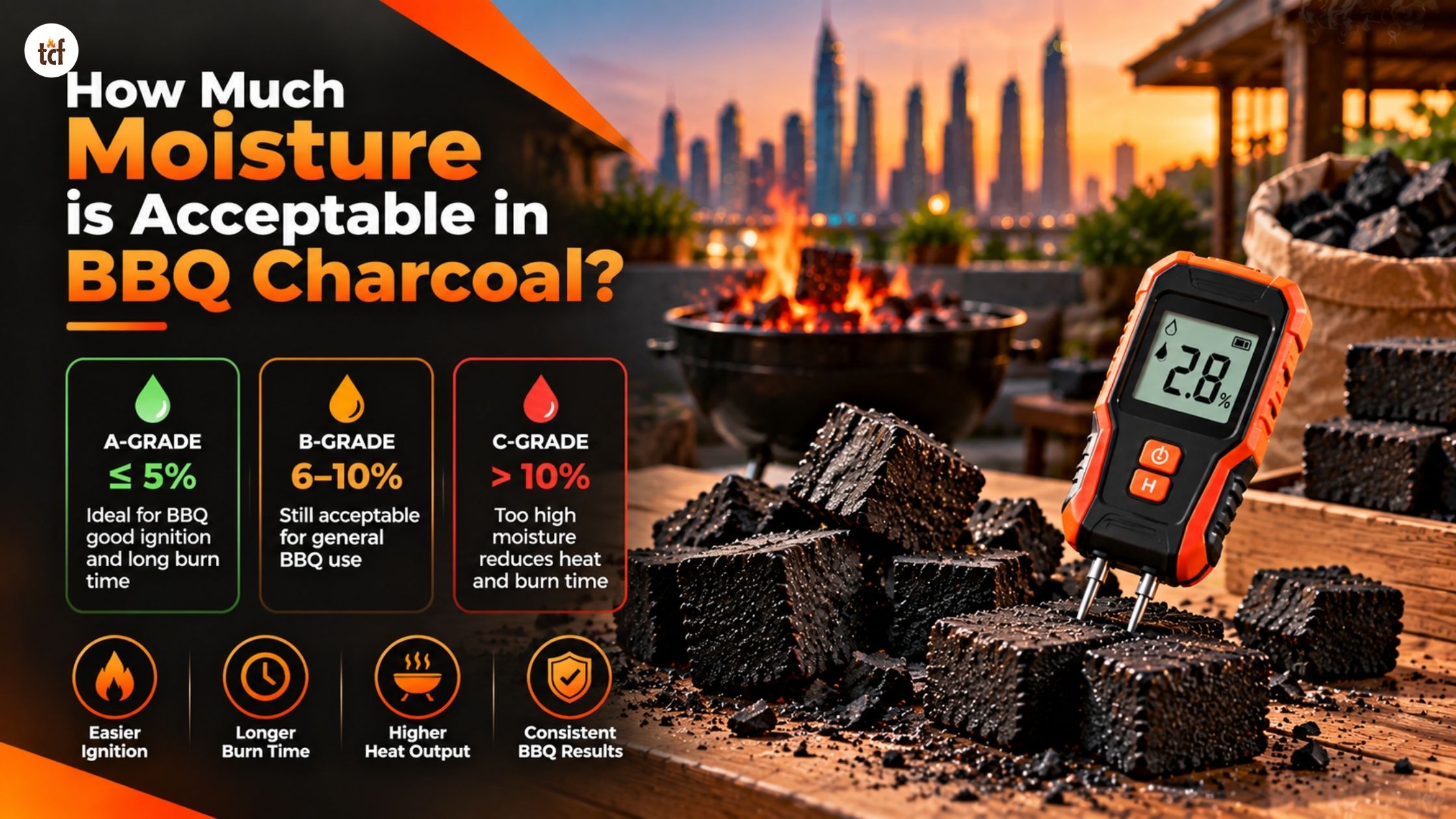
There is no single global limit, so the right number is the one you agree with your supplier and write into the purchase order. Commercial specifications for BBQ charcoal commonly ask for moisture below about 8%, and some buyers ask for lower. Ask the supplier for the moisture result on the lab report for your batch, and check it against your agreed limit.
National standards give a sense of the range. China’s former bamboo charcoal standard, GB/T 26913-2011, set moisture at 12% or less for qualified-grade bamboo charcoal. It was withdrawn on 1 March 2026 and replaced by GB/T 26913-2025, which also replaced the separate standard for fuel bamboo charcoal (SAMR). If you buy against a Chinese standard, ask the supplier to quote the 2025 version.
What higher moisture costs you on the grill:
- Slower lighting. Heat goes into boiling off water before the charcoal can glow.
- More smoke, hissing and sparking during the first part of the burn.
- Less heat per kilogram. You are paying freight and duty on water.
- Cracking and more fines, as trapped water expands when heated.
When you set a limit, also state where it is measured: at loading in the factory, or on arrival at your warehouse. The two numbers can differ, as the next section explains.
Also read –
Best Material for Making Charcoal
Quick Light Vs Natural Coconut Charcoal
Why does dry charcoal arrive damp?
Charcoal is porous and absorbs moisture from the air, so a batch that tested dry at the factory can pick up water before it reaches you. The usual causes are:
- Humid storage before packing or after unloading, especially in tropical ports.
- Torn or unsealed bags that let humid air reach the charcoal.
- Rain on bags left outdoors before loading.
- Condensation inside the container, as temperatures swing between day and night during the voyage.
Wet charcoal is also a safety issue, not only a quality one. When charcoal absorbs water it releases heat, and the CINS shipping guidelines warn that this can speed up self-heating in a container. They advise against thermal liners for the same reason, because they trap condensation (CINS). Our guide to shipping charcoal in containers covers the packing rules.
How should you sample a container for moisture?
Moisture is rarely even across a container. Bags near the doors, on the floor and against the walls tend to be the first to pick up condensation, so sample from all of them.
A practical approach:
- Pick bags from at least five positions: door end, middle and back of the container, from both the top and bottom layers.
- Run the quick checks on each bag as you open it, and note any damp patches or clumped fines.
- Take a sample from each bag and run the oven test separately, so a single wet zone isn’t hidden in an average.
- Photograph the bags and record the results with the container number and date.
- Compare with the factory’s loading report. If moisture rose in transit, the cause is storage or shipping, not production.
If you find a problem, these records are what a supplier or insurer will ask for. For the documents to request before shipment, see our charcoal supplier verification checklist.
Order charcoal that arrives dry
The Charcoal Factory produces bamboo charcoal in Anhui Province, China, for distributors, brands and retailers. Moisture and the other key parameters for each batch are shown on its lab test reports, available on request.
Request samples and run the oven test yourself before you order. See our bulk charcoal page, read how charcoal is manufactured, or compare raw materials in the best material for making charcoal. Email info@thecharcoalfactory.com for samples.
Frequently Asked Questions – How to Test the Moisture Content of BBQ Charcoal
Can you dry out damp charcoal?
Yes, if it is only damp rather than soaked. Spread it out in a dry, ventilated, covered space for a few days and recheck. Charcoal that was soaked often cracks and crumbles once dry, so it may not recover its original quality.
Does wet charcoal go bad?
Charcoal does not rot, but moisture makes it slower to light, smokier and weaker on heat. Briquettes bound with starch can also soften and fall apart if they get wet.
Is moisture the same as ash or volatile matter?
No. Moisture is water that evaporates at 105°C. Volatile matter is released at much higher temperatures, and ash is the mineral residue left after burning. A full lab report lists all three, plus fixed carbon.
How should charcoal be stored to stay dry?
Keep bags sealed, off the floor on pallets, away from walls and under cover, in a ventilated space. Use older stock first.