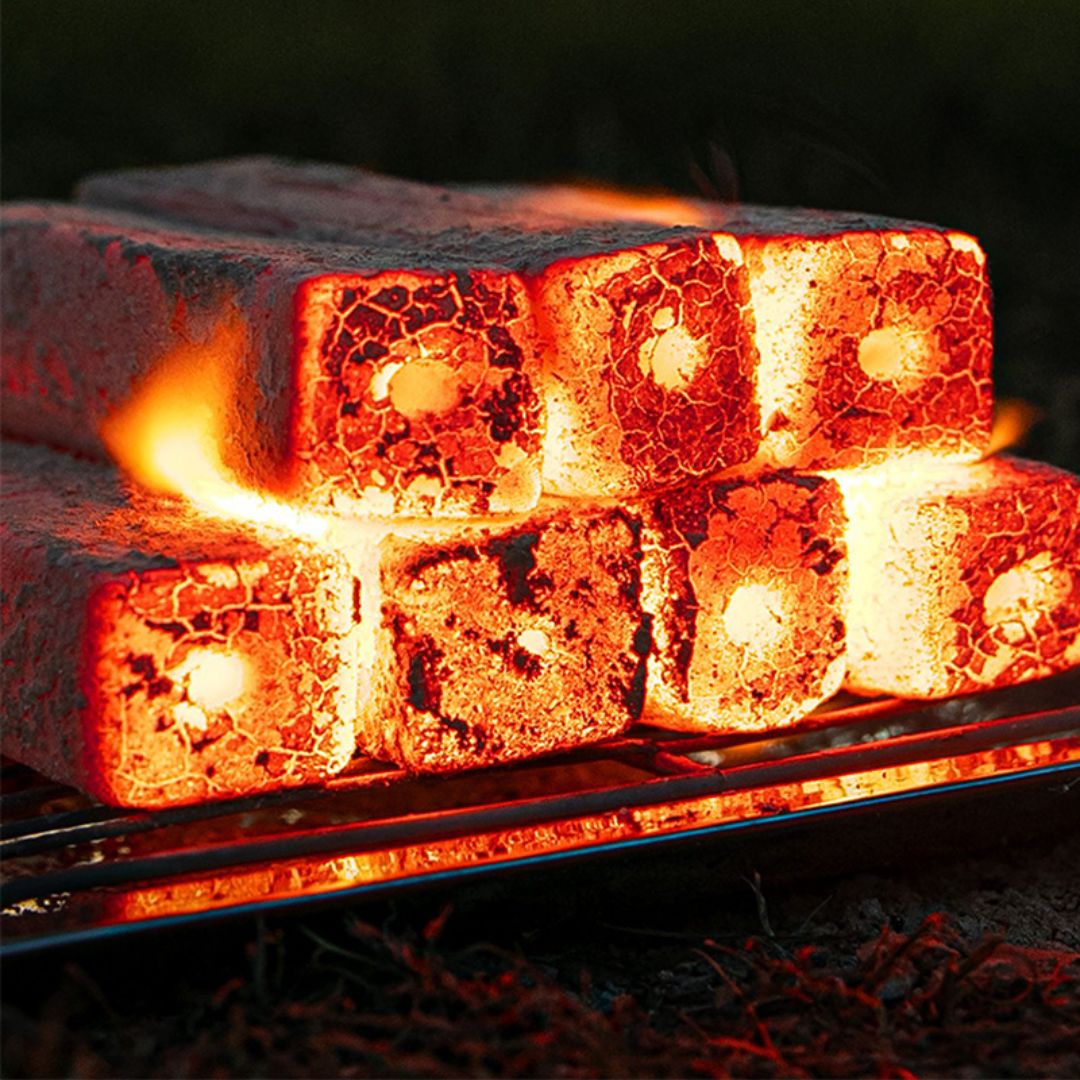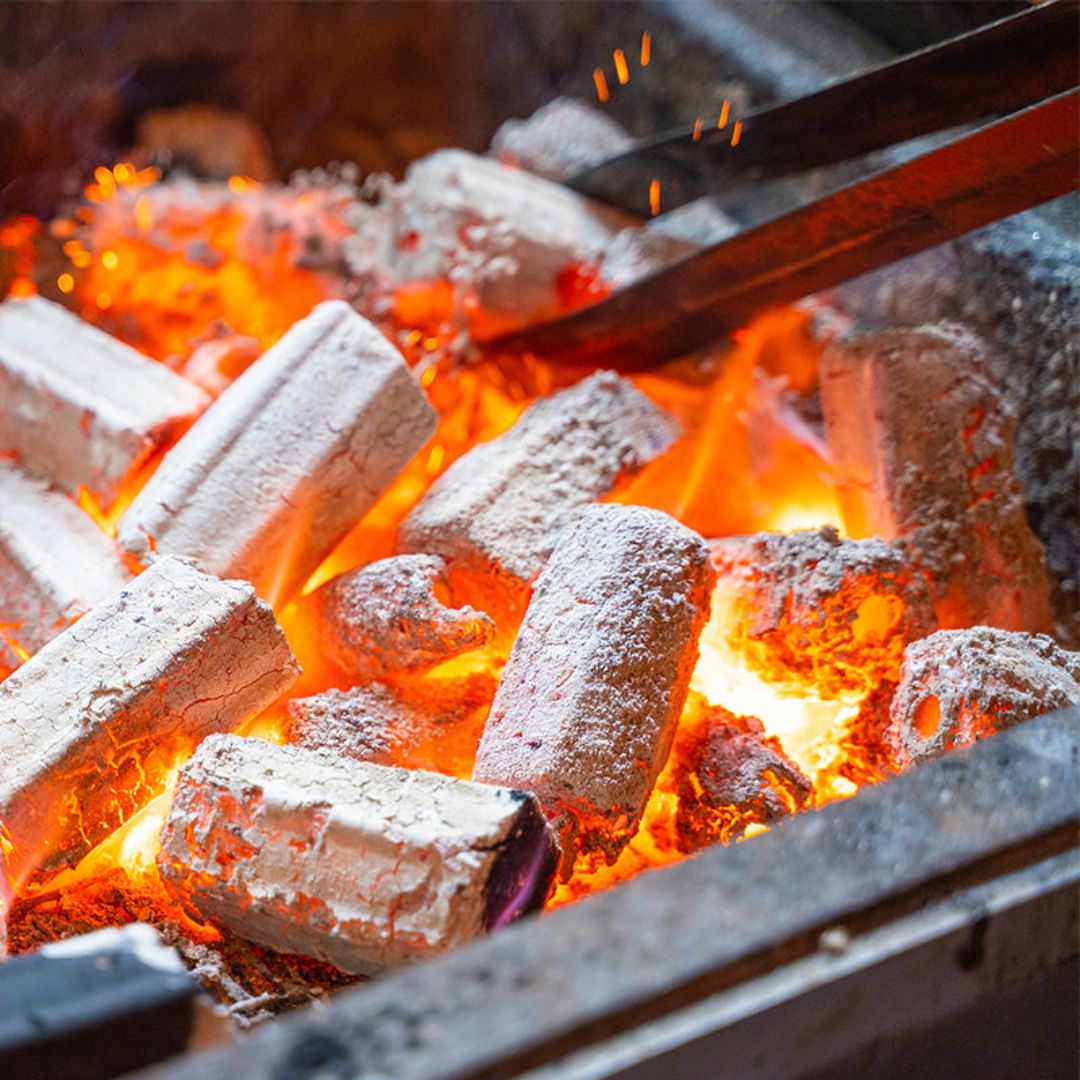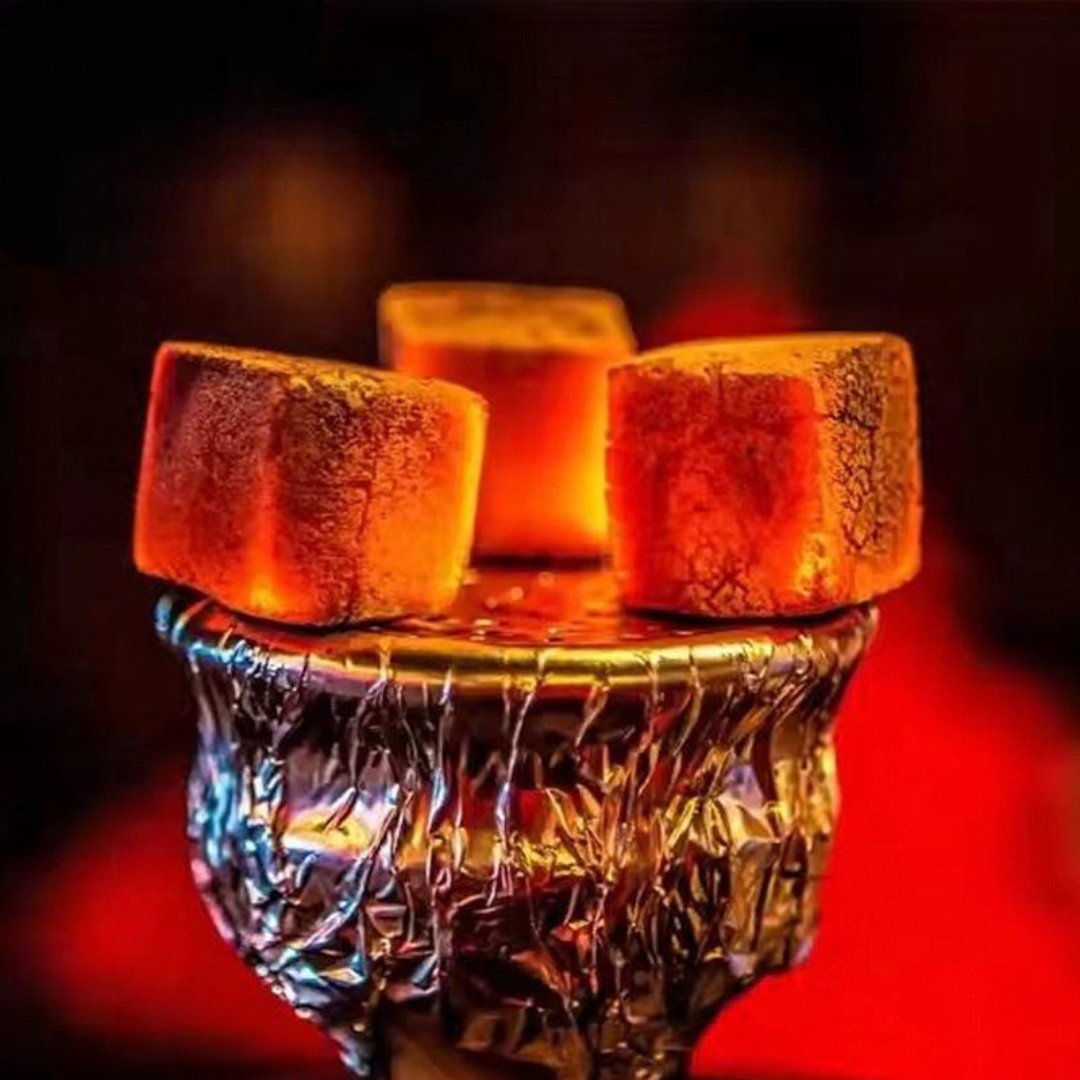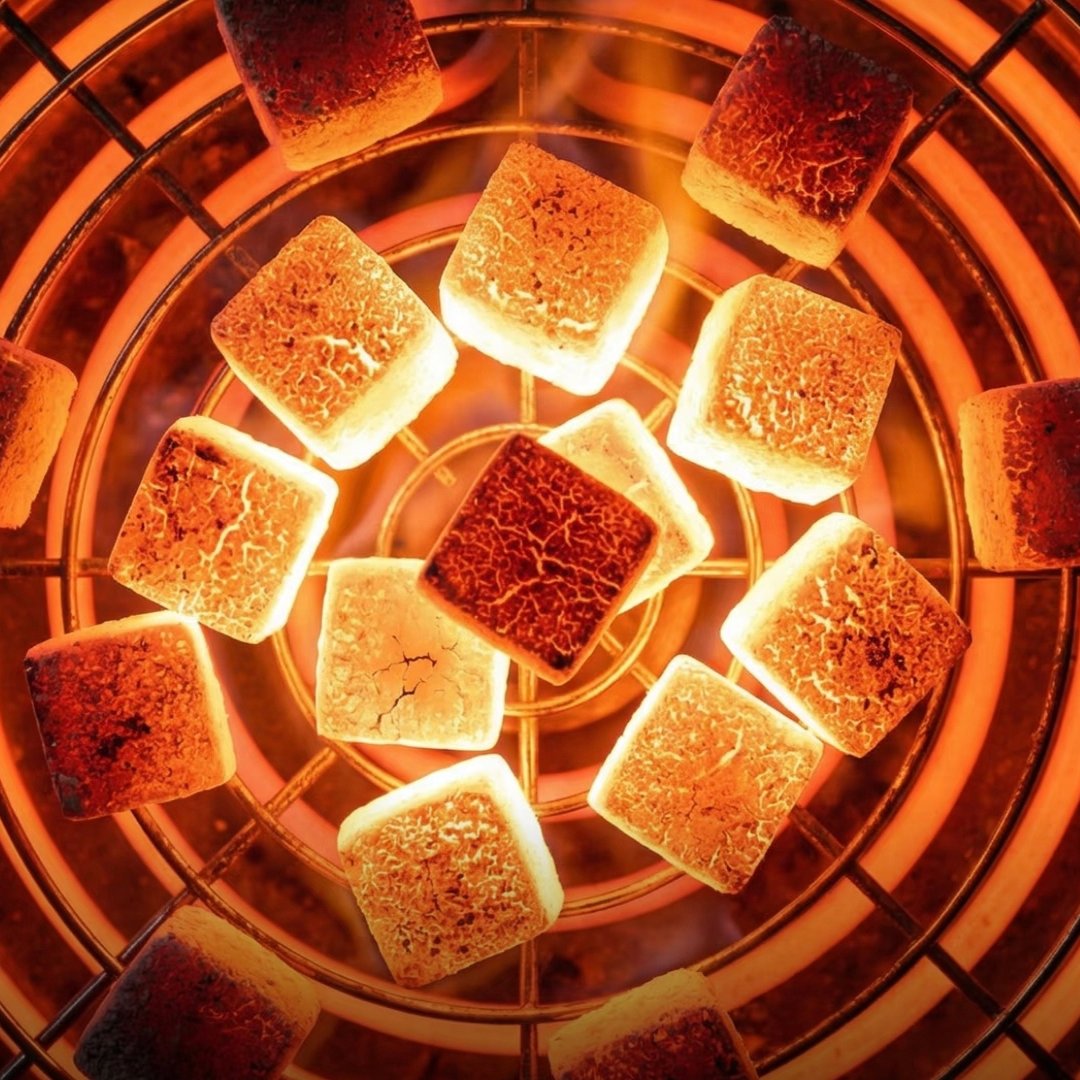




Hookah Charcoal vs BBQ Charcoal: Hookah charcoal and BBQ charcoal are not interchangeable. Hookah charcoal is made to burn cleanly, without taste or sparks, inside a small closed bowl, while BBQ charcoal is made to give strong heat that the cook can raise or lower with airflow.
Both are carbon, and some are made from the same raw materials. The difference is in how they are shaped, bound, carbonized, and tested, because each is built for a different job.
Key takeaways
- Different jobs, different design. Hookah charcoal must be invisible to the smoker; BBQ charcoal must respond to the cook.
- Ash, smoke and sparks matter far more in a bowl than on a grill.
- BBQ charcoal in a hookah is a firm no. Hookah coals on a grill are possible but rarely worth the cost.
- “Dual-purpose” claims need a spec sheet. The same raw material does not mean the same product.
- EN 1860-2:2023 covers BBQ charcoal only. For hookah charcoal, ask for a full lab report instead.
- Keep the two lines separate, with their own specs, SKUs and marketing.
Table of Contents
What is each charcoal designed to do?
A hookah bowl is a small, closed space directly under the smoker’s nose. Anything the coal gives off, whether smoke, smell or ash, ends up in what the smoker inhales. So hookah charcoal is designed to be neutral: steady heat, no taste, as little ash as possible and no sparks.
A grill is the opposite: open, fed with air and adjusted constantly. The cook wants to control the fire, opening the vents to sear and closing them to smoke slowly. So BBQ charcoal is designed to be responsive, and some smoke and wood aroma are welcome.
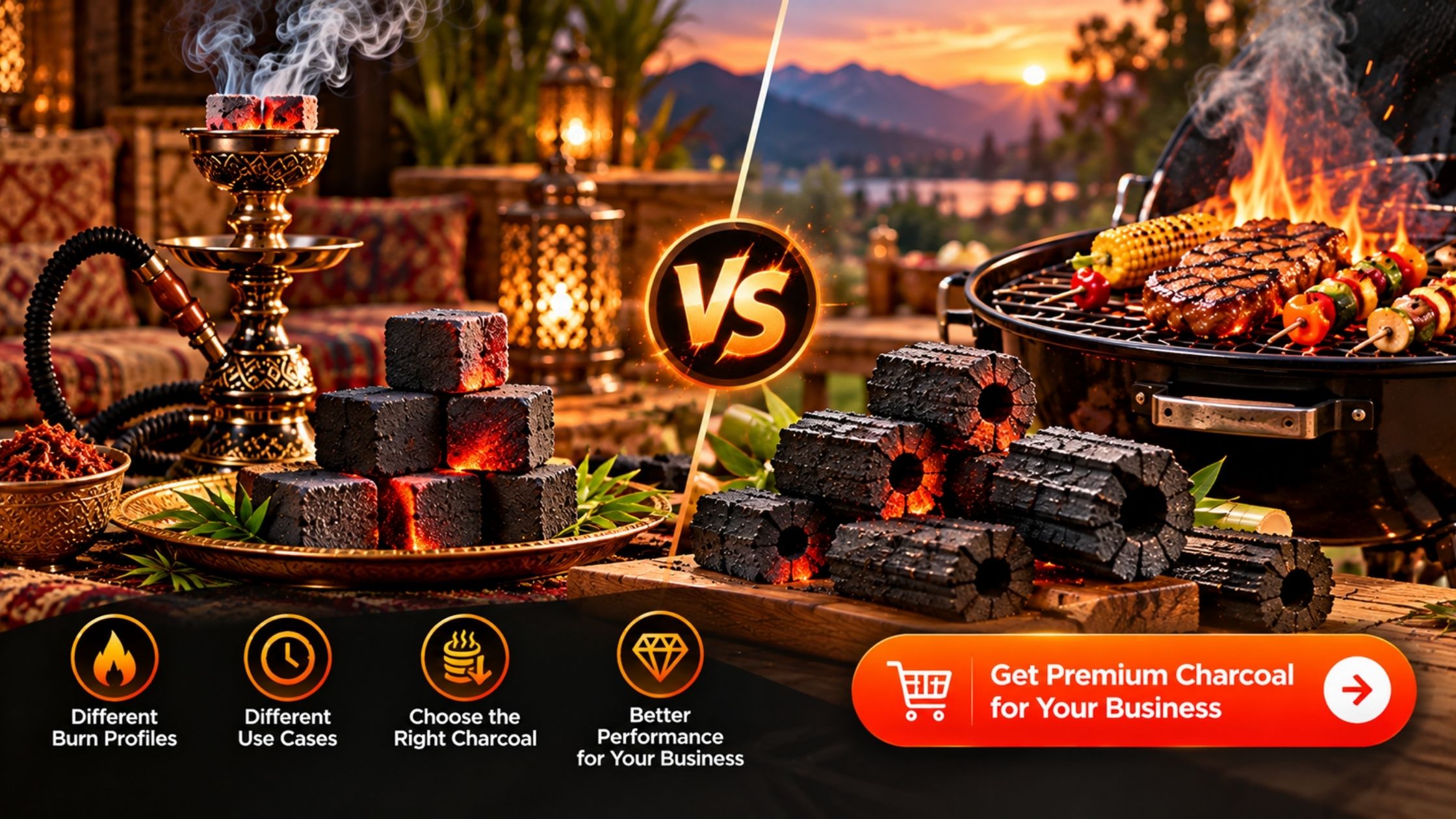
How do hookah charcoal vs BBQ charcoal compare?
| Hookah charcoal | BBQ briquettes | BBQ lump charcoal | |
| Raw material | Coconut shell or bamboo, pressed with a food-grade binder or extruded | Charcoal fines or sawdust, pressed with a binder | Natural hardwood pieces |
| Shape | Small, uniform cubes, flats or shaped pieces sized for a bowl | Uniform pillows, hexagons or cylinders | Irregular lumps |
| How it lights | Burner or coil lighter (natural); hand lighter (quick-light) | Chimney starter recommended | Lights fastest of the three |
| Heat control | Fixed; managed by moving the coal | Steady, adjusted with vents | Wide range, reacts quickly to vents |
| Ash | Kept as low as possible | Higher; binders and fillers add ash | Usually low |
| Smoke and taste | Neutral by design | Some smoke on lighting | Wood aroma is part of the appeal |
| Sparks | Must be spark-free | Acceptable outdoors | Common outdoors |
| Standard that applies | Not covered by EN 1860-2; buy on lab report | EN 1860-2:2023 in Europe | EN 1860-2:2023 in Europe |
Uniform size matters in both, but for different reasons. A hookah coal needs the same mass every time so each session starts the same. A briquette needs the same density so a bed of them burns down evenly over a long cook.
Why do ash, smoke and sparks matter so differently?
The three things a hookah coal must avoid are things a grill can live with.
| Why hookah charcoal must avoid it | Why BBQ charcoal can live with it | |
| Ash | Ash drops through the foil or heat device into the bowl and spoils the flavour | Ash falls into the tray below the grate and is thrown away |
| Smoke and aroma | Any wood or binder smell overpowers flavoured tobacco | Wood smoke is part of the flavour grillers want |
| Sparks | Coals are handled with tongs over furniture, carpets and guests | Sparks stay inside an outdoor firebox |
Neither product is better made than the other. They are tuned in opposite directions, and that is why one cannot quietly replace the other.
Can you swap hookah charcoal and BBQ charcoal?
| Swap | Verdict | Why |
| Hookah charcoal on a grill | Possible, rarely sensible | It works for a small tabletop grill or a few skewers. For a full cook, the small pieces pack tightly and restrict airflow, and you pay a shisha price for BBQ fuel |
| BBQ briquettes in a hookah | No | Binder and filler smell in the smoke, heavy ash in the bowl, and a risk of sparks near guests |
| BBQ lump in a hookah | No | Strong wood smoke and irregular shapes that will not glow evenly on a bowl |
| Quick-light shisha discs on a grill | No | The ignition coating adds smell and the discs burn out quickly |
For lounges deciding between natural and quick-light coals, see our guide to quick-light vs natural coconut charcoal.
One safety point applies to both. All burning charcoal gives off carbon monoxide, which has no smell. BBQ charcoal belongs outdoors, and hookah lounges need proper ventilation and CO alarms.
Also read – Best Charcoal for Heating
What about “dual-purpose” coconut or bamboo briquettes?
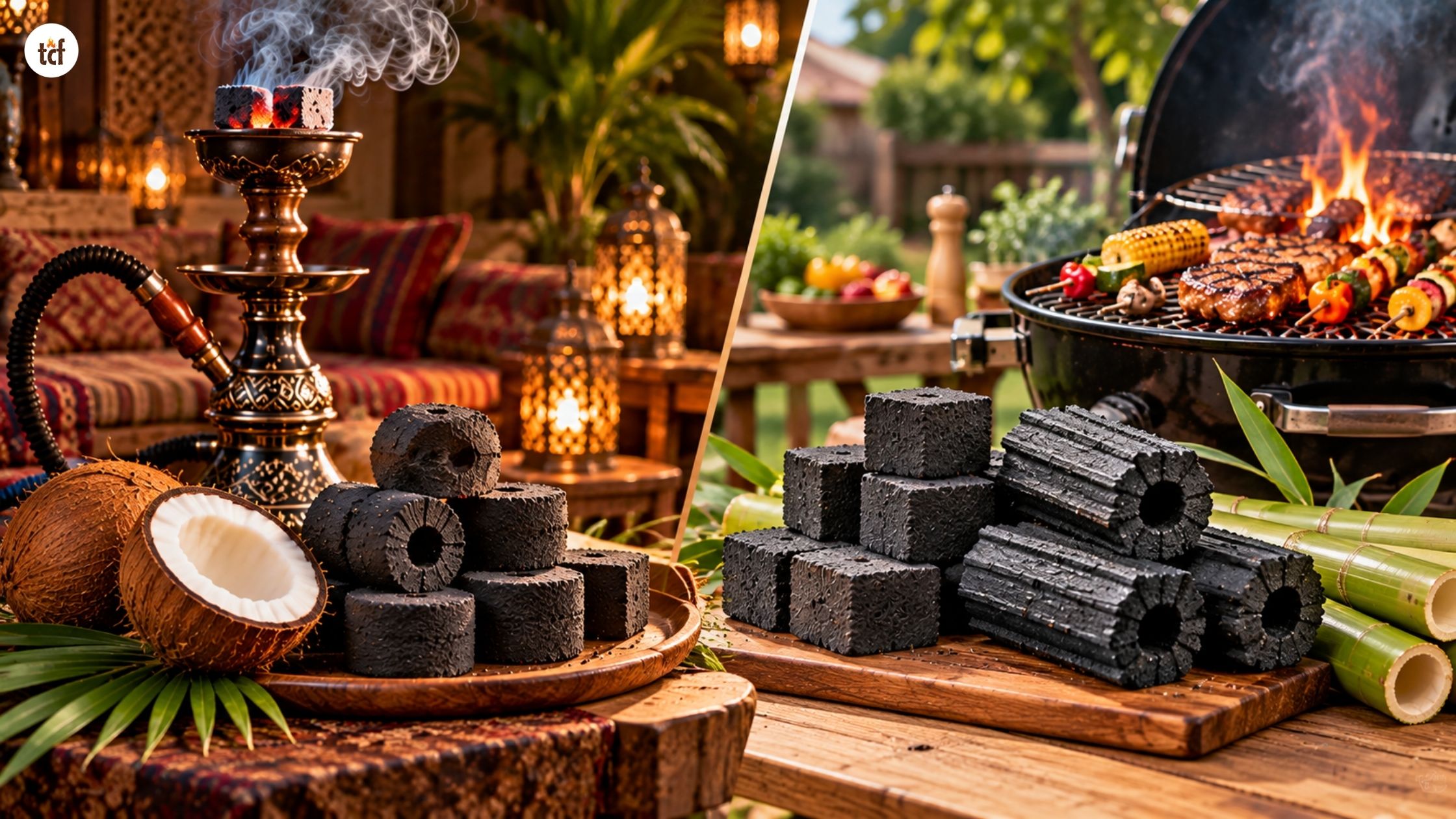
Treat any “works for both” claim as a raw-material claim, not a product claim. BBQ-grade coconut or bamboo briquettes are usually larger and may be blended with wood powder. Shisha-grade coals are small, uniform and made with a food-grade binder or none at all. Same material, different product.
Before accepting a dual-purpose claim, ask the supplier for:
- Ash, fixed carbon, moisture and volatile matter from a lab report, for each product.
- A binder declaration naming what holds the coal together.
- The size and shape tolerance, since shisha coals must fit a bowl and heat device.
- Whether any ignition additive is used.
If the supplier can’t answer, the claim is marketing.
Which standards apply to hookah and BBQ charcoal?
In Europe, barbecue charcoal and briquettes are covered by EN 1860-2:2023, which replaced the 2005 edition (iTeh Standards). It sets different limits for the two BBQ formats:
| EN 1860-2:2023 | Lump charcoal | Briquettes |
| Fixed carbon (dry basis) | At least 75% | At least 60% |
| Ash | No more than 8% | No more than 18% |
A certificate is not proof that every bag meets it. In December 2025, the European Commission reported that many charcoal barbecue products tested fall short of the standard on composition and emissions. Briquettes in that research tended to have more ash and to give off more carbon monoxide than lump charcoal (European Commission).
EN 1860-2 is written for barbecue fuel, so it says nothing about hookah charcoal. A supplier offering an EN 1860-2 certificate for a shisha order is answering the wrong question. For hookah charcoal, request a batch lab report covering ash, fixed carbon, moisture and volatile matter. Calorific value is useful for comparing heat output between suppliers, and some markets also ask for heavy metals testing, so check what your importer or regulator requires.
Is hookah charcoal always made from coconut?
No. Coconut shell is the best-known raw material for hookah coals, but bamboo makes good shisha charcoal too. Both carbonize into dense, low-ash carbon that burns without a strong smell.
The Charcoal Factory’s hookah range includes both:
- Bamboo shisha charcoal, in shaped and machine-made forms, such as our Low Ash Shaped Bamboo Shisha Charcoal and Machine-Made Bamboo Shisha Charcoal.
- Machine-made shisha charcoal for clean, sustained heat.
- Quick-light shisha charcoal for terraces, events and backup use.
See the full range on our hookah charcoal page. For how coconut and bamboo compare as raw materials, read the best material for making charcoal.
Our BBQ range is built separately, with machine-made and shaped bamboo charcoal for grilling. See our BBQ charcoal page.
Which charcoal should you buy for your market?
Decide what your customers burn before you decide what to import.
| Buyer | What to buy | What to check first |
| Middle East lounges and wholesalers | Natural coconut or bamboo shisha coals | Ash, smell, durability in transit and batch-to-batch consistency |
| European and North American BBQ retail | Lump charcoal and briquettes as two separate lines | EN 1860-2:2023 conformity, moisture on arrival and retail-ready packaging |
| Western hookah lounges | Natural shisha coals with full documentation | A batch lab report, not an EN 1860-2 certificate |
| Traders carrying both | Both lines, kept strictly apart | Separate SKUs, spec sheets and marketing so the two are never confused |
For grilling buyers choosing between fuels by cooking style, see our guide to the best charcoal for grilling. For lump specifications by grade, see bulk lump charcoal.
Source both lines from one factory
The Charcoal Factory makes shisha charcoal and BBQ charcoal as separate lines, each with its own specification and private-label packaging. Both lines can go in the same container, subject to the shipping line’s approval, so check this with your forwarder before booking. EN 1860-2:2023 test data is available on request for BBQ shipments to Europe.
Browse our hookah charcoal and BBQ charcoal ranges, see our wholesale bamboo charcoal, or email info@thecharcoalfactory.com with your market and order size for samples and specifications.
Frequently asked questions
Can I use hookah charcoal for grilling?
Yes, on a small tabletop grill for a few skewers. For a full grill, it packs too tightly for good airflow and costs far more than BBQ charcoal for the same job.
Can I use BBQ charcoal in a hookah?
No. BBQ charcoal adds smoke and binder smell to the session, leaves heavy ash in the bowl and can spark near guests.
Which burns hotter, hookah coals or BBQ charcoal?
It depends on what you measure. A single hookah coal runs very hot for its size, but an open grill bed fed with air can match or exceed it. What really differs is control: a grill’s heat can be turned up and down, a hookah coal’s cannot.
Why does hookah charcoal produce less ash?
It is made from low-mineral raw materials such as coconut shell or bamboo, with little or no binder, and it is tested for ash because ash in the bowl spoils the flavour.
Is bamboo charcoal good for hookah?
Yes, when it is made for shisha. Bamboo shisha charcoal is dense and low in ash, and is shaped to sit on a bowl. BBQ bamboo charcoal rods are a different product and should not be used in a hookah.