

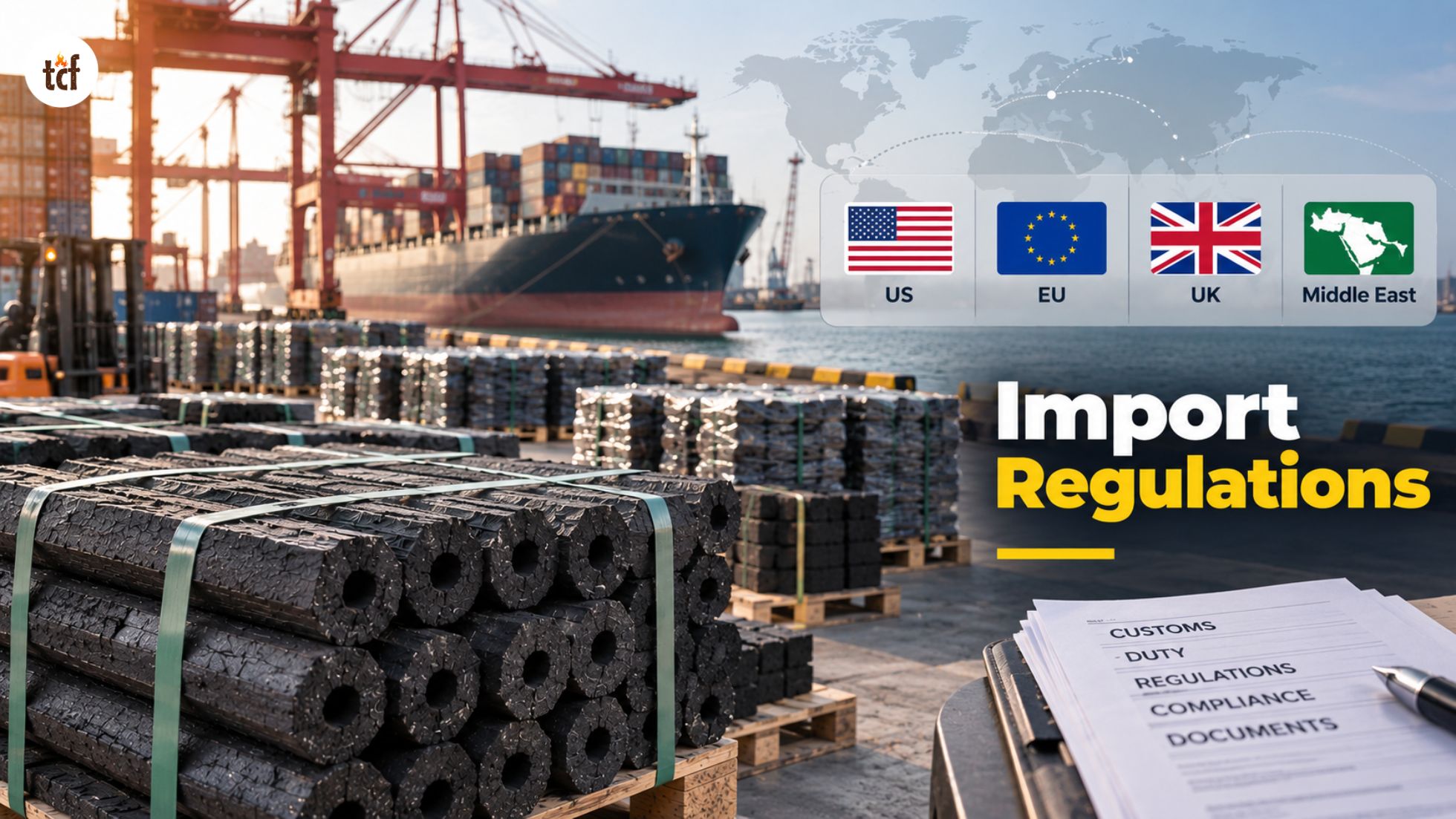
Charcoal Import Regulations by Country: Every major market classifies charcoal under HS heading 4402 with a 0% base duty, but that’s where the similarity ends. The US adds Section 301 tariffs on Chinese-origin charcoal that can push effective duty above 35%. The EU requires deforestation due diligence under EUDR from December 2026. The UK currently exempts charcoal from its equivalent forest-risk framework. The Middle East applies a flat 5% duty regardless of origin. And both the EU and UK have an outright ban on charcoal from Somalia, tied to international sanctions, not trade policy.
Here’s how the 4 major markets actually compare: customs codes, sustainability rules, dangerous goods requirements, and restricted-origin rules.
Table of Contents
Quick Comparison – Charcoal Import Regulations by Country
| United States | European Union | United Kingdom | Middle East (GCC) | |
| HS/customs code | HTS 4402 (10-digit) | CN 4402 (10-digit TARIC) | HS 4402 (10-digit) | HS 4402 |
| Base duty rate | 0% | 0% | 0% | 5% (all origins) |
| China-specific tariffs | Section 301, can exceed 35% effective | None | None | None |
| Deforestation/legality due diligence | Lacey Act declaration (since 2009) | EUDR, mandatory from Dec 30, 2026 | Not currently in scope under Environment Act 2021 | Not formalized |
| Product safety standard | None federally mandated | EN 1860-2 (BBQ charcoal) | Same EN 1860-2 basis, enforced via UKCA/product regs | Not standardized |
| Dangerous Goods classification (sea freight) | UN1361, Class 4.2, mandatory | UN1361, Class 4.2, mandatory | UN1361, Class 4.2, mandatory | UN1361, Class 4.2, mandatory |
| Sanctioned origin | Somalia (UN-based restrictions) | Somalia, explicit legal prohibition | Somalia, explicit legal prohibition | Follows UN sanctions framework |
United States
Charcoal enters under HTS 4402 at a 0% base duty from most countries. The complication is Chinese-origin product, which can carry Section 301 tariffs on top of the base rate, pushing effective duty well above 35% for List 3-affected goods.
The US also requires a Lacey Act Plant and Plant Product Declaration for formal entries, a requirement that’s been in place since Phase III enforcement began in October 2009, not a recent addition. This covers the scientific name, harvest country, and quantity of the wood or plant material.
For the full entry process, ISF filing, Form 7501, MPF and HMF calculations, and Lacey Act declaration details, our US charcoal import requirements guide covers the complete step-by-step process.
Also read – Bamboo charcoal vs. wood charcoal vs. coconut shell charcoal
European Union
The EU classifies charcoal under CN 4402, using a 10-digit TARIC code, with a 0% MFN duty rate for most origins. Countries eligible under the EU’s Generalised Scheme of Preferences can also qualify for 0% with a valid origin declaration.
What sets the EU apart is the regulatory stack layered on top of customs classification: the EU Deforestation Regulation (EUDR), which brings HS 4402 under mandatory due diligence obligations from December 30, 2026 for large and medium operators, and EN 1860-2, the European product safety standard for BBQ charcoal covering fixed carbon, ash, moisture, particle size, and labeling requirements. Non-compliant EUDR shipments risk market refusal or fines starting at 4% of annual turnover.
Our charcoal import regulations in Europe guide covers all 5 EU regulatory layers, customs, EUDR, EN 1860-2, packaging, and IMDG Dangerous Goods requirements, in full detail.
United Kingdom
Post-Brexit, the UK runs its own tariff schedule independently of the EU. Charcoal under HS 4402 carries a 0% duty under the UK Global Tariff, but a 20% import VAT applies on the CIF-plus-charges value; VAT-registered businesses can recover this through Postponed VAT Accounting, limiting the real cost impact to the duty rate itself, which for charcoal is zero.
Here’s the notable gap: while the UK’s Environment Act 2021 introduced its own forest-risk commodity due diligence framework, similar in spirit to the EU’s EUDR, charcoal has not been brought into scope under that framework. Unlike the EU, where HS 4402 sits explicitly inside EUDR’s Annex I, UK importers currently face no equivalent legal requirement to demonstrate deforestation-free sourcing for charcoal specifically. This has drawn criticism from environmental groups, given that a meaningful share of UK charcoal imports originate from higher deforestation-risk countries. Buyers should monitor UK government guidance directly, since scope can change.
Preferential origin also matters more than it might seem: countries sourced under the UK’s Developing Countries Trading Scheme (DCTS) currently benefit from reduced or 0% duty, but scheduled graduations (Indonesia is set to graduate from DCTS on January 1, 2027) will shift some coconut charcoal imports onto standard MFN rates going forward.
Middle East (GCC)
Gulf Cooperation Council states, Saudi Arabia, UAE, Qatar, Kuwait, Bahrain, and Oman, apply a flat 5% customs duty on charcoal under HS 4402, applied uniformly regardless of country of origin, including China. There’s no equivalent to the US’s Section 301 mechanism creating origin-based cost differences here.
The Middle East is also, by volume, one of the largest charcoal import markets globally, driven almost entirely by shisha and hookah demand rather than BBQ or industrial use. Sustainability or deforestation-linked due diligence requirements are less formalized in this region compared to the EU, though buyers supplying larger retail or hospitality chains increasingly request FSC documentation voluntarily, even where it isn’t a legal requirement.
Restricted origin: the Somalia charcoal ban
This is the piece most import guides miss entirely. Both the EU and UK have an explicit legal prohibition on importing charcoal that originates in or has been exported from Somalia, along with related bans on purchasing, transporting, financing, or insuring such shipments. Under UK law (Sanctions Regulations, Part 5, Chapter 5), this is a criminal offence, though a defence exists if the person genuinely didn’t know and had no reasonable cause to suspect Somali origin. The EU’s equivalent restriction traces back to the same underlying UN Security Council framework, put in place specifically to cut off a funding source linked to al-Shabaab.
This matters practically for buyers sourcing from East Africa or through consolidators handling multi-origin African charcoal: verifying actual country of harvest and export, not just the shipping origin on the bill of lading, is a real compliance requirement, not a formality. Transshipment through a third country doesn’t change the underlying legal restriction if the charcoal itself originated in Somalia.
Phytosanitary requirements: often requested, rarely mandatory
Charcoal is a carbonized, processed product, and the pyrolysis process itself typically eliminates the pest and pathogen risk that phytosanitary certificates exist to address. Despite this, phytosanitary certificates are still commonly issued and requested as standard practice across most export markets, more a matter of customs officer familiarity and importer expectation than a strict legal necessity in every jurisdiction.
Confirm with your specific destination country whether a phytosanitary certificate is a hard requirement or a commonly-requested convenience document; requirements vary by country and can change, so this isn’t something to assume based on a prior shipment’s paperwork.
Dangerous Goods: the one requirement that’s identical everywhere
Regardless of destination, charcoal shipped by sea is classified as UN1361, Class 4.2 (spontaneously combustible) under the IMDG Code, and this classification is now mandatory globally as of the January 2026 enforcement date, not something that varies by importing country. Our charcoal dangerous goods shipping guide covers the weathering, packaging, and documentation requirements this triggers, regardless of which of these 4 markets you’re importing into.
Sourcing across multiple markets
If you’re supplying distributors or retail buyers across several of these regions at once, our charcoal supplier verification checklist covers the documentation to request upfront so you’re not scrambling to meet a specific market’s requirements after a shipment is already booked. Our charcoal distributor and importer supply page covers our current export documentation standard, including phytosanitary certificates issued per shipment and additional certification available for buyers entering regulated markets.
This article is for general informational purposes and isn’t a substitute for advice from a licensed customs broker or trade compliance specialist. Duty rates, sanctions lists, and regulatory scope change; confirm current requirements against official government sources before finalizing an import.
Frequently asked questions
Does charcoal have the same HS code in every country?
The first 6 digits (4402, with subheadings .10 bamboo, .20 coconut shell, .90 wood) are internationally standardized. Countries then extend to their own digit length, 10 digits in the US, EU, and UK. Always use the destination country’s full code length on declarations.
Which market has the highest effective duty on charcoal?
The US, specifically for Chinese-origin charcoal subject to Section 301 tariffs, where effective duty can exceed 35%. The base 0% rate under HTS 4402 only applies cleanly to non-Section-301 origins.
Is charcoal subject to deforestation due diligence in every market?
No. The EU’s EUDR brings charcoal into scope from December 2026. The UK’s comparable framework currently does not cover charcoal specifically. The US relies on the Lacey Act, a different mechanism with its own scope and declaration requirements. The Middle East has no equivalent formal requirement at present.
Can I import charcoal from Somalia into the EU or UK?
No. Both jurisdictions have an explicit legal prohibition on importing, purchasing, or transporting charcoal that originates in or was exported from Somalia, tied to international sanctions. This applies regardless of how the shipment is routed.