


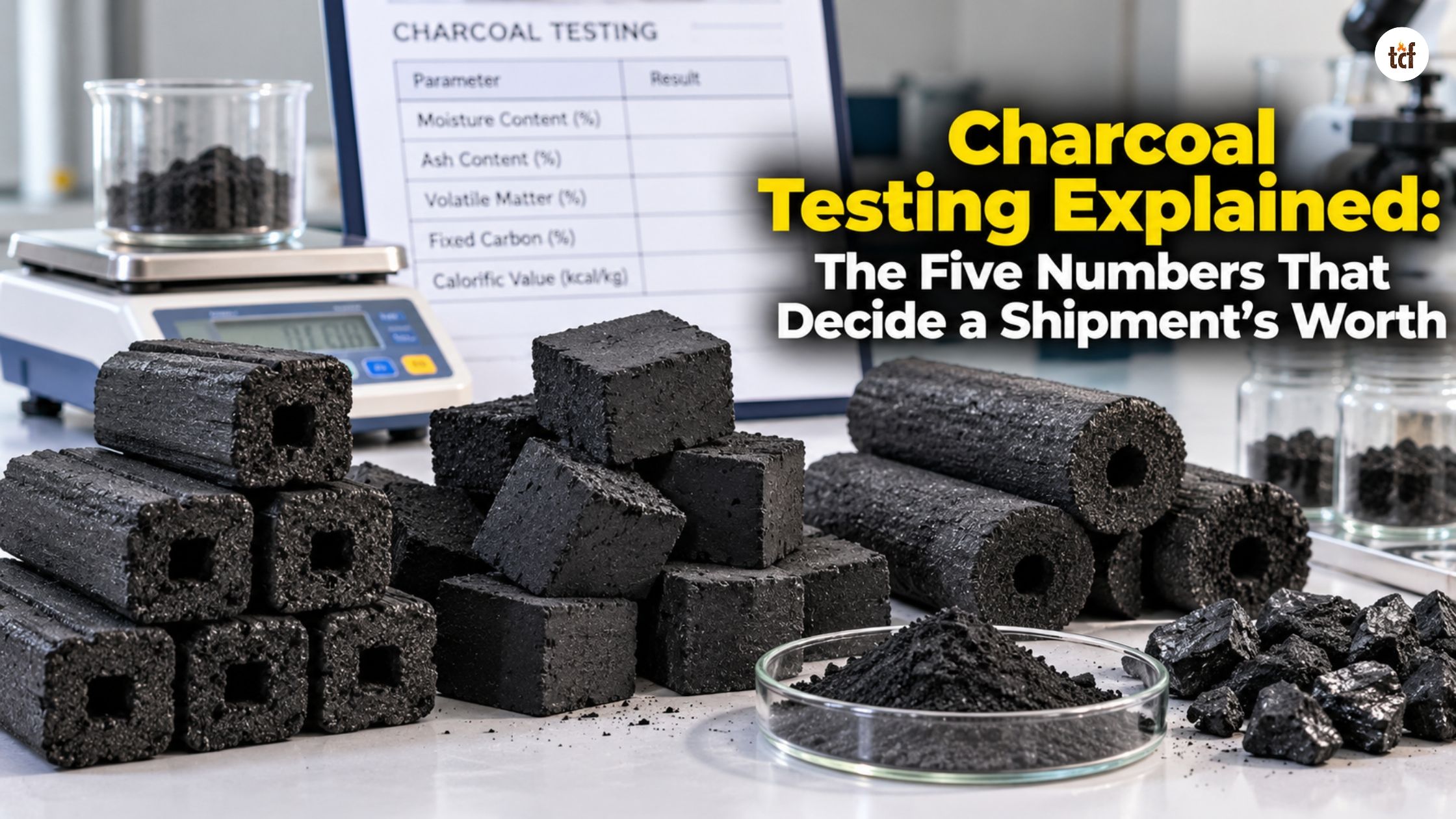
Charcoal Testing Explained: Charcoal testing comes down to five numbers: moisture, ash, volatile matter, fixed carbon and calorific value. Together they tell you how much usable heat you are buying per ton, how much of what you pay for is water or mineral residue, and how the charcoal will behave for your customers.
The price per ton on a quotation is only half the picture. Two offers that look close on price can be far apart once you convert the test results into heat per dollar.
Key takeaways
- Moisture is water you pay freight and duty on, and it lowers usable heat.
- Ash is mineral residue: no heat, more cleaning, more complaints.
- Volatile matter decides smoke and flare-ups; high levels suit few buyers.
- Fixed carbon is the part that burns as steady heat.
- Calorific value is the heat per kilogram, and the best single number for comparing offers.
- Compare offers by cost per unit of heat, on the same test basis, not by price per ton alone.
Table of Contents
What does charcoal testing measure?
Most charcoal testing is a proximate analysis plus a calorific value test. ASTM D1762, the standard test method for wood charcoal, covers moisture, volatile matter and ash; fixed carbon is then calculated as what is left (ASTM).
| Number | What it measures | Higher means | Effect on a shipment’s worth |
| Moisture | Water in the charcoal | Slower lighting, less heat | You pay to ship water |
| Ash | Mineral residue after burning | More cleaning, weaker airflow | Dead weight with no heat |
| Volatile matter | Gases released as smoke | More smoke and flare-ups | Lower value for restaurants and shisha |
| Fixed carbon | Carbon that burns as glowing heat | Longer, steadier heat | The core of what you are buying |
| Calorific value | Heat released per kilogram | More heat per ton | The best single measure of value |
On the same basis, moisture, volatile matter, ash and fixed carbon add up to 100%. That means you can’t improve one without another changing: lower ash and volatile matter leave more room for fixed carbon.
Always check the basis. Dry-basis figures exclude moisture and look better than as-received figures for the same charcoal. In Europe, EN 1860-2:2023 sets its barbecue charcoal limits on a dry basis (iTeh Standards).
What is each number worth?
1. Moisture: you pay to ship water
Every percentage point of moisture is water you pay for at the factory price, then again in freight and duty. Wet charcoal also has to boil off that water before it gives useful heat, so customers see slow lighting and smoke. Moisture can also rise in transit, so agree whether the limit applies at loading or on arrival; see how to test the moisture content of BBQ charcoal.
2. Ash: dead weight that costs twice
Ash doesn’t burn, so it is weight with no heat value. It also costs your customers: more cleaning, ash blowing onto food, and a fire that cools as ash smothers the coals. For shisha charcoal, ash falling into the bowl affects flavor directly. EN 1860-2:2023 allows up to 8% ash for lump charcoal and 18% for briquettes, which shows how wide the range in the market can be.
3. Volatile matter: decides who will buy it
Volatile matter burns off as smoke and flame. High levels make charcoal light faster but smoke more and flare up when fat drips. Restaurants, table-grill venues and shisha buyers usually want it low, so high volatile matter narrows your market.
4. Fixed carbon: the heat you are actually buying
Fixed carbon is what glows steadily after the volatiles have burned off. Higher fixed carbon generally means longer, more even heat. EN 1860-2:2023 sets a minimum of 75% for lump charcoal and 60% for briquettes, on a dry basis.
5. Calorific value: the number that ties it together
Calorific value measures the total heat released per kilogram, usually in MJ/kg or kcal/kg. Because it reflects the combined effect of fixed carbon, volatile matter and ash, it is the most useful single number for comparing value between offers. Check whether it is reported as gross or net, and on which basis.
For what each figure typically looks like by grade, see charcoal ash content and moisture specs and charcoal grades explained.
How do you compare two offers using test results?
Convert each offer into cost per unit of heat. A simple version:
- Take the dry-basis calorific value and adjust it for moisture: as-received heat = dry calorific value × (1 − moisture).
- Convert to gigajoules per ton (MJ/kg is the same number as GJ/t).
- Divide the price per ton by the GJ per ton.
This simplified method ignores the extra heat needed to evaporate the water, so it slightly favors wetter charcoal. Real differences are a little larger than shown.
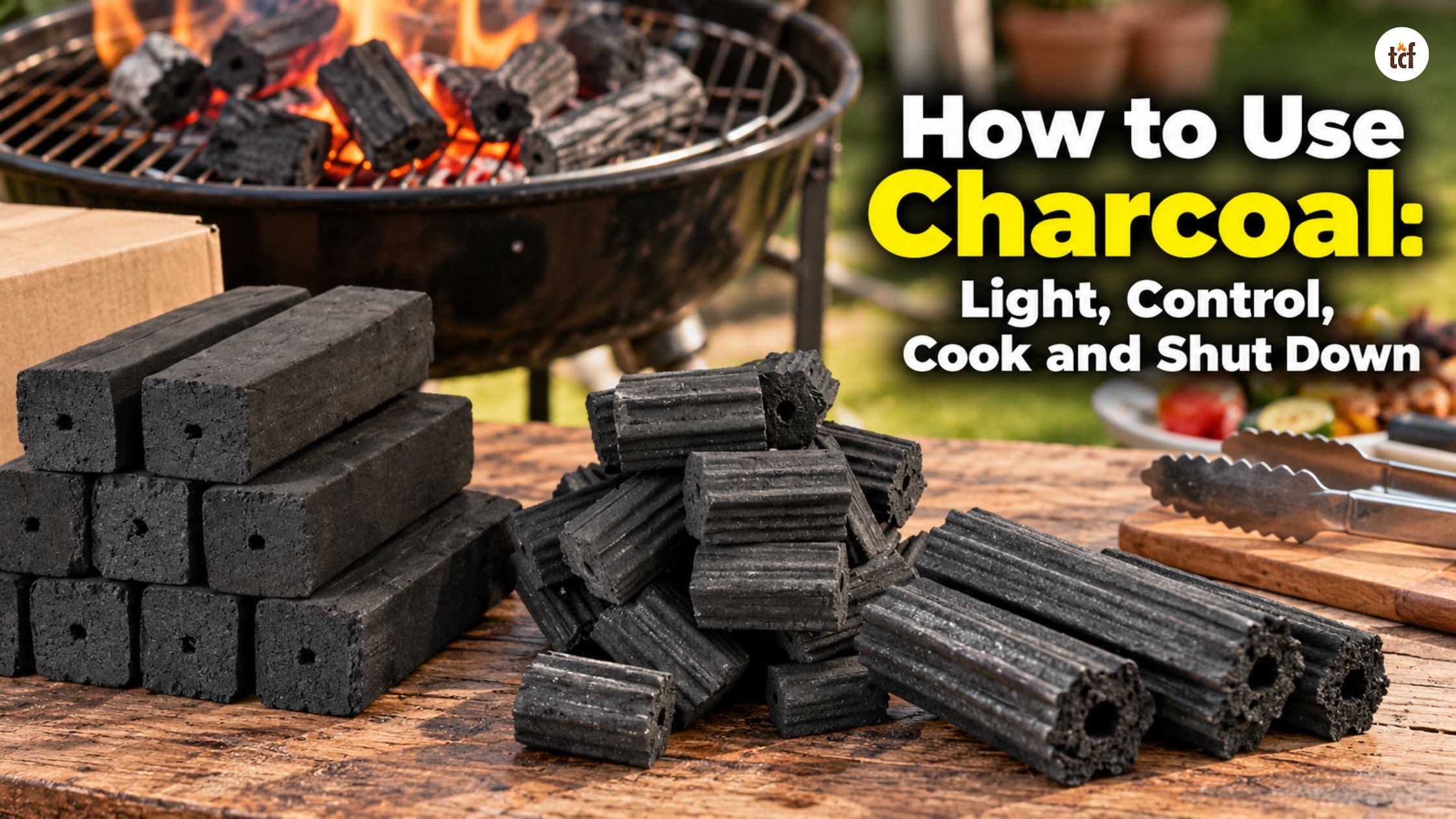
Also read – How to Use Charcoal
Worked example (illustrative figures)
| Offer A | Offer B | |
| Price per ton | $480 | $440 |
| Moisture | 6% | 12% |
| Ash | 3% | 8% |
| Calorific value, dry basis | 30 MJ/kg | 27 MJ/kg |
| Heat as received | 28.2 GJ/t | 23.8 GJ/t |
| Cost per GJ | $17.02 | $18.52 |
| With $100/t freight and duty added | $20.57 per GJ | $22.73 per GJ |
Offer B is about 8% cheaper per ton but about 9% more expensive per unit of heat, and the gap widens to about 10% once freight and duty are added, because you are shipping more water and ash. It also has more ash for your customers to deal with.
Use your own landed costs and the real test results. The point is the method: compare heat per dollar, not price per ton.
How should charcoal testing fit into your purchase process?
The five numbers only protect you if they are measured properly and written into the contract.
- Set limits for all five numbers in the purchase order, not just the two that look best on the supplier’s sheet.
- Fix the basis and method, for example dry basis using ASTM D1762 for the proximate analysis, so results from different labs can be compared.
- Sample properly. Take samples from several bags across the batch, not one bag from the top of the pile.
- Test at the right points. A batch lab report before loading, and a moisture check on arrival.
- Use an accredited lab for first orders and disputes; supplier in-house results are fine for routine checks with a trusted supplier.
- Agree a tolerance and a remedy, such as a price adjustment per point of excess ash or moisture.
- Keep retained samples from each batch for re-testing if there is a dispute.
For how to check that a lab report is genuine and complete, see how to read a certificate of analysis for charcoal. For typical spec ranges, see charcoal quality specifications.
Frequently asked questions – Charcoal Testing Explained
What is the most important number in charcoal testing?
For comparing value, calorific value adjusted for moisture. For customer satisfaction, ash and volatile matter matter most, because they decide cleaning, smoke and flavor.
What standard is used for charcoal testing?
ASTM D1762 is widely used for moisture, volatile matter and ash in charcoal, with fixed carbon calculated from them. In Europe, barbecue charcoal is assessed against EN 1860-2:2023.
Why do two labs give different results for the same charcoal?
Usually because of different sampling, test methods or reporting basis. Agree all three in advance.
Is a high fixed carbon figure always better?
Generally yes for fuel, but check it alongside ash and moisture on the same basis. A high figure on a dry basis can look better than a slightly lower as-received figure from another supplier.
How much does charcoal testing cost?
It depends on the lab and the tests requested. A basic proximate analysis costs far less than a single container problem, so it is worth doing on every first order.