

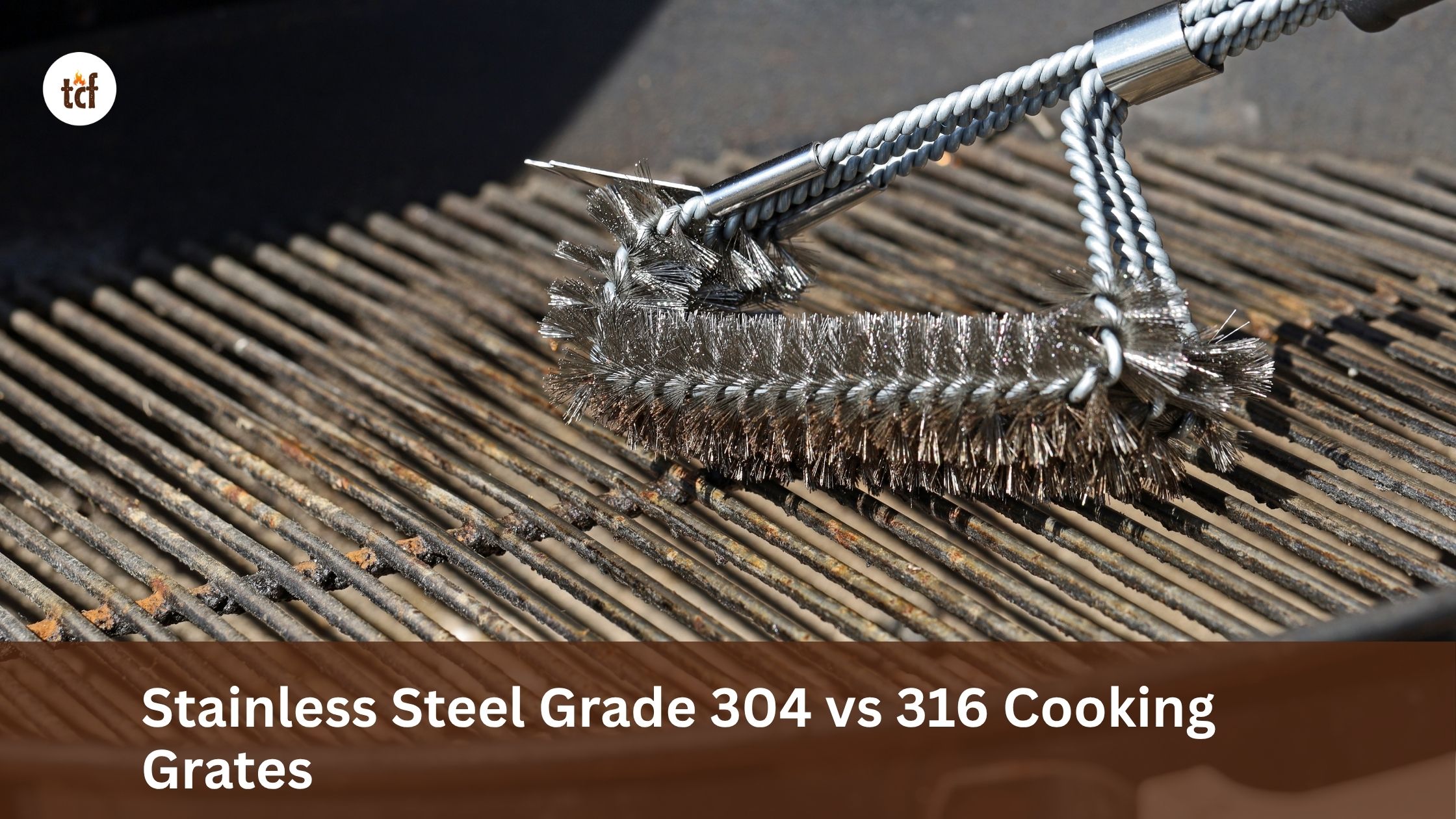
Stainless Steel Grade 304 vs 316 Cooking Grates: Grade 316 stainless steel cooking grates outlast Grade 304 in chloride-heavy environments because of one element: molybdenum. The 2 to 3% molybdenum content in 316 raises its pitting resistance index from approximately 18 to 20 (Grade 304) to 24 to 28, giving it the ability to handle chloride concentrations up to 2,000 ppm before pitting begins, compared to Grade 304’s threshold of around 100 ppm. For most inland buyers, 304 is sufficient. For coastal installations, 316 is a meaningfully different material in the conditions that matter most.
Table of Contents
What Actually Separates Stainless Steel Grade 304 vs 316 Cooking Grates?
Both grades are austenitic stainless steels from the 300-series family. Both form the same corrosion-resistant passive film, which is a thin, self-repairing layer of chromium oxide that blocks moisture and oxygen from reaching the base metal. The difference is what happens when that film is attacked by chloride ions.
Grade 304 contains 18 to 20% chromium and 8 to 10.5% nickel, with no molybdenum. Grade 316 contains 16 to 18% chromium and 10 to 14% nickel, with 2 to 3% molybdenum added.
Molybdenum enhances the electrochemical stability of the passive film, specifically improving its resistance to chloride-induced breakdown, which is the mechanism behind pitting and crevice corrosion. Without it, chloride ions penetrate weak points in the film, create microscopic anodic dissolution sites, and initiate a self-accelerating pit that is very difficult to halt once started.
| Property | Grade 304 | Grade 316 |
| Chromium | 18–20% | 16–18% |
| Nickel | 8–10.5% | 10–14% |
| Molybdenum | 0% | 2–3% |
| PREN (Pitting Resistance Equivalent) | 18–20 | 24–28 |
| Chloride tolerance before pitting | ~100 ppm | ~2,000 ppm |
| Pitting onset in 3% NaCl solution | ~15–20°C | ~25–30°C |
| Oxidation resistance (continuous use) | Up to ~870°C (1,598°F) | Comparable; better under cyclic heat |
| Tensile strength (annealed, min.) | 515 MPa (75,000 psi) | 515 MPa (75,000 psi) |
| Cost premium vs 304 | Baseline | Typically 15–40% higher |
Data sourced from ATI Materials ASTM A240 datasheet and independent engineering analyses by MakerStage and Besser Cast.
What Is the PREN and Why Does It Matter for Cooking Grates?
The Pitting Resistance Equivalent Number (PREN) is the standard index metallurgists use to compare stainless steel grades for chloride environments. The formula is PREN = %Cr + 3.3(%Mo) + 16(%N). The 3.3 multiplier on molybdenum reflects how disproportionately effective it is at resisting pitting relative to chromium alone.
For Grade 304 with no molybdenum, a mid-range ASTM A240 composition (19% Cr, 0% Mo, 0.05% N) produces a PREN of approximately 19.8. For Grade 316 with 2.5% Mo (17% Cr, 2.5% Mo, 0.05% N), the PREN reaches approximately 26.1. That is a roughly 30 to 44% improvement in chloride pitting resistance from a single alloying addition.
For cooking grate buyers, PREN translates directly into service life in outdoor environments. Higher PREN means the grate can withstand higher chloride concentrations from salt air, brine marinades, chemical sanitisers, and sea spray before the first signs of pitting appear. Once pitting begins on a stainless grate, the damage is irreversible.
Also read – Top 5 FAQs about buying charcoal
How Does Each Grade Perform on the Grill?
Heat Performance: Both Grades Handle BBQ Temperatures Comfortably
Standard charcoal and gas grilling produces surface temperatures typically in the range of 200 to 500°C under normal use. Both Grade 304 and Grade 316 handle this range without difficulty, as oxidation issues in stainless steel begin to appear only at sustained temperatures approaching 870°C (1,598°F) in continuous use.
Grade 304 can resist oxidation up to approximately 870°C continuously and around 925°C intermittently. Grade 316 performs comparably in this range and offers marginally better resistance to cyclic heat stress in corrosive combustion environments. For standard residential or commercial BBQ use, neither grade approaches its thermal limits, so heat performance is not the differentiating factor when choosing between the two grades for cooking applications.
Where Grade 316 does offer a meaningful advantage near heat is in combined chloride-and-heat conditions. A built-in outdoor grill on a coastal deck, for example, faces salt air at the same time as repeated thermal cycling. At elevated temperatures, chloride attack on stainless passive films accelerates. Grade 316’s higher PREN provides more margin in this combined stress scenario.
Corrosion Performance: The Critical Divergence
Grade 304 performs reliably in standard backyard environments where chloride exposure is limited to normal atmospheric moisture, standard cooking acids, and routine cleaning. Quality 304 stainless steel grates, properly maintained, should last 10 to 15 years under these conditions.
In coastal or chloride-heavy environments, the picture changes significantly. Coastal exposure can reduce the effective lifespan of Grade 304 grates by 30 to 50% relative to inland use. The critical proximity threshold identified consistently across grill industry guidance is within approximately 5 km (3 miles) of saltwater. Inside this zone, Grade 304’s 100 ppm chloride threshold is regularly exceeded by ambient sea air alone, and pitting on exposed grate surfaces typically becomes visible within 3 to 5 years.
Grade 316 holds its passive film at chloride concentrations up to approximately 2,000 ppm, which is a 20-fold improvement over Grade 304 at the same threshold. According to ATI Materials’ technical data, Grade 316 performs without evidence of corrosion in standard salt spray tests that would visibly attack Grade 304 within the same period.
Does the Type of Charcoal Used Affect Grate Corrosion?
This is a practical question that rarely appears in materials comparisons. The answer is yes, though the mechanism runs through ash chemistry rather than combustion itself.
Charcoal ash is alkaline and hygroscopic. Ash left on grates between uses draws ambient humidity and creates an electrolytic environment on the metal surface. In coastal locations, this ash-moisture layer can concentrate chlorides from sea air, creating a localised high-chloride environment directly on the grate surface. This accelerates pitting on Grade 304 significantly faster than open air exposure alone.
Premium charcoal products with very low ash output generate less residue per cook than high-ash alternatives. Coconut shell briquettes from our coconut charcoal briquettes wholesale range typically produce just 2 to 4% ash by weight, compared to 5 to 10% from lower-grade wood charcoal. For the full comparison between charcoal types and their ash characteristics, see our wood vs coconut charcoal guide.
Cleaning grates after every session and allowing them to cool before covering removes the ash-moisture pathway almost entirely, meaningfully extending service life for both grades. For Grade 304 grates in near-coastal environments, post-session cleaning is not optional maintenance. It is a material protection measure.
Who Should Choose Grade 304, and Who Should Choose Grade 316?
This is the practical question most buyers need answered, and the answer follows a relatively binary logic.
Choose Grade 304 if the grill or cookstation is installed more than 5 km from the coastline, is not regularly exposed to heavy sea air, uses standard marinades and cleaning products without heavy chlorinated agents, and will be covered or protected from standing moisture between uses. In these conditions, Grade 304 delivers an excellent combination of hygiene, durability, and value. Most residential BBQ installations globally fall into this category, and it is the grade used in the vast majority of quality-tier grill products from established manufacturers.
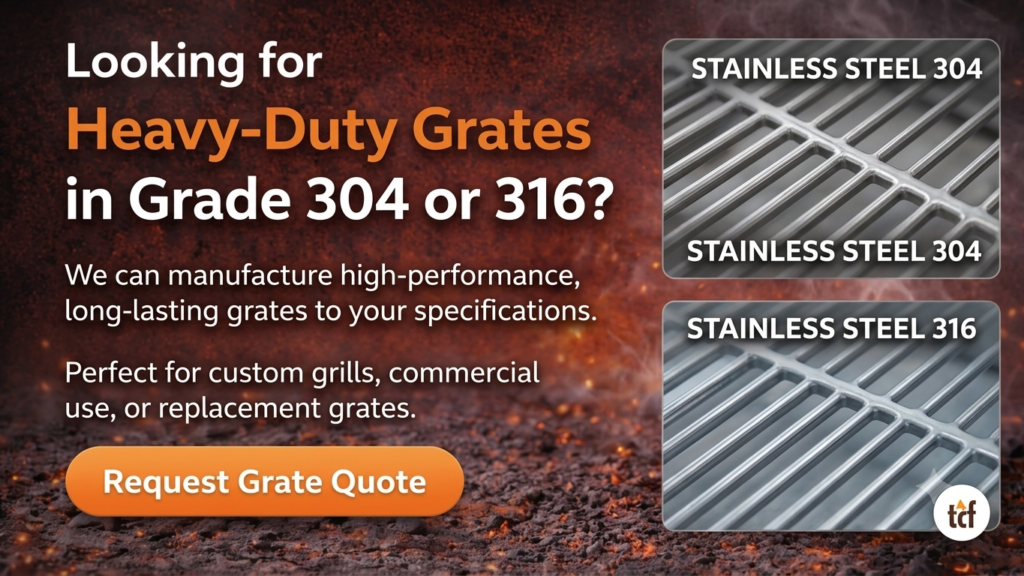
Choose Grade 316 if the installation is within 5 km of saltwater or in a marine environment, the grill is built into a coastal outdoor kitchen with limited protection from salt air, heavy chlorinated sanitisers are used regularly (common in commercial kitchens), or the installation is a permanent fixture that will not be stored or protected between uses over a multi-year service life. The 15 to 40% cost premium for Grade 316 grates becomes straightforward economics when a Grade 304 grate would need replacing in 4 to 6 years rather than lasting 10 to 15.
Commercial charcoal restaurant kitchens running continuous service with heavy brine exposure or frequent chemical sanitisation represent a specific case where Grade 316 is the correct specification regardless of geographic location. Buyers sourcing bulk charcoal for restaurants running high-volume operations should factor grate specification into the total cost of service setup from the outset.
What About Grade 430 and Other Stainless Grades?
Buyers comparing stainless grate options will encounter Grade 430 on budget-tier products. Grade 430 is a ferritic stainless steel containing approximately 17% chromium and no nickel or molybdenum. It is magnetic, has lower corrosion resistance than either 304 or 316, and is not suitable for outdoor use in anything other than dry, protected environments. It is used in entry-level grills primarily because it is cheaper to produce, not because it performs comparably. Grill industry data consistently show 430 developing visible surface deterioration within 18 to 36 months in humid or coastal conditions.
Grade 443, a ferritic grade with higher chromium content, offers corrosion resistance approaching 304 with lower thermal expansion, which is relevant for components subject to repeated heating cycles. It is used in some commercial BBQ applications but is less common in grate specifications than the 300-series grades.
For charcoal-based cooking where direct flame and extended heat cycles are standard, the 300-series grades (304 and 316) remain the specification benchmark across the industry.
How Does Gauge (Thickness) Relate to Grade in Durability?
Grade specification and metal gauge are separate variables that both affect grate durability, and they compound each other. A thin 304 grate degrades faster than a thick 304 grate in the same environment. A thin 316 grate may outlast a thin 304 grate in chloride conditions but will still underperform a thick 304 grate in standard inland use.
For cooking grate durability specifically, gauge matters because thicker rods resist physical warping under repeated thermal cycling, hold heat more evenly during cooking, and provide more material before corrosion penetrates to a structurally significant depth. Commercial-grade cooking grates typically run 6mm rod diameter or heavier. Residential grates at 4 to 5mm are adequate for home use but will show heat distortion and corrosion progression faster than commercial spec equivalents in the same material.
Buyers evaluating a Grade 316 grate against a Grade 304 grate of the same gauge are making a pure environment-driven decision. Buyers comparing grates of different gauges are making a combined environment-and-construction decision, and cheaper Grade 316 at a lighter gauge may not outperform heavier Grade 304 in standard conditions. The grade and the gauge need to be evaluated together.
What Charcoal Works Best With Stainless Grates?
Beyond ash content, the charcoal type affects how consistently the grate reaches and holds the temperatures where stainless performs optimally. Dense, slow-burning fuels deliver sustained, even heat with fewer temperature spikes, which is easier on the metal over time than rapid cycles of extreme heat and cooling.
High fixed-carbon charcoal, including quality bulk lump charcoal and charcoal briquettes wholesale, burns consistently within the temperature range that both 304 and 316 handle without stress. Lower-quality charcoal with high volatile matter and poor fixed carbon content burns unevenly, creates more temperature variance, and generates more ash residue per session, all of which increase the maintenance burden on any grate regardless of grade.
For a detailed breakdown of what the key charcoal quality parameters mean in practice, see our charcoal grades explained guide. For buyers supplying restaurants or foodservice operations where grate performance and longevity are operational costs, our best charcoal for grilling guide covers fuel selection by cooking application.
FAQ – Stainless Steel Grade 304 vs 316 Cooking Grates
Is Grade 316 stainless steel worth the extra cost for cooking grates?
It depends entirely on the installation environment. In inland residential settings with normal atmospheric conditions, the 15 to 40% cost premium of Grade 316 over Grade 304 delivers no meaningful performance benefit, as Grade 304 will last 10 to 15 years with proper care. In coastal environments within 5 km of saltwater, the cost premium is justified by a service life that is 30 to 50% longer than Grade 304 would provide under the same conditions.
What is the PREN, and why does it matter for BBQ grates?
The Pitting Resistance Equivalent Number (PREN) quantifies a stainless steel’s resistance to chloride-induced pitting corrosion. Grade 304 scores approximately 18 to 20, and Grade 316 scores approximately 24 to 28. The higher the PREN, the greater the chloride concentration the steel can withstand before pitting begins. For outdoor cooking grates exposed to salt air, brine, or chlorinated cleaning agents, a higher PREN directly translates to a longer surface life.
Can I use Grade 304 grates near the ocean?
Grade 304 can be used in coastal environments, but expect accelerated surface degradation. The practical threshold most grill industry professionals cite is 5 km from saltwater. Inside this zone, 304’s chloride tolerance is routinely exceeded by ambient salt air, and visible pitting typically appears within 3 to 5 years. Regular post-session cleaning to remove ash and residue, combined with dry storage between uses, extends service life. For permanent outdoor installations within 5 km of the coast, Grade 316 is the correct long-term specification.
Does charcoal ash damage stainless steel grates?
Ash itself does not corrode stainless steel directly, but it is hygroscopic and draws moisture from the air. In coastal environments, ash-moisture accumulation on grate surfaces concentrates ambient chlorides from sea air, creating a localised accelerant for pitting on Grade 304. Choosing low-ash charcoal and cleaning grates after each session removes this risk almost entirely. Coconut shell briquettes generating 2 to 4% ash are significantly easier on grates than high-ash wood alternatives in this regard.
What is the minimum thickness recommended for stainless steel cooking grates?
Commercial kitchens typically specify rod diameters of 6mm or heavier for durability under continuous service. For residential use, 4 to 5mm rod diameter grates in Grade 304 are adequate for standard conditions. Grade and gauge are both relevant when evaluating grates: a heavy-gauge 304 grate in a standard environment will outperform a light-gauge 316 grate in the same location.
Is Grade 316 used in any mainstream charcoal grills?
Grade 316, sometimes labelled marine-grade stainless, is used by premium grill manufacturers specifically for coastal or harsh-environment models. Blaze’s Premium Marine Grade LTE grill specifies 316 stainless steel throughout, including grates, hood, and flame tamers. These products carry a price premium that reflects both the material cost difference and the market they are designed for. For most standard charcoal grill applications, 304 remains the industry specification.