

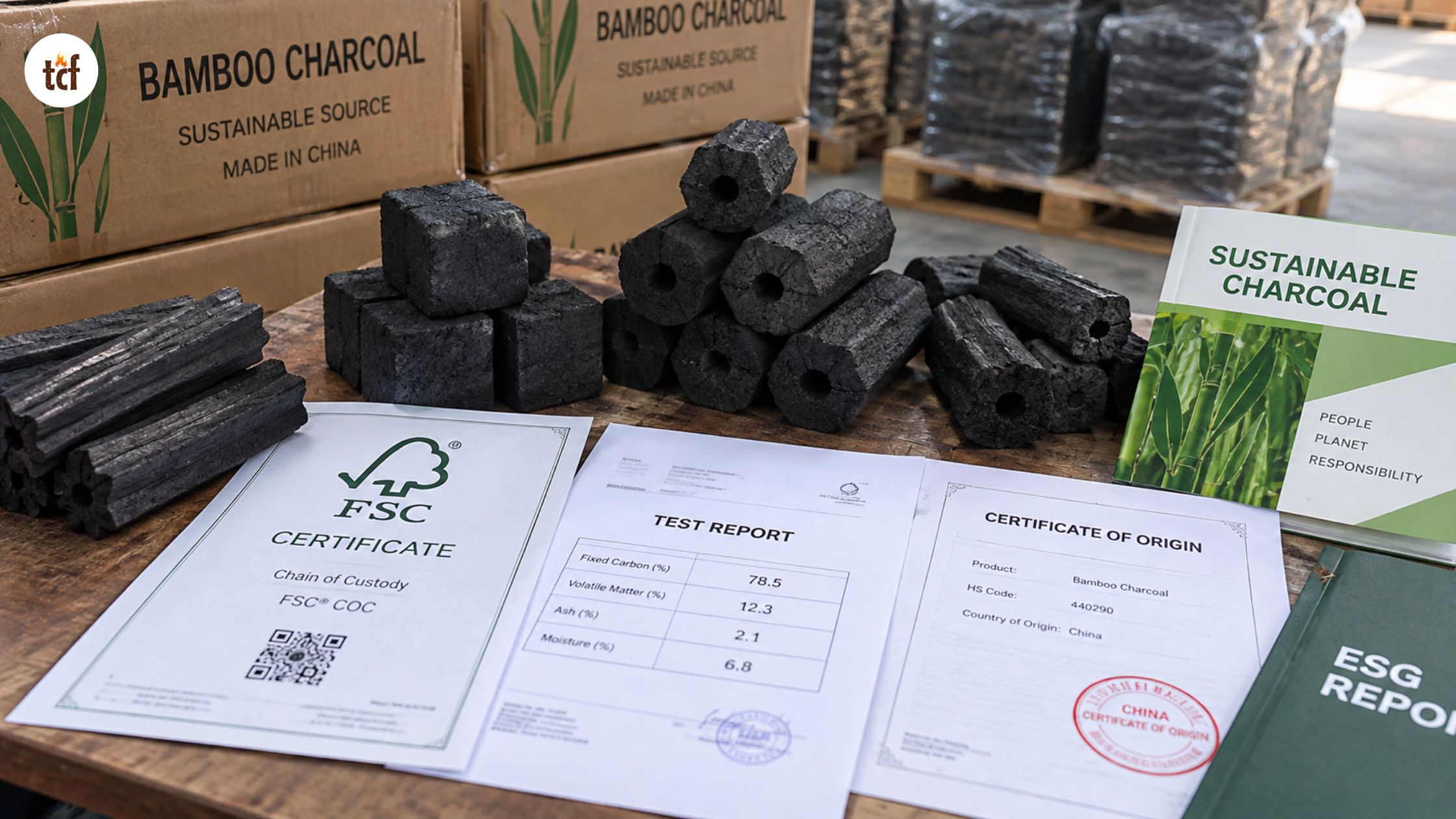
ESG and supply chain reporting: Charcoal buyers should request 3 categories of documentation regardless of whether they’re legally required to: environmental (EUDR Due Diligence Statement, FSC chain of custody, carbon footprint data), social (a SMETA or BSCI audit report, labor and health & safety policy), and governance (verified factory status, business license, anti-corruption policy). Even buyers with no direct legal ESG obligation increasingly need this documentation because their own customers, retailers, hospitality chains, and distributors are asking for it.
Here’s what to request in each category, and why the “we’re too small to need this” assumption is getting riskier every year.
Table of Contents
Why this matters even if you’re not legally in scope
The EU’s Corporate Sustainability Due Diligence Directive (CSDDD) now applies only to companies with more than 5,000 employees and over €1.5 billion in global turnover, following the Omnibus I amendments finalized in late 2025, a substantially narrower scope than originally proposed, and it doesn’t take effect until July 2029. Most charcoal importers and distributors fall well outside that threshold.
But that doesn’t mean ESG documentation requests are going away. Large retailers and hospitality groups that are in scope for CSRD (Corporate Sustainability Reporting Directive) need supply chain data from their own suppliers to complete their reporting under ESRS S2 (workers in the value chain) and ESRS E4 (biodiversity), and that requirement flows downstream. If you’re supplying a large European supermarket chain or hotel group, you may be asked to produce documentation your own company isn’t directly required to hold, simply because your customer needs it to complete their own filing.
EUDR is the one regulation in this space that applies regardless of company size, if you’re placing charcoal (HS 4402) on the EU market, the Due Diligence Statement requirement applies to operators and traders, with no small-business exemption.
Environmental documentation
- EUDR Due Diligence Statement reference number: required for any charcoal entering the EU market from December 2026. Our EUDR Due Diligence Statement guide covers what this document contains and how it’s generated through TRACES NT.
- FSC chain of custody certificate: verifies sourcing claims through an independent audit trail rather than a supplier’s self-declaration; request the certificate number and confirm it against FSC’s own database.
- Product Carbon Footprint (PCF) or Scope 3 emissions data: increasingly requested by buyers who need supply chain emissions data for their own sustainability reporting. Not every charcoal manufacturer currently produces this; ask directly rather than assuming it’s unavailable.
- Geolocation and harvest origin data: the same production-plot data required under EUDR is also useful evidence for any broader deforestation-risk due diligence a downstream customer might request.
Social documentation
- A SMETA or BSCI audit report: these are the standard third-party social audit frameworks covering labor conditions, working hours, and workplace safety at the actual production facility. Request a report tied to the specific factory you’re sourcing from, not a general industry certification.
- Labor policy documentation: a written policy addressing child labor and forced labor, ideally with evidence of how it’s actually enforced, not just a policy statement.
- Health and safety records: relevant specifically for charcoal given its UN1361 Dangerous Goods classification; ask how the factory manages weathering, temperature control, and worker safety around self-heating material. This is both a safety and a documentation question.
- Wage and working hours documentation: increasingly requested alongside social audits, particularly by buyers supplying markets with stricter supply chain labor disclosure expectations.
Governance documentation
- Verified factory status: confirm you’re actually dealing with the manufacturer, not an undisclosed trading company reselling another factory’s output. Our guide to verifying a Chinese charcoal factory covers how to check this directly.
- Business license and registration matching your contract: the legal entity you’re contracting with should match the entity on any certification presented to you.
- Anti-bribery and anti-corruption policy: increasingly a standard request in RFPs for larger corporate buyers, even where it isn’t yet a legal requirement for the supplier.
- A sustainability or ESG scorecard, where available: platforms like EcoVadis are commonly used by large buyers to assess supplier sustainability performance across environmental, social, and governance criteria in a single standardized format. Not every charcoal manufacturer will have one, but ask, and treat a supplier’s willingness to pursue one as a signal of how seriously they take documentation generally.
Also read – calculate the landed cost of bulk charcoal
Which framework actually applies to you
| Framework | Who it applies to | What it requires |
| EUDR | Any company placing charcoal (HS 4402) on the EU market, regardless of size | Due Diligence Statement, geolocation, risk assessment |
| CSDDD | EU companies with 5,000+ employees and €1.5B+ turnover; non-EU companies with equivalent EU-generated turnover | Full value chain human rights and environmental due diligence |
| CSRD (ESRS S2/E4) | Large EU companies subject to CSRD reporting | Sustainability reporting, often requiring supply chain data from suppliers |
| Buyer-driven requirements (EcoVadis, SMETA, BSCI) | Any supplier working with a buyer who requests it | Varies by buyer, generally social and environmental performance data |
The practical reality for most charcoal importers and distributors: you likely don’t fall directly under CSDDD, but EUDR applies regardless of size if you’re EU-bound, and buyer-driven requirements can apply to you the moment a customer asks for them, regardless of what EU law technically requires.
A documentation checklist for your next RFP
- [ ] EUDR Due Diligence Statement reference number (for EU-bound shipments)
- [ ] FSC chain of custody certificate, with a checkable license number
- [ ] Most recent SMETA or BSCI social audit report, tied to the specific production facility
- [ ] Written labor policy covering child and forced labor
- [ ] Health and safety documentation, including how Dangerous Goods handling is managed
- [ ] Business license confirming the contracting entity matches presented certifications
- [ ] Sustainability scorecard (EcoVadis or equivalent), if available
- [ ] Product Carbon Footprint or emissions data, if your own reporting requires it
Building ESG documentation into your supplier relationship
Requesting this documentation is most effective when it’s written into the supply agreement itself, not treated as an ad hoc request after a relationship is already established. Our bulk charcoal supply contracts guide covers how to structure quality and compliance clauses with real enforcement mechanisms; the same approach applies well to ESG documentation requirements.
This article is for general informational purposes and isn’t legal or compliance advice. ESG regulatory scope and thresholds have changed significantly and continue to evolve; confirm current requirements with legal counsel before relying on this guide for a compliance determination.
Frequently asked questions
Does a small charcoal distributor need to comply with CSDDD?
Almost certainly not directly. Following the 2025 Omnibus amendments, CSDDD applies only to companies with more than 5,000 employees and over €1.5 billion in global turnover. Most distributors fall well below this threshold, though their larger customers may still request ESG documentation to meet their own obligations.
Is EUDR the same as CSDDD?
No. EUDR is commodity-specific (covering charcoal under HS 4402 along with wood, cocoa, coffee, and others) and applies to any company placing those goods on the EU market regardless of size. CSDDD is a broader human rights and environmental due diligence obligation that applies only to very large companies. The two regimes are complementary, not interchangeable, and a company can be in scope for one without the other.
What’s the difference between CSRD and CSDDD?
CSRD is a reporting obligation, requiring large EU companies to disclose sustainability data. CSDDD is an action obligation, requiring in-scope companies to actually identify and address human rights and environmental risks in their value chain. A company already reporting under CSRD has some overlap with CSDDD’s disclosure elements but still needs to demonstrate actual due diligence action.
Why would my customer ask for ESG documentation if I’m not legally required to provide it?
Because your customer may be legally required to collect it, even if you aren’t required to produce it. Large retailers and hospitality groups reporting under CSRD often need supply chain data from every tier of their supply chain to complete their own filings, which pushes documentation requests down to suppliers regardless of that supplier’s own regulatory status.
Is an EcoVadis score mandatory for charcoal suppliers?
Not by law. It’s a buyer-driven requirement that’s become increasingly common among large corporate buyers as a standardized way to assess supplier sustainability performance. Not having one isn’t a compliance failure, but it can be a competitive disadvantage when bidding against suppliers who do.