


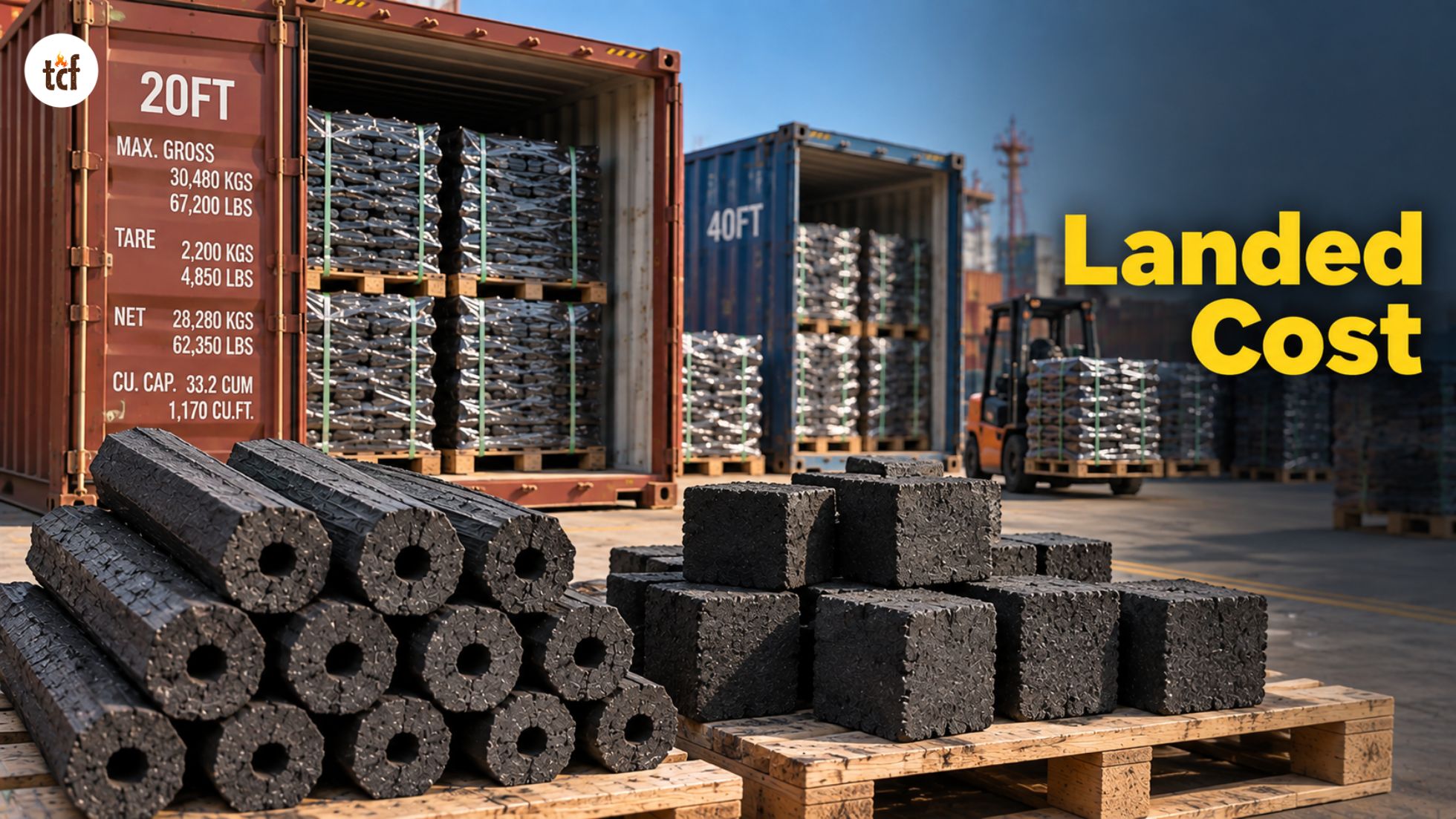
To calculate the landed cost of bulk charcoal, landed cost equals your FOB or product cost, plus international freight, marine insurance, import duty, destination taxes (VAT or equivalent), port and handling charges, customs broker fees, and inland delivery to your warehouse. For charcoal specifically, add one more line most calculators miss: Dangerous Goods compliance costs, since charcoal ships as UN1361, Class 4.2.
Here’s the full formula, plus 3 worked examples across different destination markets so you can see how the same FOB price lands at very different final costs depending on where you’re importing to.
Table of Contents
The landed cost formula
Landed cost = Product cost (FOB) + International freight + Marine insurance + Import duty + Destination taxes (VAT/GST) + Port and handling charges + Customs broker fees + Inland delivery
This structure follows the same core methodology outlined by the US International Trade Administration for determining total export/import price, calculate your CIF value first (cost, insurance, freight), apply duty and tax on that CIF base, then add the destination-side fees that a customs value calculation doesn’t capture.
If you’re buying on CIF terms instead of FOB, freight and insurance are already folded into your quoted price. Our FOB vs CIF charcoal pricing guide covers how to normalize quotes between the two before you start this calculation, since comparing an FOB quote to a CIF quote without adjusting for this first will throw off every number below.
Step 1: Establish your base product cost
Start with your FOB (or CIF) price per ton, multiplied by your container’s actual tonnage. This varies significantly by charcoal type and packaging; our charcoal container loading guide covers typical tonnage ranges, roughly 10 to 20 tons for a 20ft container and 24 to 28 tons for a 40ft, depending on density and packaging format.
Step 2: Add international freight
Ocean freight rates fluctuate with fuel costs, capacity, and season; get a current quote rather than using a figure from a prior shipment. Freight is typically quoted per container, not per ton, so this is a flat addition regardless of how full your container is.
Step 3: Add marine insurance
Marine insurance is commonly calculated as a small percentage of the CIF value, often around 0.3 to 0.5%, though this varies by insurer and coverage level. If you’re buying CIF, confirm what coverage percentage of invoice value is actually included; standard CIF terms often default to a minimum coverage level (commonly 110% of invoice value), which may be lower than what you’d want for a full replacement claim.
Step 4: Calculate import duty
This is where landed cost varies most dramatically by destination, and where charcoal has a specific wrinkle worth knowing.
- US: HTS 4402 carries a 0% base duty from most origins. Chinese-origin charcoal is a different story: a September 2025 US Federal Circuit ruling upheld Section 301 tariffs on Lists 3 and 4A as permanent, not a temporary trade measure subject to further challenge. For Chinese bamboo charcoal or machine-made wood briquettes, this can add over $300 per ton on top of a $900/ton FOB price, before freight, insurance, or any other charge.
- EU and UK: 0% base duty under CN/HS 4402 from most origins.
- Middle East (GCC): a flat 5% customs duty applied to all origins, including China, with no equivalent to the US’s origin-based tariff differences.
Our charcoal import regulations comparison covers the full duty picture across these markets in more depth.
Step 5: Calculate destination taxes
- US: no federal VAT/GST equivalent, but state and local taxes may apply depending on destination
- UK: 20% VAT on the CIF-plus-duty value; VAT-registered businesses can typically recover this through Postponed VAT Accounting
- EU: VAT rates vary by member state, commonly in the 17 to 27% range, calculated on CIF-plus-duty value
- Middle East: VAT rates vary by GCC member state, commonly 5 to 15%
Also read – how to verify that a charcoal factory in china is real
Step 6: Add port, handling, and compliance charges
This is the category most landed cost estimates underbudget:
- Terminal Handling Charges (THC): charged at both origin and destination ports, commonly $100 to $300 per container depending on port
- Merchandise Processing Fee (MPF), US only: 0.3464% of value, with a minimum of $31.67 and maximum of $614.35 per formal entry
- Harbor Maintenance Fee (HMF), US only: 0.125% of value on ocean entries
- Customs broker fee: typically a flat fee per entry, commonly $75 to $200, varies by broker and complexity
- Dangerous Goods documentation and inspection fees: charcoal-specific, covering the UN1361 Dangerous Goods Declaration, and in some cases a Self-Heating Test fee that’s billed separately from the base product price
- Inland delivery: trucking from port to warehouse, varies significantly by distance
Worked example 1: 20ft container to the United States (China origin)
| Line item | Amount |
| Product cost (18 tons × $900/ton FOB) | $16,200 |
| Section 301 duty (~35% on Chinese bamboo charcoal) | $5,670 |
| Ocean freight | $2,800 |
| Marine insurance (~0.4% of CIF) | $76 |
| MPF (0.3464%, within min/max) | $65 |
| HMF (0.125%) | $23 |
| Customs broker fee | $150 |
| THC (both ports) | $400 |
| Inland delivery | $600 |
| Estimated landed cost | ~$25,984 |
| Landed cost per ton | ~$1,444 |
Notice that Section 301 duty alone adds more to the total than freight, insurance, and every fee combined. This is exactly why the Federal Circuit ruling matters, it’s not a temporary cost to wait out, it’s now a permanent part of the US landed cost model for Chinese-origin charcoal.
Worked example 2: 40ft container to the UK (non-China origin)
| Line item | Amount |
| Product cost (26 tons × $750/ton FOB) | $19,500 |
| Import duty (0% under UK Global Tariff) | $0 |
| Ocean freight | $3,200 |
| Marine insurance (~0.4% of CIF) | $91 |
| VAT (20% on CIF + duty) | $4,558 |
| Customs broker fee | £150 (~$190) |
| THC (both ports) | $350 |
| Inland delivery | $500 |
| Estimated landed cost (VAT recoverable for registered businesses) | ~$28,239, effective ~$23,681 after VAT recovery |
The UK example shows why VAT registration status matters so much to your actual cash cost, a VAT-registered business recovers that 20% through Postponed VAT Accounting, while an unregistered buyer absorbs it as a real cost.
Worked example 3: 20ft container to Saudi Arabia / GCC
| Line item | Amount |
| Product cost (18 tons × $850/ton FOB, coconut shell) | $15,300 |
| GCC customs duty (5%, all origins) | $765 |
| Ocean freight | $1,900 |
| Marine insurance (~0.4% of CIF) | $69 |
| VAT (varies by GCC state, ~5-15%) | $825 to $2,474 |
| Customs broker fee | $150 |
| THC (both ports) | $300 |
| Inland delivery | $400 |
| Estimated landed cost | ~$19,709 to $21,358 |
A reusable formula for your own calculation
$$\text{Landed cost per ton} = \frac{\text{FOB cost} + \text{Freight} + \text{Insurance} + \text{Duty} + \text{Taxes} + \text{Port & handling fees} + \text{Broker fee} + \text{Inland delivery}}{\text{Total tons in container}}$$
Run this calculation before comparing supplier quotes, not after. A lower FOB quote from a China-origin supplier can easily land more expensive than a slightly higher FOB quote from a non-China origin once Section 301 duty is factored in, exactly what worked example 1 shows.
Common mistakes that throw off a landed cost estimate
- Comparing FOB and CIF quotes directly without adjusting for the freight and insurance CIF already includes
- Forgetting MPF and HMF on US entries, small individually but a real line item on every formal entry
- Assuming Section 301 duty is temporary and excluding it from long-term pricing models; the 2025 Federal Circuit ruling closed that door
- Ignoring Dangerous Goods compliance costs, weathering documentation, DG declarations, and Self-Heating Test fees that some suppliers bill separately from the base quote
- Using outdated freight rates; ocean freight is volatile enough that a quote from 2 months ago isn’t reliable for a new calculation
Frequently asked questions
What’s typically the biggest line item in landed cost after product price?
For China-origin charcoal imported into the US, Section 301 duty, often exceeding both freight and every other fee combined. For other origin-destination pairs without special tariffs, ocean freight is usually the largest single line item after product cost.
Is Section 301 duty on Chinese charcoal still temporary?
No. A September 2025 US Federal Circuit ruling upheld Section 301 tariffs on Lists 3 and 4A as legally permanent and not subject to further challenge. Buyers should treat this as a fixed cost, not something likely to be removed.
Does landed cost include the cost of getting the product to my final warehouse, or just to the port?
A full landed cost calculation should include inland delivery from the destination port to your warehouse, not just port arrival. Stopping the calculation at the port understates your real cost.
How much does marine insurance typically add to landed cost?
Commonly around 0.3 to 0.5% of the CIF value, a relatively small line item compared to duty and freight, but still worth including for an accurate total.