

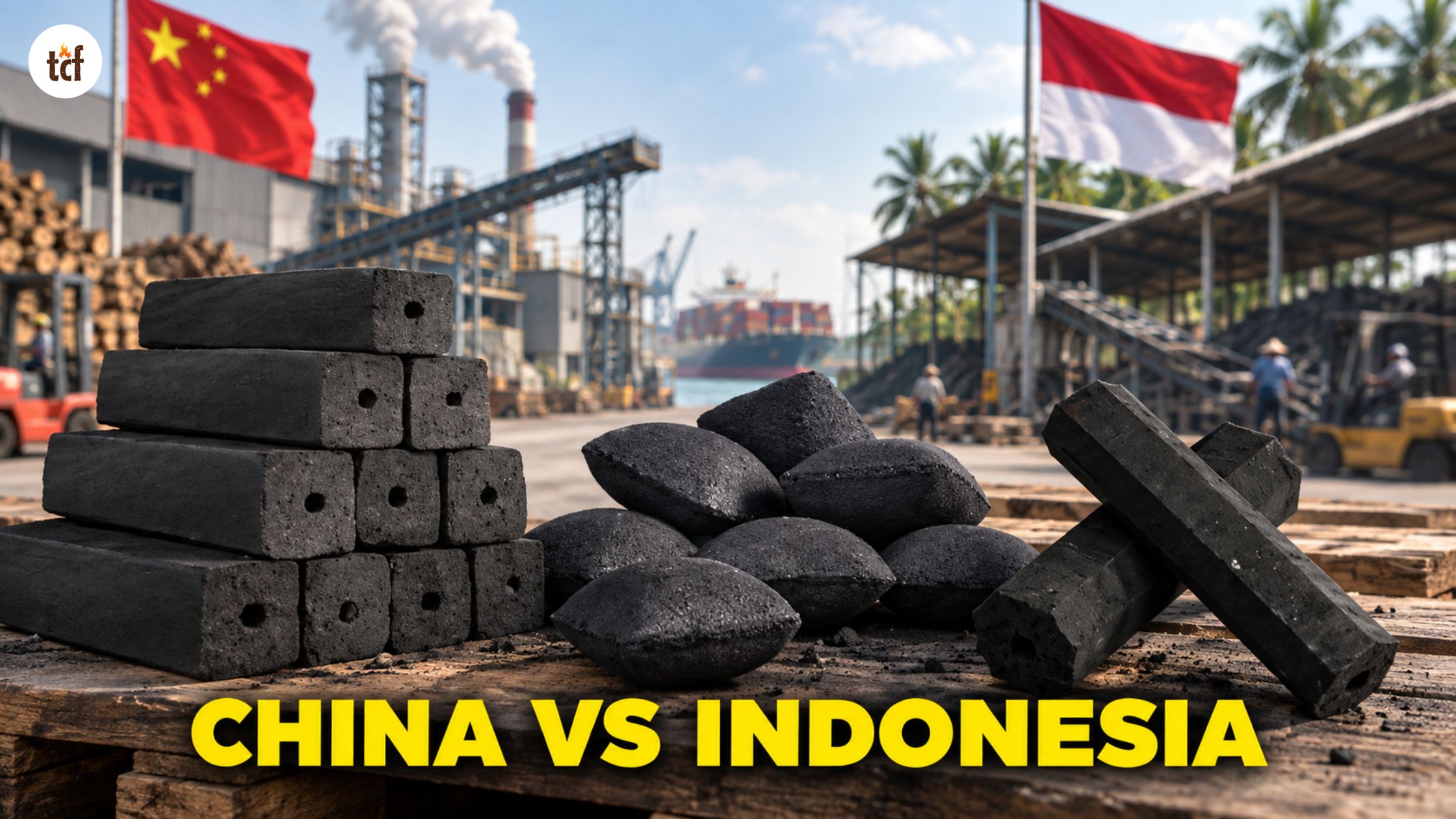
China vs Indonesia Charcoal Manufacturing: For most wholesale buyers, the choice comes down to this: China offers manufacturing scale, product diversity, and vertically integrated supply chains, while Indonesia dominates coconut shell briquette production and leads the world in export volume. The right answer depends on what you are buying and who you are selling to.
Table of Contents
How Do China and Indonesia Compare as Charcoal Exporters?
Indonesia is the world’s largest charcoal exporter, accounting for roughly 23% of global charcoal exports and generating over $350 million in 2024, according to ITC Trade Map data. Its strength is focused and deep coconut shell charcoal briquettes for BBQ, shisha, and hookah markets, exported primarily to Saudi Arabia, China, and Malaysia.
China’s picture is more complex. It remains one of the largest charcoal manufacturing nations by output, with major industrial clusters in Zhejiang, Shanxi, and Liaoning provinces. However, China’s charcoal exports dropped sharply by 45.7% in 2024, a significant shift driven by growing domestic demand. China is now a net importer of charcoal, with import demand for BBQ-grade product alone exceeding $200 million annually.
This matters for buyers: China’s transition means Indonesian and other Southeast Asian exporters are filling a supply gap that continues to grow.
What Raw Materials Does Each Country Use?
China’s Raw Material Advantage: Diversity
China’s charcoal manufacturing benefits from significant regional diversity in raw materials. Provinces like Zhejiang and Guangdong produce bamboo charcoal using abundant local bamboo resources. Shanxi and Liaoning use hardwood biomass for machine-made briquettes and industrial-grade charcoal. Southern regions, including Guangxi, are known for coconut and fruit wood charcoal.
This diversity means Chinese manufacturers can supply a wide range of charcoal types from a single origin hardwood lump, bamboo briquettes, machine-made wood charcoal, and activated carbon, making China attractive for buyers who need variety across product lines. You can explore different charcoal types and their applications in our types of charcoal overview.
Indonesia’s Raw Material Advantage: Coconut Shell at Scale
Indonesia’s advantage is focused but formidable. As one of the world’s largest coconut-producing nations, it has access to an enormous and renewable supply of coconut shells, a byproduct of the coconut processing industry that would otherwise go to waste.
Coconut shell charcoal has naturally high fixed carbon content, produces minimal ash, and burns cleanly with low smoke — qualities that make it the preferred raw material for premium shisha and hookah charcoal. No other country can match Indonesia’s volume and cost structure in this specific segment. Our comparison of wood vs coconut charcoal explains the technical differences in detail.
How Does Manufacturing Technology Compare – China vs Indonesia Charcoal Manufacturing
China: Industrial Scale and Vertical Integration
Chinese manufacturers have invested heavily in modern kiln technologies, including retort kilns and continuous carbonisation systems, which allow for consistent, high-volume output. Facilities in Zhejiang, for example, operate on sites exceeding 10,000 m² with integrated supply chains covering raw material sourcing, kiln processing, briquetting, and containerised shipping under one roof.
This vertical integration reduces quality variance across batches and gives Chinese manufacturers strong control over lead times. Response times among established Chinese exporters are among the fastest in the global charcoal market, with some suppliers averaging under four hours a practical advantage for buyers managing tight procurement cycles.
Indonesia: Specialist Production with Fragmented Structure
Indonesian coconut charcoal manufacturing has evolved significantly, with investment in advanced carbonisation plants and emission control systems driving quality improvements in established factories. Certified Indonesian producers now consistently meet the benchmarks of fixed carbon above 75% and moisture below 10% the standard international buyers require.
However, Indonesia’s charcoal industry is more fragmented than China’s. A larger number of small and medium-scale producers operate alongside larger exporters, and quality consistency can vary between factories, particularly in hardwood lump charcoal, which is not Indonesia’s primary strength. Buyers sourcing at scale should verify supplier capacity carefully and request third-party lab reports per batch. Our charcoal supplier verification checklist is a useful starting point for this process.
How Does Product Range Compare Between the Two Countries?
| Product Type | China | Indonesia |
| Hardwood lump charcoal | Strong | Moderate (variable quality) |
| Coconut shell briquettes (BBQ) | Available | World-leading |
| Coconut shell briquettes (shisha/hookah) | Available | World-leading |
| Bamboo charcoal | Strong (largest producer) | Limited |
| Machine-made wood briquettes | Strong | Moderate |
| Activated carbon | Major global supplier | Limited |
| Shaped/cube shisha briquettes | Available | Strong |
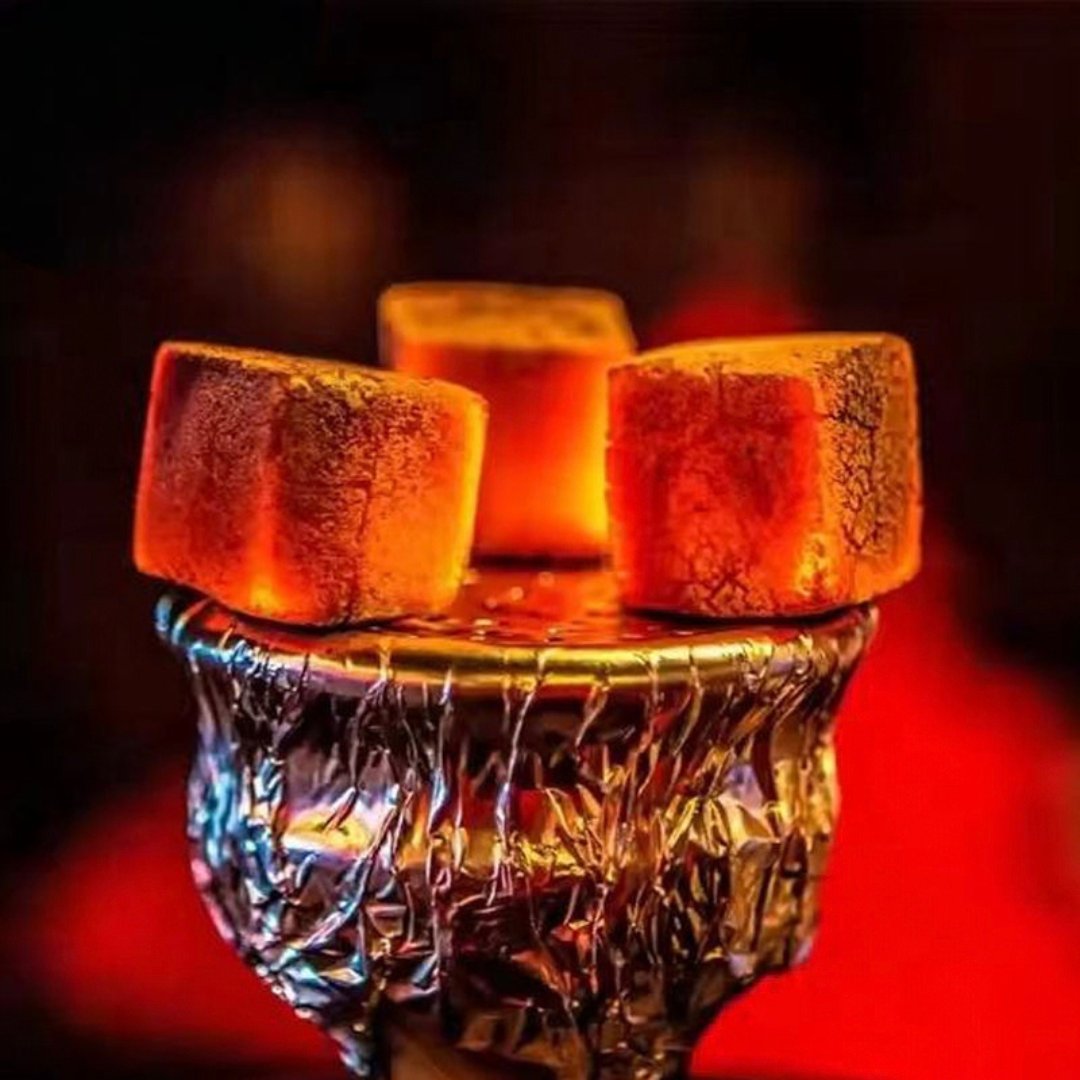
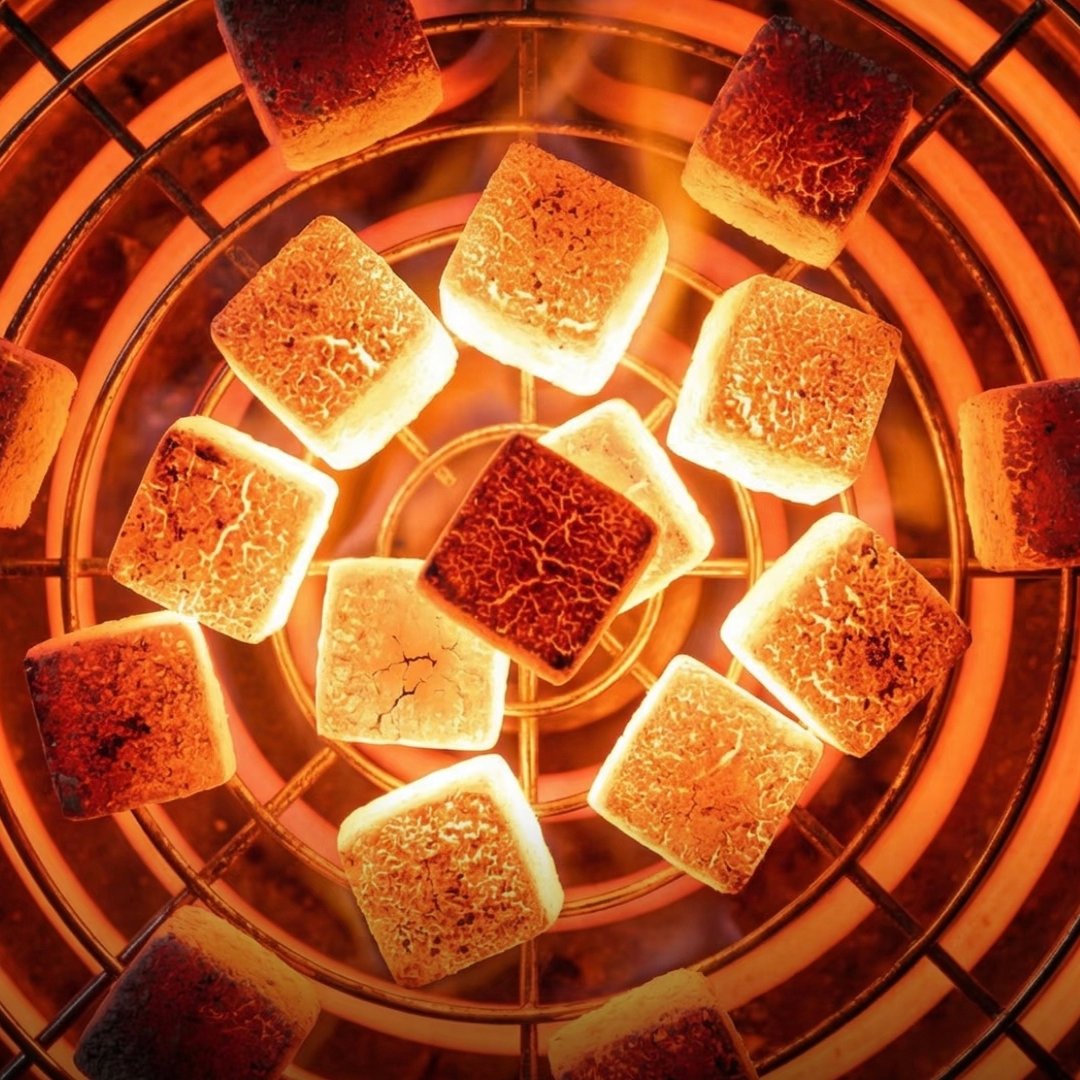
For buyers supplying the hookah and shisha market specifically, Indonesia is the dominant source for cube and finger briquettes. Our wholesale shisha charcoal range and wholesale hookah charcoal pages cover what product specifications to look for in this segment.
What Are the Pricing Differences?
China: Competitive on Scale, Rising on Speciality
Chinese charcoal pricing has historically been competitive due to economies of scale and mature logistics networks. However, rising domestic demand, environmental regulation tightening production in certain provinces, and the sharp export decline in 2024 suggest that China’s era as a low-cost export-first producer is transitioning.
For bamboo charcoal and machine-made briquettes, China still offers strong pricing for buyers willing to work with established exporters. For coconut shell products specifically, Chinese pricing is generally less competitive than Indonesian equivalents when landed cost product plus freight plus duties is calculated.
Indonesia: Best Value for Coconut Shell at Volume
Indonesia’s cost structure for coconut shell briquettes remains unmatched globally. Low raw material costs (coconut shell is agricultural waste), established export infrastructure to Middle Eastern and Asian markets, and competitive labour costs combine to make Indonesian coconut charcoal the value benchmark for this product category.
As of 2024, lump charcoal is typically quoted at $800–$1,400 per metric ton on an FOB basis, depending on type and origin, with shipping from Southeast Asia to Europe or North America adding $200–$400 per ton. Buyers comparing China and Indonesia should always calculate landed cost, not FOB unit price, before making a sourcing decision.
Also read – What Wholesale Buyers Look for in a Charcoal Supplier
How Do Lead Times and Logistics Compare?
China’s established port infrastructure and high container freight volumes mean shorter production lead times for established products — often 7 to 15 working days for a full container load from ready stock. The trade-off is that lead times can extend significantly during peak export periods or if orders require custom specifications.
Indonesian exporters typically quote 12 to 18 working days for full container loads, with small orders sometimes fulfilled in as little as 7 days. Indonesia’s main export ports — Tanjung Priok (Jakarta) and Surabaya — handle significant container volume, but transit times to European markets are generally similar to China given comparable geographic distances.
For buyers planning around seasonal peaks — particularly Ramadan for the hookah market or summer BBQ seasons — locking in orders well in advance is essential from both origins. The consequences of waiting are well documented: procurement delays can add 20% or more to total costs and cause buyers to miss peak trading windows entirely.
What About Certifications and Compliance?
This is an area where the two countries face different challenges in 2025 and beyond.
China’s Certification Landscape
Established Chinese exporters have invested heavily in international certification. ISO 9001 quality management certification is common among larger manufacturers. FSC certification is available through verified suppliers, particularly in provinces with managed forestry programmes. China-based suppliers exporting to the EU are increasingly familiar with EN 1860-2 compliance requirements for BBQ charcoal.
Indonesia’s Compliance Challenges
Indonesia faces a more complex compliance environment, primarily because of the EU Deforestation Regulation (EUDR), which came into enforcement in December 2025 for large and medium operators. The regulation requires exporters to prove that wood-derived products are deforestation-free and fully traceable to their forest origin.
Indonesia’s charcoal supply chain involves a mix of large plantation companies, community forests, and smallholder producers — making traceability and legality verification a significant administrative challenge. Buyers sourcing Indonesian hardwood lump charcoal for EU markets in particular need to work with suppliers who have already invested in compliance infrastructure and can provide plantation-level documentation.
For coconut shell charcoal — Indonesia’s main product — EUDR impact is lower because coconut shell is classified as agricultural waste rather than a primary forest product. This gives Indonesian coconut shell suppliers a structural compliance advantage over their hardwood competitors when targeting EU buyers.
Which Country Is Better for Private Label and Custom Packaging?
Both countries offer private label and OEM packaging options, but the nature of that flexibility differs.
Chinese manufacturers, due to vertical integration, tend to offer broader customisation — including shaped briquettes, custom sizing, mixed product pallets, and a wide range of packaging formats from retail cartons to industrial bulk bags. This makes China attractive for distributors building a multi-SKU product range under a single brand.
Indonesian suppliers are highly experienced in private label for their core coconut shell products, particularly for shisha and BBQ segments. Custom cube sizing, branded retail boxes, and white-label packaging for supermarket buyers are all well-established capabilities among larger Indonesian exporters. Our private label charcoal for supermarkets page outlines what the process involves for retail buyers.
Must read – Best Charcoal Manufacturers in the United States
Side-by-Side Comparison: China vs Indonesia
| Factor | China | Indonesia |
| Global export share (2024) | Declining (-45.7% YoY) | ~23% of global exports |
| Primary product strength | Bamboo, machine-made briquettes, activated carbon | Coconut shell briquettes (shisha/BBQ) |
| Raw material base | Diverse (hardwood, bamboo, coconut) | Coconut shell (dominant), hardwood |
| Manufacturing scale | Very large, vertically integrated | Large, more fragmented structure |
| Typical production lead time | 7–15 working days | 12–18 working days |
| FSC certification availability | Available via verified suppliers | Available, EUDR compliance evolving |
| Pricing competitiveness | Strong for bamboo/machine-made | World-best for coconut shell |
| Product variety | High | Moderate (coconut-focused) |
| EUDR compliance risk | Moderate | Higher for hardwood; lower for coconut shell |
| Best suited for | Buyers needing a range, bamboo charcoal, and activated carbon | Buyers sourcing shisha, hookah, or coconut BBQ briquettes at scale |
Which Country Should You Source From?
The answer is rarely one or the other it is usually both, matched to product type.
If your business supplies shisha lounges, hookah wholesalers, or BBQ distributors who specifically want coconut shell briquettes, Indonesia is the clear choice. The product quality, cost structure, and production infrastructure are without equal for this segment. See our coconut charcoal briquettes wholesale range for what is available.
If your business supplies a broader market retail charcoal, bamboo charcoal for health or food applications, or buyers who need multiple charcoal types, China’s product diversity and manufacturing depth make it a stronger single-origin source. Our bulk lump charcoal and wholesale bamboo charcoal pages are relevant starting points.
For buyers operating in the EU market, the EUDR compliance environment makes supplier verification from both origins essential but the risk profile is different. Coconut shell buyers sourcing from Indonesia face fewer complications than hardwood buyers, while Chinese suppliers with established FSC certification are generally well-positioned for EU requirements.
Experienced wholesale buyers often dual-source — pairing a high-capacity Chinese manufacturer for bamboo or machine-made products with an Indonesian specialist for coconut shell. This approach diversifies supply chain risk while ensuring the right product quality for each end market.
External references: ITC Trade Map — HS 4402 Charcoal Export Data 2024 | Coconut Shell Charcoal Market Insights 2025–2032, Congruence Market Insights
Frequently Asked Questions – China vs Indonesia Charcoal Manufacturing
Is Indonesia or China the world’s largest charcoal exporter?
Indonesia currently holds the top position, accounting for roughly 23% of global charcoal exports and over $350 million in export value in 2024. China’s charcoal exports declined sharply by 45.7% in 2024 as domestic demand increased, shifting China from a net exporter to a net importer of charcoal.
What type of charcoal is Indonesia best known for?
Indonesia is globally dominant in coconut shell charcoal briquettes, particularly for the shisha, hookah, and BBQ segments. Its position is built on access to abundant coconut shell raw material, competitive production costs, and well-established export infrastructure.
Is Chinese charcoal of good quality?
Yes established Chinese manufacturers produce high-quality charcoal across multiple product types, including bamboo charcoal, machine-made wood briquettes, and activated carbon. Key quality markers to verify include fixed carbon content above 75%, ash residue below 5%, and moisture below 10%, backed by third-party lab reports.
Does the EU Deforestation Regulation affect charcoal sourced from Indonesia?
It depends on the product. Coconut shell charcoal, Indonesia’s main export, is classified as agricultural waste and faces fewer EUDR complications. Indonesian hardwood lump charcoal, however, is more directly affected, as buyers must verify deforestation-free sourcing and full traceability. Buyers importing any wood-derived charcoal to the EU should confirm supplier compliance status before placing orders.