


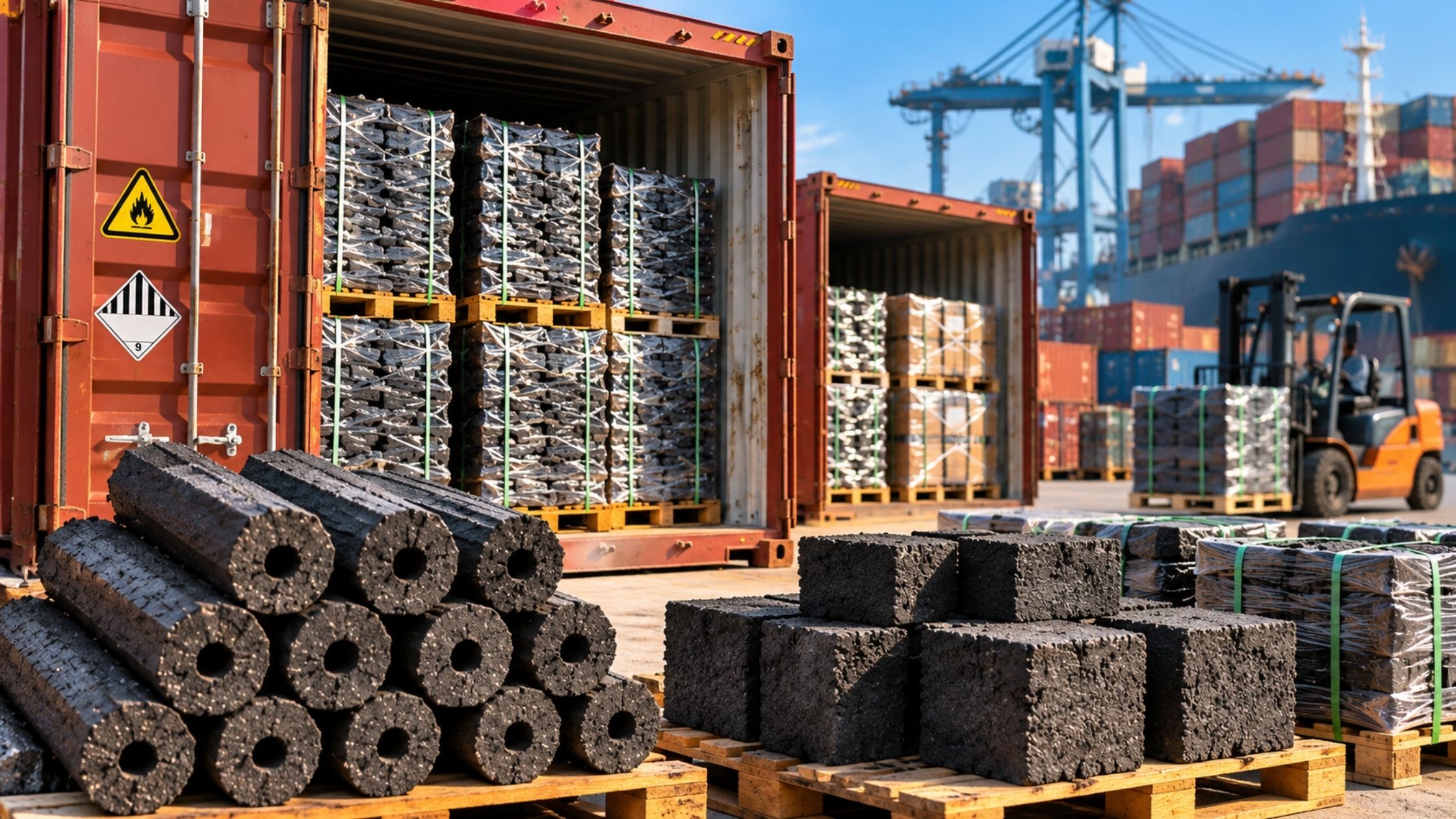
How to Ship Charcoal in Containers Safely? Since 1 January 2026, every container of charcoal shipped by sea must be declared as dangerous goods under UN1361, Class 4.2, with no test-based exemptions. The charcoal must be weathered before packing, packed at 40°C or below, and loaded with at least 30 cm of headspace in the container.
These rules come from Amendment 42-24 of the IMDG Code and its new Special Provision 978. Carriers and the industry body CINS add further requirements on top, and that is where most importers get confused.
Key takeaways
Charcoal is UN1361, Class 4.2. That covers wood, bamboo and coconut shell charcoal, including shisha charcoal.
The old exemption is gone. A passed self-heating test can no longer be used to ship charcoal as general cargo.
Weather for 14 days. Unpacked charcoal must rest under cover in open air for at least 14 days after production.
40°C limit on packing day. No part of the charcoal may be warmer than 40°C when it goes into bags or cartons.
30 cm headspace. Leave at least 30 cm between the top of the cargo and the container roof, and limit stack height or block size.
Three extra data points. The transport document must show the production date, packing date and packing-day temperature.
Carriers ask for more. Expect to supply a weathering report and an independent vanning survey before the booking is accepted.
Table of Contents
Is charcoal dangerous goods for sea freight?
Yes. Charcoal is classed as a Class 4.2 substance, meaning it is liable to spontaneous combustion. It can heat itself in air until it catches fire, with no spark or flame needed.
The record shows why carriers take this seriously. CINS, the Cargo Incident Notification System run by container lines and P&I insurers, logged at least 68 charcoal fires on board ships between January 2015 and December 2022. Every one involved charcoal made as fuel, and most came from consignments that had been misdeclared, so the crew did not know what was in the box (CINS guidelines).
Why does charcoal catch fire inside a container?
Charcoal is mostly carbon. In contact with oxygen, that carbon oxidizes slowly and gives off heat.
Charcoal is also a good insulator, so the heat stays trapped inside the stack. Higher temperature speeds up oxidation, which creates more heat, until the charcoal reaches its self-ignition point.
Four things make this more likely:
- Fresh charcoal. Charcoal packed straight from the kiln has not had time to cool and stabilize.
- Wetting. When charcoal absorbs water, it releases heat. Bags left outdoors in rain before packing are a known risk.
- Under-carbonization. Charcoal fired at too low a temperature keeps unburned organic matter and stays chemically unstable.
- Ignition additives. CINS notes that fuel charcoal is often treated with chemicals that speed up lighting. The Charcoal Factory’s BBQ charcoal contains no ignition chemicals
The last three are also quality issues. Well-carbonized, dry charcoal is safer to ship as well as better to cook with. Our guide to bamboo charcoal quality covers how kiln temperature affects this.
Which UN number applies to charcoal: UN1361, UN1362 or UN3088?
Charcoal made for fuel ships as UN1361, Carbon, animal or vegetable origin. The IMDG Code entry names charcoal from bamboo, coconut shell, jute and wood directly, so BBQ, bamboo and shisha charcoal all fall under it.
| UN number | Proper shipping name | Packing group | Use it for charcoal? |
| UN1361 | Carbon, animal or vegetable origin | II or III | Yes, this is the correct entry |
| UN1362 | Carbon, activated | III | No, only for activated carbon used in filtering and purification |
| UN3088 | Self-heating solid, organic, n.o.s. | II or III | No, charcoal must not be declared under this entry |
The UN1361 vs UN1362 line matters because ordinary charcoal is the raw material for activated carbon. CINS warns that charcoal shipped for activation is sometimes declared as if it had already been activated.
Trade names do not change the classification either. Cargo described as “carbon briquettes,” “hardwood,” “coconut shell” or “bamboo charcoal” is still UN1361 if it is charcoal. Using a vague name to avoid a dangerous goods booking is misdeclaration.
For packaging, UN1361 uses packing instruction P002. That allows up to 50 kg per bag, but CINS recommends a 30 kg maximum so bags can be handled by hand. Bag and carton weights vary by order, so agree them with your supplier within these limits.
What changed for charcoal shipping on 1 January 2026?
Amendment 42-24 of the IMDG Code became mandatory on 1 January 2026, after a voluntary transition year in 2025. For charcoal, it closed the exemption route that many exporters relied on.
Before, a shipper could send a sample to a lab for the UN N.4 self-heating test. If the charcoal passed, special provisions SP925 and SP223 let it travel as ordinary dry cargo. Amendment 42-24 removed SP925 and made SP223 no longer apply to UN1361. In their place it added Special Provision 978.
What does Special Provision 978 require?
SP978 sets six rules for UN1361 charcoal:
- Definition. It covers carbon made by pyrolysis of organic material such as bone, bamboo, coconut shell, jute or wood, not mined or geological carbon.
- No test exemption. The UN N.4 self-heating test cannot be used to exempt charcoal from the Code.
- Packing group. Without testing, charcoal is assigned to at least packing group III. Testing can still place it in packing group II, but never outside the Code.
- Pre-treatment. Unless the competent authority approves otherwise, the charcoal must either be weathered under cover in open air for at least 14 days after production, or be steamed, cooled and packed under inert gas such as nitrogen, then left under loose cover for at least 24 hours.
- Temperature. The charcoal can only be packed when its temperature does not exceed 40°C on the day of packing.
- Loading. The container must keep at least 30 cm of headspace, and either the stack height should not exceed 1.5 m, or blocks of packages should be no larger than 16 m³ with at least 15 cm between blocks.
Two practical notes for buyers. First, the 14-day clock starts when pyrolysis ends, and packing cannot begin before the 14 days are over. Second, CINS says the steam and inert-gas route relates to a specialist product, biochar, rather than ordinary charcoal. For BBQ and shisha charcoal, plan on the 14-day weathering route.
What is legally required, what carriers add, and what is a myth?
Much of what is written about charcoal shipping mixes three different things: the IMDG Code itself, the CINS guidelines, and individual carrier rules. They carry different weight, and some widely repeated claims are simply wrong.
| Claim you will see | What actually applies | Where it comes from |
| “A passed self-heating test lets charcoal ship as general cargo” | Not since 2026. The test cannot exempt UN1361 | IMDG Code, SP978 |
| “All charcoal is packing group III” | PG III is the minimum without testing. Some charcoal is PG II | IMDG Code, SP978 |
| “Charcoal can be packed straight from the kiln if it has cooled” | 14 days of weathering first, then 40°C or below on packing day | IMDG Code, SP978 |
| “Inert-gas packing is a quick alternative to weathering” | Allowed by the Code, but CINS links it to biochar, not ordinary charcoal | CINS guidelines |
| “Thermal liners or thermal jackets are mandatory” | The opposite. CINS recommends not using them, because condensation can speed up self-heating | CINS guidelines |
| “The weathering report is an IMDG document” | The Code requires three data points on the transport document. The report itself is a CINS recommendation that carriers such as CMA CGM now require | CINS guidelines, carrier rules |
| “A vanning survey is optional” | Not in the Code, but CINS recommends an independent survey and major carriers require one | CINS guidelines, carrier rules |
| “On-deck stowage is an IMDG rule” | The Code requires protection from heat and cool stowage. Accessible on-deck stowage is a CINS recommendation that goes further | IMDG Code, CINS guidelines |
| “Calling it ‘carbon briquettes’ or ‘hardwood’ avoids DG rules” | The classification follows what the cargo is, not its trade name | IMDG Code |
In practice, treat the CINS and carrier items as required too. A carrier can refuse a booking that meets the Code but not its own charcoal policy. CMA CGM’s charcoal flyer, for example, lists the dangerous goods declaration, weathering certificate and vanning survey as required (CMA CGM).
How should a charcoal container be packed?
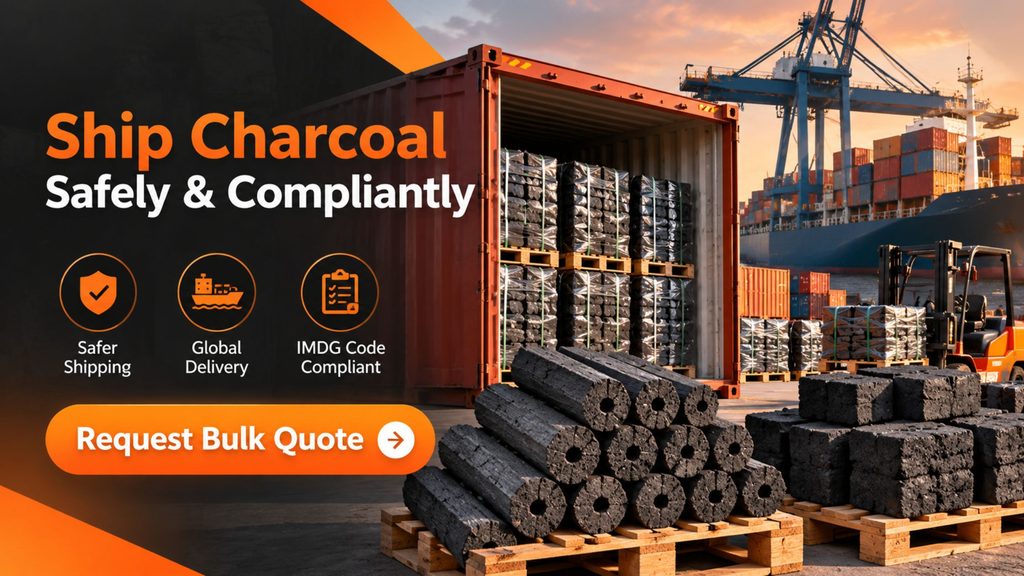
Charcoal can only ship packaged, never loose. Bulk containers (BK1 and BK2) cannot be used for unpackaged charcoal.
Start with the right container. It should be structurally sound, clean, dry and free of residues from earlier cargo, plant material and pests.
Then pack in this order:
- Check the temperature. CINS recommends a thermal camera used continuously while packing, so no bag goes in above 40°C.
- Use sound packaging. Bags or cartons must be intact. Torn bags let air and moisture reach the charcoal.
- Protect the bottom layers. Plan stack weight so the lowest bags are not crushed or split.
- Keep 30 cm of headspace. This is required whichever loading layout you use.
- Choose a layout. Either keep stacks no higher than 1.5 m, or build blocks of up to 16 m³ with gaps of at least 15 cm between them. CINS recommends airbags when using the block layout.
- Spread the load evenly and secure it. Packages must not shift during the voyage.
- Leave a gap at the doors. CINS recommends empty space next to the doors so the container can be flooded quickly if a fire starts at sea.
- Skip thermal liners. They trap condensation, which can speed up self-heating.
[Image 5: original diagram of the three loading layouts: headspace only, 1.5 m stack height, and 16 m³ blocks with 15 cm gaps]
What does the vanning survey check?
CINS recommends an independent vanning survey before the container is sealed. The surveyor confirms that:
- the cargo is packed and secured in line with the CTU Code and CINS guidance
- the packaging is in good condition and not torn
- the weathering report is available and credible
- the inside of the container is clean and odourless, with no fumes or smoke
The Charcoal Factory’s containers are inspected by an independent vanning surveyor before they are sealed.
Which documents are needed to ship charcoal?
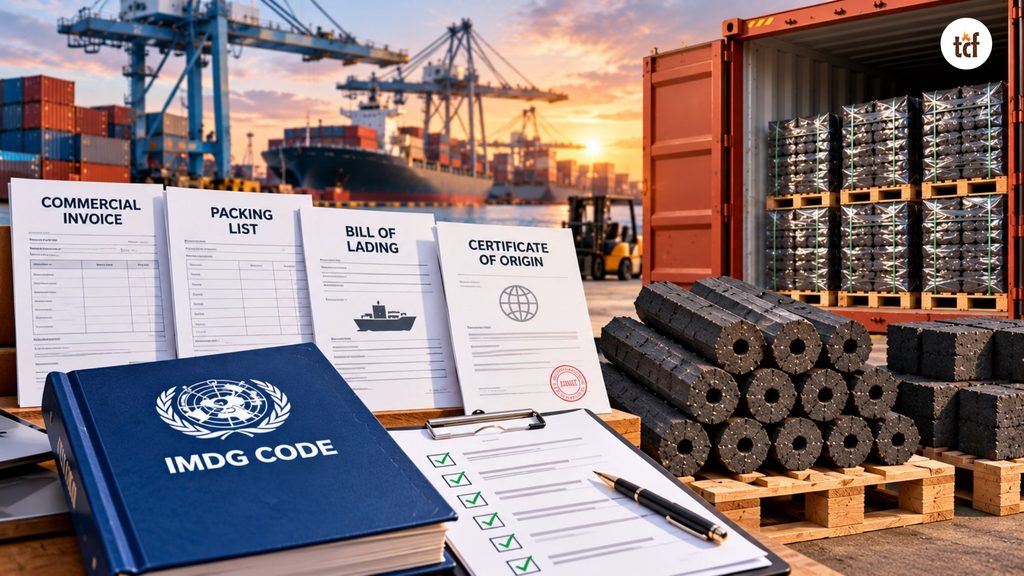
Under SP978, the dangerous goods transport document for UN1361 must include three extra entries: the production date, the packing date, and the charcoal temperature on the day of packing (°C).
Must read –
A complete charcoal shipment usually needs:
| Document | What it shows | Who prepares it |
| Dangerous goods declaration | UN1361, Class 4.2, packing group, plus the three SP978 entries | Shipper or forwarder |
| Weathering report | Production date, packing date, packaging type and mean packing-day temperature | Manufacturer |
| Vanning survey report | Packing, securing and container condition at stuffing | Independent surveyor |
| Container packing certificate | That the container was packed in line with the IMDG Code | Person responsible for packing |
| Safety data sheet | Hazards, handling and firefighting information | Manufacturer |
| Commercial invoice, packing list, bill of lading | Standard trade and shipping details | Exporter and carrier |
Destination countries may add their own requirements, such as certificates of origin or plant health documents. Check these with your customs broker before the order ships.
Where are charcoal containers stowed on the ship?
The IMDG Code requires charcoal to be protected from sources of heat and kept as cool as reasonably practicable. CINS goes further and strongly recommends accessible on-deck stowage, out of direct sunlight, so the crew can reach the container if it starts to heat.
Under-deck stowage is only suggested when the container itself holds an automatic fire-suppression device that works without anyone triggering it. CINS notes that CO₂ systems in the hold are unlikely to put out a charcoal fire, and a container below deck is hard to reach.
The carrier decides stowage, not the shipper. But a correct declaration is what lets the carrier place the container safely, which is why misdeclaration is behind most charcoal fires.
How long does it take to get charcoal from the kiln to the vessel?
Plan for at least 14 days between the end of production and packing, on top of normal production and booking time. Here is the sequence for one container:
- Day 0: carbonization ends. The weathering clock starts here, not when the charcoal is graded or cut.
- Days 0 to 14: weathering. The unpacked charcoal rests under a roof in open air, protected from rain.
- Day 14 or later: temperature check and packing. Every part of the batch must read 40°C or below. The factory records the production date, packing date and packing temperature.
- Stuffing the container. Bags are loaded with 30 cm headspace, a compliant stack or block layout, a door gap and proper securing.
- Vanning survey. An independent surveyor inspects and photographs the container before sealing.
- Dangerous goods booking. The shipper submits the declaration, weathering report and survey to the carrier’s dangerous goods desk for approval.
- Gate-in and loading. The carrier stows the container according to its charcoal policy.
For importers, the practical effect is a longer lead time and a higher freight cost than general cargo. Carriers charge dangerous goods surcharges and must approve each booking before the container moves, so build both into your planning.
When you are comparing suppliers, ask for a sample weathering report and a past vanning survey before you place the order. Our charcoal supplier verification checklist lists what else to request.
Ship charcoal with a factory that handles the paperwork
The Charcoal Factory exports bamboo charcoal and coconut shell charcoal from Anhui Province, China, with DG-compliant shipping and complete export documentation. Orders start from one 20GP container, and containers are checked by an independent vanning surveyor before they are sealed.
See our bulk charcoal and wholesale bamboo charcoal pages, read how charcoal is manufactured, or compare fuels in our guide to the types of charcoal. For shipping questions, email info@thecharcoalfactory.com.
Frequently asked questions – How to Ship Charcoal in Containers Safely
Can charcoal still ship as general cargo in 2026?
No. Since Amendment 42-24 became mandatory on 1 January 2026, charcoal for fuel must always be declared as UN1361 dangerous goods. Shipping it as general cargo is misdeclaration, and carriers can apply heavy penalties for misdeclared dangerous goods.
Does bamboo charcoal follow the same rules as wood charcoal?
Yes. The UN1361 entry names bamboo directly, along with wood, coconut shell, jute and bone.
Is shisha charcoal treated differently?
Shisha charcoal is also UN1361 and follows the same SP978 rules. CINS flags hookah tablets as a particular concern, because some are suspected of containing a flammable solid that lowers their ignition temperature. The Charcoal Factory’s shisha charcoal is natural: it contains a binder but no accelerants. Even so, some shipping lines decline to carry shisha charcoal, so check with your forwarder that the carrier accepts it before you book.
What should an importer check before the container ships?
Confirm the shipment is booked as UN1361, Class 4.2, and ask for the weathering report and vanning survey. Check that your forwarder handles dangerous goods and that your destination port and customs broker are ready for a Class 4.2 container.