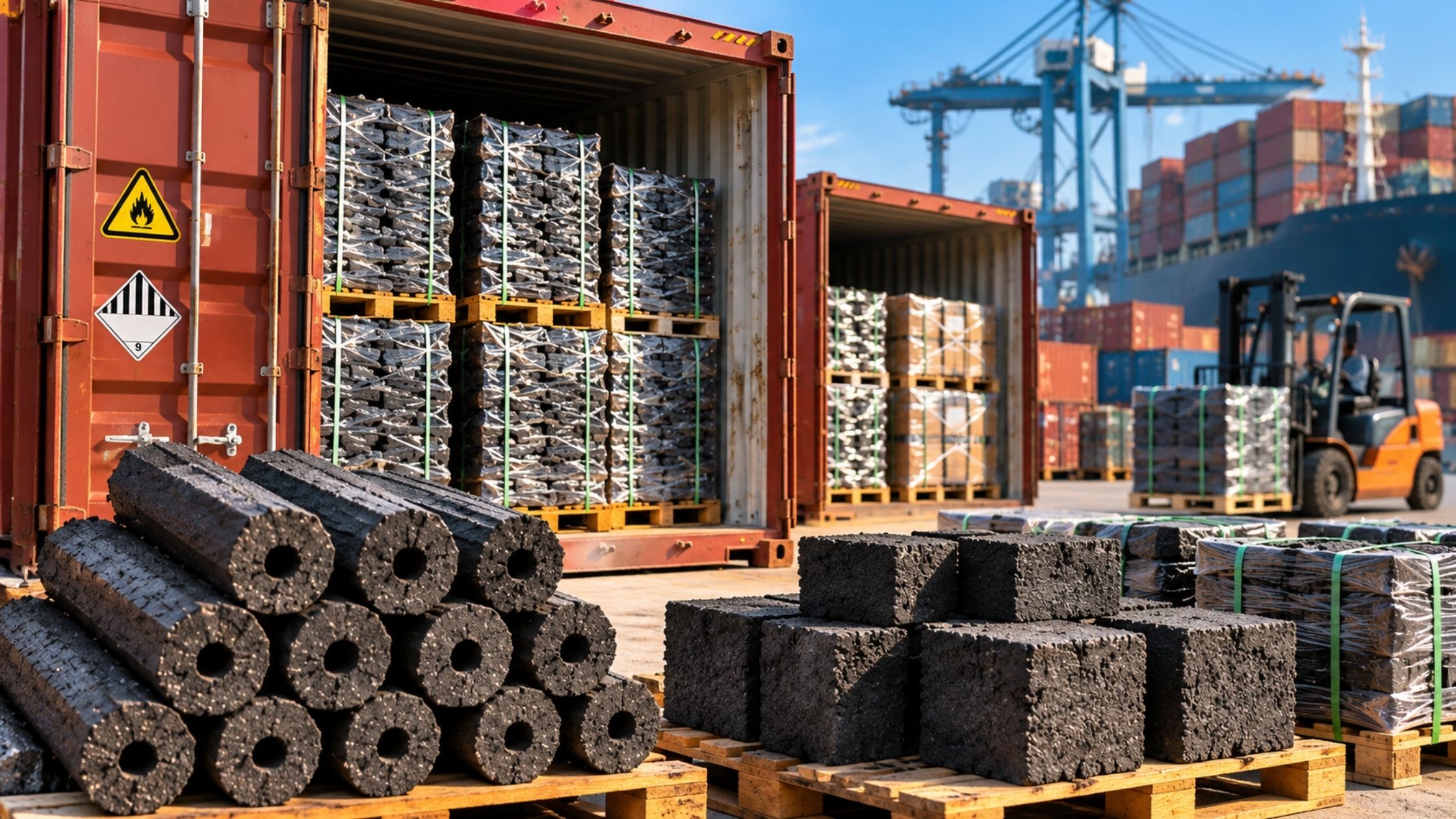




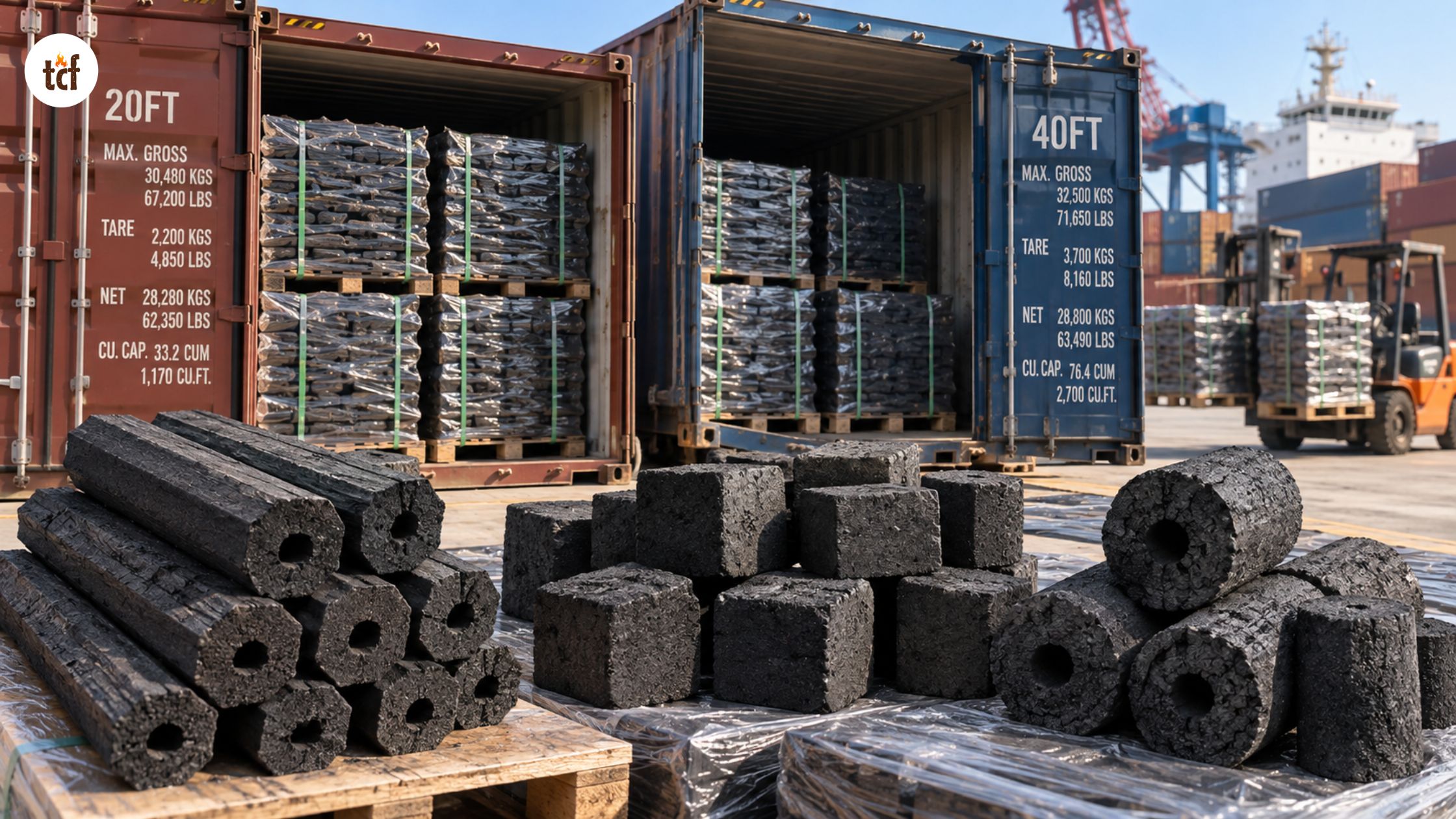
Charcoal Container Loading Guide: A 20ft container typically holds 10 to 20 tons of charcoal, and a 40ft container holds 24 to 28 tons, depending on the charcoal type, packaging, and whether it’s floor-stuffed or palletized. Dense coconut shell briquettes load heavier than lump wood charcoal, and pallets cost you 15 to 20% of usable capacity.
There’s no single answer here; charcoal isn’t a uniform product. Below is the breakdown by type, plus the safety limits that cap how full you can actually pack a container.
Table of Contents
Why charcoal capacity varies so much
Container capacity is limited by 2 different things: weight and volume. For most cargo, weight is the limiting factor; you hit the container’s maximum payload before you run out of physical space.
Charcoal is different. It’s light and bulky relative to its weight. For lump charcoal and low-density briquettes, you often run out of usable space before you hit the container’s weight limit. For dense coconut shell cubes, you can get much closer to the structural weight maximum.
That’s why “how many tons fit in a container” doesn’t have one answer; it depends on what kind of charcoal you’re loading and how dense it is.

Container capacity by charcoal type
| Charcoal type | 20ft container | 40ft / 40ft HQ container |
| Lump wood charcoal, bagged | 10 to 14 tons | 24 to 25 tons |
| Sawdust or hexagon briquettes | 13 to 14 tons | 25 tons |
| Coconut shell briquettes (cube, full retail packaging) | 17 to 18.5 tons | 25 to 26 tons |
| Coconut shell briquettes (bulk packaging, no inner box) | 19.5 to 20 tons | 26 to 28 tons |
| General BBQ charcoal in 10kg bags | Roughly 1,000 to 1,100 bags (10 to 11 tons) | Roughly 2,000 to 2,800 bags (20 to 28 tons) |
These are industry-typical figures pulled from multiple exporters’ loading data, not a fixed standard. Ask your specific supplier for their loading spec sheet, since bag size, box type, and stacking pattern all shift the number.
Also read – US Charcoal Import Requirements
Floor stuffing vs pallets
Palletizing a container costs real capacity. Pallets take up space that could otherwise hold product, and they can’t be stacked as tightly against the container walls and ceiling.
- 20ft container, floor stuffed: up to 17.5 to 20 tons of coconut charcoal (full packaging)
- 20ft container, palletized: drops to roughly 14 to 16.5 tons, a loss of about 3 to 4 tons
- 40ft container, floor stuffed: up to 25 to 26 tons
- 40ft container, palletized: around 22 tons, fitting about 20 standard pallets
The tradeoff is unloading speed. Palletized cargo comes out with a forklift in a fraction of the time floor-stuffed cargo takes to unload by hand. If your destination warehouse has forklift access and labor costs are high, palletizing can still be worth the lost capacity. If you’re optimizing purely for cost per ton shipped, floor stuffing wins.
Why you can’t just fill the container to the ceiling
Charcoal is classified as Dangerous Goods under UN1361, Class 4.2, and that classification comes with physical loading limits, not just paperwork:
- 30cm minimum headspace is required between the top of the stacked cargo and the container roof, to allow heat generated by the charcoal to dissipate rather than build up
- Bag weight limits cap commonly at 30kg per bag under current carrier guidance, though 50kg bags are permitted in some cases
- Stowage pattern matters too; guidance from cargo insurers recommends specific stacking patterns designed to prevent heat accumulation in the center of the load, not just maximum density packing
Skipping the headspace requirement to squeeze in more tonnage isn’t a minor infraction. It’s one of the loading errors tied directly to the container fire incidents that led to charcoal’s current Dangerous Goods enforcement. A container packed to the ceiling is a container more likely to get flagged, held, or rejected at the port, not just a safety risk at sea.
A simple way to estimate your own load
If your supplier gives you a bulk density figure instead of a tonnage number, you can estimate capacity yourself:
- Take the container’s usable internal volume (roughly 28 to 30 cubic meters for a 20ft, 58 to 68 cubic meters for a 40ft, before subtracting headspace)
- Subtract the volume taken up by the mandatory 30cm headspace across the container’s floor area
- Multiply the remaining volume by your product’s bulk density (commonly 250 to 350 kg per cubic meter for loose lump charcoal, 450 to 600 kg per cubic meter for pressed briquettes)
- That gives you an estimated maximum weight; cross-check it against the packaging and bag-count figures your supplier quotes
This is a rough estimate, not a substitute for your supplier’s actual loading plan. Packaging air gaps, pallet use, and stacking pattern all shift the real number in either direction.
Questions to ask your supplier before booking a container
- What’s your standard tonnage for this exact product and packaging, not a general “charcoal” figure?
- Is that figure floor-stuffed or palletized?
- Does your loading plan account for the 30cm headspace requirement?
- What bag or box weight are you using, and does it fall within current carrier limits?
- Can you provide a vanning survey or loading photos before the container is sealed?
A supplier who can answer these with specific numbers for your exact product, rather than a general range, is one whose loading plan you can actually trust.
Must read – FOB vs CIF Charcoal Pricing
Frequently asked questions
How many tons of charcoal fit in a 20ft container?
Typically 10 to 20 tons, depending on the charcoal type. Dense coconut shell briquettes in bulk packaging load closer to 20 tons, while lighter lump wood charcoal loads closer to 10 to 14 tons.
How many tons of charcoal fit in a 40ft container?
Typically 24 to 28 tons, again depending on product density and whether the container is floor-stuffed or palletized.
Why does charcoal load lighter than other cargo in the same container?
Charcoal is bulky relative to its weight, so it often reaches its volume limit before reaching the container’s maximum weight capacity. Dense briquettes get closer to the weight limit than loose lump charcoal does.
Does using pallets reduce how much charcoal fits in a container?
Yes. Pallets typically cost 15 to 20% of usable capacity compared to floor stuffing, since the pallets themselves take up space and can’t be packed as tightly against the container walls.