

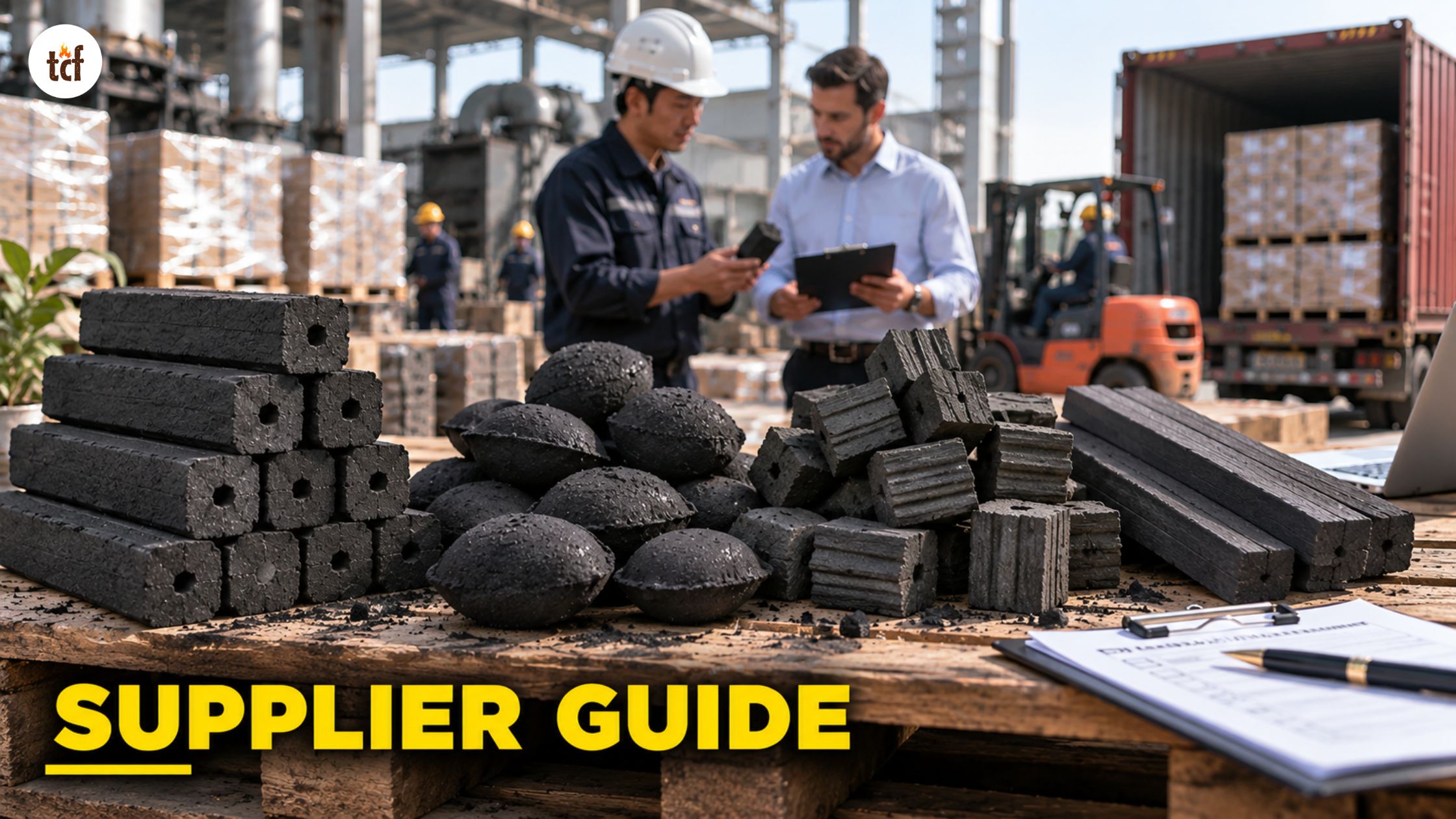
How to choose the right charcoal supplier: evaluate seven things: product quality and charcoal type, production capacity, export experience and documentation, pricing transparency, sample performance, reputation and references, and communication responsiveness. The best suppliers provide graded charcoal with a Certificate of Analysis, handle full export documentation, and have a verifiable track record with importers in your target market. A supplier that checks all seven boxes, like The Charcoal Factory is worth building a long-term partnership with.
The wrong charcoal supplier costs you more than money. It costs you customer trust, market reputation, and months of recovery time after a bad shipment arrives. A delayed container, inconsistent ash content, or undocumented moisture levels can unravel a retail contract you spent a year building.
Yet most buyers find a supplier the same way: a Google search, a few Alibaba listings, a price comparison, and a gut call. That process works until it doesn’t.
This guide is written for importers, distributors, restaurant operators, and retail buyers who need to make the right call the first time. It covers every factor that separates a reliable long-term charcoal partner from a supplier who looks good on paper but fails in the field.
Table of Contents
Why Choosing the Right Charcoal Supplier Is a Business Decision, Not a Purchase Decision
Charcoal is not a commodity you can treat like office supplies. The quality gap between the best and worst hardwood lump charcoal from two different manufacturers can be enormous — even if the product description reads identically. Fixed carbon content, moisture level, ash output, and burn time all vary significantly based on raw material quality, carbonization temperature, and storage conditions.
When you buy charcoal as an importer or distributor, you’re not buying bags — you’re buying consistency. Your customers — restaurants, retailers, end consumers — need the same product performance on every order. A supplier that delivers A-grade quality on the trial order and B-grade quality on container two is not a supplier at all. It’s a liability.
The global wholesale BBQ charcoal market has grown significantly, with demand rising across the Middle East, Europe, Southeast Asia, and North America. More suppliers have entered the market as a result, making the vetting process more important than ever.
The 7 Factors to Evaluate When Choosing a Charcoal Supplier
1. Charcoal Type and Product Match
Before you evaluate any supplier, you need to know exactly what you’re buying and why. Different charcoal types serve fundamentally different applications, and not every supplier produces every type well.
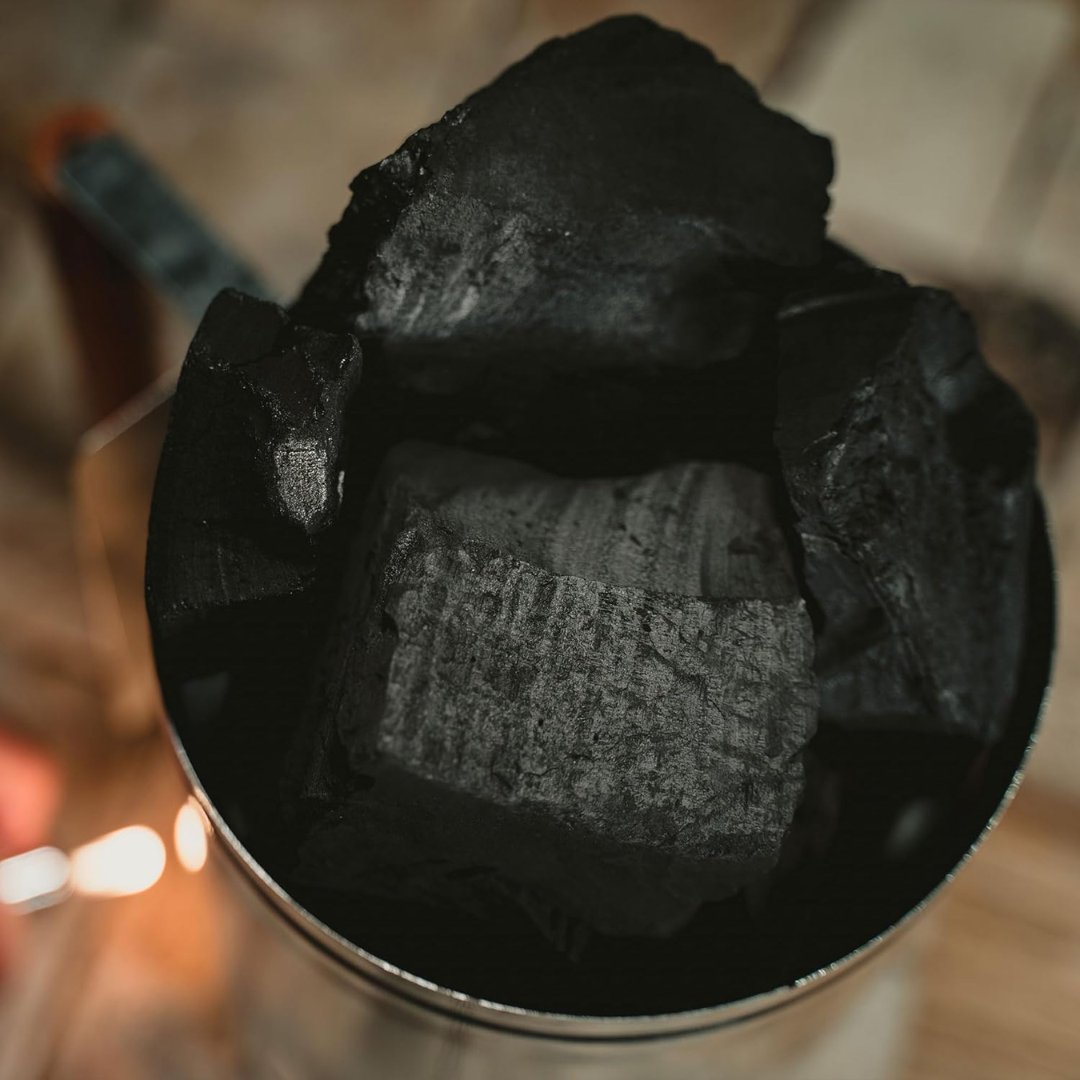
Hardwood lump charcoal is the standard for restaurant BBQ and high-heat grilling. It burns hot, produces genuine wood smoke, and leaves minimal ash. The wood species matters — oak, hardwood blends, and tropical hardwoods like Quebracho all behave differently. If you’re supplying restaurants or bulk charcoal for restaurant operations, this is typically what you need.
Bamboo charcoal burns hotter than most hardwoods with a clean, nearly neutral smoke profile and very low ash. It’s increasingly preferred in premium markets, particularly for wholesale shisha charcoal and high-end restaurant applications where smoke neutrality matters.
Coconut shell charcoal briquettes are favored for shisha and hookah markets because of their low odor, consistent burn time, and eco-friendly sourcing. If you’re supplying hookah lounges, you need a supplier who specialises specifically in this category.
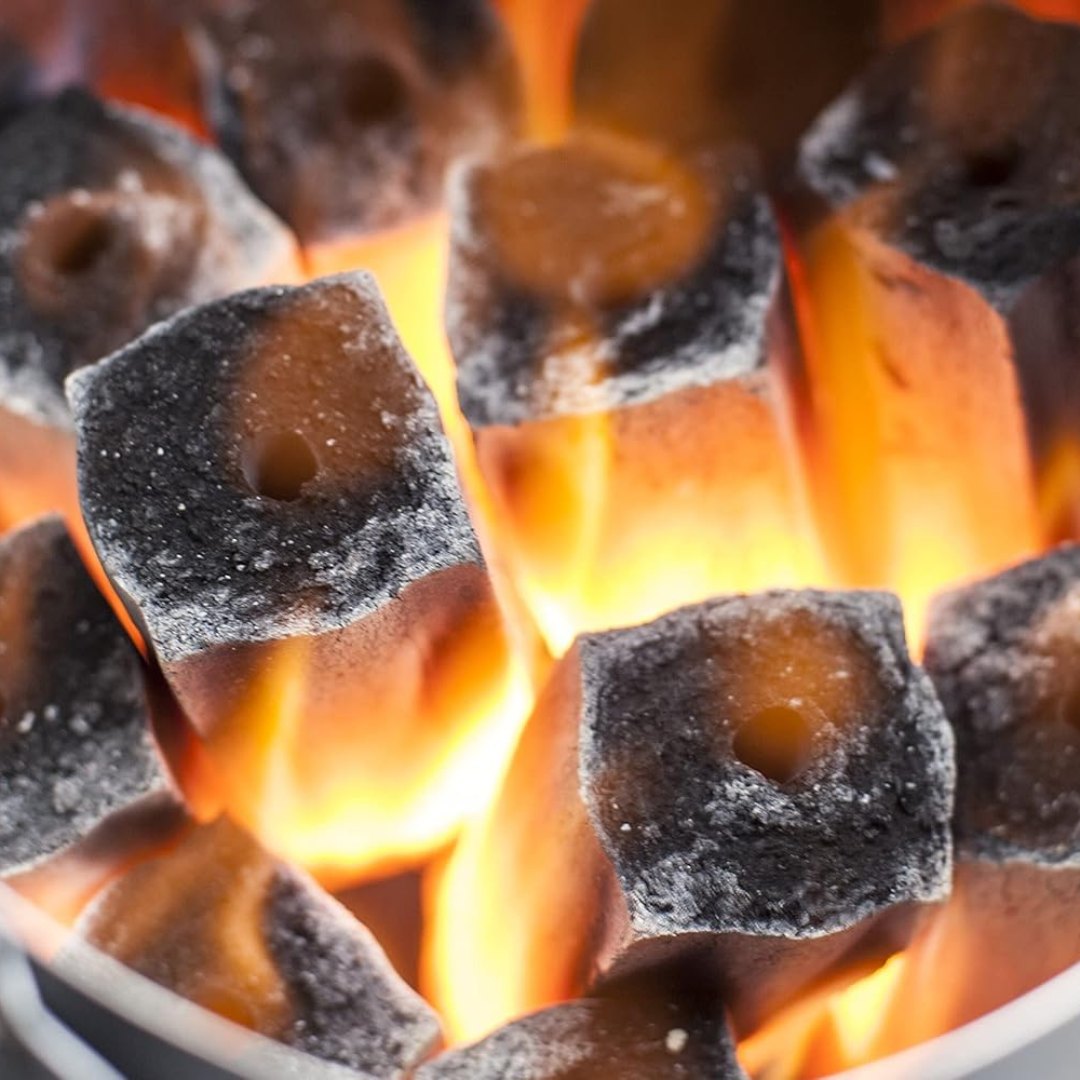
Charcoal briquettes — whether hardwood or compressed — are the backbone of the retail mass market. They’re uniform, easy to light, and predictable. Charcoal briquettes wholesale accounts for a significant share of global charcoal trade because of the sheer volume demanded by supermarkets and garden centers.
What to ask a supplier:
- What is the raw material source (wood species, bamboo variety, coconut shell)?
- What carbonization method and temperature do you use?
- What are the fixed carbon, ash content, moisture, and calorific value specs for each product?
- Do you produce all your charcoal types in-house, or do you source some from third parties?
Match the supplier’s specialty to your actual market need. A supplier that excels at bamboo charcoal may not be your best choice for bulk wood charcoal — and vice versa.
2. Production Capacity and Supply Consistency
Volume capability sounds straightforward but is routinely underestimated by buyers. The question isn’t whether a supplier can fulfill your first order — it’s whether they can fulfill your sixth order at the same quality, at the same time of year, at the same scale.
Ask for monthly and annual production capacity in metric tons. Then ask what percentage of that capacity is already committed to existing clients. A supplier running at 95% capacity is a supply risk when your volumes grow.
Equally important is seasonality. Charcoal production is affected by weather — high-humidity seasons can delay kiln drying and increase moisture content in finished product. Suppliers who manage this well have covered storage facilities, climate-controlled packaging environments, and buffer stock. Suppliers who don’t will pass their weather problems on to you as delayed shipments and off-spec product.
What to ask:
- What is your monthly production capacity in metric tons?
- How do you manage quality consistency across production batches?
- Can you supply year-round, including during your region’s rainy season?
- What is your typical lead time from order confirmation to container loading?
3. Export Experience and Documentation
This is where many buyers are burned, and it’s the factor most commonly underweighted in supplier selection.
Charcoal is classified as Dangerous Goods (UN 1361) by many shipping lines because improperly processed charcoal can self-heat during transit. This makes documentation not just a formality — it’s a critical risk management step. A supplier who has never dealt with this classification before will hand you a logistics problem at the worst possible moment.
A competent charcoal exporter should routinely provide:
- Certificate of Origin — proves the charcoal’s country of manufacture
- Phytosanitary Certificate — required by most countries for wood-based products
- Self-Heating Test (SHT) Certificate — demonstrates the charcoal has been processed to prevent self-ignition in containers
- Certificate of Analysis (CoA) — documents moisture content, ash content, fixed carbon, and calorific value per batch
- Commercial Invoice and Packing List — standard trade documentation
- Bill of Lading — shipping documentation for customs clearance
Ask to see samples of these documents from previous shipments before committing. A supplier who hesitates to share documentation samples — or who doesn’t know what an SHT certificate is — is not ready to be your export partner.
Suppliers like The Charcoal Factory include the full export documentation package as standard with every shipment. That level of operational readiness is a genuine competitive advantage when you’re clearing customs in Germany, the UAE, or Japan.
4. Quality Grading and Transparency
Premium charcoal suppliers don’t just describe their product as “high quality.” They grade it, document it, and back it with verifiable test data.
Look for suppliers who operate with a clear charcoal grading system, A, B, and C grades at minimum with published specifications for each tier. A-grade charcoal should come with a Certificate of Analysis for every batch, not just the first order. This protects you against the common problem of trial-order quality that doesn’t match ongoing supply.
When evaluating grade claims, the numbers that matter most are:
- Fixed carbon content — higher is better; premium hardwood charcoal should be above 75%, premium bamboo above 80%
- Moisture content — should be below 5% for export-grade product
- Ash content — lower ash means cleaner performance; premium lump should be under 3–5%
- Calorific value — measured in kcal/kg; a higher value means more heat output per kilogram
Ask for third-party lab test results, not just in-house reports. Third-party testing from an accredited laboratory is the only way to verify these numbers independently.
The charcoal manufacturing process and production facility at a serious manufacturer will reflect these standards — controlled carbonization temperatures, proper moisture management, and size-graded output.
5. Pricing: What the Numbers Actually Mean
Price matters, but it’s the most misunderstood factor in charcoal supplier selection. The cheapest quote is rarely the best value, and the most expensive supplier isn’t always the best quality.
Charcoal pricing is affected by:
- Wood species and raw material cost
- Carbonization method (traditional kiln vs. controlled industrial process)
- Fixed carbon content and performance specifications
- Packaging type and quality (moisture-proof bags, branded retail packs, bulk sacks)
- Export documentation and logistics costs
- Port of loading and shipping terms (FOB, CIF, DDP)
When comparing quotes, always request pricing under the same Incoterms from every supplier. A FOB price doesn’t include freight and insurance; a CIF price does. Comparing one to the other without adjustment is meaningless.
Be skeptical of prices that are significantly below market. Charcoal that costs 30% less than comparable products from established suppliers usually gets that way through one of three routes: lower raw material quality, higher moisture content (charcoal is sold by weight — wet charcoal is profitable for suppliers, not for buyers), or inconsistent production standards that look fine on small orders and fail on large ones.
Ask for a breakdown of what’s included in the price: packaging, documentation, inland freight to port, and any applicable export taxes. A supplier who can walk you through their pricing structure clearly is a supplier who understands their costs — and will be predictable to work with long-term.
6. Reputation, References, and Track Record
A supplier’s history is the most reliable predictor of their future performance. Before placing any significant order, do the verification work.
Request business credentials: Business registration, export licenses, and any applicable certifications (FSC for sustainably sourced wood, ISO quality management, relevant food-safety certifications for charcoal going into restaurant supply chains).
Ask for references from existing clients, specifically importers in your target market or a similar one. A supplier who has been exporting consistently to Germany, Japan, or the UAE for five or more years has demonstrated they can meet the strict compliance standards those markets demand.
Search for the company independently. Look for the supplier’s name on trade databases, LinkedIn, and industry forums. Do the products they sell match their listed specialisation? Are there any negative mentions from previous buyers? A supplier with an active online presence, published product specifications, and verifiable export history is a meaningfully lower risk than one who exists only as a price sheet in your inbox.
Check their product range depth. Suppliers who offer machine-made wood charcoal, shaped wood charcoal, machine-made bamboo charcoal, and shaped bamboo charcoal from in-house production are demonstrably more serious operations than those offering a single product type with no evidence of manufacturing depth.
7. Communication and Responsiveness
This factor is easy to overlook during supplier selection and impossible to ignore once you’re three containers in. A supplier who is slow to respond during sales is a supplier who will be slow to respond when you have a problem.
Evaluate communication quality from your first contact. Do they respond to technical questions with specific, accurate answers, or with generic marketing language? Can they discuss fixed carbon percentages, SHT certification procedures, and Incoterm implications in detail? Do they proactively share documentation and test reports, or do you have to chase every piece of information?
Suppliers who are transparent and technically competent during the evaluation phase are the ones who handle problems constructively when something goes wrong — because something always eventually goes wrong in international shipping. The question is whether your supplier is a partner in resolving it or a source of further delay.
Also read – Best charcoal for grilling
Red Flags: When to Walk Away
Not every warning sign is obvious in a first call or product brochure. These are the signals experienced importers have learned to take seriously:
Refusing to send samples. Any legitimate wholesale charcoal manufacturer can provide samples. Refusal or excessive delay almost always means the product on hand doesn’t match what they’ve described.
Inability to explain their manufacturing process. If a supplier can’t describe how their charcoal is produced, at what temperature, using what raw materials, and with what quality control steps, they are likely a trader, not a manufacturer. Traders aren’t inherently bad, but they carry more supply chain risk because they’re sourcing from factories they don’t directly control.
Prices dramatically below market rate. As covered above, this is almost always explained by quality compromise. If a supplier can’t explain why their price is lower than the market average, the explanation is usually in the product spec — specifically in higher moisture or lower fixed carbon content.
Vague or missing documentation. A supplier who is slow to produce a Certificate of Origin, has never issued a Self-Heating Test certificate, or can’t provide a CoA for their A-grade product is not equipped to export reliably to most major markets.
Inconsistency between product description and test results. If a supplier describes their charcoal as “high fixed carbon, low ash” but their lab report shows 68% fixed carbon and 8% ash, that’s a fundamental misrepresentation — and a preview of how they’ll handle disputes.
No references or verifiable export history. New suppliers aren’t automatically bad, but a supplier who claims years of export experience and can’t name a single verifiable client or destination market has something to hide.
The Supplier Evaluation Checklist
Before placing a bulk order with any charcoal supplier, run through this checklist:
Product Quality
- [ ] Certificate of Analysis provided for sample batch
- [ ] Third-party lab test results available (not just in-house reports)
- [ ] Fixed carbon, moisture, ash content, and calorific value clearly stated
- [ ] Product type matches your market application
Production Capability
- [ ] Monthly capacity confirmed in metric tons
- [ ] In-house manufacturing (not just trading)
- [ ] Year-round supply capability confirmed
- [ ] Storage and packaging environment appropriate for moisture control
Export Readiness
- [ ] Self-Heating Test (SHT) certificate available
- [ ] Phytosanitary certificate process confirmed
- [ ] Certificate of Origin process confirmed
- [ ] CoA issued per batch as standard
- [ ] Export license and business registration provided
Commercial Terms
- [ ] Pricing quoted under consistent Incoterms
- [ ] Packaging options and costs clearly explained
- [ ] Lead time and minimum order quantity confirmed
- [ ] Payment terms clearly stated
Reputation
- [ ] References from existing importers provided
- [ ] Export history to your target market or equivalent verifiable
- [ ] Company independently verifiable online
Communication
- [ ] Technical questions answered specifically and accurately
- [ ] Response time within 24–48 hours consistently
- [ ] Proactive documentation sharing
Private Label and Supermarket Supply: An Additional Consideration
For importers supplying retail chains or building their own charcoal brand, supplier capability goes beyond product quality and logistics. You need a manufacturer who can support custom packaging, brand artwork, and consistent retail-unit specifications.
This is a specialised capability. Not every bulk charcoal manufacturer can transition into retail-grade production with consistent bag weights, branded printing, and presentation standards appropriate for European or Middle Eastern supermarket shelves.
The Charcoal Factory’s private-label program for supermarkets is built specifically for this use case — handling production, branded packaging, and export documentation as a single integrated service for retail buyers.
How to Start the Supplier Relationship
Once you’ve identified a supplier who passes your initial evaluation, the right sequence is:
1. Request a sample. For nearby suppliers, ask for a direct sample shipment. For international suppliers, a paid sample with freight is standard and worthwhile. Test the sample against the CoA: weigh a known quantity, burn it, measure ash output, and assess smoke character.
2. Place a trial order. One container or the minimum order quantity. Match the delivered product against the CoA from the sample phase. Check moisture content on arrival, verify packaging integrity, and review all documentation.
3. Review the full experience. Was communication consistent throughout? Were timelines met? Did the product match the sample? Were documents provided proactively and correctly? These are the signals that predict long-term reliability.
4. Build the relationship deliberately. Good charcoal suppliers — like any serious manufacturer — prefer working with buyers who are professional, consistent, and growing. Share your volume projections. Give reasonable lead times. Pay on agreed terms. The suppliers who are most reliable are also the most selective about who they work with long-term.
Final Verdict
Choosing the right charcoal supplier is one of the highest-leverage decisions an importer or distributor makes. Get it right and you have a stable supply chain, consistent product quality, and the confidence to grow your market. Get it wrong and you’re managing customer complaints, custom shipment rejections, and supply gaps that your competitors will fill.
The supplier that earns a long-term partnership is not necessarily the cheapest or the largest. It’s the one that is transparent about product grading, meticulous about export documentation, technically competent, and consistent from container one to container twenty.
Use the checklist in this guide before every new supplier relationship. Request samples. Verify documentation. Check references. And trust the numbers — not the marketing language — when evaluating product specs.
Frequently Asked Questions
What is the most important factor when choosing a charcoal supplier?
Quality consistency across orders, not just on the trial. A Certificate of Analysis per batch, third-party lab results, and clear product grading are the most reliable signals that a supplier can maintain standards at scale.
How do I verify a charcoal supplier’s quality before ordering?
Request samples, ask for a Certificate of Analysis and third-party lab test results, and conduct a burn test on the sample. Check moisture content on arrival and compare ash output to spec. For a detailed process, see the charcoal supplier verification checklist.
What documents should a charcoal supplier provide?
At minimum: Certificate of Origin, Phytosanitary Certificate, Self-Heating Test (SHT) Certificate, Certificate of Analysis, Commercial Invoice, Packing List, and Bill of Lading.
What is the difference between a charcoal manufacturer and a charcoal trader?
The manufacturer produces charcoal directly from raw materials in their own facility. A trader sources charcoal from multiple factories and resells it. Manufacturers generally offer more consistency and traceability; traders may offer more product variety but carry higher batch-to-batch variability risk.
How do I find a charcoal supplier for my restaurant?
Look for a supplier with specific bulk charcoal for restaurant experience, high fixed carbon content product (for high-heat cooking), low ash output, and reliable delivery schedules. Restaurant supply requires consistency above all else.