

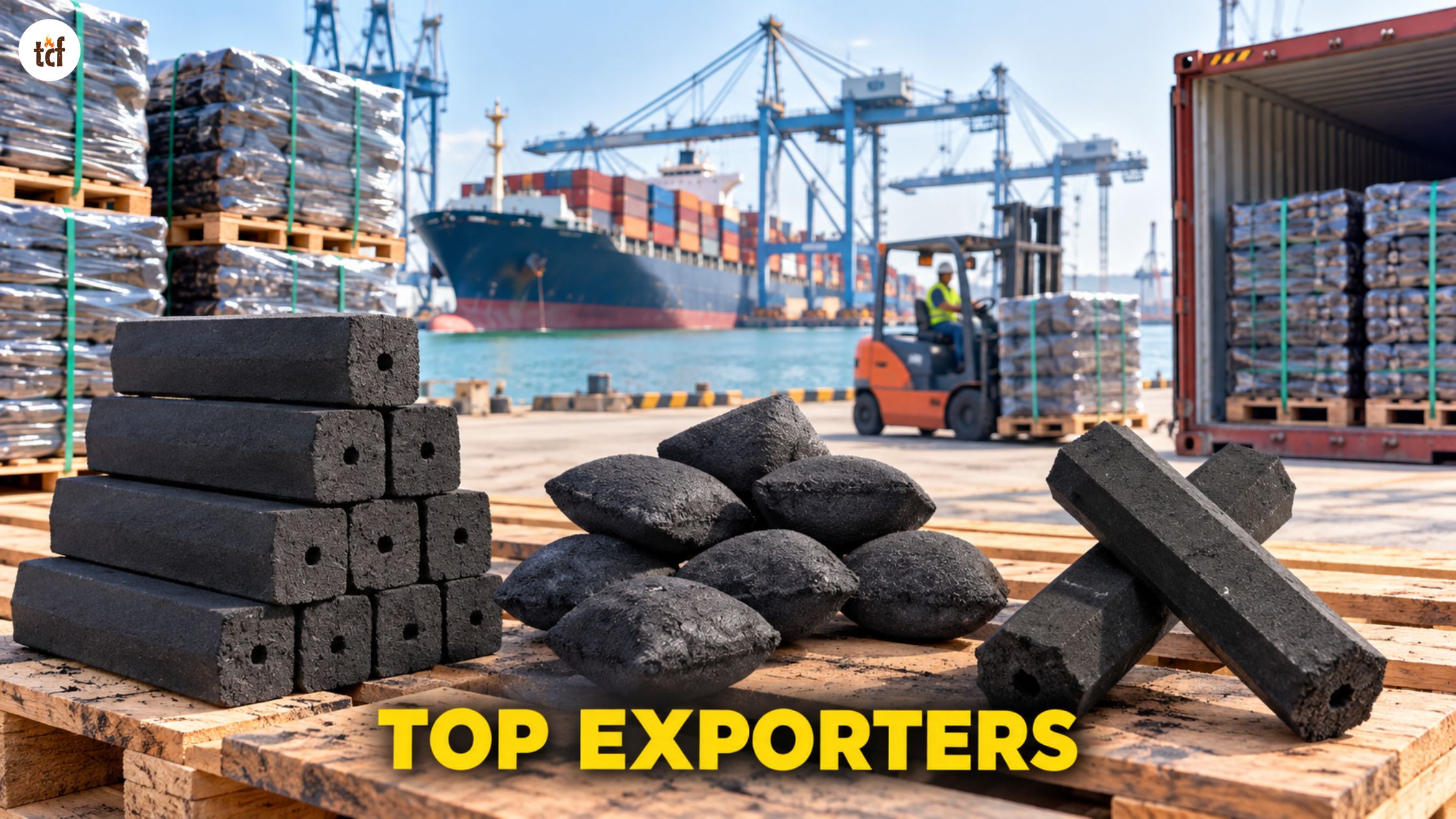
The top countries exporting charcoal in 2024–2026 are Indonesia (the undisputed world leader at ~23% of global export value), followed by Vietnam, Laos (the fastest-rising), the Philippines, and China. Together, the top 15 charcoal-exporting nations account for around 80% of the $1.53 billion global charcoal export market. Indonesia alone generated a net export surplus of US$350.6 million in 2024, making it the single most dominant force in the international charcoal trade.
Table of Contents
Key takeaway
Indonesia is the world’s largest charcoal exporter, with about 23% of the US$1.53 billion export market, followed by Vietnam, Laos, the Philippines, and China. Southeast Asia dominates supply, East Asia and the Middle East drive demand, and buyers increasingly require certified, sustainable charcoal.
The Global Charcoal Export Market in 2026: What the Numbers Tell Us
The global wood charcoal export market is worth US$1.53 billion as of 2024 the most recent full-year trade data available, representing a 16% increase over the $1.32 billion recorded in 2020. However, it marked a slight 3.9% dip from the $1.59 billion peak in 2023, reflecting a correction in international trade prices following a period of sustained growth.
The broader charcoal market (including domestic production and consumption) is significantly larger. According to Research and Markets’ 2026 forecast, the entire charcoal industry was valued at $5.86 billion in 2025, growing to $6.27 billion in 2026, and is projected to reach $8.12 billion by 2030 at a CAGR of approximately 6.7%.
Key global trade statistics as of 2024–2026:
| Metric | Data |
| Total global charcoal export value (2024) | US$1.53 billion |
| Average export price per tonne (2024) | US$526/tonne |
| Average import price per tonne (2024) | US$540/tonne |
| Year-on-year change in export value | -3.9% (from 2023) |
| 5-year growth (2020–2024) | +16% |
| Top 15 countries’ share of global exports | ~80% |
| Total global charcoal market (2026 est.) | $6.27 billion |
| Projected global market by 2030 | $8.12 billion |
Source: International Trade Centre (ITC), World’s Top Exports, IndexBox Global Wood Charcoal Market Report 2026
What makes the charcoal export market particularly interesting in 2026 is its duality. The largest volume producers — Brazil, Ethiopia, and Nigeria — produce charcoal almost entirely for domestic consumption. The international trade network is a separate ecosystem, primarily supplying premium-grade charcoal for BBQ culture, metallurgy, filtration, and restaurant use to industrialised nations in East Asia, Europe, and the Middle East.
Also read – Types of Charcoal
10 Top Countries Exporting Charcoal (2024–2026 Rankings)
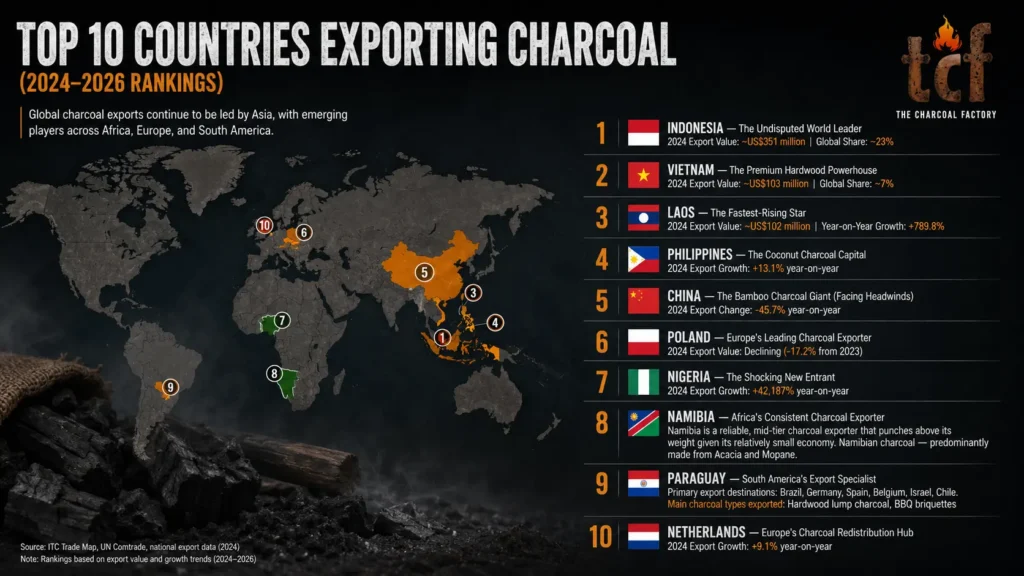
1. 🇮🇩 Indonesia — The Undisputed World Leader
2024 Export Value: ~US$351 million | Global Share: ~23%
Indonesia is one of the top countries exporting charcoal and has held the top position in global charcoal exports for over a decade, and that dominance shows no sign of reversing. The country’s vast tropical forests provide an abundant and diverse feedstock, with hardwood lump charcoal and coconut shell charcoal briquettes being its two flagship export products. Indonesian lump charcoal is internationally celebrated for its high heat output, long burn time, and clean burn with minimal ash, making it highly sought after in Europe, the Middle East, Japan, and North America.
Coconut shell charcoal briquettes represent a growing share of Indonesian exports, driven by surging global demand for eco-friendly fuel alternatives. Indonesia’s charcoal producers have invested heavily in modern kiln technology and certification programmes, with many now holding FSC (Forest Stewardship Council) and other sustainability credentials that open doors to premium European and North American markets.
Despite a 9.7% decline in net export surplus from 2023, reflecting competitive pricing pressures from fast-emerging rivals like Laos and Vietnam, Indonesia remains the singular dominant force in international charcoal trade. Government-backed certification for eco-friendly charcoal production is strengthening its long-term position.
Primary export destinations: Japan, China, Saudi Arabia, South Korea, Germany, Netherlands, UK. Main charcoal types exported: Hardwood lump charcoal, coconut shell charcoal briquettes, activated charcoal
Tip: Much of the premium lump charcoal and coconut shell charcoal available in the UK market is sourced from Indonesia.
2. 🇻🇳 Vietnam — The Premium Hardwood Powerhouse
2024 Export Value: ~US$103 million | Global Share: ~7%
Vietnam has established itself as one of the world’s most respected charcoal exporters, particularly known for its high-quality mangrove charcoal and hardwood lump charcoal. Vietnamese charcoal is prized in the Japanese market, one of the world’s most discerning charcoal buyers, for its consistent quality, clean burn, and suitability for traditional cooking methods.
A strong manufacturing infrastructure with modern carbonisation kilns and robust export logistics supports the country’s charcoal industry. Vietnam is a primary supplier to Saudi Arabia’s rapidly growing hospitality sector, and a key source for South Korea’s BBQ restaurant industry. It is also the origin of much of the premium charcoal sold in speciality BBQ stores across Europe.
Vietnam’s charcoal export industry has grown significantly over the last decade, with the country positioning itself for premium market segments rather than competing purely on volume and price. Sustainability certifications and value-added processing (pre-packaging, branded retail) are distinguishing Vietnamese exporters in international markets.
Primary export destinations: Japan, Saudi Arabia, South Korea, China, the USA, UAE. Main charcoal types exported: Mangrove charcoal, hardwood lump charcoal, sawdust briquettes
3. 🇱🇦 Laos — The Fastest-Rising Star
2024 Export Value: ~US$102 million | Year-on-Year Growth: +789.8%
Laos is the most dramatic charcoal export story of 2024. From a relatively minor player, the country recorded a staggering 789.8% increase in the value of charcoal exports in a single year, catapulting it into the top tier of global suppliers. This explosive growth is driven by Laos’ abundant bamboo and hardwood resources, improving export infrastructure, and close geographic proximity and trade ties with major East Asian importers, particularly China and South Korea.
Laotian charcoal is particularly price-competitive due to lower production and labour costs. It primarily produces lump charcoal varieties, which command higher international prices for their superior burn quality and minimal ash residue. Investment in modern kilns and export-grade processing facilities is ongoing, and Laos is widely expected to consolidate and expand its position through 2026 and beyond.
Primary export destinations: China, South Korea, Japan, Thailand. Main charcoal types exported: Hardwood lump charcoal, bamboo charcoal
Also read – Charcoal grades
4. 🇵🇭 Philippines — The Coconut Charcoal Capital
2024 Export Growth: +13.1% year-on-year
The Philippines occupies a unique position in the global charcoal trade; it is the world’s foremost producer of coconut shell charcoal, benefiting from its enormous coconut industry and abundant shell by-product supply. Philippine coconut shell charcoal briquettes are exported globally, with particularly strong demand from shisha/hookah markets in the Middle East, European BBQ markets, and eco-conscious buyers across North America and Asia.
Filipino coconut charcoal is internationally recognised for its high carbon content, very low ash production, long burn time (4–5 hours), and zero deforestation impact. These attributes make it one of the most environmentally compelling bulk charcoal products in global trade, and exporters are increasingly winning premium pricing in sustainability-focused markets. The Philippines continues to expand its export capacity with investment in modern briquetting facilities.
Primary export destinations: Saudi Arabia, UAE, Germany, Netherlands, UK, USA, Japan. Main charcoal types exported: Coconut shell charcoal briquettes, coconut shell lump charcoal
5. 🇨🇳 China — The Bamboo Charcoal Giant (Facing Headwinds)
2024 Export Change: -45.7% year-on-year
China has historically been a top-5 global charcoal exporter, most notably for its bamboo charcoal — a sustainable alternative to hardwood charcoal made from China’s abundant and fast-growing bamboo resources. Bamboo charcoal is widely used for cooking, but also finds significant applications in water filtration, air purification, and even skincare, making Chinese charcoal exports unusually diversified.
However, 2024 saw a significant 45.7% decline in Chinese charcoal exports. This reflects several pressures: increased domestic consumption driven by China’s own booming BBQ culture and silicon manufacturing industry (which uses charcoal as a reducing agent), rising competition from lower-cost Southeast Asian producers, and tighter environmental regulations affecting domestic charcoal production capacity. Despite this correction, China’s infrastructure, bamboo resource base, and diversified product portfolio mean it will remain a major player in the global charcoal trade.
Primary export destinations: Japan, South Korea, the USA, Germany, and Vietnam. Main charcoal types exported: Bamboo charcoal, activated charcoal, and hardwood charcoal briquettes. China is also known for the best charcoal types for BBQ.
6. 🇵🇱 Poland — Europe’s Leading Charcoal Exporter
2024 Export Value: Declining (-17.2% from 2023)
Poland is the standout charcoal-exporting nation within Europe and has consistently ranked among the top global exporters. It primarily produces premium hardwood charcoal from managed European forests, predominantly oak and beech, which is highly prized across Germany, France, and the broader EU BBQ market for its high calorific value, long burn duration, and clean flavour profile.
Poland’s charcoal benefits from two key competitive advantages: its strategic geographic location in central Europe for efficient intra-EU distribution, and its adherence to strict European sustainable forestry standards. Polish charcoal is widely stocked in European supermarkets, garden centres, and BBQ speciality retailers. However, it faces growing competition from lower-cost Southeast Asian producers, contributing to its recent export decline.
Primary export destinations: Germany, Netherlands, France, Czech Republic, UK, Belgium. Main charcoal types exported: Hardwood lump charcoal (oak, beech), hardwood briquettes
Also read – charcoal manufacturers uk
7. 🇳🇬 Nigeria — The Shocking New Entrant
2024 Export Growth: +42,187% year-on-year
Nigeria’s emergence as a significant charcoal exporter in 2024 is arguably the most remarkable trade story in the entire commodity sector. A staggering 42,187% increase in export value (from an extremely low base) signals that Nigeria is rapidly converting part of its massive charcoal production capacity — it is one of the world’s top 3 charcoal producers — from purely domestic use into international export channels.
Nigeria, Ethiopia, and Brazil together produce approximately 30% of global charcoal by volume, almost all of which has historically been consumed domestically. Nigeria’s shift toward exports reflects improving trade infrastructure, growing interest from European and Middle Eastern importers looking to diversify supply chains, and increasing production capacity. The country’s hardwood resources are substantial, though concerns about sustainable sourcing and deforestation remain a significant issue that Nigerian exporters must address to gain access to premium, certification-sensitive markets.
Primary export destinations: Europe, the Middle East (emerging). Main charcoal types exported: Hardwood lump charcoal
8. 🇳🇦 Namibia — Africa’s Consistent Charcoal Exporter
Namibia is a reliable, mid-tier charcoal exporter that punches above its weight, given its relatively small economy. Namibian charcoal, predominantly made from Acacia and Mopane hardwoods, is celebrated in European BBQ markets (particularly Germany) for its extremely high density, intense heat, and distinctive aromatic smoke. It is frequently positioned as a premium product in the European retail market.
Notably, charcoal accounts for a significant share of Namibia’s total export value, underscoring how central the industry is to the country’s economy. Sustainable forestry management is a growing focus, with Namibian producers working with European importers to develop certified sustainable supply chains.
Primary export destinations: Germany, Netherlands, UK, South Africa, Botswana. Main charcoal types exported: Mopane and Acacia hardwood lump charcoal
9. 🇵🇾 Paraguay — South America’s Export Specialist
Paraguay is South America’s dominant charcoal exporter, although it has faced criticism for the role of charcoal production in driving deforestation of the country’s tropical dry forests. The country exports primarily to Brazil, the world’s largest charcoal consumer as well as to Europe, Israel, and Chile. High-quality barbecue charcoal from Paraguay is particularly well-regarded in Spain, Germany, and Belgium.
Primary export destinations: Brazil, Germany, Spain, Belgium, Israel, and Chile. Main charcoal types exported: Hardwood lump charcoal, BBQ briquettes
Must read – cost to import charcoal from China
10. 🇳🇱 Netherlands — Europe’s Charcoal Redistribution Hub
2024 Export Growth: +9.1% year-on-year
The Netherlands’ presence in the top charcoal-exporting countries may initially seem surprising for a country with limited native forest resources. Its role is that of a trade and logistics hub rather than a primary producer. Netherlands-based traders and distributors import large volumes of charcoal (predominantly from Southeast Asia, Africa, and Eastern Europe), reprocess and repackage them, and redistribute them across European markets.
Rotterdam — Europe’s largest port — sits at the centre of this redistribution activity, giving Dutch traders unparalleled logistical access to the European continent. The Netherlands is growing its charcoal re-export activity (+9.1% in 2024), particularly for premium and sustainably certified product lines destined for the UK, German, and Scandinavian retail markets.
Primary re-export destinations: Germany, UK, France, Belgium, Scandinavia. Main charcoal types handled: Lump charcoal, coconut shell briquettes, and hardwood briquettes.
Countries Whose Charcoal Exports Are Declining (2024)
Not every nation is growing its charcoal export footprint. These countries saw significant export declines in 2024:
| Country | Export Change (2024 vs 2023) | Key Reason |
| China | -45.7% | Rising domestic demand, competition, and tighter regulations |
| Mexico | -42.1% | Supply chain disruptions, reduced US demand |
| Cuba | -21.5% | Economic challenges, reduced production capacity |
| Poland | -17.2% | Competition from Southeast Asian producers |
| Germany | -17.1% | Shifting to redistribution rather than domestic production |
Who Is Buying? Top Charcoal Importing Countries (2024–2026)
Understanding where charcoal is going is as important as understanding where it comes from. The top three charcoal-importing nations by value in 2024 were:
| Country | 2024 Import Value | Global Share | Primary Use |
| 🇨🇳 China | ~$194 million | ~11% | Industrial (silicon manufacturing), BBQ culture |
| 🇯🇵 Japan | ~$122 million | ~7% | Premium binchotan, restaurant yakitori |
| 🇰🇷 South Korea | ~$119 million | ~6.8% | BBQ culture, restaurant industry |
| 🇸🇦 Saudi Arabia | High demand | Growing | Shisha/hookah, hospitality sector |
| 🇺🇸 USA | ~$116 million | ~6.6% | BBQ culture, outdoor cooking |
China, Japan, and South Korea together account for approximately 24% of global charcoal import value, a remarkable concentration that demonstrates East Asia’s insatiable appetite for quality charcoal. Saudi Arabia’s hospitality boom and deeply rooted BBQ and shisha traditions also make it a consistently high-demand market.
The UK and Germany, though not in the top five by value, are critical markets for premium BBQ charcoal, binchotan, and sustainability-certified products and represent the markets most directly relevant to PartSparkz’s audience.
Also read – how is activated bamboo charcoal made
What Type of Charcoal Do Countries Export?
Different countries specialise in different charcoal products, and the type of charcoal they export shapes their market access significantly:
| Charcoal Type | Leading Exporting Countries | Primary Use |
| Hardwood Lump Charcoal | Indonesia, Vietnam, Laos, Namibia, Nigeria, Paraguay | BBQ, restaurant grilling |
| Coconut Shell Briquettes | Philippines, Indonesia, Sri Lanka | BBQ, shisha/hookah |
| Bamboo Charcoal | China | Cooking, filtration, skincare |
| Hardwood Briquettes (Oak/Beech) | Poland, Germany, Czech Republic | European BBQ retail |
| Mangrove Charcoal | Vietnam, Indonesia | Traditional cooking, export premium |
| Binchotan (White Charcoal) | Japan | Premium restaurant and BBQ use |
| Activated Charcoal | China, India, Philippines | Industrial, filtration, pharmaceutical |
Tip: Looking for a specific charcoal type for your BBQ setup? The Charcoal Factory’s Full Charcoal Product Range stocks lump charcoal, coconut shell briquettes, hardwood briquettes, and premium binchotan sets, all curated for the UK BBQ market.
2025–2026 Trends Shaping Global Charcoal Exports
1. The Sustainability Shift Is Accelerating
Nearly 60% of new charcoal product launches in 2024 focused on renewable materials: coconut shells, bamboo, and agricultural waste rather than hardwood. FSC certification, ISO standards, and eco-labelling are no longer optional for exporters targeting European and North American markets. Countries that can certify sustainable supply chains are winning premium pricing.
2. Southeast Asia Is Consolidating Its Dominance
Indonesia, Vietnam, Laos, and the Philippines together are cementing Southeast Asia’s position as the undisputed centre of global charcoal export. The region’s combination of tropical hardwood resources, coconut industry by-products, competitive production costs, and improving logistics infrastructure is difficult for other regions to replicate.
3. Africa Is Awakening as an Export Force
Nigeria’s explosive entry into export markets in 2024 signals a broader potential shift. Africa produces approximately 63% of global charcoal by volume, but has historically consumed virtually all of it domestically. As infrastructure improves and international buyers seek supply chain diversification, African exports are expected to grow significantly through 2026–2030.
4. East Asian Demand Continues to Drive the Market
China’s domestic BBQ culture is growing rapidly even as its charcoal exports decline, a paradox that reflects the country’s transformation from net exporter to net importer. South Korea’s BBQ restaurant culture remains one of the most consistent drivers of import demand globally. Japan’s yakitori and premium grilling culture sustains strong demand for high-value binchotan and quality lump charcoal.
5. The Middle East Is a Rising Import Market
Saudi Arabia’s hospitality sector boom new hotels, resorts, and commercial catering operations opening at pace is driving surging charcoal demand. Combined with the region’s deep-rooted shisha/hookah culture, the Middle East is one of the fastest-growing destinations for charcoal exports from Southeast Asia and Africa.
6. Price Correction After the 2023 Peak
The average export price of charcoal fell to $526 per tonne in 2024, down 14.8% from the $617 peak in 2023. For consumers and BBQ enthusiasts, this is broadly positive news; import prices should stabilise or moderate in 2025–2026 after a period of sustained increases.
Why Does Charcoal Trade Matter to BBQ Enthusiasts?
You might be wondering: why does any of this matter to someone who just wants to fire up their grill for a weekend cook?
The answer is, supply chains and sourcing matter for three reasons:
1. Quality — The origin of your charcoal directly affects what you’re burning. Indonesian hardwood lump and Philippine coconut shell charcoal are internationally validated as high-quality, clean-burning fuels. Knowing your source helps you make better buying decisions.
2. Sustainability — Charcoal production is responsible for significant deforestation in certain regions (particularly parts of Africa and South America). Choosing FSC-certified charcoal or coconut shell charcoal from Philippines-origin producers means your BBQ is not contributing to forest destruction.
3. Price — Global trade disruptions, shipping cost fluctuations, and price corrections in exporting countries directly flow through to what you pay at retail. The 2024 price correction means better value for consumers is possible in 2025–2026.
Conclusion: What the Global Charcoal Trade Means in 2026
The global charcoal export market in 2026 is dynamic, increasingly sustainability-focused, and dominated by a clear Southeast Asian axis led by Indonesia, Vietnam, Laos, and the Philippines. The most dramatic stories of the moment are the explosive rise of Laos and Nigeria as fast-emerging exporters, the continued decline of China as an exporter (even as it grows as an importer), and the global pivot toward eco-certified, coconut-shell, and bamboo-based charcoal products.
For BBQ enthusiasts in the UK, understanding this global picture helps you make smarter, more informed buying decisions — knowing where your charcoal comes from, what it’s made of, and whether it was produced responsibly.
For Further Reading:
Charcoal HS Codes
lump charcoal vs briquettes
Best charcoal for grilling
Charcoal grades
can you reuse charcoal
Best charcoal for smoking
types of charcoal
Frequently Asked Questions
Which country exports the most charcoal in the world?
Indonesia is the world’s largest charcoal exporter by a significant margin, accounting for approximately 23% of global charcoal export value in 2024. Its net export surplus reached US$350.6 million, the highest of any nation. Indonesia exports hardwood lump charcoal and coconut shell charcoal briquettes.
What is the total value of global charcoal exports?
Global wood charcoal exports were valued at approximately US$1.53 billion in 2024, a 16% increase over 2020 levels, though a slight 3.9% dip from the 2023 peak of $1.59 billion.
Which charcoal-exporting country had the fastest growth in 2024?
Nigeria recorded the most dramatic growth, up approximately 42,187% year-on-year, from an extremely low base as it began converting some of its enormous domestic production capacity into international exports. Laos was the other standout, up 789.8%, making it one of the top three exporters in 2024.
Which countries are the biggest charcoal producers (not exporters)?
Brazil (7.4M tonnes), Ethiopia (5M tonnes), and Nigeria (4.9M tonnes) are the world’s top three charcoal producers by volume, together representing 29% of global production. However, most of this is consumed domestically, particularly in Brazil for the steel industry and in Ethiopia and Nigeria for household cooking fuel.
Why does Japan import so much charcoal?
Japan imports approximately $122 million of charcoal per year, primarily premium-grade binchotan and high-quality hardwood charcoal to support its yakitori restaurant culture, traditional grilling traditions, and high-end BBQ market. Japan has limited domestic charcoal production capacity and extremely high quality standards, making it one of the most discerning and lucrative import markets in the world.
What is the average price of exported charcoal per tonne?
The average global wood charcoal export price was $526 per tonne in 2024, down 14.8% from the 2023 peak of $617 per tonne. The long-term price trend shows an average annual increase of +2.3% from 2012 to 2024 despite this recent correction.