

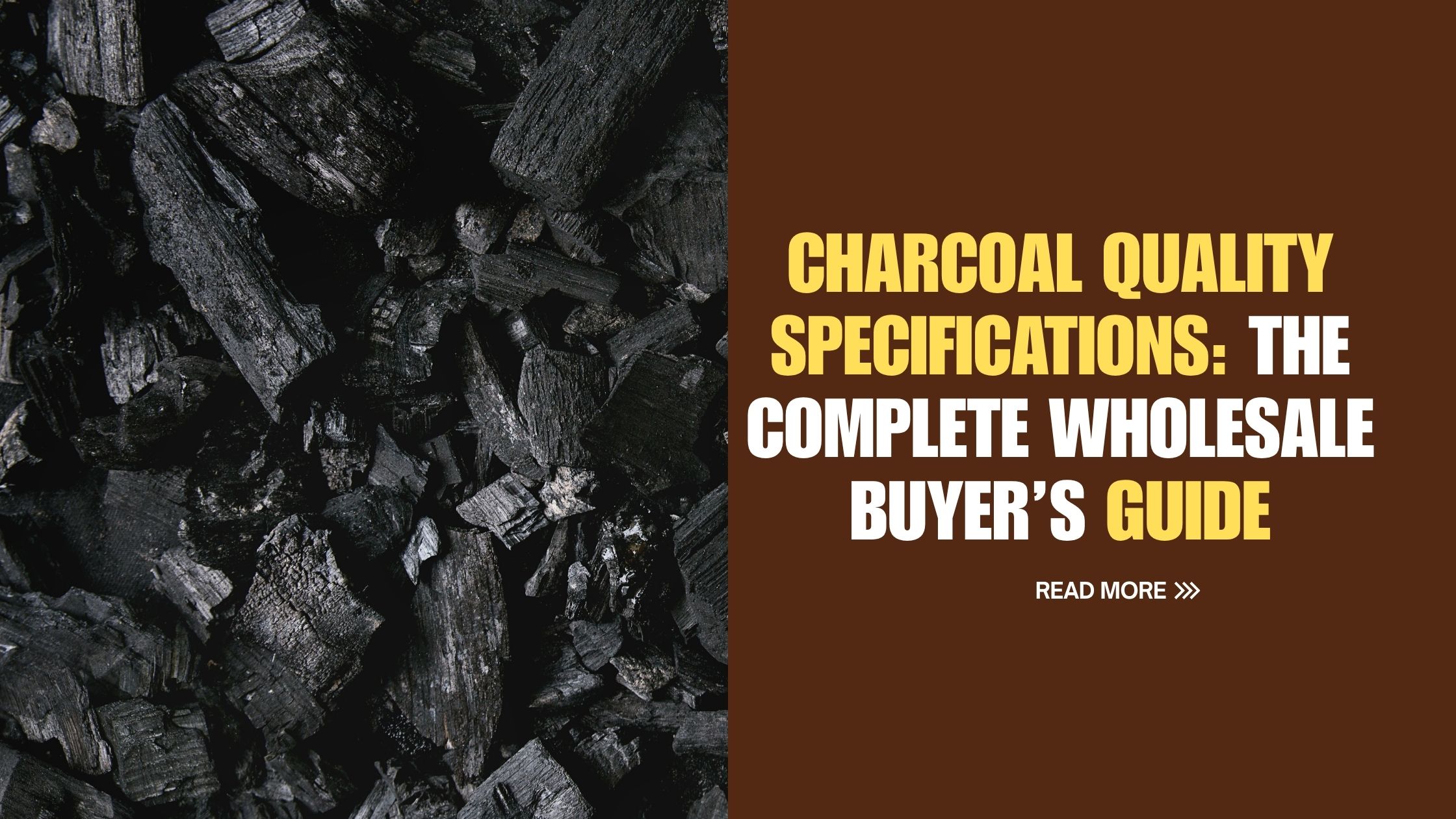
When buying charcoal in bulk, price is never the real variable; quality is.
Every experienced importer, distributor, or procurement manager eventually learns the same lesson:
If your charcoal quality specifications are not clearly defined and verified, everything else, pricing, logistics, and even supplier relationships or charcoal supplier verification, becomes unstable.
Poor-quality charcoal leads to:
- Inconsistent burn performance
- High ash residue and customer complaints
- Increased breakage during shipping
- Margin loss through returns and waste
This guide is built for serious wholesale buyers. It combines:
- Industry-standard specifications
- Real-world buyer insights
- Export market expectations
- A ready-to-use charcoal specification sheet
What Are Charcoal Quality Specifications?
Charcoal quality specifications are the technical standards used to evaluate how a charcoal product will actually perform in real-world conditions, not just in a lab, but in a grill, a shisha setup, or a commercial kitchen.
For wholesale buyers, these specifications act as a decision framework. They help you compare suppliers objectively, define acceptable quality levels, and avoid costly mistakes caused by inconsistent production or misleading samples.
At the core, most charcoal evaluation is based on a set of measurable parameters: moisture content, ash content, fixed carbon, volatile matter, and calorific value. Together, these determine how easily the charcoal ignites, how long it burns, how clean it is to use, and ultimately whether it meets the expectations of your end customers. Sometimes, charcoal quality specifications also mean checking the Charcoal grades.
The core specifications include:
- Moisture content
- Ash content
- Fixed carbon
- Volatile matter
- Calorific value
These are not just lab numbers; they directly determine:
how charcoal ignites, burns, and performs in real use.
Core Charcoal Quality Specifications (Industry Benchmarks)
1. Moisture Content (Controls Ignition & Efficiency)
Moisture content is one of the most underestimated yet impactful charcoal quality specifications. It refers to the amount of water retained inside the charcoal after production and during storage.
Even when charcoal leaves the factory within acceptable moisture limits, it can absorb humidity during transportation—especially in long sea shipments or poorly sealed packaging. This is why experienced buyers don’t just rely on supplier data; they verify moisture levels on arrival.
From a performance standpoint, high moisture creates immediate problems. It slows down ignition, reduces the effective heat output, and often produces excess smoke during the initial burn phase. For restaurants and professional users, this translates into longer preparation times and inconsistent cooking results.
In most wholesale scenarios, keeping moisture below 6–8% is considered safe. However, premium segments—especially shisha charcoal often demand even tighter control.
- Premium: ≤ 5%
- Standard wholesale: ≤ 6–8%
- Lump charcoal: ≤ 10%
Why it matters:
- High moisture = difficult ignition
- Reduces heat output
- Increases smoke
Real buyer insight:
Many importers report that charcoal shipped in humid conditions arrives with higher moisture than stated, leading to performance complaints even when initial specs were good.
Also read – Charcoal Ash Content Moisture Specs
2. Ash Content (Cleanliness & Airflow)
Ash content measures the amount of non-combustible residue left after the charcoal has burned. While it might seem like a minor detail, in practical use, it has a direct impact on both performance and user experience.
Charcoal with high ash content tends to clog airflow in grills and burners, reducing combustion efficiency over time. This forces users to clean equipment more frequently and interrupts continuous operation—something that commercial kitchens and BBQ businesses actively try to avoid.
Another important factor is the type of ash produced. High-quality charcoal typically leaves behind a fine, powdery ash that is easy to manage. In contrast, low-quality charcoal often produces dense, clumpy residue, which is usually a sign of impurities or poor carbonization.
For wholesale buyers, controlling ash content is not just about quality—it’s about reducing friction for the end user.
- Premium: 2–5%
- Standard: ≤ 7%
Why it matters:
- High ash blocks airflow
- Requires frequent cleaning
- Reduces usable heat
What experienced buyers look for:
- Light, powdery ash → good carbonization
- Heavy, clumpy residue → poor quality or fillers
Also read this – Charcoal Bulk Buying Guide
3. Fixed Carbon (The Most Important Metric)
Fixed carbon is widely considered the most important specification because it represents the portion of charcoal that actually generates heat during combustion.
In simple terms, the higher the fixed carbon content, the more efficient and longer-lasting the burn. This is especially critical for businesses that rely on consistent heat output, such as restaurants, shisha lounges, and industrial users.
Low fixed carbon often indicates incomplete carbonization or poor raw material quality. While such charcoal may be cheaper upfront, it typically burns faster, produces less heat, and leads to higher consumption rates—ultimately increasing the total cost of use.
This is why experienced buyers treat fixed carbon as a non-negotiable parameter and often use it as a primary filter when comparing suppliers.
- Standard: 65%+
- High quality: 75–85%+
Why it matters:
- Determines burn duration
- Drives heat intensity
- Core indicator of product value
If you check only one specification, check this.
4. Volatile Matter (Smoke & Burn Behaviour)
- Typical range: 5–20%
Why it matters:
- High volatile matter = more smoke
- Lower levels = cleaner burn
Critical for:
- Shisha charcoal
- Indoor or controlled environments
Also read – Wood vs Coconut Charcoal
5. Calorific Value (Energy Output)
- Benchmark: ≥ 6,500 kcal/kg
Why it matters:
- Indicates total heat output
- Essential for restaurants and industrial buyers
Charcoal Quality Specifications by Application
| Application | Moisture | Ash | Fixed Carbon | Priority |
| BBQ Charcoal | ≤5–8% | ≤7% | 65%+ | Heat & usability |
| Shisha Charcoal | ≤6% | ≤6% | 75%+ | Clean burn |
| Restaurant Use | ≤5% | ≤5% | 75%+ | Consistency |
| Industrial Use | ≤10% | ≤15% | 60%+ | Cost efficiency |
From Specifications to Real Performance: Choosing the Right Charcoal Products
As a charcoal factory in China, we supply a complete range of export-grade charcoal products, including premium lump charcoal, coconut shell shisha charcoal cubes, BBQ briquettes, and industrial charcoal, all manufactured with controlled specifications for moisture, ash, and fixed carbon to ensure consistent real-world performance. Our products are designed for wholesalers, distributors, restaurants, and international buyers who need reliable quality across every shipment, not just on paper.
Why work with us:
- Consistent, specification-backed quality across batches
- Low moisture, low ash, and high fixed carbon standards
- Strong packaging to prevent moisture and breakage in transit
- Custom sizes, shapes, and private labelling available
- Batch-wise testing with COA and export-ready compliance
Charcoal Quality Specifications for Export Markets
Different markets expect different standards. This is where many suppliers fail.
UAE & GCC (Shisha Market)
- Very low ash (≤5%)
- Odorless combustion
- Consistent cube shape
Even minor odour issues lead to rejection.
Europe (UK, Germany, Netherlands)
- Balanced specs (low ash + consistent size)
- Increasing focus on sustainability and traceability
- Packaging quality matters heavily
USA & Canada
- Strong preference for lump charcoal
- Focus on:
- Burn performance
- Natural composition
- Minimal additives
Asia (Japan, South Korea)
- High preference for dense, low-smoke charcoal
- Extremely strict quality expectations
Good vs Bad Charcoal Specifications (Buyer Red Flags)
| Parameter | Good Quality | Warning Signs |
| Moisture | ≤6% | 10%+ (poor ignition) |
| Ash | ≤5–7% | 10%+ (dirty burn) |
| Fixed Carbon | 75%+ | <60% (weak heat) |
| Volatile Matter | Balanced | Too high (smoky burn) |
| Density | High | Crumbly / weak |
If 2–3 parameters fall into the “bad” range, expect serious performance issues.
Physical & Practical Specifications Buyers Often Miss
Lab specs alone are not enough.
Size & Uniformity
- Ensures even burning
- Critical for retail and foodservice
Density & Strength
- Stronger charcoal survives shipping
- Burns longer
Odor & Purity
- No chemical smell
- Indicates proper production
What Buyers Actually Say (Community Insights)
Across BBQ communities and sourcing discussions, a consistent pattern emerges:
Buyers trust performance over paper specs
Common concerns:
- “Specs looked good, but burn time was inconsistent.”
- “Charcoal absorbed moisture during shipping.”
- “Too much dust and breakage in bags”
Conclusion:
Specifications must always be verified with real testing
The Hidden Gap: Spec Sheet vs Reality
One of the most common challenges in charcoal wholesale is the gap between declared specifications and actual delivered quality.
On paper, many suppliers can present excellent numbers. But in practice, those specifications can change due to factors like inconsistent raw materials, variations in production processes, or poor handling during storage and transportation.
A typical example is moisture. Charcoal that leaves the factory at 5% moisture can easily reach 8–10% by the time it arrives at the destination port if packaging is inadequate or humidity levels are high.
This is why professional buyers never rely solely on specification sheets. Instead, they build a system that combines:
- Document verification
- Sample testing
- Pre-shipment inspection
- Arrival checks
Because ultimately, performance, not paperwork, is what defines quality.
Declared specs ≠ delivered performance
Why does this happen?
- Poor storage conditions
- Mixed raw materials
- Inconsistent production
- Weak packaging
Example:
- Moisture can increase significantly during transit in humid environments
- This alone can ruin an otherwise good product
Wholesale Charcoal Specification Sheet (Copy & Use)
You can use this directly when dealing with suppliers:
Charcoal Quality Requirements:
- Moisture: ≤ 6%
- Ash: ≤ 5–7%
- Fixed Carbon: ≥ 70%
- Volatile Matter: 10–20%
- Calorific Value: ≥ 6,500 kcal/kg
Physical Requirements:
- Uniform size and shape
- Low breakage rate
- No chemical odour
Packaging:
- Moisture-resistant bags
- Inner liner required
- Proper palletization
Documentation:
- Certificate of Analysis (COA) per batch
- Traceability (lot number, production date)
How to Use Charcoal Quality Specifications When Buying
Understanding charcoal quality specifications is only the first step. The real advantage comes from how you apply them in your sourcing process.
Successful buyers translate these specifications into clear operational standards. They define acceptable ranges, include them in contracts, and ensure that every shipment is evaluated against those benchmarks.
Equally important is consistency. A supplier who meets specifications once but fails to maintain them across batches creates more risk than a slightly lower-spec supplier who delivers reliably.
In practice, this means building a process where specifications are not just discussed but enforced through testing, documentation, and accountability.
1. Define Your Standards
Set acceptable ranges based on your market
2. Lock Specs in Contracts
Include:
- Tolerances
- Penalties
- Replacement clauses
3. Test Samples Properly
- Run burn tests
- Measure ash
- Track performance
4. Verify Every Shipment
- Pre-shipment inspection
- Arrival checks
Common Mistakes Buyers Make
- Buying based only on price
- Ignoring moisture content
- Accepting “perfect samples.”
- Not defining packaging standards
- Not planning for scale
Final Takeaway
Charcoal quality specifications are not just technical data—they are your control system for quality, cost, and consistency.
Professional buyers:
- Define clear specifications
- Verify them through testing
- Work only with suppliers who can deliver consistently
Because in wholesale charcoal:
The difference between a profitable shipment and a failed one
It is almost always hidden in the specifications.
FAQs:
What are the key charcoal quality specifications?
Moisture, ash content, fixed carbon, volatile matter, and calorific value.
What is the most important charcoal specification?
Fixed carbon determines heat output and burn time.
What causes poor charcoal performance?
High moisture, high ash, and low fixed carbon.