


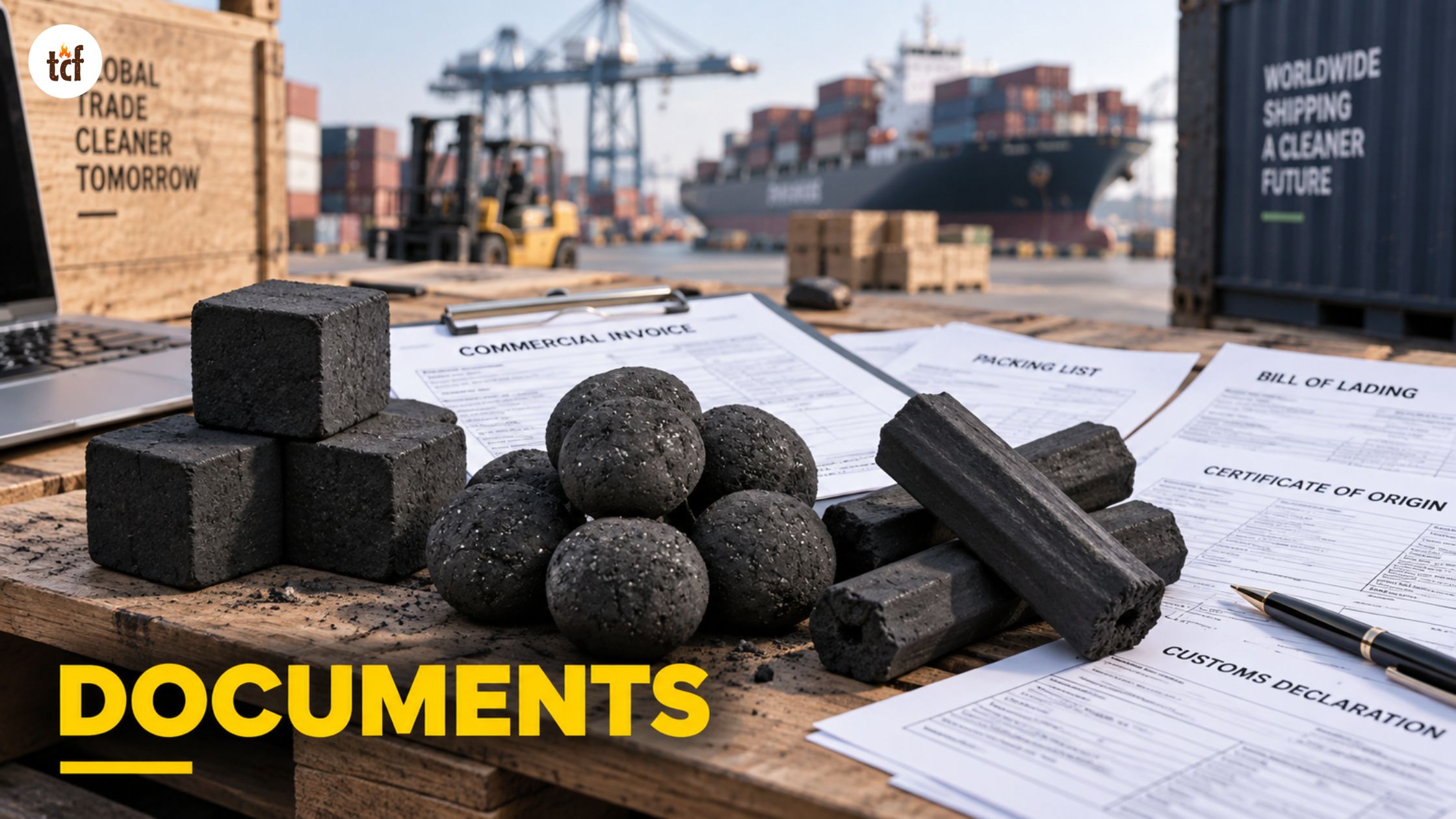
Required documents for importing charcoal. Getting a charcoal shipment from a supplier to a warehouse involves more paperwork than most first-time buyers expect. A missing fumigation certificate has held containers at the port for days. A wrong product description on a commercial invoice has triggered customs inspections. A charcoal shipment declared without dangerous goods documentation has been rejected by carriers. This guide covers every document you need, what it is, why customs requires it, and what happens when it is missing.
Table of Contents
Why Is Charcoal Documentation More Complex Than Other Products?
Charcoal sits at the intersection of several overlapping regulatory frameworks. It is a plant-derived commodity, which means it is subject to phytosanitary rules. It is a self-heating substance under international maritime law, which means it carries dangerous goods classification requirements. It is a wood or biomass product, which brings it under deforestation compliance frameworks in major markets. And it is an internationally traded commodity with specific HS code classification requirements that affect duty rates and regulatory obligations.
Most products only touch one or two of these frameworks. Charcoal touches all of them simultaneously. Understanding each layer is what separates importers who clear customs smoothly from those whose containers sit on demurrage while documents are chased down.
What Are the Core Required Documents for Importing Charcoal for Every Charcoal Shipment?
Commercial Invoice
The commercial invoice is the primary financial and customs document for any shipment. For charcoal imports, it must include the full product description, not just “charcoal” but the specific type (e.g., “coconut shell charcoal briquettes, cube shape, 25mm, moisture content <5%”), the HS code, quantity, unit price, total value, currency, Incoterms, country of origin, and both buyer and seller details.
Vague descriptions are the single most common trigger for customs delays in the charcoal trade. Customs officers need to verify that the declared product matches the applicable duty rate and regulatory requirements. A description that does not align precisely with the HS code on the declaration creates an immediate flag.
Packing List
The packing list provides a physical inventory of the shipment — number of bags or cartons, gross and net weight per unit, total gross and net weight, and how the goods are packed inside the container. Customs use it to verify that what was declared matches what is physically present.
A critical operational point: the weights on the packing list must match the weights on the Bill of Lading exactly. Weight discrepancies between these two documents are one of the most common triggers for unnecessary physical inspections, which can delay a container by several days and generate significant port storage costs.
Proforma Invoice
The proforma invoice is issued before the final commercial invoice, typically at the point of order confirmation. It outlines the same core product details, quantity, pricing, and terms. Buyers use it to initiate payment, apply for import licences where required, open a Letter of Credit, or obtain pre-shipment approvals from relevant authorities. It is not a customs document in itself but is frequently requested by banks and regulatory bodies before a shipment begins.
Sales Contract
The signed sales contract between buyer and seller establishes the agreed terms, product specifications, quantity, price, Incoterms, payment terms, delivery timeline, and any quality or documentation guarantees. Customs authorities in some markets request the contract to verify that the declared invoice value reflects an arm’s-length commercial transaction. It is also the legal foundation for any dispute resolution if product quality or documentation falls short.
Also read – Customs Duties on Imported Charcoal
What Shipping Documents Are Required?
Bill of Lading (Ocean) or Airway Bill (Air)
The Bill of Lading (B/L) is the most legally significant document in an international charcoal shipment. It serves three simultaneous functions: it is the carrier’s receipt confirming the cargo was loaded, the contract of carriage between shipper and carrier, and the document of title, meaning the original B/L must be presented to release the goods at the destination port.
For charcoal specifically, the B/L must accurately reflect the dangerous goods classification under the new IMDG Code requirements (see below). The cargo description on the B/L must match the dangerous goods transport document and cannot simply read “charcoal” without the required UN classification information.
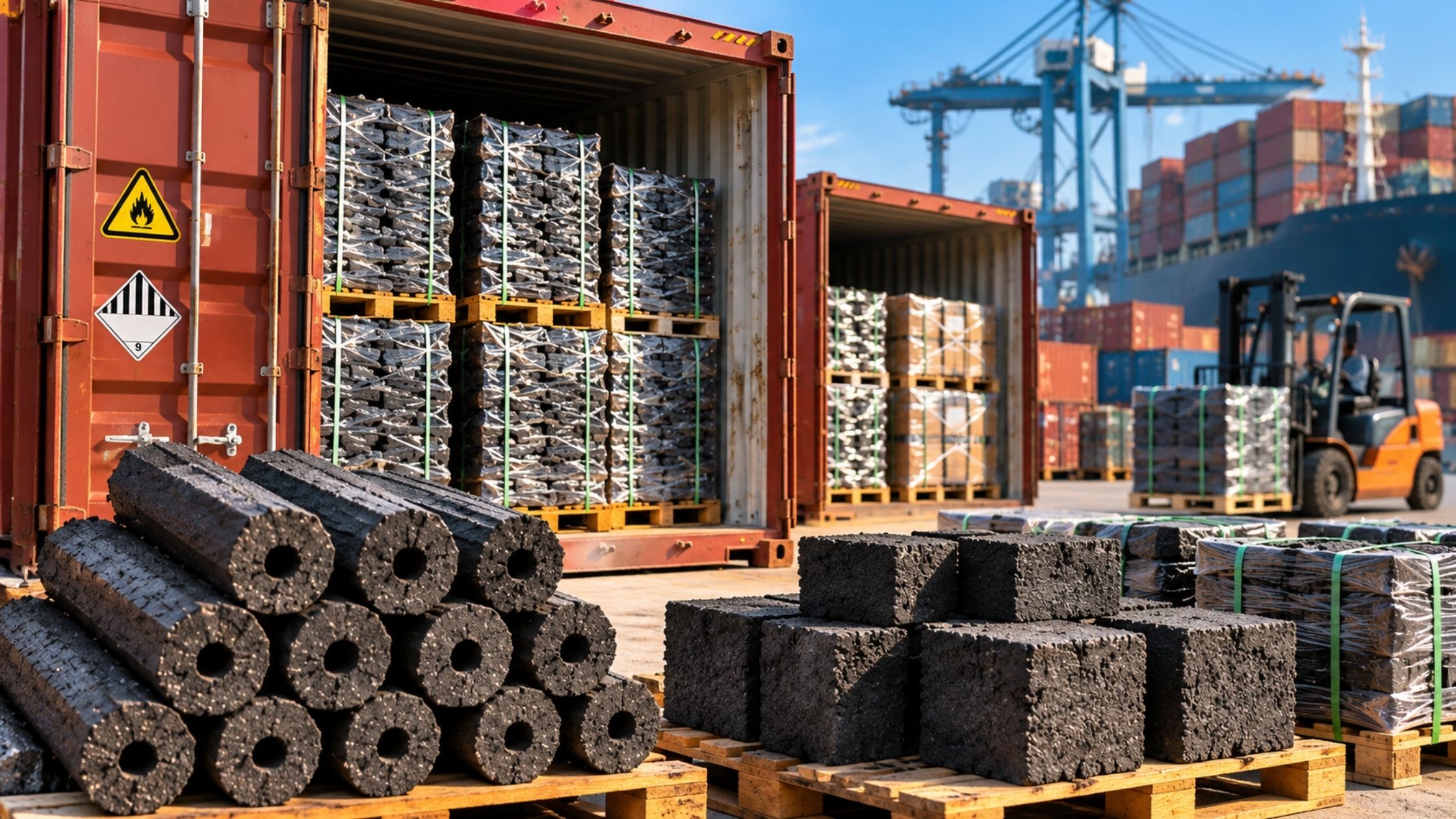
Most bulk charcoal moves by sea in 20-foot or 40HQ containers. Sample shipments may occasionally use air freight, in which case an Airway Bill replaces the B/L, though air freight is rarely used for commercial charcoal orders due to the weight-to-value ratio.
What Regulatory and Compliance Documents Are Required?
Certificate of Origin (COO)
The Certificate of Origin officially declares where the charcoal was produced. It is required by customs authorities in virtually every importing country to determine applicable duty rates and whether preferential tariff treatment applies under any free trade agreements.
For charcoal, the COO also serves a traceability function. When buyers are demonstrating responsible sourcing to their own customers, certifiers, or regulators, the COO is the baseline document confirming origin. It is issued by the exporting country’s chamber of commerce or relevant government body.
In the EU context, the COO is a prerequisite document for EUDR due diligence. Without a confirmed origin, geolocated sourcing data cannot be assembled, and the due diligence statement cannot be submitted.
Phytosanitary Certificate
The phytosanitary certificate is issued by the National Plant Protection Organisation (NPPO) of the exporting country. It certifies that the charcoal shipment has been inspected and is free from regulated pests and plant diseases.
Many importing countries, including EU member states, the UK, the US, Australia, Japan, and Saudi Arabia, require a phytosanitary certificate for charcoal because it is derived from plant material. The specific requirements vary by destination. Australia has historically applied particularly stringent phytosanitary rules on charcoal imports, though requirements for the Australian market have been updated in recent years.
The phytosanitary certificate must be issued for each shipment by an authorised government official. It cannot be copied, reused, or applied to a different consignment. Buyers should confirm the specific pest-free declarations required by the destination country’s NPPO before the shipment is prepared.
Fumigation Certificate
The fumigation certificate confirms that the charcoal shipment and specifically any wooden packaging material (pallets, wooden dunnage) in the container has been treated to eliminate insects, larvae, and other pests.
Two distinct fumigation requirements apply to charcoal shipments:
The first is fumigation of the charcoal product itself, which some destination markets require as a condition of entry. The second and universally applicable is ISPM 15 compliance for any wooden packaging material used in the container. ISPM 15 (the International Standards for Phytosanitary Measures No. 15) requires that all wood packaging material used in international trade is heat-treated or methyl bromide-fumigated and bear the official IPPC mark. Major importing markets, including the US, EU, UK, Australia, Japan, and most others, enforce this requirement. A shipment arriving with non-compliant wooden pallets can be refused entry or quarantined at the importer’s expense.
In January 2026, APHIS reinstated the full ISPM 15 hyphen requirement for wood packaging material, meaning the IPPC mark must correctly format the country code and facility code with a hyphen a compliance detail that caused issues when enforcement was temporarily suspended in 2025.
Certificate of Analysis (COA)
The Certificate of Analysis is a third-party laboratory test report confirming the charcoal’s physical and chemical specifications, typically including fixed carbon content, moisture content, ash content, volatile matter, and calorific value. It is issued by an independent testing body such as SGS, Intertek, or Bureau Veritas.
The COA is not a statutory customs requirement in most markets, but it is functionally non-negotiable in the B2B charcoal trade. Wholesale buyers require it to verify that the product meets the specifications agreed in the contract, and it is the primary basis on which quality disputes are adjudicated. For buyers supplying food service, retail, or shisha markets, the COA is also the document most often requested by their end customers or brand compliance teams.
The COA must correspond to the specific production batch being shipped a COA from a previous order does not confirm the quality of the current consignment. Reputable manufacturers issue a batch-specific COA as part of every shipment’s documentation package. You can read more about what specifications matter in our charcoal grades explained guide.
Material Safety Data Sheet (MSDS)
The MSDS, sometimes called a Safety Data Sheet (SDS) provides standardised information on the material’s composition, physical and chemical properties, handling hazards, first aid measures, fire safety, storage requirements, and disposal guidance. It is required by port authorities, customs in some markets, and logistics providers when handling charcoal as a dangerous goods shipment.
With the IMDG Code Amendment 42-24 now mandatory from January 2026 (see below), the MSDS has become a more operationally critical document than it previously was. Carriers and freight forwarders will request it as part of the dangerous goods booking process.
What Is the Dangerous Goods Documentation Now Required for All Charcoal Shipments?
This is the most significant documentation change in the charcoal trade in recent years, and many importers have not yet fully adjusted.
IMDG Code Amendment 42-24 Mandatory from January 2026
The International Maritime Dangerous Goods (IMDG) Code Amendment 42-24 became mandatory for all sea freight as of 1 January 2026. Before this change, charcoal shipments could avoid full dangerous goods classification if they passed certain self-heating tests (under Special Provisions SP925 and SP223). Both of those exemptions have been removed.
Under the new regime, all charcoal, including bamboo charcoal, coconut shell briquettes, hardwood lump charcoal, and BBQ briquettes must be declared and transported as dangerous goods classified as UN 1361 CARBON, animal or vegetable origin, Class 4.2 (substances liable to spontaneous combustion). There are no exemptions, regardless of test results.
The new Special Provision SP 978 introduces specific requirements:
The charcoal must be weathered for a minimum of 14 days in covered, open-air storage after production before being packaged for transport. Alternatively, it may be steam-cooled after pyrolysis and packed under an inert gas atmosphere with a 24-hour storage period.
The decision to classify this way traces to a troubling pattern: between 2015 and 2022, at least 68 container fires were linked to charcoal, most starting days after loading due to self-heating. The previous “tested-safe” exemptions failed to prevent these incidents, which is why the IMO removed them entirely.
What Dangerous Goods Documentation Is Now Required?
Every sea freight charcoal shipment must include a Dangerous Goods Declaration (DGD), sometimes called a Shipper’s Declaration for Dangerous Goods. This document must specify: UN number (UN 1361), proper shipping name (CARBON, animal or vegetable origin), class (4.2), packing group (II or III, based on testing), packaging type and quantity, and net weight.
The DGD must be completed by the shipper and provided to the freight forwarder and carrier before booking is confirmed. Major carriers, including Hapag-Lloyd, introduced early enforcement from April 2025. Any charcoal shipment booked without compliant DG documentation will be rejected at the port.
The MSDS and Container Stuffing Certificate or Vehicle Packing Certificate are also part of the dangerous goods documentation package, confirming the container was packed correctly and safely in line with IMDG requirements.
What Additional Documents Are Required for Specific Markets?
European Union: EUDR Due Diligence Statement
From 30 December 2026, large and medium operators importing charcoal under HS 4402 into the EU must submit a Due Diligence Statement (DDS) through the EU’s TRACES platform before the goods are placed on the EU market. This is not a voluntary sustainability declaration; it is a customs clearance prerequisite. The reference number generated by the DDS filing must be included in the customs declaration. Without it, the shipment cannot be legally cleared.
The DDS requires geolocated origin data confirming the charcoal was produced on land not deforested after 31 December 2020, supply chain mapping identifying each link from forest to shipment, and a risk assessment confirming negligible deforestation risk. Non-compliance carries penalties of at least 4% of annual EU turnover, goods seizure, or suspension from EU market access.
FSC certification is not a substitute for EUDR compliance, but is one of the most practical tools to support a compliant DDS. FSC chain-of-custody certification provides the traceability documentation that underpins the sourcing data requirements of the regulation.
For more on the EUDR and what it means for your supplier relationships, see our charcoal supplier verification checklist.
United States: CBP Entry Documentation and Importer Security Filing
US imports require formal customs entry documentation submitted through the Automated Commercial Environment (ACE) system, typically handled by a licensed customs broker. For commercial shipments over $2,500, a customs bond is required. The Importer Security Filing (ISF, also called 10+2) must be submitted at least 24 hours before the vessel departs the foreign port.
US buyers sourcing from China must additionally account for Section 301 tariff classification. The customs entry must correctly identify the Section 301 list applicable to the specific HTS subheading, as this determines the total duty assessed.
Australia: AQIS and Biosecurity Requirements
Australia applies strict biosecurity requirements to charcoal imports through the Department of Agriculture, Fisheries and Forestry (DAFF). Historical requirements for AQIS fumigation at the level of the Australian Fumigation Accreditation Scheme (AQIS-AFAS standard) applied per shipment at the port of departure. Requirements have been updated in recent years and buyers should verify current biosecurity conditions for their specific product type with their Australian customs broker before booking.
What Does a Complete Charcoal Import Document Set Look Like?
The following table summarises the standard document set for a commercial charcoal shipment, indicating which are universally required and which are market-specific:
| Document | Purpose | Required By |
| Commercial Invoice | Customs valuation, duty calculation | All markets |
| Packing List | Physical inventory verification | All markets |
| Bill of Lading / Airway Bill | Title, contract of carriage | All markets |
| Certificate of Origin | Origin declaration, duty rate determination | All markets |
| Phytosanitary Certificate | Plant health compliance | Most markets (verify by destination) |
| Fumigation Certificate + ISPM 15 | Wood packaging pest control | All markets using wood pallets |
| Certificate of Analysis (COA) | Quality verification | B2B standard (not statutory) |
| MSDS / SDS | Safety handling information | Required for DG shipments |
| Dangerous Goods Declaration (DGD) | IMDG UN 1361 Class 4.2 compliance | All sea freight from Jan 2026 |
| Container Stuffing Certificate | DG packing compliance | All DG sea freight |
| FSC Certificate (supplier-level) | Responsible sourcing evidence | EU/UK retail, EUDR-linked |
| EUDR Due Diligence Statement | Deforestation-free compliance | EU market from Dec 2026 |
| Proforma Invoice | Pre-order formalities, LC, permits | As required by buyer/bank |
| Sales Contract | Transaction terms reference | Market-specific, banking |
What Are the Most Costly Documentation Mistakes in Charcoal Imports?
Mismatched weights. The weight on the packing list, Bill of Lading, and customs declaration must align. Even a minor discrepancy creates an audit flag that can delay clearance for days and generate port storage charges that quickly exceed the value of the documentation error itself.
Vague product descriptions. “Charcoal” on a commercial invoice is insufficient. Customs officers need to verify classification, and an ambiguous description leaves the door open for reclassification, inspection, and delay. Always specify the type, raw material, shape, size, and key quality parameters.
Missing or late dangerous goods documentation. Since January 2026, carriers have rejected charcoal bookings without compliant DG declarations. Late submission of the DGD after booking means the shipment misses the vessel, and the container goes into storage. This is now one of the most common first-order costs for buyers who have not updated their documentation processes.
COA from the wrong batch. A Certificate of Analysis issued for a previous production batch does not certify the current shipment. If a dispute arises about product quality, a COA that does not correspond to the specific production lot is not evidentially useful and may void contractual remedies.
ISPM 15 non-compliance on wooden pallets. Wooden pallets without the IPPC heat-treatment mark are a standard ground for quarantine detention in Australia, the US, and EU markets. This is a supplier-side obligation, but the importer bears the cost of detention and re-export. Always confirm with your supplier that all wooden packaging material carries the correct ISPM 15 mark before the container is loaded.
Frequently Asked Questions
Which document is most important for clearing charcoal at customs?
The commercial invoice and Bill of Lading are the two most operationally critical documents: the invoice for duty calculation and the B/L for cargo release. However, following IMDG Amendment 42-24, the Dangerous Goods Declaration has become equally critical because carriers will reject the booking without it, meaning the shipment never arrives at customs in the first place.
Is a Certificate of Analysis legally required to import charcoal?
A COA is not a statutory customs requirement in most markets. It is, however, a commercial standard in the B2B charcoal trade; virtually all wholesale buyers require it to verify product quality against specifications. Buyers should treat it as functionally mandatory even where it is not legally compulsory.
What changed about charcoal dangerous goods documentation in 2025 and 2026?
IMDG Code Amendment 42-24 removed the previous exemptions that allowed charcoal to ship without full dangerous goods classification if it passed self-heating tests. From January 2026, all charcoal, regardless of type or test results, must be declared as UN 1361 CARBON, Class 4.2 dangerous goods. This requires a Dangerous Goods Declaration, correctly completed, to be submitted to the carrier before booking. Major carriers began enforcing this from early to mid-2025.
Do I need an FSC certificate to import charcoal into the EU?
FSC certification is not a statutory customs requirement for EU charcoal imports. However, the EUDR Due Diligence Statement (required from December 2026) demands geolocated sourcing data and supply chain traceability and FSC chain-of-custody certification is one of the most practical ways to build a compliant evidence base. Retailers and supermarket buyers in Europe already treat FSC as a market entry requirement regardless of EUDR timelines.
What is the phytosanitary certificate, and who issues it?
A phytosanitary certificate is an official government document issued by the National Plant Protection Organisation (NPPO) of the exporting country. It certifies that the charcoal has been inspected and is free from regulated plant pests. It must be issued fresh for each shipment by an authorised government official it cannot be copied or reused from a prior order. Requirements vary by destination country.