


FOB vs CFR vs CIF for charcoal imports: For most first-time or mid-volume charcoal buyers, CIF is the safer default, it bundles freight and insurance into one price and shifts Dangerous Goods carrier booking to the exporter. Experienced buyers with their own freight forwarder often do better under FOB, where they control freight costs directly instead of paying whatever rate is baked into a supplier’s quote.
There’s no universally “best” term. There’s a best term for your specific situation. Here’s how to figure out which one that is.
The 3 terms in plain terms
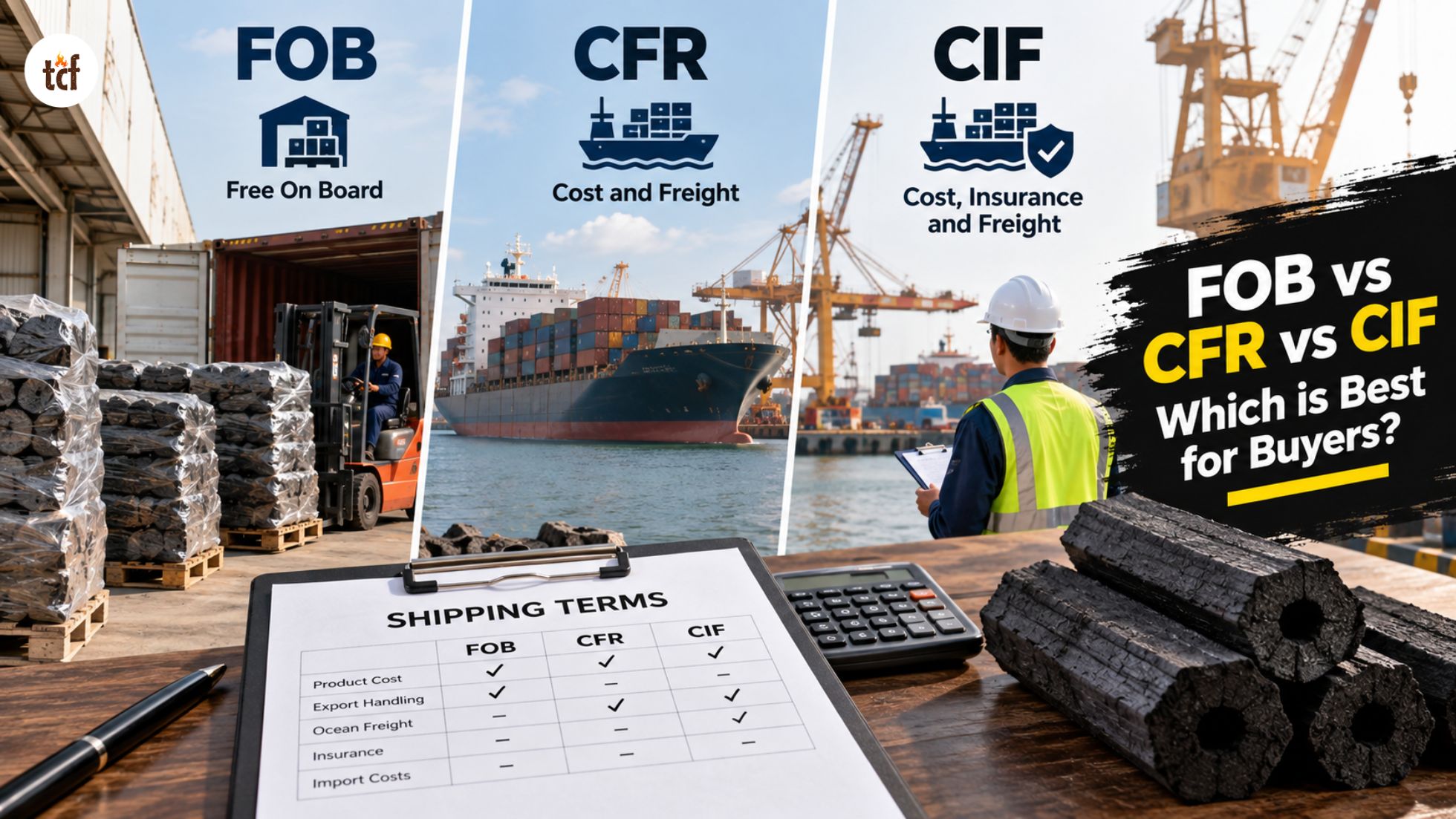
- FOB (Free On Board): seller’s responsibility ends once the charcoal is loaded onto the vessel. Buyer arranges and pays for freight and insurance.
- CFR (Cost and Freight): seller pays for freight to your destination port. Buyer still arranges and pays for insurance separately.
- CIF (Cost, Insurance, and Freight): seller pays for both freight and insurance to your destination port. Buyer gets one bundled delivered-to-port price.
Risk transfers to the buyer at the same point under all 3 terms, once cargo is loaded onto the vessel. What changes is who pays for freight and insurance, and who’s responsible for booking the shipment, not who bears risk during the voyage.
Also read – Machine-made vs natural charcoal
Why this decision matters more for charcoal than most cargo
Charcoal ships as Dangerous Goods under UN1361, Class 4.2. Booking a DG shipment requires a carrier that accepts DG cargo, a completed Dangerous Goods Declaration, documented weathering and packing-day temperature records, and UN-certified packaging.
Under FOB, that entire booking and compliance coordination sits with the buyer or their freight forwarder. Under CFR and CIF, the exporter, who typically ships UN1361 charcoal routinely, handles it. This is the single biggest reason the “best” Incoterm answer skews differently for charcoal than it would for a non-hazardous commodity.
A decision framework, not just a definition list
Choose FOB if:
- You already work with a freight forwarder experienced in Dangerous Goods bookings
- You import high enough volume to negotiate better freight rates than what’s built into a supplier’s CFR or CIF quote
- Your destination port has frequent, competitively priced charcoal-carrying routes
- You want direct control over carrier selection and shipping schedule
Choose CFR if:
- You want the supplier to handle freight and DG carrier booking, but you already have a trusted marine insurance provider or broker
- You’re comfortable evaluating and arranging cargo insurance yourself, and want to control coverage terms directly rather than accepting the seller’s standard policy
Choose CIF if:
- You’re new to importing charcoal and want one clear, bundled number
- You don’t have an existing relationship with a DG-capable freight forwarder
- You’d rather the exporter carry accountability for the shipment through the full voyage, since they’re the one who arranged it
- Your destination port is less frequently served, making freight sourcing harder to do independently
What most buyers get wrong
Assuming CIF means zero exposure. It doesn’t. Risk transfers at loading regardless of Incoterm. CIF just means the seller pre-arranged insurance, typically at a minimum coverage level (commonly 110% of invoice value). If you want broader coverage, you may need supplemental insurance regardless of which term you choose.
Assuming FOB is always cheaper. A low FOB number without freight and insurance added back in isn’t a real comparison against a CIF quote. Once you add realistic freight and insurance costs to an FOB price, the gap to a CIF quote is often much smaller than it first appears; sometimes it disappears entirely.
Not asking who handles the DG paperwork under CFR. CFR quotes cover freight, but Dangerous Goods documentation and packaging compliance aren’t automatically bundled the way they typically are under a CIF quote from an experienced charcoal exporter. Confirm this explicitly rather than assuming.
A simple way to decide
- Do you already have a relationship with a DG-capable freight forwarder? No: lean CIF. Yes: FOB or CFR become viable.
- Do you want to control insurance terms directly? Yes: CFR. No: CIF.
- Is your order volume high enough to meaningfully negotiate freight rates? Yes: FOB may save money. No: the admin overhead of managing freight yourself likely isn’t worth the marginal savings.
- Is this your first order with this supplier? Yes: CIF reduces the number of unfamiliar variables you’re managing at once. You can renegotiate toward FOB once the relationship and your own freight relationships are established.
Related reading
If you’re past the “which term” question and need actually to compare 2 supplier quotes on different Incoterms, our guide on FOB vs CIF charcoal pricing walks through normalizing quotes to a comparable basis, including a worked pricing example. Our charcoal manufacturing process page also covers how weathering and compliance documentation get built into a shipment before it’s ever quoted under any of these terms.
This article is for general informational purposes and isn’t a substitute for advice from a licensed freight forwarder or trade advisor. Confirm specific terms, coverage levels, and DG compliance responsibilities directly with your supplier and forwarder before booking.
Frequently asked questions
Is CIF more expensive than FOB for charcoal?
Not necessarily; once you account for the freight and insurance costs, an FOB buyer still has to pay separately. CIF often looks more expensive only because it’s a single bundled number being compared against an incomplete FOB figure.
Does FOB or CIF affect who’s responsible for Dangerous Goods compliance?
Yes, meaningfully. Under FOB, the buyer’s freight forwarder handles DG carrier booking and documentation. Under CIF, and typically CFR as well if the supplier’s freight arrangement includes it, this responsibility usually sits with the exporter.
What’s the main reason to choose CFR instead of CIF?
Control over insurance. CFR gives you the seller’s freight arrangement without locking you into their insurance provider or coverage terms, useful if you already have a marine insurance relationship you trust more.
Should a first-time charcoal importer use FOB?
Generally not recommended unless you already have a Dangerous Goods-capable freight forwarder lined up. CIF removes more of the unfamiliar coordination work for a first order.