


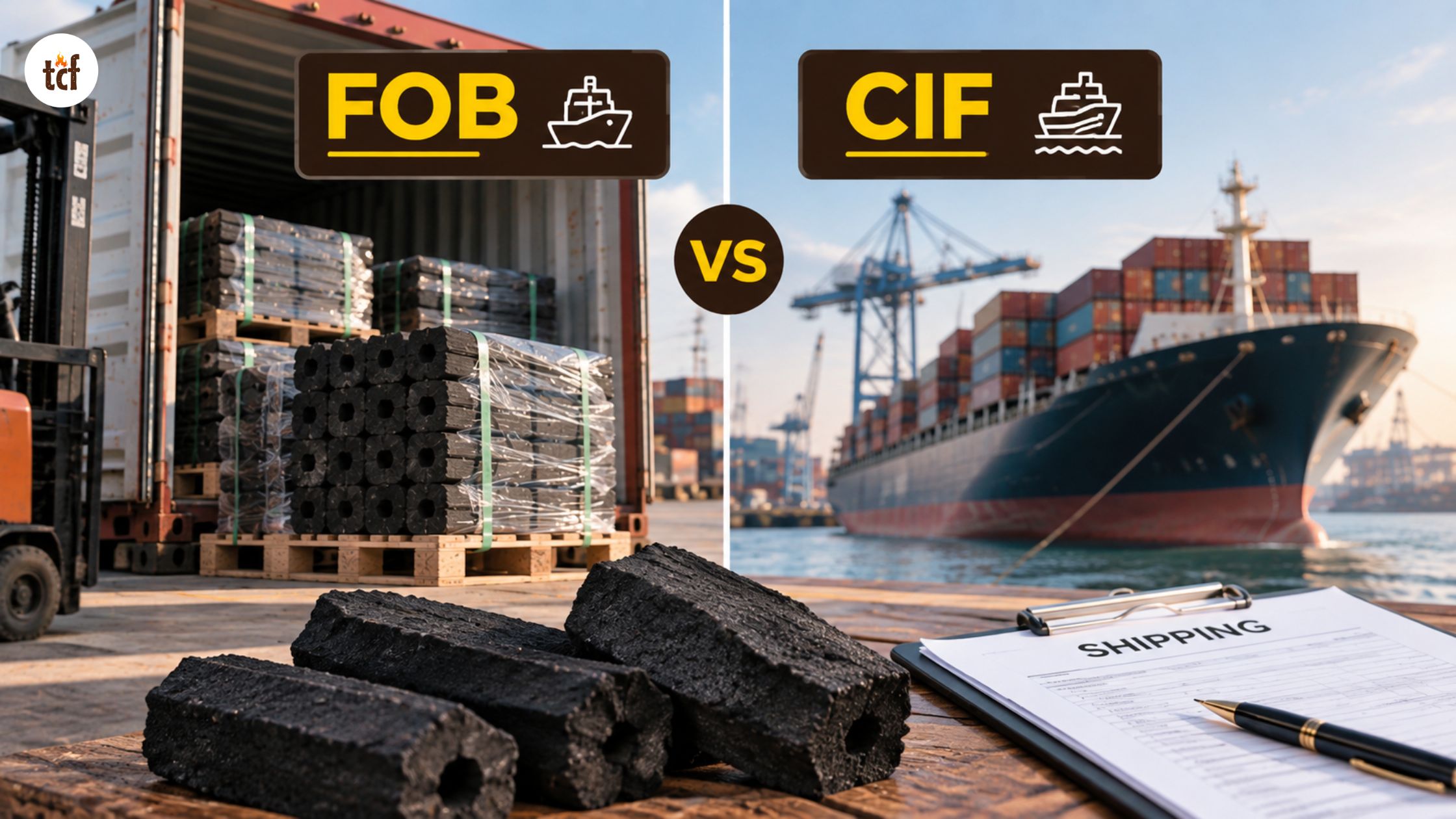
FOB vs CIF charcoal pricing: FOB (Free On Board) charcoal pricing covers the product up to loading onto the vessel at the origin port, freight and insurance are on you. CIF (Cost, Insurance, and Freight) pricing includes the product, international freight, and marine insurance all the way to your destination port.
Comparing an FOB quote to a CIF quote as if they’re the same number is the single most common pricing mistake buyers make. Here’s what’s actually inside each one, and how to normalize quotes so you’re comparing real costs.
Table of Contents
What is FOB charcoal pricing?
FOB means the seller’s responsibility ends once the charcoal is loaded onto the vessel at the port of origin. The FOB price typically includes:
- Product cost
- Domestic packing (bags, cartons, or big bags)
- Inland transport to the port
- Export customs clearance
- Port handling and loading onto the vessel
Everything after that- ocean freight, marine insurance, destination port charges, and inland delivery at your end- is arranged and paid by the buyer.
What is CIF charcoal pricing?
CIF includes everything in FOB, plus 2 additional cost components the seller arranges and pays for:
- International ocean freight to your named destination port
- Marine insurance covering the cargo for the voyage
CIF gives you one number that’s supposed to represent the full delivered cost to your port, minus your own destination-side charges (customs duties, port handling at your end, and inland delivery from the port to your warehouse).
What about CFR?
CFR (Cost and Freight) sits between the two. The seller pays for freight to your destination port, same as CIF, but doesn’t arrange insurance. That part is still on you. You’ll see CFR quoted less often than FOB or CIF, but it’s worth knowing since some suppliers default to it without labeling clearly.
Side-by-side comparison – FOB vs CIF Charcoal Pricing
| FOB | CFR | CIF | |
| Seller pays freight | No | Yes | Yes |
| Seller pays marine insurance | No | No | Yes |
| Who books the shipping | Buyer | Seller | Seller |
| Who handles Dangerous Goods booking | Buyer | Seller | Seller |
| Risk transfers to buyer | When loaded on vessel | When loaded on vessel | When loaded on vessel |
| Paperwork burden on buyer | High | Medium | Low |
One detail buyers miss: under all 3 terms, risk transfers to the buyer at the same point, once the cargo is on board the vessel. What changes between FOB, CFR, and CIF is who pays for freight and insurance, not who bears the risk during the voyage. CIF covering insurance means a claims process exists if something goes wrong, it doesn’t mean the buyer has no exposure at all.
Why this matters more for charcoal specifically
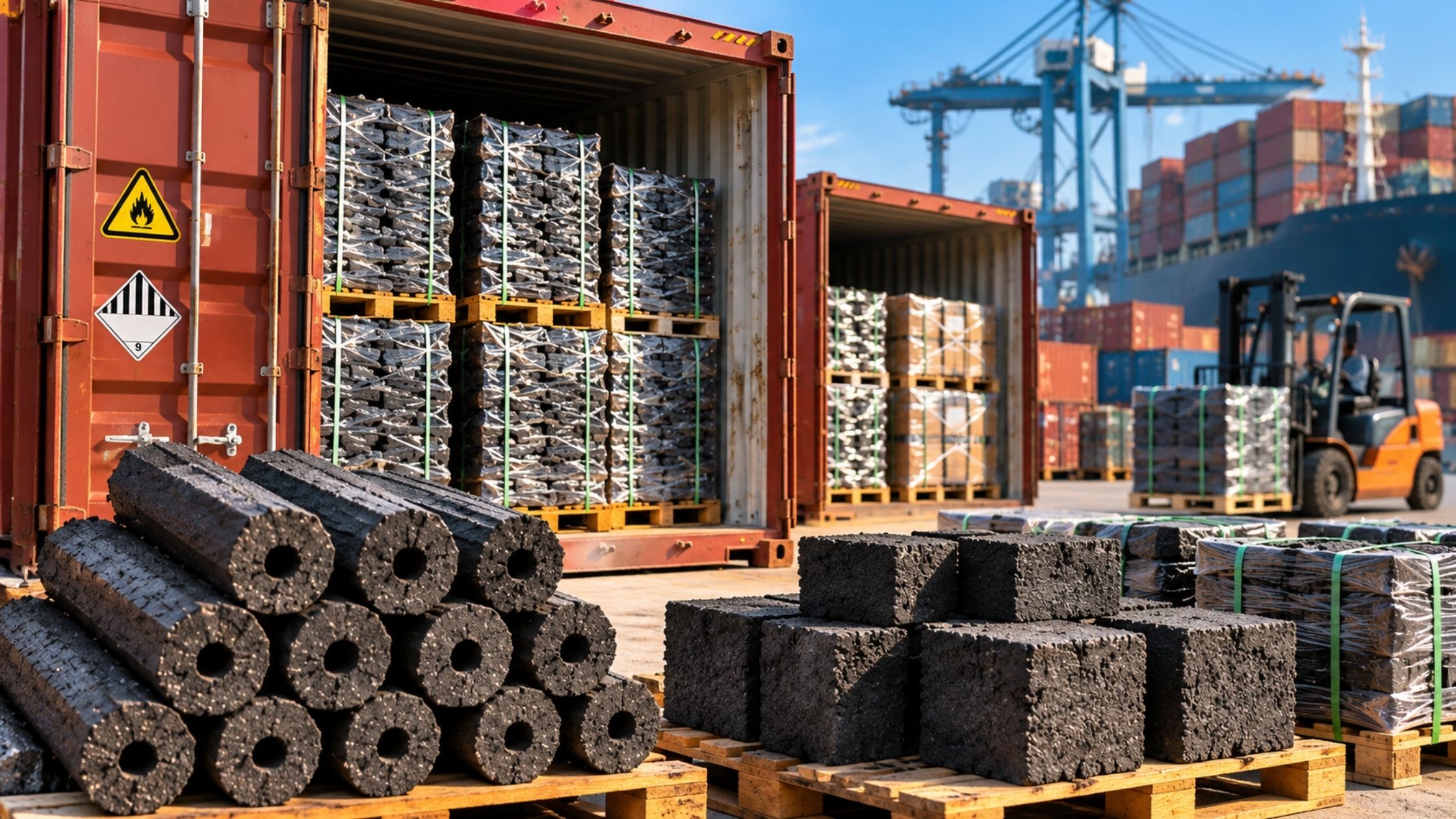
Charcoal ships as Dangerous Goods under UN1361, Class 4.2. Booking a Dangerous Goods shipment isn’t the same as booking a standard container. It requires a carrier that accepts DG cargo, a completed Dangerous Goods Declaration, weather and temperature documentation, and UN-certified packaging.
Under FOB, all of that downstream coordination- finding a DG-capable carrier and getting the paperwork right- falls on the buyer or their freight forwarder. Under CIF, the exporter, who typically ships UN1361 charcoal on a routine basis, handles that part.
This is the real reason CIF tends to get recommended to first-time charcoal importers. It’s not just about a simpler invoice; it’s about shifting a compliance-heavy booking process to the party who already does it regularly.
Also read – US Charcoal Import Requirements
How to actually compare 2 supplier quotes
This is where most buyers get tripped up. A quote comparison only works if you’re comparing the same scope of cost. Here’s the process:
- Confirm the Incoterm on each quote. Don’t assume, ask directly. “FOB Bangkok” and “CIF Los Angeles” are not comparable numbers without conversion.
- Convert FOB quotes to a landed estimate. Add estimated ocean freight, marine insurance, and destination charges to the FOB number before comparing it to a CIF quote.
- Check what “destination port charges” means in the CIF quote. Some CIF quotes stop at the port of discharge, before Terminal Handling Charges (THC), demurrage, or inland delivery at your end. Ask specifically what’s excluded.
- Ask who handles the Dangerous Goods declaration and packaging compliance. A cheaper FOB quote that leaves DG booking to you may cost more once you factor in a freight forwarder’s DG handling fee.
- Compare insurance coverage terms, not just the fact that insurance exists. CIF insurance is often set at a minimum coverage level (commonly 110% of invoice value under standard terms). If you want broader coverage, you may need to arrange supplemental insurance regardless of the Incoterm.
- Normalize per unit, not per shipment. If container sizes or fill rates differ between quotes, convert both to a cost per metric ton or per kilogram before comparing.
A worked example
Say Supplier A quotes $650 FOB per metric ton, Bangkok, and Supplier B quotes $780 CIF per metric ton, Los Angeles.
To compare fairly, estimate the freight and insurance cost for Supplier A’s shipment to Los Angeles, say $110 in ocean freight and $8 in marine insurance per ton. Supplier A’s landed estimate becomes roughly $768 per ton, close to Supplier B’s CIF quote, not the $130 gap the raw numbers suggested.
This is also where destination charges matter. If Supplier B’s CIF quote excludes THC and inland delivery, and Supplier A’s forwarder includes an all-in estimate, the real gap could run the other way once you add those costs to both.
When FOB makes sense
- You already work with a freight forwarder experienced in Dangerous Goods bookings
- You ship high enough volume to negotiate better freight rates than what’s baked into a supplier’s CIF quote
- Your destination port is well-served with frequent charcoal-carrying routes, keeping freight costs predictable
When CIF makes sense
- You’re new to importing charcoal and want one clear delivered number
- Your destination port is harder to reach or further from major charcoal-exporting regions
- You’d rather not manage Dangerous Goods carrier bookings and insurance coordination directly
- You want the exporter accountable for the cargo through the full voyage, since they’re the one arranging it
Questions to ask before accepting either quote
- What exactly does “destination port” mean: the port of discharge, or delivered to my warehouse?
- Is the marine insurance value based on invoice value, and at what percentage?
- Who prepares the Dangerous Goods Declaration and confirms the weather and temperature records?
- Are Terminal Handling Charges (THC) included or billed separately at destination?
- What happens to pricing if the shipment gets flagged for a Dangerous Goods compliance issue and delayed?
A supplier who answers these clearly and specifically, rather than with a general reassurance, is usually the one whose quote you can trust at face value.
Also read – Charcoal Dangerous Goods Shipping
Frequently asked questions
Is CIF always more expensive than FOB?
Not necessarily once you add freight and insurance to the FOB number yourself. CIF often looks more expensive at first glance because it’s a single bundled number, while FOB looks cheaper because it’s missing 2 major cost components you’ll still have to pay someone.
Does CIF mean I have no responsibility during shipping?
No. Risk transfers to the buyer once the cargo is loaded onto the vessel, under FOB, CFR, and CIF alike. CIF means the seller arranged and paid for insurance, not that the buyer has zero exposure.
Why does the Dangerous Goods classification affect which Incoterm I should choose?
Because UN1361 charcoal requires DG-specific carrier bookings, packaging, and documentation. Under FOB, that coordination burden sits with the buyer. Under CIF, the seller, who typically already handles it routinely, takes it on instead.
What should I ask a supplier before comparing their FOB and CIF quotes?
Ask exactly what’s included at the destination end (THC, inland delivery, demurrage exposure), what the marine insurance coverage percentage is, and who’s responsible for the Dangerous Goods paperwork.