


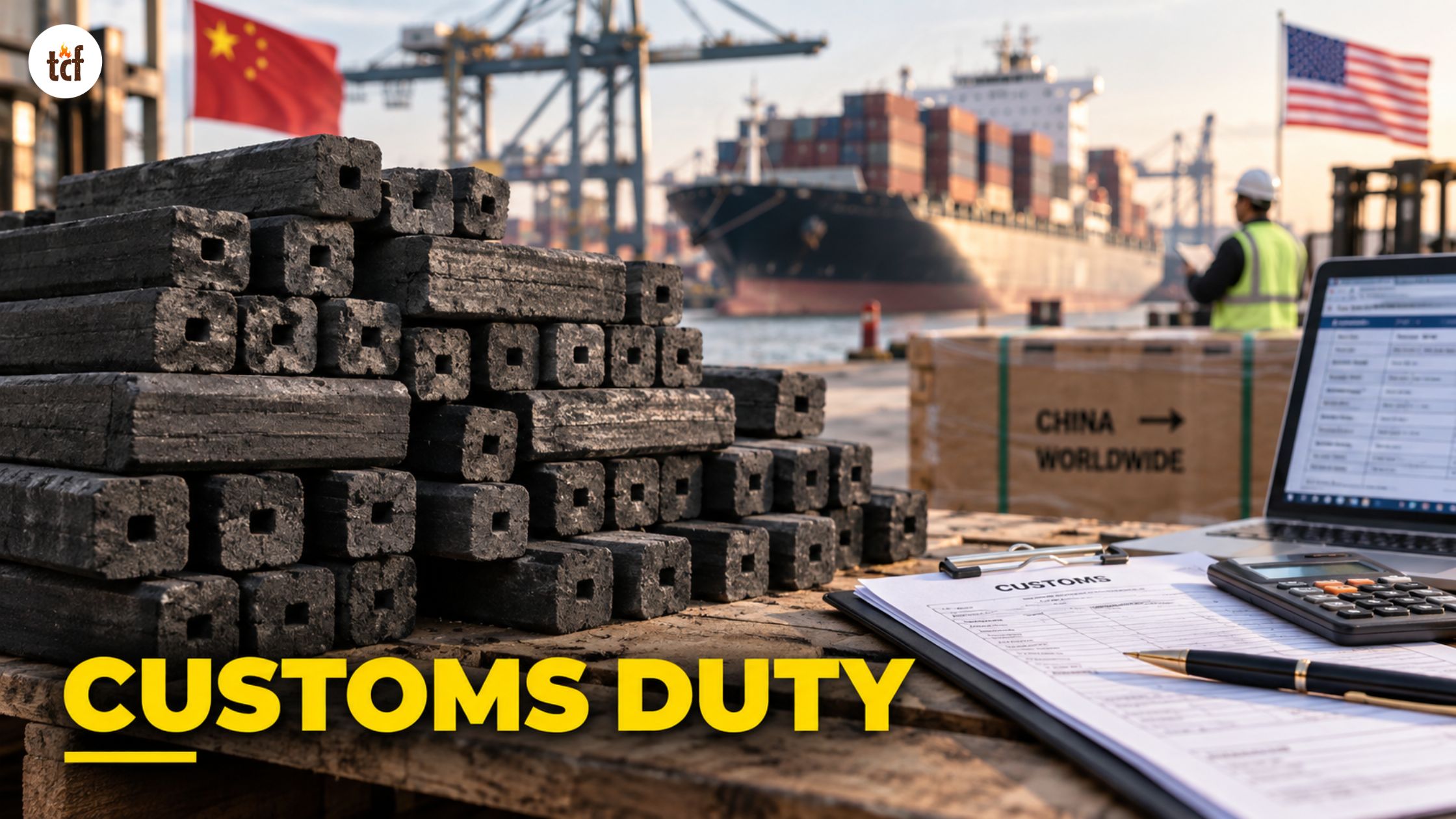
Charcoal from China faces zero Customs Duties on imported charcoal from China in most major markets, but that headline figure tells only part of the story. Depending on where you are importing, additional tariff layers, deforestation regulations, and country-specific trade measures can significantly change the actual landed cost. This guide covers what buyers in every major importing region actually pay.
Table of Contents
Why Does Origin Matter So Much for Chinese Charcoal?
China is one of the world’s largest charcoal exporters, producing bamboo charcoal, machine-made wood briquettes, coconut shell briquettes, and shaped charcoal products on an industrial scale. Because Chinese charcoal competes in virtually every major wholesale market, its duty treatment has direct consequences for landed cost calculations and sourcing decisions.
The complication is that trade policy on Chinese goods has become layered and market-specific. Several major destinations apply standard zero tariffs on charcoal under HS 4402, but then stack additional trade measures on Chinese-origin goods specifically, changing the effective rate substantially. Understanding the difference between the base tariff and the total effective rate is what separates accurate sourcing cost modelling from expensive miscalculations.
What are the Standard Global Customs Duties on Imported Charcoal From China?
Before getting into China-specific treatment, it helps to understand the baseline. Under the WCO Harmonised System, charcoal falls under HS heading 4402, with three six-digit subheadings:
4402.10 Bamboo charcoal 4402.20 Shell or nut charcoal (including coconut shell) 4402.90 Other wood charcoal and briquettes
The standard Most Favoured Nation (MFN) duty rate for charcoal in most developed markets is 0%. This applies regardless of origin when no additional trade measures exist. China benefits from MFN status in most WTO member countries. The critical question for each market is whether additional measures are stacked on top of that zero base.
What Do US Importers Pay for Chinese Charcoal?
The Base MFN Duty
The base HTS duty on charcoal (HTS 4402) imported into the United States is 0% under the standard MFN rate. This applies to charcoal from any origin without preferential trade agreements.
Section 301 Tariffs: The Critical Additional Layer
This is where Chinese charcoal diverges sharply from products sourced elsewhere. Since 2018, the US has imposed Section 301 tariffs on Chinese imports across four lists of goods, covering approximately $370 billion in annual trade. These tariffs were imposed in response to findings that China’s trade practices related to intellectual property, technology transfer, and innovation are unfair and harmful to US commerce.
Charcoal under HS 4402 falls within the Section 301 framework, with List 3 goods subject to 25% and List 4A goods at 7.5%. Buyers importing Chinese charcoal need to verify which specific 10-digit HTS subheading their product falls under and confirm its list assignment via the USTR’s official tariff lookup tool before committing to a sourcing price.
Current Section 301 exclusions, a limited set of 178 active product-specific exclusions, are extended through November 10, 2026, under the US-China trade agreement reached in October 2025. Wood charcoal is not among the excluded categories, meaning the Section 301 surcharge applies in full to Chinese charcoal shipments.
Also read – Charcoal HS Codes
The Full US Duty Stack in Practice
US tariff policy on Chinese goods in 2026 operates in layers. A single Chinese shipment can attract four separate duty types: the base MFN rate, a fentanyl surcharge (reduced to 10% effective November 2025), a Section 301 surcharge, and in some cases a Section 232 duty on steel and aluminium-adjacent products.
For charcoal specifically, the realistic effective duty rate for a US importer sourcing from China is:
| Duty Layer | Rate | Applies to Chinese Charcoal? |
| Base MFN Duty (HTS 4402) | 0% | Yes — zero base rate |
| Section 301 Surcharge (List 3) | 25% | Yes, for most charcoal HTS lines |
| Fentanyl Surcharge | 10% | Yes — applies to all Chinese goods |
| Merchandise Processing Fee (MPF) | 0.3464% (min/max apply) | Yes |
| Harbor Maintenance Fee (HMF) | 0.125% | Yes |
The total effective rate for a US importer of Chinese charcoal on List 3 runs to approximately 35% before MPF and HMF. This is a substantial cost differential compared to sourcing from Indonesia, Vietnam, or other origins where only the MFN rate (0%) applies.
The September 2025 Federal Circuit ruling upheld the legality of Section 301 tariffs on Lists 3 and 4A, confirming these duties are not temporary and are not subject to further legal challenge. US buyers should treat Section 301 duties as a permanent fixture of the landed cost model when sourcing Chinese charcoal.
What Does This Mean for US Buyers in Practice?
A US importer buying Chinese bamboo charcoal or machine-made wood briquettes at $900 per metric ton FOB effectively faces an additional $315+ per ton in Section 301 duties alone before freight, insurance, and other charges. This is why many US buyers have shifted to Indonesian or Latin American suppliers for standard BBQ charcoal, while retaining Chinese suppliers for speciality products, primarily bamboo charcoal, where no comparable alternative origin exists.
For buyers who still source from China, the landed cost model must incorporate the full duty stack from day one. Underestimating this figure is one of the most expensive errors in charcoal import planning.
What Do European Buyers Pay for Chinese Charcoal?
EU Standard Duty Rate
The EU import duty rate on charcoal under all 4402 subheadings is 0% under the standard TARIC tariff. There are no anti-dumping measures specific to charcoal from China currently in effect in the EU. This means European buyers do not face the same Section 301-style surcharge layer that US importers encounter.
VAT applies at national rates typically 20% in France, 19% in Germany, 22% in Italy, 21% in the Netherlands, assessed on the CIF value plus import charges. VAT-registered businesses recover this on their return, so it is a cash flow item rather than a permanent cost.
The EUDR Dimension
The cost and compliance picture for EU buyers of Chinese charcoal is changing materially through the EU Deforestation Regulation (EUDR). Following a second postponement, the legally binding start for EUDR market obligations is now 30 December 2026 for large and medium operators, and 30 June 2027 for micro and small operators.
HS heading 4402 is listed in EUDR Annex I, meaning Chinese charcoal importers into the EU will need to demonstrate deforestation-free sourcing through full due diligence statements (DDS), geolocated origin data, and supply chain traceability documentation. While this is not a tariff in the traditional sense, the compliance cost is real, and suppliers who cannot provide the required documentation will lose access to the EU market regardless of the zero duty rate.
On 4 May 2026, the European Commission presented a package of simplification measures, including updated guidance, a draft delegated act on product scope, and updates to the EUDR Information System. Buyers should monitor these developments closely, as adjustments to the product scope could affect which Chinese charcoal products face the full due diligence burden.
For Chinese bamboo charcoal specifically declared under 4402.10, the EUDR obligations apply in full, as bamboo is a wood-derived product under the regulation’s scope.
What Do UK Buyers Pay for Chinese Charcoal?
Post-Brexit, the UK operates its own tariff schedule independently of the EU. The UK Global Tariff duty rate on charcoal under heading 4402 is 0% from China. There are no UK-specific anti-dumping measures on Chinese charcoal currently in force.
UK importers pay UK customs duty (0% for charcoal) plus 20% import VAT, assessed on the CIF value. Post-Brexit, these charges apply to all commercial imports from China. VAT-registered UK businesses recover import VAT through Postponed VAT Accounting (PVA), so the effective additional cost is limited to the duty rate, which in charcoal’s case is zero.
UK buyers are not subject to EUDR, but the UK has its own forest risk commodity regulations under the Environment Act 2021, which require due diligence for forest risk commodities. Implementation timelines and scope for charcoal specifically should be monitored via the UK government’s official guidance.
The practical cost difference between a UK and US buyer sourcing Chinese charcoal is substantial. A UK buyer pays essentially the same duty on Chinese charcoal as on Indonesian or Vietnamese charcoal — zero. A US buyer on List 3 products pays 35%+ effective duties on the same container.
What Do Middle East Buyers Pay for Chinese Charcoal?
Gulf Cooperation Council (GCC) member states Saudi Arabia, UAE, Qatar, Kuwait, Bahrain, and Oman apply a 5% customs duty on charcoal imports under HS 4402 from all origins, including China. There are no additional China-specific tariff measures within the GCC.
The Middle East is one of the world’s largest charcoal import markets, driven almost entirely by shisha and hookah demand. Key flows include Indonesia to Saudi Arabia and Malaysia, with the Philippines and Vietnam supplying the UAE, Japan, and South Korea. China competes in the GCC market primarily on machine-made shisha charcoal shapes, where its production flexibility and private label capability give it an advantage over more commodity-oriented Indonesian suppliers.
For GCC buyers, the 5% duty applies equally to all origins, so there is no trade policy incentive to source from one country over another. The supplier decision is driven entirely by product quality, reliability, and price.
What Does China’s Own Export Policy Mean for Buyers?
This is a dimension of the Chinese charcoal trade that most buyers overlook entirely. China does not freely export all charcoal products. According to WTO records, China has maintained an export prohibition on certain categories of wood charcoal under HS 4402 since 2004.
The WTO-notified restriction, based on MOFCOM, GACC, and State Forestry Administration Joint Announcement 2004, No. 40 (effective 1 October 2004), covers wood charcoal under HS 4402 specifically wood charcoal not of bamboo, excluding shell or nut charcoal. China justifies this restriction under GATT Article XX(g) — the conservation of exhaustible natural resources in response to deforestation concerns from domestic hardwood charcoal production.
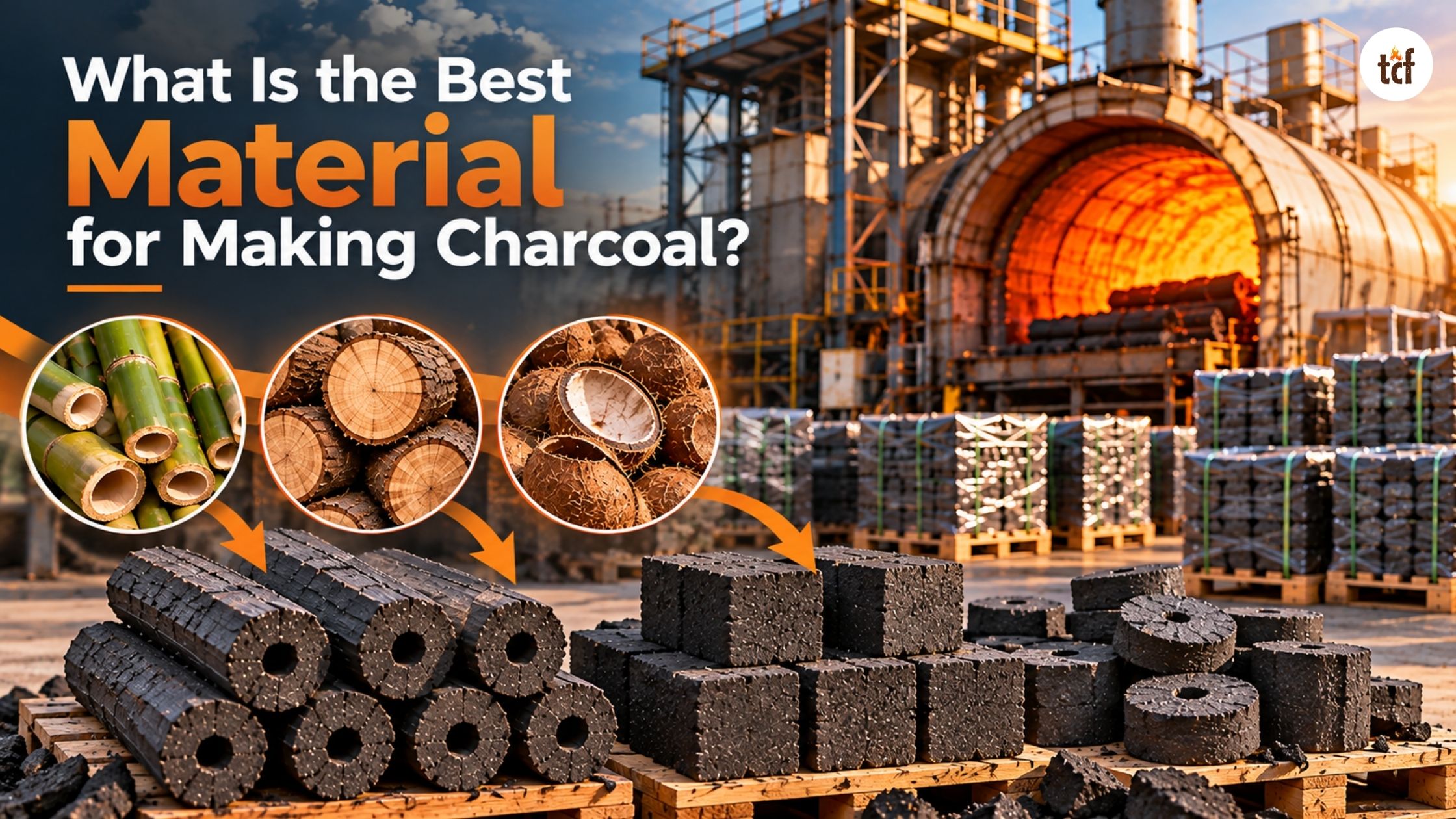
The practical implication is significant: China does not freely export hardwood lump charcoal in the conventional sense. The Chinese charcoal that reaches international markets is predominantly bamboo charcoal, coconut shell briquettes (using imported or coastal coconut shell), and machine-made wood briquettes from approved product types — not traditional hardwood lump charcoal from Chinese forest resources.
This explains why buyers who specifically need hardwood lump charcoal look to Indonesia, Vietnam, or other Southeast Asian origins — not China. It also means that a wholesale buyer seeking to understand why Chinese charcoal export volumes look lower than expected in hardwood categories now has their answer.
How Do Total Landed Costs Compare by Destination Market?
The table below summarises the effective duty position for a buyer importing standard Chinese charcoal (wood briquettes or bamboo charcoal, HS 4402.10 or 4402.90) in 2026:
| Market | Base Duty | Additional China-Specific Measures | Effective Duty Rate | VAT / GST |
| United States | 0% | Section 301 (~25%) + fentanyl surcharge (10%) | ~35% | N/A federally |
| European Union | 0% | None (EUDR compliance cost from Dec 2026) | 0% | 19–22% (recoverable) |
| United Kingdom | 0% | None | 0% | 20% (recoverable) |
| Saudi Arabia / GCC | 5% | None | 5% | N/A |
| India | ~10–15% basic | Social welfare surcharge + IGST | ~30% effective total | 0% GST on 4402 |
| Australia | 0% | None | 0% | 10% GST (recoverable) |
| Japan | 0–3% | None | 0–3% | 10% consumption tax |
Rates are indicative and subject to change. Always verify with a licensed customs broker before placing container-scale orders. The Section 301 rates in particular are subject to ongoing policy review.
What Should Buyers Do Before Importing Chinese Charcoal?
For buyers in any market, the recommended steps before placing a charcoal order from China are consistent and sequential.
Confirm the exact 10-digit HTS or commodity code for your specific product in the destination country. Do not rely on the six-digit HS subheading alone; the additional digits determine which specific measures apply. Consult a licensed customs broker or freight forwarder with China trade experience for the destination market. Verify Section 301 list assignment using the USTR’s official lookup tool (for US buyers). For EU buyers, begin preparing for EUDR documentation requirements from Chinese suppliers now, requesting geolocated sourcing data and traceability documentation before December 2026. Build the full duty stack base rate, additional measures, MPF/HMF where applicable, and any VAT into your landed cost model before calculating profitability at the product level.
For context on how Chinese charcoal compares to alternative origins and what to verify from any supplier, see our how to choose the right charcoal supplier and charcoal supplier verification checklist guides.
Check out the product categories of The Charcoal Factory:
wholesale hookah charcoal
wholesale BBQ charcoal
Charcoal Supplier for Distributors
bulk charcoal for restaurants
private label charcoal for supermarkets
Frequently Asked Questions
Is there a zero duty rate on Chinese charcoal in the EU?
Yes. The standard EU TARIC duty rate on charcoal from China under all 4402 subheadings is 0%. There are no anti-dumping measures on Chinese charcoal currently in force in the EU. However, EUDR compliance requirements from December 2026 create a non-tariff cost that will affect all EU importers of Chinese wood charcoal.
How much Section 301 tariff apply to charcoal from China in the US?
Most wood charcoal from China falls under Section 301 List 3, which carries a 25% additional duty on top of the zero base MFN rate. The fentanyl surcharge adds another 10% (reduced from 20% in November 2025). Combined, this puts the effective duty rate for most Chinese charcoal entering the US at approximately 35% before port fees. Always verify the specific HTS subheading with a customs broker, as list assignment determines the exact applicable rate.
Does the Section 301 tariff apply to bamboo charcoal from China?
Bamboo charcoal (HTS 4402.10) from China is subject to the same Section 301 tariff framework as other Chinese charcoal products. US buyers of Chinese bamboo charcoal face the same duty stack as buyers of wood briquettes. Because no other country produces bamboo charcoal at comparable scale, some US buyers accept this cost as unavoidable for this specific product type.
Why does China not export much hardwood lump charcoal?
China has maintained an export prohibition on hardwood wood charcoal under HS 4402 since 2004, justified at the WTO under conservation grounds. Chinese charcoal exports are therefore concentrated in bamboo charcoal, coconut shell briquettes, and machine-made wood briquettes — not traditional hardwood lump charcoal. Buyers who specifically need hardwood lump charcoal source from Indonesia, Vietnam, or other origins.