

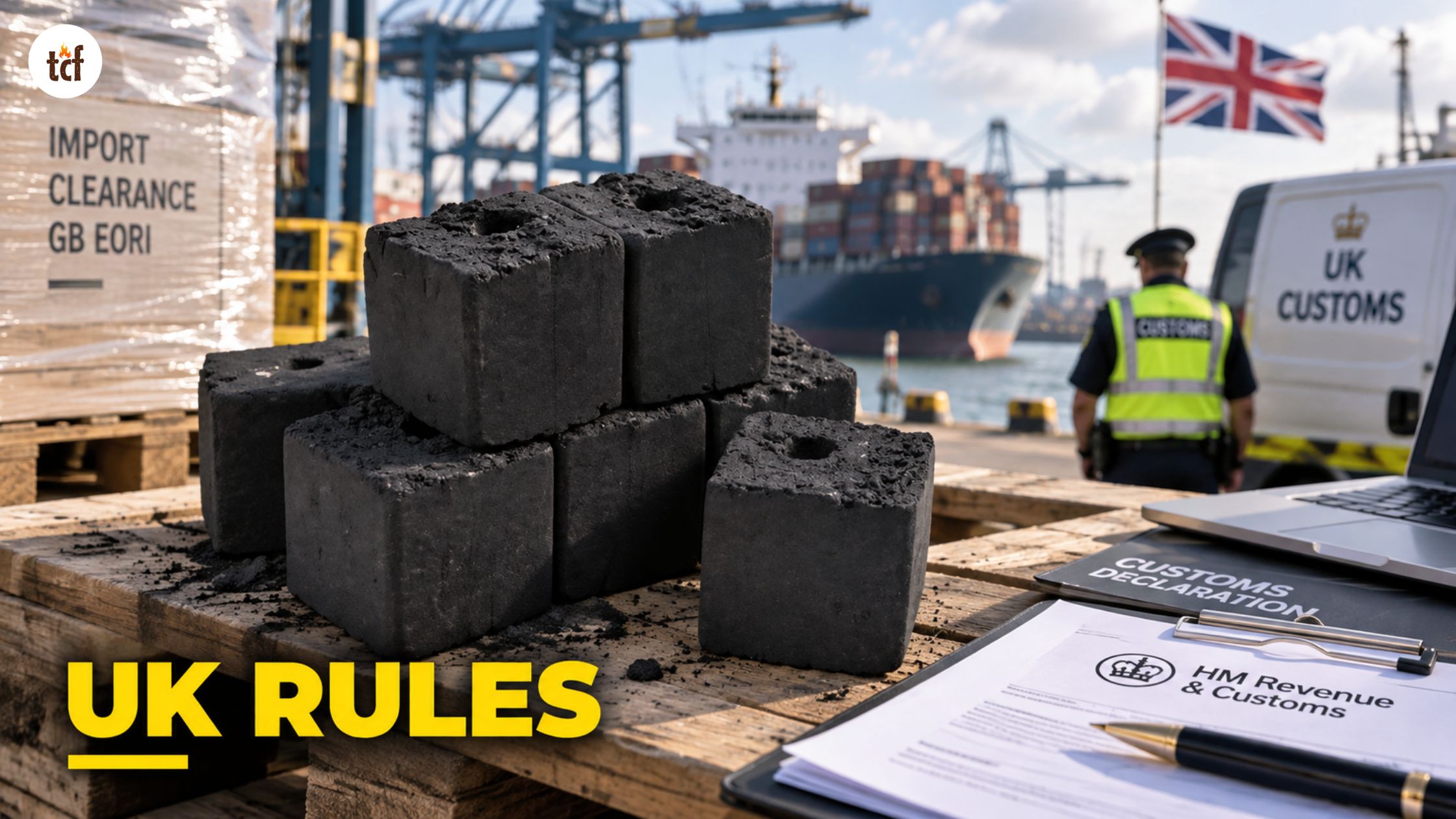
Charcoal Import Regulations in the UK require compliance across four distinct regulatory areas: HMRC customs classification and duty, the UK Timber Regulations (UKTR) on legal sourcing, the BS EN 1860-2 product standard for BBQ and retail charcoal, and the IMDG Code’s mandatory dangerous goods classification that became enforceable from January 2026. There is also a critical tariff change on the horizon that every buyer sourcing from Indonesia needs to plan around.
Table of Contents
What Commodity Code Is Used for UK Charcoal Imports?
All charcoal imports into the UK are classified under heading 4402 of the UK Global Tariff “Wood charcoal (including shell or nut charcoal), whether or not agglomerated.”
The correct 10-digit commodity code depends on the product type. Lump wood charcoal falls under 4402.10 sub-headings, while coconut shell and nut charcoal, the dominant product for shisha and hookah imports, is classified under 4402.20.00.00. Briquettes and other agglomerated forms that do not fall under shell or nut charcoal use residual codes within 4402.90.
Using the correct sub-code matters. HMRC guidance published on GOV. The UK specifically states that wood charcoal obtained by carbonising wood is classified under heading 4402, and that misclassification, including using the residual 4402.90 code when a more specific sub-heading applies, can result in delays, incorrect duty charges, and UKTR compliance scrutiny. You can verify the correct code for your specific product using the HMRC Trade Tariff tool at gov.uk/trade-tariff.
What Import Duty and VAT Apply to Charcoal in the UK?
Duty Rates by Origin
The UK Global Tariff (UKGT) base rate for charcoal under heading 4402 is 0% for most trading partners. This means buyers importing from Indonesia, Vietnam, the Philippines, and other Southeast Asian suppliers do not currently face a customs duty charge on the product itself.
For goods originating in the EU and meeting rules of origin requirements under the UK-EU Trade and Cooperation Agreement (TCA), the 0% rate also applies, provided the supplier can issue a valid EUR.1 movement certificate or supplier declaration of origin
The DCTS Preferential Rate and Indonesia’s Graduation Timeline
Indonesia currently benefits from the UK’s Developing Countries Trading Scheme (DCTS), which provides preferential tariff access. For charcoal (HS 4402), the DCTS preferential rate is 0%, provided the exporter supplies a valid DCTS Origin Declaration on the commercial invoice.
However, UK importers sourcing from Indonesia need to plan carefully around two upcoming changes.
The first is the goods graduation notice published by the UK government in September 2025, which suspended DCTS Standard Preferences on specific product chapters from India and Indonesia from 1 January 2026 to 31 December 2028. Charcoal (Chapter 44) is not listed in the graduated categories for Indonesia — meaning Indonesian charcoal continues to benefit from DCTS preferences through 2026.
The second change is more significant. In January 2026, the UK government published guidance confirming that Indonesia will graduate entirely from the DCTS on 1 January 2027. Indonesia has been classified by the World Bank as an Upper Middle-Income Country for three consecutive years (2022, 2023, 2024), triggering full graduation under DCTS eligibility criteria. From 1 January 2027, Indonesian goods — including charcoal — will trade under the standard UK Global Tariff rather than the DCTS preferential rate.
The UK has applied an 18-month transition period. DCTS access for Indonesia ends on 31 December 2026 and full graduation takes effect from 1 January 2027. Importers building long-term sourcing agreements with Indonesian suppliers should factor this into pricing structures and contract terms.
VAT on Charcoal Imports
Import VAT is charged at the standard UK rate of 20% on commercial bulk charcoal imports. The reduced 5% rate for solid fuels applies only to domestic-use quantities below one metric ton — not to commercial container-load imports.
UK VAT-registered importers can use Postponed VAT Accounting (PVA) to account for import VAT on their VAT return rather than paying it upfront at the border, which provides a cashflow advantage on high-volume shipments.
Also read – Charcoal Import Regulations in the USA
UK Tariff Summary for Charcoal Imports – Charcoal Import Regulations in the UK: In 2026
| Origin | UKGT Base Rate | Preferential Rate | VAT | Key Notes |
| Indonesia | 0% | 0% DCTS (with Origin Declaration) | 20% | Graduates from DCTS 1 Jan 2027 |
| Vietnam | 0% | 0% DCTS (with Origin Declaration) | 20% | DCTS access continues |
| Philippines | 0% | 0% | 20% | Check current DCTS eligibility |
| EU (meeting TCA rules of origin) | 0% | 0% (TCA) | 20% | EUR.1 or supplier declaration required |
| China | 0% | No preferential rate | 20% | Full UKGT rate applies |
Always verify current rates via the HMRC Trade Tariff tool before finalising pricing, as preference schemes can change with limited notice.
What Are the UK Timber Regulations (UKTR) and Do They Apply to Charcoal?
Yes, the UK Timber Regulations apply directly to charcoal importers, and this is one of the most important compliance obligations that buyers overlook.
The Timber and Timber Products (Placing on the Market) Regulations 2013, now operating as the UK Timber Regulation (UKTR) since January 2021 following Brexit, make it illegal to place illegally harvested timber or timber products — including charcoal — on the UK market. UKTR replaced the EU Timber Regulation (EUTR) in Great Britain and carries the same requirements.
The UKTR applies to anyone who first places timber or wood-derived products on the UK market, including importers. It requires operators to exercise due diligence, assessing and mitigating the risk that the product originates from illegal sources.
What Does UKTR Compliance Require?
Due diligence under the UKTR means gathering and retaining information about the product, including country of harvest, species of timber, quantity, supplier details, and evidence that the product complies with the legislation of the country of harvest. It also requires conducting a risk assessment and applying risk mitigation measures where the risk of illegal sourcing is non-negligible.
The most practical way to demonstrate UKTR compliance is through FSC or PEFC chain-of-custody certification, which the UK government recognises as Category A evidence under its Timber Procurement Policy. However, FSC certification does not exempt an importer from conducting its own due diligence it supports it.
For charcoal imported from Indonesia specifically, UKTR has an additional layer. Indonesia is the only country with which the UK has a FLEGT Voluntary Partnership Agreement (VPA). Timber imported from Indonesia under a FLEGT licence is accepted by the UK government as evidence of legal sourcing. Importers of Indonesian hardwood lump charcoal should confirm whether their supplier’s product qualifies for FLEGT documentation.
Enforcement of UKTR in the UK sits with the Office for Product Safety and Standards (OPSS) on behalf of DEFRA. Importers found to be placing illegally sourced timber products on the UK market face penalties including fines and seizure of goods. Retaining sourcing documentation for at least five years is strongly recommended.
Our charcoal supplier verification checklist covers the documentation importers should obtain from suppliers to support UKTR compliance.
Does the BS EN 1860-2 Standard Apply to Charcoal Sold in the UK?
For charcoal sold at retail or to the professional BBQ and catering market in the UK, BS EN 1860-2:2023 is the relevant product safety standard. It is the British adoption of the European EN 1860-2 standard, which specifies requirements and test methods for barbecue charcoal and briquettes used in BBQ appliances.
The standard covers product definitions (BBQ charcoal, table-grill charcoal, restaurant charcoal, briquettes, and impregnated products), safety requirements, fixed carbon and ash content criteria, granulometry specifications, moisture requirements, and mandatory consumer marking and instructions. The 2023 edition superseded the previous 2005 version.
While BS EN 1860-2 is a voluntary standard rather than a legal requirement in the UK, it is widely expected by major retailers, food-service buyers, and quality-focused distributors as evidence that the product meets recognised safety and performance benchmarks. Importers supplying supermarkets, garden centres, or professional catering accounts should expect to be asked for BS EN 1860-2 compliance evidence.
The standard also requires that packaging carries consumer information, including guidance on safe use. Impregnated products — those treated to aid ignition — have specific additional labelling requirements under the standard.
For buyers new to the UK market, our guide to the best charcoal suppliers UK covers what compliance evidence established UK buyers typically request.
What Is the IMDG UN1361 Dangerous Goods Requirement for Charcoal?
This is the most operationally significant regulatory change for charcoal importers since Brexit, and it applies to every shipment arriving in the UK by sea.
Under IMDG Code Amendment 42-24, all charcoal shipped by sea must be declared as Dangerous Goods UN1361, Carbon of animal or vegetable origin, Class 4.2 (substances liable to spontaneous combustion). The change became mandatory globally from 1 January 2026. Major carriers, including Hapag-Lloyd and MSC, began enforcing it earlier, from April and November 2026, respectively.
The reason for the change is well-documented. Between 2015 and 2022, at least 68 container fires were linked to charcoal self-heating, often starting days after loading. The previous exemptions under Special Provisions SP223 and SP925, which allowed some charcoal to ship without full dangerous goods classification if it passed self-heating tests, have been removed entirely.
Also read – Charcoal Exporters Compared
What Does This Mean for UK Importers?
Under the new Special Provision SP978, charcoal must be weathered for at least 14 days after production before packing, or packed under inert gas following pyrolysis with a 24-hour storage period. Material temperature must not exceed 40°C on the day of packing. Containerised bulk transport without packaging is no longer permitted.
Packaging must use UN-certified bags with correct hazard labels and marks. Full container loads must carry Class 4.2 placards on all four sides. All shipping documentation — including the Bill of Lading and Dangerous Goods Declaration — must reflect the UN1361 classification. Some carriers have also introduced a Dangerous Goods Premium surcharge, adding approximately USD 250 / EUR 210 per container to freight costs.
Importers should verify DG compliance with their supplier before booking freight. Non-compliant shipments are being rejected at the point of loading by major carriers, with costs falling on the importer.
What Standard Entry Documentation Is Required for UK Charcoal Imports?
Every charcoal shipment entering the UK requires a standard customs entry package submitted through HMRC’s Customs Declaration Service (CDS). From 31 January 2025, Entry Summary Declarations (ENS) are also required for goods imported from the EU, aligning EU imports with the existing requirements for rest-of-world shipments.
Importers need a GB EORI (Economic Operators Registration and Identification) number to file customs declarations and ENS submissions. Without a GB EORI number, goods cannot be cleared for import.
Core Documentation Checklist
| Document | Purpose | Who Provides It |
| Commercial invoice | Customs value and product description | Supplier |
| Packing list | Shipment verification | Supplier |
| Bill of Lading | Shipping contract and proof of dispatch | Freight carrier |
| Certificate of Origin | Proof of origin for preferential tariff claims | Supplier / Chamber of Commerce |
| DCTS Origin Declaration | Required for preferential 0% DCTS rate | Supplier (on invoice) |
| UKTR due diligence records | Legal sourcing evidence | Importer (supported by supplier docs) |
| FSC / PEFC certificate | Timber legality evidence | Supplier |
| FLEGT licence (Indonesian hardwood only) | VPA-based legality verification | Supplier / Indonesian authority |
| DG Declaration (UN1361, Class 4.2) | IMDG dangerous goods compliance | Supplier / freight forwarder |
| Third-party lab test report | Product quality verification | Independent lab |
The UKTR due diligence obligation sits with the UK importer, not the overseas supplier. Importers who rely solely on supplier declarations without conducting their own risk assessment are not considered compliant under the regulation.
Working with a licensed UK customs broker is strongly recommended for first-time charcoal importers. The combination of UKTR obligations, DCTS origin documentation, IMDG dangerous goods requirements, and CDS entry procedures creates a compliance workload where errors are costly.
What Should UK Buyers Know About Importing Different Charcoal Types?
The practical compliance picture varies depending on what product you are importing. Our overview of types of charcoal is a useful reference for understanding the product landscape.
Coconut shell briquettes imported for the shisha and hookah market — classified under 4402.20.00.00 — benefit from a relatively straightforward UKTR position since coconut shell is agricultural waste rather than a forest timber product. This reduces, though does not eliminate, the due diligence burden around illegal logging. Our wholesale shisha charcoal and wholesale hookah charcoal pages are relevant for buyers in this segment.
Hardwood lump charcoal imported from Indonesia or other tropical origins carries higher UKTR scrutiny. Buyers sourcing this product for the UK BBQ or restaurant market should ensure their suppliers hold FSC certification or FLEGT licences, and that origin traceability documentation is robust.
For buyers supplying the restaurant trade in bulk, our bulk charcoal for restaurants page covers product specifications and supply structure, and our charcoal bulk buying guide addresses how to structure compliant import agreements.
External references: GOV.UK — Country Graduation from the DCTS: Indonesia | GOV.UK — Regulations: Timber and FLEGT Licences
Frequently Asked Questions
What is the import duty rate on charcoal in the UK?
The UK Global Tariff base rate for charcoal (heading 4402) is 0% for most origins. Indonesian and Vietnamese exporters can access a 0% DCTS preferential rate by providing a valid DCTS Origin Declaration on the commercial invoice. Indonesia’s DCTS access ends on 31 December 2026, after which Indonesian charcoal will be assessed at the full UK Global Tariff rate from 1 January 2027. Import VAT at 20% applies to all commercial charcoal imports.
Do the UK Timber Regulations apply to charcoal?
Yes. Charcoal is a timber-derived product and falls within the scope of the UKTR. UK importers who first place charcoal on the market must conduct due diligence to verify the product’s legal origin, maintain records of species, country of harvest, and supplier information, and retain that documentation for at least five years. FSC or PEFC chain-of-custody certification from the supplier supports compliance but does not replace the importer’s own due diligence obligation.
What is the BS EN 1860-2 standard and is it mandatory?
BS EN 1860-2:2023 is the British Standard specifying requirements and test methods for BBQ charcoal and briquettes. It is a voluntary standard rather than a legal requirement, but is widely expected by UK retailers, supermarkets, and professional catering buyers as evidence of product quality and safety. Importers selling into organised retail channels should expect to provide BS EN 1860-2 compliance evidence.
What is the IMDG UN1361 requirement and when did it take effect?
Under IMDG Code Amendment 42-24, all charcoal shipped by sea must be classified as Dangerous Goods — UN1361, Class 4.2 — from January 2026. This applies to all sea freight shipments arriving at UK ports. Charcoal must be weathered at least 14 days post-production before packing, packed in UN-certified packaging, and shipped with a valid Dangerous Goods Declaration. Suppliers who cannot provide DG-compliant shipments are being rejected by major carriers.