

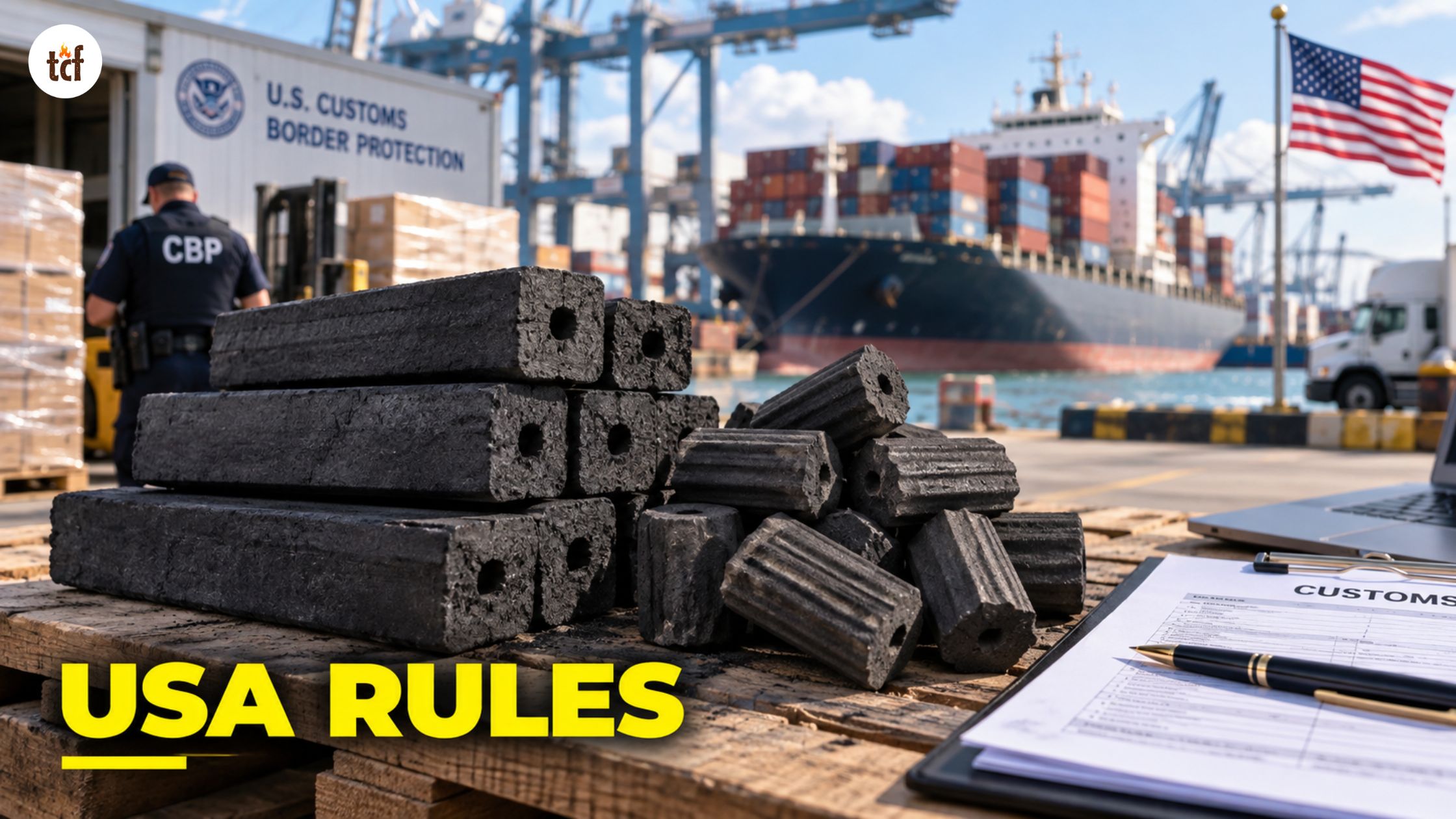
Charcoal import regulations in the USA. Importing charcoal into the United States involves more regulatory layers than most buyers expect. Beyond standard customs clearance, importers must comply with the Lacey Act for wood traceability, CPSC labelling requirements, the IMDG Code’s dangerous goods classification that became mandatory in January 2026, and, if sourcing from China, significantly elevated tariff rates under the current trade policy.
What HS Code Is Used for Charcoal Imports in the USA?
Every charcoal shipment entering the US must be classified under the correct Harmonised Tariff Schedule (HTS) code, the 10-digit US-specific extension of the international HS Code 4402.
The two primary sub-classifications relevant to charcoal importers are 4402.10.00 for natural lump charcoal and 4402.90.00 for charcoal briquettes and other agglomerated forms. Using the wrong sub-code is not a minor administrative issue it can trigger customs holds, duty reassessments, and penalties under 19 USC Section 1592 for failure to exercise reasonable care in classification.
The base import duty rate for charcoal (HTS 4402) entering the USA from most countries is 0%. However, the effective rate changes significantly depending on the country of origin, particularly for goods sourced from China. See the tariff section below for the current position.
What Are the Current Import Tariff Rates for Charcoal?
Standard Rate (Most Countries)
For charcoal imported from Indonesia, Vietnam, the Philippines, and most other trading partners, the standard MFN (Most Favoured Nation) tariff rate under HTS 4402 is 0%. This means buyers sourcing from Southeast Asian producers — currently the world’s dominant charcoal exporters — face no import duty on the product itself under normal trade conditions.
As of April 2025, however, a baseline 10% reciprocal tariff was introduced on imports from most countries under the IEEPA executive order. Specific country rates were subsequently suspended until July 9, 2025, but the situation remains subject to ongoing policy development. Buyers should verify current applicable rates with a licensed customs broker before committing to pricing agreements.
Also read - What Wholesale Buyers Look for in a Charcoal SupplierChina-Origin Charcoal
For charcoal sourced from China, the tariff picture is substantially different. Chinese goods are currently subject to additional duties that, when combined, amount to significantly elevated landed costs compared to other origins. The current IEEPA-based tariffs apply a 125% additional rate on Chinese goods, on top of any pre-existing Section 301 duties.
This is a major practical reason why China’s charcoal export volumes dropped 45.7% in 2024, and why buyers sourcing for the US market have increasingly shifted procurement to Indonesia, Vietnam, and other Southeast Asian origins. Our top countries exporting charcoal overview covers the sourcing landscape in full.
Tariff Rate Summary by Origin (2025)
| Origin Country | Base HTS 4402 Duty | Additional Tariff | Effective Position |
| Indonesia | 0% | 10% baseline IEEPA* | Subject to policy updates |
| Vietnam | 0% | 10% baseline IEEPA* | Subject to policy updates |
| Philippines | 0% | 10% baseline IEEPA* | Subject to policy updates |
| China | 0% | 125% IEEPA + Section 301 | Very high — verify with broker |
| EU (e.g. Poland) | 0% | 10% baseline IEEPA* | Subject to policy updates |
*Country-specific rates suspended until July 9, 2025; the 10% baseline applies in the interim. Importers should confirm current rates with CBP or a licensed customs broker as this is an actively evolving trade policy area.
What Is the Lacey Act, and Does It Apply to Charcoal?
The Lacey Act is one of the most significant compliance obligations for any importer of wood-derived products into the USA, and charcoal falls squarely within its scope.
The Act makes it illegal to import any plant product — including charcoal — that was harvested or traded in violation of the laws of the United States or any foreign country. It was originally passed in 1900 and substantially expanded in 2008 to cover all plant and plant-derived products, including wood charcoal.
What Must Importers Declare?
At the time of import, the importer of record (or their licensed customs broker) must file a Lacey Act declaration through CBP’s Automated Commercial Environment (ACE) system. As of January 1, 2026, paper submissions are no longer accepted. All declarations must be filed electronically.
The declaration must include the scientific name (genus and species) of the plant material, the country of harvest, the quantity, and the value of the plant components. For charcoal specifically, this means identifying the tree species used, not just the finished product type. Declaring “hardwood charcoal” without identifying the specific genus and species is insufficient and can result in shipment holds.
The Lacey Act also requires importers to exercise “due care” — actively verifying that imported plant materials were legally harvested. Acceptable supporting documentation includes certificates of origin, FSC or PEFC chain-of-custody certificates, supplier declarations confirming legal harvest, and applicable export permits from the country of origin. Retaining this documentation for at least five years is strongly recommended.
Penalties for non-compliance are serious. Providing false or misleading information to CBP can result in civil and criminal actions, as well as seizure and forfeiture of merchandise.
Our charcoal supplier verification checklist covers the documentation importers should request from suppliers to support Lacey Act compliance.
What Are the CPSC Labelling Requirements for Retail Charcoal?
Any charcoal sold at retail level in the USA must comply with labelling requirements set by the Consumer Product Safety Commission (CPSC) under the Federal Hazardous Substances Act (FHSA).
Charcoal is specifically named in 16 C.F.R. § 1500.14 as a substance with special labelling requirements due to the carbon monoxide (CO) hazard it presents when burned in enclosed spaces. The CPSC has estimated that approximately 25–28 people die each year and hundreds are hospitalised from CO poisoning caused by burning charcoal in enclosed areas such as homes, campers, vehicles, and tents.
The required warning label must prominently communicate the carbon monoxide hazard, that CO is colourless and odourless, and that charcoal must never be burned indoors — including in tents or vehicles. The label must include a pictogram showing prohibited indoor environments, and must be legible to both English speakers and non-English speakers.
Importers selling charcoal at retail in the US are responsible for ensuring that packaging complies with CPSC requirements before the product reaches consumers. Products without the required labelling are subject to recall, enforcement action, and import detention by CBP.
This applies equally to imported charcoal — the compliance obligation sits with the US importer of record, not the overseas manufacturer.
What Is the New IMDG Dangerous Goods Requirement for Charcoal Shipments?
This is one of the most significant recent regulatory changes for charcoal importers, and it applies to every shipment arriving in the USA by sea.
From January 1, 2026, under IMDG Code Amendment 42-24, all charcoal shipped by sea must be declared as Dangerous Goods, classified as UN1361 Carbon, animal or vegetable origin, Class 4.2 (substances liable to spontaneous combustion). Major carriers, including Hapag-Lloyd, began enforcing this requirement from April 1, 2025, ahead of the mandatory global deadline.
Class 4.2 is the classification for substances that can self-ignite when exposed to air or heat a genuine risk with charcoal, which has been responsible for container fires when insufficiently cooled or packed too soon after production.
What Does This Mean Practically?
The new classification under Special Provision 978 requires that charcoal be weathered for at least 14 days after production before packing, or packed under an inert gas following pyrolysis, with a subsequent 24-hour storage period. The material temperature must not exceed 40°C on the day of packing. Containerised bulk transport without packaging is no longer permitted.
Packaging must use UN-certified bags with correct marks and labels. Full container loads must carry Class 4.2 placards on all four sides of the unit. All shipping documentation, including the Bill of Lading and Dangerous Goods Declaration, must reflect the UN1361 classification.
Suppliers who cannot provide DG-compliant packaging and documentation are being excluded from the market by major carriers. Importers should verify DG compliance with their supplier before booking freight, as non-compliant shipments are being rejected at the point of loading.
Also read – China vs Indonesia Charcoal Manufacturing Comparison
What Are the Standard CBP Entry Requirements for a Charcoal Import?
Beyond the product-specific requirements above, every charcoal shipment arriving in the USA by ocean freight must meet standard CBP entry requirements.
Importer Security Filing (ISF 10+2)
The ISF, also known as the 10+2 filing, must be submitted electronically to CBP at least 24 hours before the cargo is loaded onto the vessel at the foreign port. It is filed by the importer or their licensed customs broker through CBP’s Automated Commercial Environment.
The ISF requires 10 data elements from the importer (including seller, buyer, manufacturer, country of origin, HTS code, and container stuffing location) plus two elements from the carrier. Late, inaccurate, or incomplete ISF filings carry penalties of $5,000 per violation, with a maximum of $10,000 per filing. Cargo holds and examination costs are added on top.
A customs bond is required for all ISF filings. A continuous (annual) bond is recommended for importers shipping multiple times per year, as it covers both the ISF and the customs entry under a single instrument.
Standard Entry Documentation
For every charcoal import, the core entry documentation package consists of a commercial invoice (showing seller, buyer, description, value, country of origin, and HTS code), a packing list, a Bill of Lading, a Certificate of Origin, and the Lacey Act declaration filed through ACE. A customs bond must be in place, and any product-specific certificates, such as phytosanitary certificates where required, or FSC chain-of-custody certificates for Lacey Act compliance, should accompany the shipment.
Do Any Other US Agencies Regulate Charcoal Imports?
The primary agencies involved in charcoal imports are CBP (customs entry and enforcement), APHIS (Lacey Act declaration collection), and the CPSC (consumer product labelling). For most commercial charcoal importers, BBQ, restaurant, shisha, and retail, no additional agency permits are required beyond these.
Activated charcoal intended for food-grade, pharmaceutical, or water treatment applications may require additional FDA oversight, depending on the intended use. Importers should confirm the applicable regulatory pathway with a compliance specialist if the product has a food-contact or pharmaceutical application.
What Documents Should a Charcoal Supplier Provide for US Imports?
A supplier exporting charcoal to the USA should be able to provide all of the following without hesitation. Any reluctance to supply these documents is a significant red flag.
| Document | Purpose | Who Provides It |
| Commercial invoice | Customs value declaration | Supplier |
| Packing list | Shipment verification | Supplier |
| Bill of Lading | Shipping contract and title | Freight carrier |
| Certificate of Origin | Country of origin verification | Supplier / Chamber of Commerce |
| Lacey Act species declaration | Plant species and harvest country | Supplier (importer files) |
| FSC or PEFC certificate | Legal harvest verification | Supplier |
| DG Declaration (UN1361) | IMDG dangerous goods compliance | Supplier / freight forwarder |
| Third-party lab report | Product quality verification | Independent lab |
For buyers building a compliant import programme for the first time, working with a licensed US customs broker is strongly recommended. The combined requirements of the Lacey Act, IMDG dangerous goods classification, CPSC labelling, and current tariff complexity create a documentation workload that experienced brokers manage efficiently and the cost of errors far exceeds broker fees.
Our bulk charcoal buying guide and how to choose the right charcoal supplier are useful companion reads for buyers building a US import programme.
Frequently Asked Questions
Is there import duty on charcoal in the USA?
The standard MFN tariff rate for charcoal under HTS 4402 is 0% for most countries including Indonesia and Vietnam. However, as of April 2025, a 10% baseline IEEPA tariff applies across most origins, with significantly higher rates for China-origin goods. Tariff policy is actively evolving — importers should always verify current rates with a licensed customs broker before finalising pricing agreements.
Does the Lacey Act apply to charcoal imports?
Yes. Charcoal is classified as a plant product under the Lacey Act. Importers must file a declaration identifying the genus and species of the wood used, the country of harvest, and the quantity. Filing must be done electronically through CBP’s ACE system. Paper submissions are no longer accepted as of January 1, 2026.
What is the IMDG UN1361 requirement for charcoal?
Under IMDG Code Amendment 42-24, mandatory from January 1, 2026, all charcoal shipped by sea must be classified as Dangerous Goods UN1361, Class 4.2. This requires charcoal to be weathered for at least 14 days after production before packing, packed in UN-certified bags with correct labels, and shipped with a valid Dangerous Goods Declaration. Non-compliant shipments are being rejected by major carriers.
What CPSC labelling is required on charcoal sold in the USA?
Retail charcoal packaging must carry a CPSC-mandated carbon monoxide warning label as required under 16 C.F.R. § 1500.14. The label must warn that charcoal must never be burned indoors, include a pictogram showing prohibited environments (homes, tents, vehicles), and be comprehensible to non-English speakers. This obligation sits with the US importer of record.