

The packaging decision you make before your first container ships will affect your landed cost per ton, your container fill rate, your shelf sell-through, and — in 2026 — whether your shipment gets accepted by the shipping line at all. This is the guide that covers what the other ones skip.
Most guides on charcoal export packaging tell you about four bag types and call it a day. PP woven, kraft paper, plastic bags, carton boxes — here’s what each one is, pick the right one. Done.
That’s not wrong, but it’s not what makes or breaks an export order. The decisions that actually matter are: which size hits the container fill rate sweet spot for your destination market, whether your packaging format will survive a 30-day sea voyage in 2026’s regulatory environment, how your packaging labels affect customs clearance on arrival, and whether the per-ton cost of your packaging makes your price competitive on shelf or kills your margin before the distributor adds their cut.
We’ve been shipping charcoal from our factory in Hefei, China to distributors, supermarkets, and lounge operators across 40 countries. What follows is what we’ve actually learned — including a few things that cost our buyers money before they figured them out the hard way.
Choosing the wrong bag size for your target market is one of the most expensive mistakes a first-time charcoal importer makes. You can’t repack a container in transit. And by the time you find out your 10kg bags don’t move in a market that expects 5kg, you’ve already paid the freight.
Start here: what determines the right packaging decision
Before we get into specific sizes and formats, it helps to understand that charcoal packaging is really four separate decisions that interact with each other:
- Product type — Shisha cube charcoal, BBQ lump charcoal, and coconut shell briquettes each have default packaging norms in their respective markets. Deviating from these norms requires a strong commercial reason.
- Destination market — A 5kg bag is the right choice for European supermarkets. The same bag is a slow seller in Middle East wholesale. Getting this wrong means your distributor is sitting on inventory.
- Sales channel — Retail shelf, food service, lounge supply, online marketplace, and wholesale redistribution each have different pack sizes, label requirements, and handling conditions.
- Container economics — The packaging you choose determines how much product fits in a container. A small difference in bag size can mean 1–2 metric tons more or less per container. At $400–600 per ton FOB, that’s real money.
None of these can be answered in isolation. The right packaging for A-grade bamboo shisha cube charcoal going to a UAE wholesale distributor is completely different from the right packaging for the same product going to a German supermarket chain. Same charcoal. Completely different packaging decision.
Market-by-market sizing guide
The fastest way to get this wrong is to copy what a competing exporter does without understanding why they chose that format. Here’s what actually sells in each major charcoal import market, and the commercial logic behind the size.
Middle East (UAE, Saudi Arabia, Jordan, Kuwait)
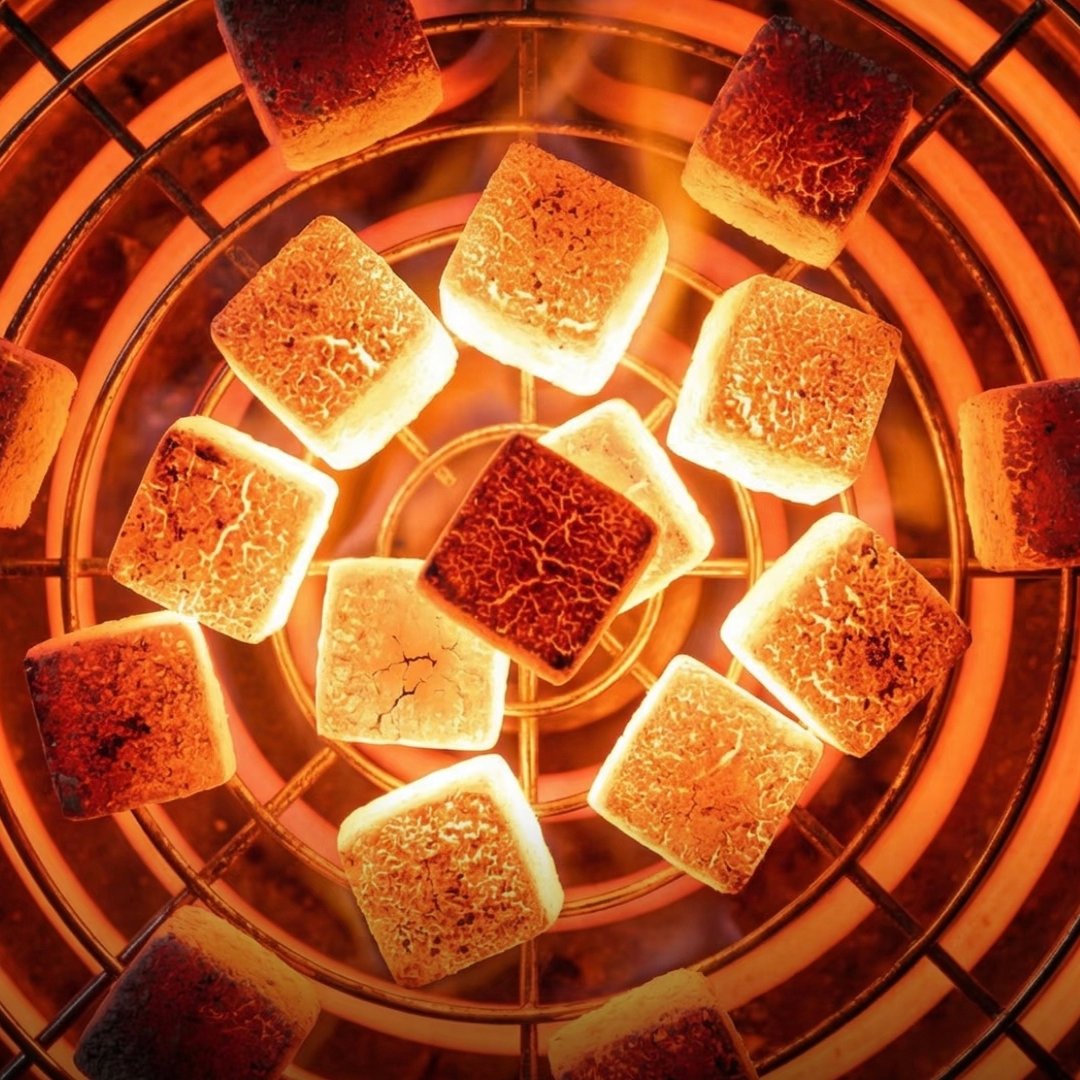
The Middle East is the world’s largest shisha charcoal market by volume, and the packaging norms here are very specific. The standard retail unit for shisha charcoal is a 1kg retail box containing 72 to 96 cubes, depending on cube size (25mm cubes give you 96 per kg; 33mm cubes give you around 72). This format has become so standard across UAE convenience stores and supermarkets that buyers who land with anything else spend months trying to educate their retail partners before the product starts moving.
For wholesale supply to hookah lounges, the format shifts. Lounge operators buying 50–200kg per week don’t want retail boxes — they want 10kg bulk bags or loose-fill master cartons that minimise packaging cost and packaging waste per session. A lounge running 30 tables a night goes through 3–5kg of charcoal per hour. They’re weighing out portions, not opening retail boxes.
For BBQ charcoal sold in the GCC for family outdoor use, the dominant retail size is 3kg and 5kg bags. Eid gatherings and weekend family BBQs are the main demand occasions — consumers want enough charcoal for the event without a large bag taking up pantry space. The 10kg+ sizes move in food service and hotel/resort supply, not in retail.
| Channel | Product | Recommended size | Why |
|---|---|---|---|
| Supermarket retail | Shisha cube | 1kg box (72–96 cubes) | Category standard — buyers expect this format on shelf |
| Convenience store | Shisha cube | 500g box | Impulse purchase format; lower price point for single-session use |
| Hookah lounge supply | Shisha cube / flat | 10kg bulk bag | Reduces packaging cost; lounges portion themselves |
| BBQ retail | Wood lump / coconut | 3kg or 5kg bag | Family BBQ occasion; shelf density and price point |
| Restaurant / hotel | Any grade | 10kg or 25kg sack | Food service purchasing; cost per kg prioritised over retail presentation |
Europe (Germany, Netherlands, UK, France)
European BBQ retail is dominated by one size: 3kg and 5kg bags. The 5kg bag is the volume leader — it fits a standard supermarket shelf slot, the weight is manageable for a consumer, and it contains enough fuel for two solid weekend BBQs without the household needing to store half a bag. German and Dutch category buyers have told us repeatedly that the 5kg format gives them the best combination of shelf turns and margin per linear metre.
The UK market leans slightly smaller — 3kg is the strongest seller at petrol stations and convenience retail, while 5kg and 10kg move at garden centres and outdoor retail stores. The difference is channel: UK consumers buy BBQ charcoal for a specific occasion more than as a pantry staple, so the smaller format reduces perceived risk at the point of purchase.
For eco-positioned products (bamboo briquette, FSC-certified hardwood), the packaging material matters as much as the size. European supermarkets — especially German discounters and Dutch lifestyle retailers — have been pushing suppliers toward paper kraft bags with minimal plastic as part of their own sustainability commitments. A PP woven bag is difficult to recycle and increasingly unwelcome on shelf in Germany and the Netherlands. This is not a regulation yet, but it functions like one in practice if you’re pitching a sustainability angle.
For foodservice and restaurant supply in Europe, the standard format is 10kg and 15kg paper sacks. Professional kitchens buy on cost per kg and don’t want the overhead of managing small retail packaging. Michelin-starred restaurants occasionally specify something premium (lump charcoal in individual bags with species identification), but most commercial kitchen purchasing is purely functional.
SA and Canada
The American BBQ market has different size norms from Europe, and getting them wrong costs buyers shelf space. US consumers buy charcoal in larger quantities than their European counterparts. The dominant retail sizes are 8lb (3.6kg), 16lb (7.3kg), and the category staple: 20lb (9kg). The 20lb bag is what most American consumers picture when they think of charcoal — it’s been the standard in US retail for decades.
For premium lump charcoal targeting the serious BBQ market (competition BBQ enthusiasts, restaurant supply, specialty retailers), the 20lb and 40lb bags are standard. The 40lb bag is almost exclusively a warehouse club or restaurant supply format in the US.
There’s an important labelling consideration for US imports: weight must be displayed in both metric and imperial units on the package, and the country of origin declaration must be prominent. US Customs Border Protection is particular about this for wood-derived products. If your packaging says “5kg” but not “11 lbs,” your distributor may face labelling compliance issues at import. This is a detail that doesn’t come up in most packaging guides — but it comes up in real imports.
Australia
Australia runs a summer BBQ season from October to March (Southern Hemisphere summer), and the dominant retail format is 4kg and 10kg bags. The 4kg format is the strongest supermarket seller — similar logic to the European 5kg. The 10kg moves well through hardware chains (Bunnings is the dominant DIY/hardware retailer and sells a significant volume of BBQ charcoal).
Australia has timber biosecurity requirements that affect charcoal imports — heat treatment certification is required for wood charcoal and some bamboo products to meet Australian biosecurity standards. This is handled at the phytosanitary certificate level, but it also affects what you can state on the packaging about the raw material. If your packaging makes claims about the wood source that can’t be verified against the phytosanitary documentation, customs can hold the container. We handle this for all Australian shipments as a standard part of export documentation, but it’s worth knowing before you finalise your packaging copy.
How packaging size affects your container fill rate — the numbers no one publishes
This is the section that makes or breaks the economics of an export order, and almost no charcoal supplier publishes the actual numbers. Here’s the reality: the packaging format you choose determines how many metric tons of product you can fit in a container, which directly determines your cost per ton shipped.
A standard 20GP container has an internal volume of roughly 33 cubic metres and a maximum payload of around 21–22 metric tons (the actual legal limit depends on your port and truck route, but 21MT is a safe working number for most routes out of China). The challenge is that charcoal is relatively low density — it fills volume before it hits weight limits. So the packaging shape and void space matter enormously.
| Packaging format | Approx. load (MT) | Units per container | Notes |
|---|---|---|---|
| 1kg retail boxes (10-box master carton) | 16–18 MT | 16,000–18,000 boxes | Carton air space reduces density. Heaviest cost per ton to ship. |
| 10kg bulk bags | 19–21 MT | 1,900–2,100 bags | Better fill rate than retail cartons. Standard wholesale format. |
| Loose fill (PP master bags) | 21–23 MT | — | Maximum fill rate. No retail presentation. Used by lounges who repack. |
| 5kg retail bags | 17–19 MT | 3,400–3,800 bags | Middle ground. Good for retail. About 4% better fill than 1kg cartons due to bag flexibility. |
| 25kg catering sacks | 20–22 MT | 800–880 sacks | Near-optimal fill rate. Right format for restaurant/foodservice supply. |
What this table shows is that choosing 1kg retail boxes over 10kg bulk bags costs you roughly 2–3 metric tons per container. At $450 per ton FOB, that’s $900–$1,350 lost per container — just in container utilisation. Over 10 containers a year, that’s over $10,000 in shipping efficiency lost to packaging choice. This is the calculation most buyers don’t do, and it’s why we always ask new buyers about their end-channel before recommending a packaging format.
The landed cost calculation
Before committing to a packaging format, work through this sequence: FOB price per ton × estimated tons per container = container product cost. Add sea freight, destination port charges, customs duty, and inland delivery. Divide by the number of retail units you’re actually shipping. That’s your landed cost per retail unit. A packaging choice that looks cost-neutral at the FOB stage can add $0.15–$0.30 per retail unit when you account for lower container utilisation and higher packaging material cost. On a 5kg bag retailing at $8, that margin difference is decisive.
The IMDG 2026 change that will get your container rejected if you’re not aware of it
This is the section that almost no charcoal packaging guide covers. It’s also the most important thing that changed in the past 12 months for charcoal exporters.
Between 2015 and 2022, 68 container fires aboard vessels were attributed to charcoal shipments. Charcoal is a self-heating material — under certain conditions of moisture and temperature, it can spontaneously combust in an enclosed container. The International Maritime Organization responded by progressively tightening the rules, and in 2026 they completed the final stage: every exemption that previously allowed charcoal to ship without a Dangerous Goods declaration is now gone.
The two exemptions that most China-origin charcoal shipments relied on — Special Provision SP 925 and SP 223 — have been eliminated from the IMDG Code. Before 2026, charcoal that passed the UN N.4 self-heating test could be declared as non-DG cargo, avoiding the additional documentation, packaging requirements, and shipping line surcharges that DG cargo attracts. That route is now closed.
What this means for your 2026 shipment
Every container of charcoal leaving China is now classified as Dangerous Goods, Class 4.2 (self-heating substances), UN 1361 or UN 1362.
This triggers four specific requirements that affect your packaging directly:
1. UN-approved packaging only. Packing instruction P002 applies. Regular PP woven bags without UN certification are no longer acceptable. You need bags or cartons with a UN packaging approval mark. Your supplier needs to be using certified packaging material — if they’re not, your container can be refused at port.
2. Moisture content must be below 5% before packing. This isn’t new as a quality standard, but it’s now a documented safety requirement. Your pre-shipment SGS report should include moisture content as a matter of course. If it doesn’t, ask for it specifically.
3. A thermal vacuum jacket is now mandatory for every container. This is a foil liner system that goes around the interior of the container and prevents condensation and external heat from triggering self-heating in the cargo. Cost is approximately $280–$400 per container. Suppliers who tell you this isn’t required are either unaware of the 2026 changes or are hoping you won’t ask. We install thermal jackets as standard on all our containers.
4. The 1.5-metre stowage height limit. Under the new rules, charcoal bags cannot be stacked higher than 1.5 metres inside the container (with a minimum 30cm headspace). This reduces the effective loading height from the full container interior height and is one reason why container fill rates are slightly lower in 2026 than they were in previous years.
The practical implication for buyers is this: if you’re comparing quotes from multiple suppliers and one is significantly cheaper, it’s worth asking whether they are compliant with IMDG Class 4.2 requirements. A supplier who is cutting corners on DG documentation is saving money that you’ll pay in one of three ways — a container rejection at the origin port, a mis-declaration fine (which can reach $15,000+), or in the worst case, a container fire at sea with all the liability that comes with it.
At The Charcoal Factory, every container we ship is DG-compliant. We use UN-certified packaging, issue a full Dangerous Goods Declaration with every Bill of Lading, and install a thermal jacket as standard. We work with shipping lines that regularly handle Class 4.2 cargo. None of this is optional, and it should be a baseline expectation from any charcoal supplier you work with in 2026.
Packaging types — what each one actually does and doesn’t do
Now that the strategic decisions are clear, here’s a practical rundown of the packaging materials themselves. Most guides list these without explaining the real trade-offs.
Kraft paper three-ply bags
This is the material of choice for retail BBQ charcoal in Europe. Three-ply kraft (paper/PE liner/paper) gives you moisture resistance on the inside, printability on the outside, and an eco-credible material story that European retailers actually value. The downside is cost — kraft three-ply is more expensive per unit than PP woven, and it’s slightly more vulnerable to physical damage in transit if bags are handled roughly at the destination port. For European supermarket supply, the sustainability credential and the print quality make it worth the premium. For Middle East wholesale distribution, it’s usually unnecessary.
PP woven bags
The workhorse of charcoal bulk packaging. Cheap, strong, tear-resistant, and available in a wide range of sizes. PP woven is the default for Middle East wholesale, Asian redistribution, and any format where retail presentation is not the primary concern. The challenge in 2026 is that standard PP woven bags without UN packaging certification are no longer compliant for sea freight of DG Class 4.2 cargo. Make sure your supplier is using UN-certified PP woven if you’re shipping post-2025. The bags look identical — the difference is in the certification documentation.
Retail carton boxes (shisha charcoal)
The standard format for shisha charcoal sold at retail in the Middle East and East Asia. A full packaging stack for shisha charcoal typically has three layers: an inner plastic bag (PE) that protects the charcoal from moisture and holds the cubes together, an inner retail box (duplex or corrugated e-flute) with your branding, and a master carton (double-wall corrugated) that holds typically 10 inner boxes. The inner plastic bag can be printed with branding — this is what your end customer actually handles when they open the retail box. The print run minimum for inner plastic bags is typically 10,000 units, which is relevant for small first orders.
The inner box is where most of the branding budget goes. A well-designed inner box with embossing, spot UV, or metallic finish can add $80–$120 per ton to your packaging cost but significantly improves shelf presence. For premium positioning in the UAE or Saudi retail market, this investment usually pays back in the margin your distributor can hold. For budget retail, a plain duplex box with two-colour printing is the cost-effective route.
Jumbo bags (FIBC / big bags)
1,000kg flexible intermediate bulk containers are used for charcoal that will be repacked at the destination. This is a specialist format — you see it in industrial charcoal supply and in operations where the importer runs their own packaging facility and wants to minimise packaging material from the origin. Not relevant for retail or food service supply, but worth knowing exists if you’re building a distribution business that eventually wants to control more of the value chain at destination
What your packaging label says affects your customs clearance
This is a connection that almost no charcoal packaging guide makes, and it catches buyers out regularly.
When your container arrives at the destination port, customs officers compare the physical goods against the documents. The commercial invoice describes the product. The packing list describes the packaging. The Certificate of Origin confirms where it was made. And your product packaging — the label on the bag — is treated as a declaration about the product inside.
Here’s where it goes wrong. If your product label says “hardwood charcoal” but your phytosanitary certificate describes the product as “bamboo charcoal”, you have a document mismatch. UAE customs, in particular, can hold a container on this basis. If your label says “made from natural wood” but your SGS lab report identifies bamboo as the raw material (bamboo is technically a grass, not a wood), a sharp customs inspector can classify this as a mislabelling issue.
The rule we give every buyer is simple: whatever your packaging says, your export documentation must say the same thing, in the same terms. If your bag says “A-grade bamboo shisha charcoal cube, 25×25×25mm, net weight 1kg,” your commercial invoice and packing list should describe the product in exactly those terms. The country of origin on the packaging must match the Certificate of Origin. The net weight must match the packing list. The raw material claim must be consistent with the phytosanitary certificate.
This sounds obvious when stated directly, but it’s genuinely common for packaging artwork to be designed by a marketing person and export documents to be written by a trade person, with no one cross-checking the two. We review both together as part of our pre-shipment process.
Private label charcoal packaging — what the MOQs actually look like
Most packaging guides either don’t cover private label at all, or give a vague “MOQ varies by supplier” answer. Here are the actual numbers from how we work, which reflect fairly standard practice among Chinese charcoal manufacturers.
| Packaging type | Typical MOQ | Lead time (packaging) | Notes |
|---|---|---|---|
| PP woven retail bags (branded, gravure print) | 1 container (from TCF) | 10–15 days | Brand name, logo, weight, barcode. 6–8 colour gravure print. |
| Kraft paper retail bags (branded) | 1 container | 12–18 days | Suitable for European eco-positioned charcoal. Paper + PE liner. |
| Shisha inner retail box (duplex, 2-colour) | 10,000 boxes | 15–20 days | Budget inner box option. 1–2 colour offset print. |
| Shisha inner retail box (full colour, laminated) | 5,000 boxes | 20–25 days | Premium presentation. Embossing, spot UV available from 10,000+. |
| Shisha inner PE plastic bag (printed) | 10,000 units | 15–20 days | Requires separate print plate setup. One-time plate cost applies. |
| Master carton (printed) | 500 cartons | 7–10 days | 1–2 colour flexo print on corrugated. Low minimum. |
The practical implication here is that if you’re placing your first order with a shisha charcoal brand and you want the full three-layer packaging (inner plastic + inner box + master carton), you need to order enough charcoal to consume 5,000–10,000 inner boxes in one go. At 1kg per box, that’s 5–10 metric tons minimum to run through your packaging. With typical container loads of 16–18MT for 1kg retail cartons, a single container is usually enough to justify the print run.
For buyers who want private label packaging but aren’t yet ready for the full print run minimum, there are two practical options. First, plain packaging with a label sticker — less professional, but allows you to test the market with a small order before committing to a print run. Second, share the print run with another buyer at the same factory who’s ordering the same packaging size but a different brand. Some factories offer this; we can facilitate it for buyers who ask.
Charcoal packaging for Amazon and e-commerce — the requirements most buyers miss
This is a growing channel that has its own specific packaging requirements, and they’re different from traditional retail in ways that catch first-time sellers out.
Amazon FBA (Fulfilled by Amazon) has detailed requirements for product packaging that must be met before goods are accepted at an Amazon fulfilment centre. For charcoal specifically:
- Bags must be self-standing or box-shaped — floppy bags that can’t be placed on a shelf without falling over are rejected at intake. Flat-bottom bags or box-style packaging is required for charcoal on Amazon FBA.
- FNSKU barcode must be on the outside of the retail unit, scannable without opening the master carton. This means your private label packaging needs to include the FNSKU barcode from the start — you can’t add it with a sticker at the warehouse without additional cost.
- Moisture-resistant packaging is effectively required for charcoal, because fulfilment centres aren’t climate-controlled and charcoal in non-moisture-resistant packaging will absorb humidity, degrade in performance, and generate negative reviews. A PE liner inside the bag is the minimum.
- Weight declaration in the selling country’s primary units — for USA Amazon, this means US customary units (lbs/oz) must be prominent. For UK Amazon, grams and kg.
Beyond FBA, online-direct charcoal sellers (Shopify, their own website, regional marketplaces) have slightly more flexibility — but the practical reality is that what protects charcoal in a sea container also protects it in a courier network. Bags that can’t handle 30 days in a container definitely can’t handle a courier throwing them in a van. The moisture protection and structural integrity requirements are, if anything, higher for e-commerce than for retail.
A practical checklist before you finalise your packaging decision
Running through these questions before you confirm your order will catch most of the expensive mistakes.
- Does your end channel have a standard format? Shisha retail, BBQ retail, food service, and wholesale all have defaults. Start with the default and only deviate if you have a specific commercial reason.
- What’s the container fill rate for your chosen packaging? Ask your supplier for the estimated metric tons per 20GP container for your specific packaging format. If they can’t give you a number, they’re not tracking this and you’re guessing on your economics.
- Is the packaging UN-certified for DG Class 4.2? After 2025, this is non-negotiable. Ask for the UN packaging certification reference number. It should be on the bag itself.
- Is a thermal jacket included in the freight quote? If your supplier is quoting you FOB without mentioning a thermal jacket, ask whether it’s included. If it’s not, add $280–$400 per container to your cost calculation.
- Does your packaging label match your export documents? Cross-check product name, raw material description, weight, and country of origin between the packaging artwork and the commercial invoice, packing list, and Certificate of Origin.
- What are the labelling requirements in your destination market? Weight in local units, language requirements (Arabic for Middle East retail, bilingual for USA), regulatory markings for food-contact or fire safety. These vary by market and need to be confirmed before artwork is finalised.
- What’s the minimum print run for your private label? Confirm whether your order size meets the packaging MOQ, or negotiate a smaller first run using sticker labelling.
Working with a manufacturer who handles this end-to-end
One thing that doesn’t get said enough in export guides: the packaging decision is significantly easier when you’re working directly with the manufacturer rather than a trading company. A manufacturer controls the production process, the packaging line, and the export documentation. They can confirm container fill rates from actual loading data, not estimates. They can cross-check the packaging artwork against the documentation before it goes to print. And when something needs to change — a different bag size for a new market, a label update for compliance — they can execute it without going back to a third party.
The Charcoal Factory is a manufacturer, not a trader. We make bamboo charcoal, wood charcoal, shisha charcoal, and coconut shell briquettes at our facility in Hefei, China. We handle private label packaging from one container minimum, produce Arabic-language packaging for Middle East markets, and manage full DG export documentation for every shipment. If you’re at the stage of working out what packaging makes sense for your market, the fastest way to get a concrete answer is to send us your end channel, destination country, and approximate quantity — we’ll come back with a packaging recommendation, container fill estimate, and FOB price within 24 hours.
The packaging decision you make before your first container ships is harder to undo than most buyers expect. Getting it right from the start — on format, size, compliance, and labelling — is the difference between a product that moves and a container that comes back to haunt you six months later.