

The global demand for charcoal is no longer seasonal. From shisha lounges across the Middle East to BBQ chains in Europe and North America, the need for consistent, high-quality charcoal supply has turned bulk procurement into a serious business function. And yet, most first-time buyers walk into it underprepared.
Buying charcoal in bulk is not simply finding a “charcoal factory near me” and placing an order. It requires understanding product types, evaluating supplier credibility, navigating international logistics, and managing pricing dynamics that shift with the seasons. Do it right, and bulk buying delivers better margins, reliable supply, and a competitive edge. Do it wrong, and you’re sitting on a container of substandard product with no recourse.
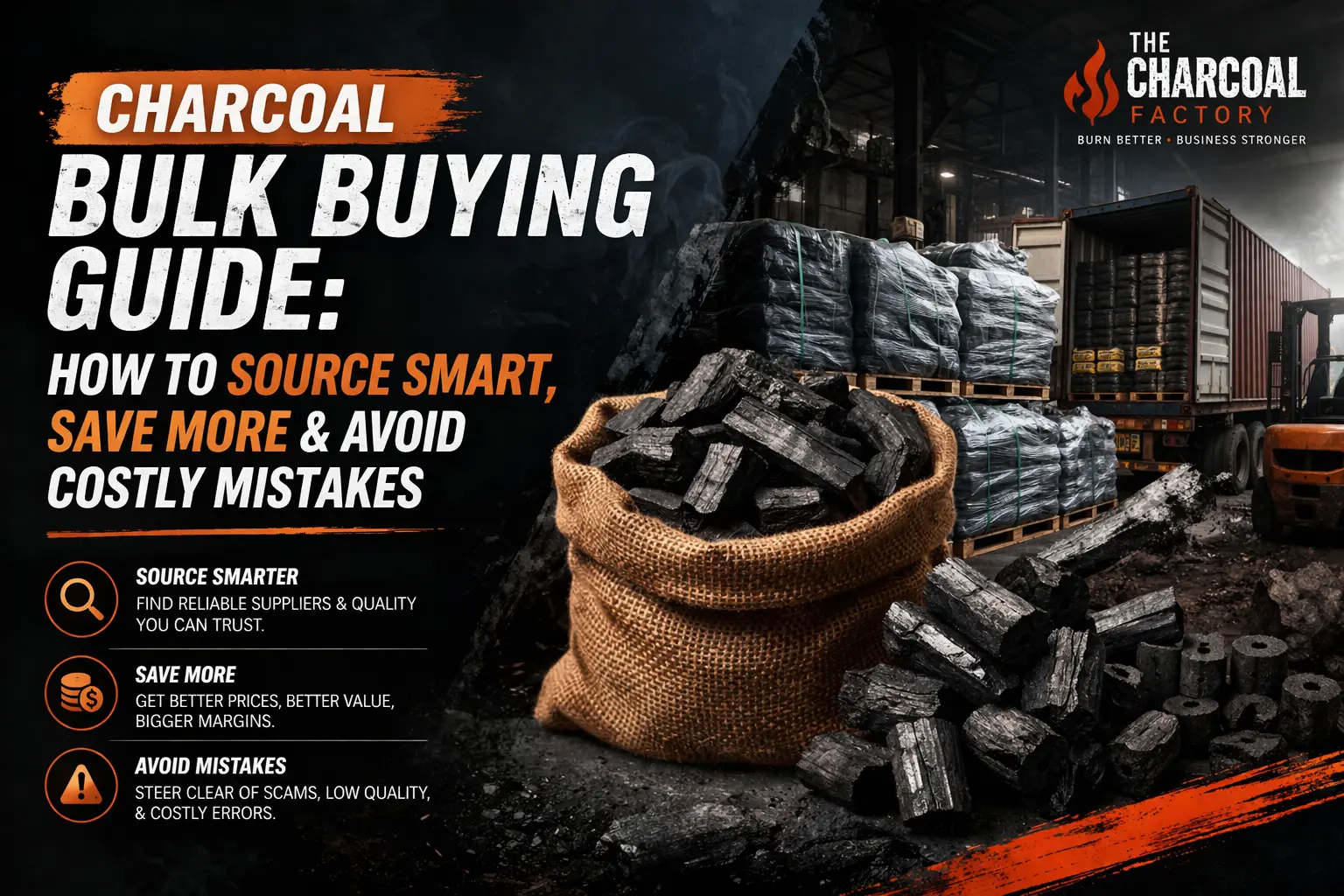
This Charcoal Bulk Buying Guide covers everything you need to know, from selecting the right charcoal type to placing your first full-container order with confidence. And if you’re looking for a manufacturer you can trust from day one, we’ll introduce you to The Charcoal Factory, a wholesale charcoal manufacturer based in Anhui, China, supplying importers and distributors across 60+ countries. But also, before buying, you must go through the charcoal supplier verification checklist.
Table of Contents
1. Why Bulk Buying Charcoal Is Growing Globally
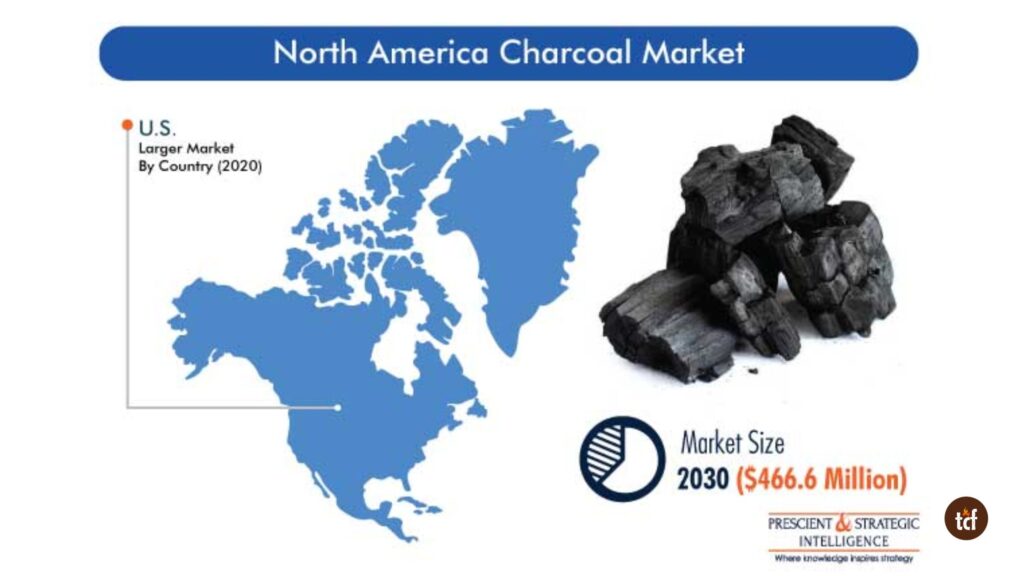
The charcoal industry has undergone a quiet transformation over the past decade. What was once a seasonal commodity tied to backyard grilling has evolved into a year-round, high-volume global trade category driven by several converging forces.
The shisha (hookah) industry has exploded across the Middle East, Europe, and Southeast Asia, creating consistent year-round demand for premium charcoal briquettes that burn long, produce minimal smoke, and deliver a clean profile. At the same time, the restaurant and hospitality sector has increasingly turned to charcoal for grilling and live-fire cooking, further driving demand.
On the supply side, the rise of bamboo charcoal manufactured from a fast-growing, renewable raw material has addressed sustainability concerns while improving production consistency. This has made large-scale manufacturing more feasible and export-grade quality more achievable across key origins, including China, Vietnam, and Indonesia.
For importers and distributors, bulk procurement is no longer just a cost-saving strategy. It’s a supply chain imperative. Buying in volume locks in pricing, ensures product consistency, and gives businesses the inventory depth to serve clients reliably through peak demand periods like Ramadan and summer grilling season. And don’t forget to check the charcoal grades.
2. Types of Charcoal Available in Bulk
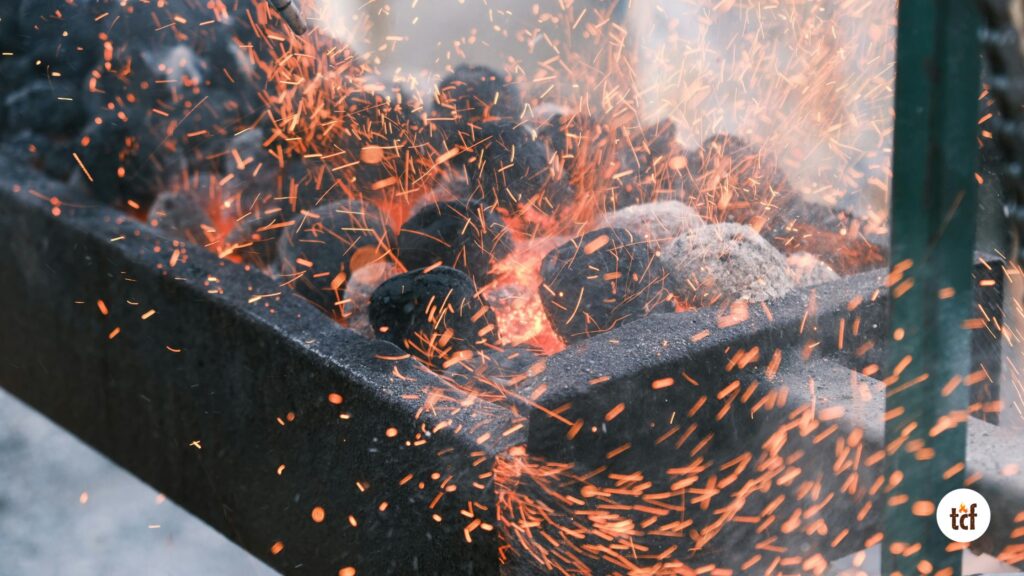
Not all charcoal is suited to every market or application. The type you choose will affect burn quality, container efficiency, price point, and how well the product performs for your end customer. Understanding the difference is the foundation of smart bulk buying.
Bamboo Charcoal
Bamboo charcoal has become one of the most sought-after formats in global bulk trade, particularly for shisha and premium BBQ applications. Manufactured from carbonised bamboo shell, it delivers a notably cleaner burn profile: low ash content, longer burn time, and no chemical additives. These characteristics make it especially well-suited to indoor shisha environments where smoke and residue are deal-breakers for customers.
What sets bamboo charcoal apart is also its raw material advantage. Bamboo is harvestable every 3 to 5 years without killing the root system, making it a genuinely renewable feedstock compared to hardwood trees that require decades to mature. For buyers in the EU and North American markets where sustainability credentials matter to end consumers, bamboo charcoal offers a real differentiation story.
Bamboo charcoal comes in two primary forms for bulk buyers:
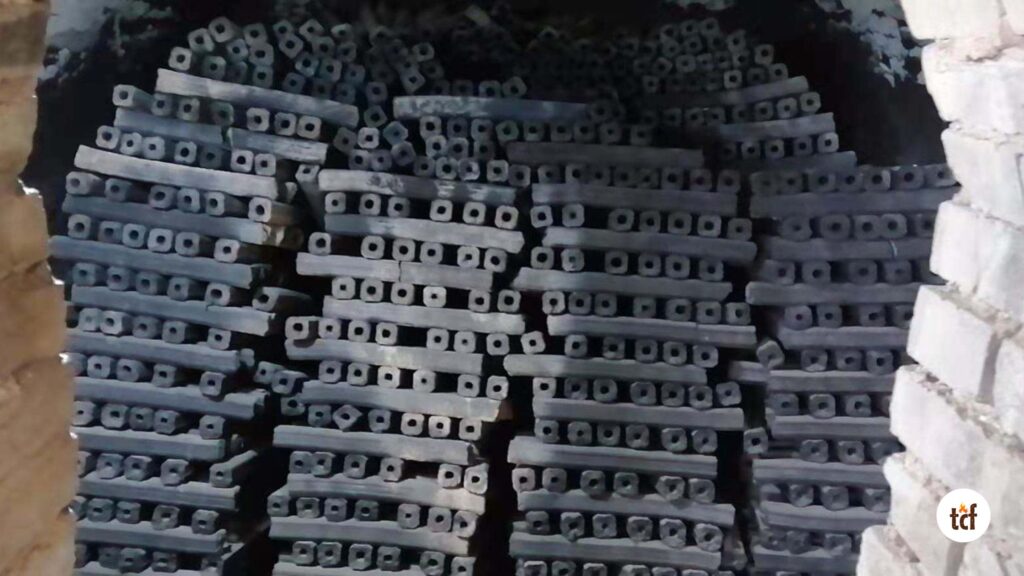
Machine-made bamboo charcoal is produced using automated pressing and carbonisation, resulting in uniform shapes, typically hexagonal or cylindrical, that are ideal for consistent shisha performance and efficient container loading.
Shaped bamboo charcoal refers to custom-formed pieces tailored for specific applications or private-label product lines. If you’re building a branded charcoal product, shaped bamboo gives you control over the visual identity of the product.
Wood Charcoal
Wood charcoal is manufactured by carbonising selected hardwood in controlled kiln environments. It produces high heat output with stable burn performance, making it a strong choice for restaurants, professional BBQ operators, and grilling-focused retail products.
Like bamboo, wood charcoal is available in machine-made wood charcoal and shaped formats. For bulk buyers, the key advantage of shaped wood charcoal is size consistency, critical for retail packaging where visual uniformity matters at the point of sale.
Wood charcoal commands a premium price point compared to bamboo, which can work in your favour when targeting markets where the natural hardwood origin story resonates with buyers.
How to Choose Between Bamboo and Wood for Bulk Orders
| Feature | Bamboo Charcoal | Wood Charcoal |
| Burn consistency | High, uniform ash, clean burn | High, stable heat output |
| Best application | Shisha, premium retail, private label | BBQ, restaurants, grilling retail |
| Sustainability | Renewable (3–5 yr harvest cycle) | Requires tree felling |
| Price at scale | Highly competitive | Slight premium |
| Private label support | Widely available | Widely available |
| Available grades | A, B, C | A, B, C |
3. How to Choose the Right Charcoal Bulk Supplier
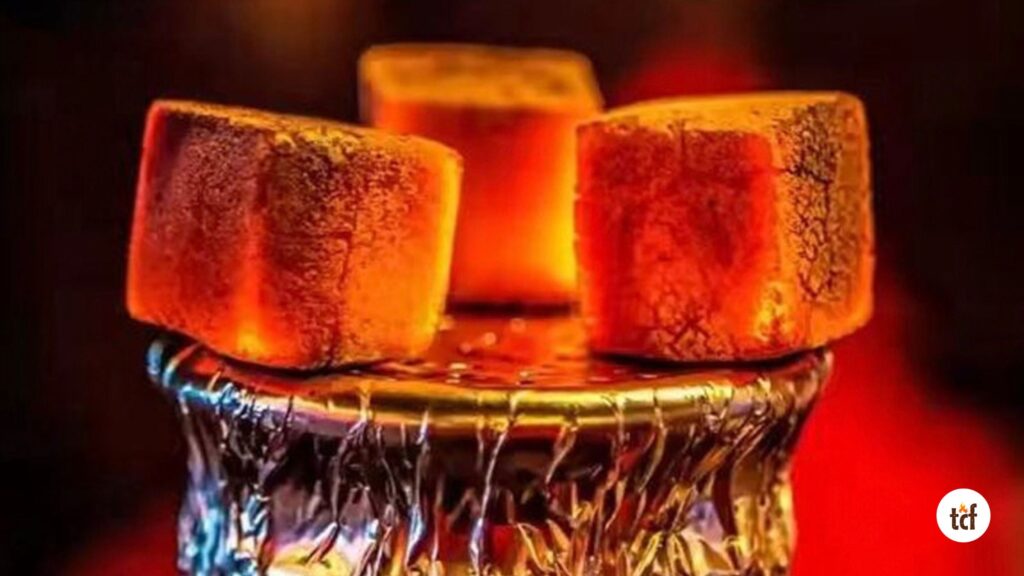
The instinct to search “charcoal suppliers near me” is understandable but limiting. For serious bulk buyers, geography is rarely the most important variable. A well-established charcoal manufacturer in China with proven export infrastructure, full documentation capabilities, and thousands of tons of annual output is almost always a better partner than a domestic broker with no factory of their own.
Here’s what to evaluate before committing to any supplier relationship:
1. Production capacity and export track record
A reliable charcoal manufacturer should be producing at scale and have documented experience shipping to international markets. Ask for references, shipping records, or evidence of prior export activity. A supplier who has never shipped internationally will struggle with the documentation requirements your customs authority expects. Look for manufacturers with a clearly stated customer reach supplying 60+ countries, for example, which signals a well-established export operation.
2. Grade transparency
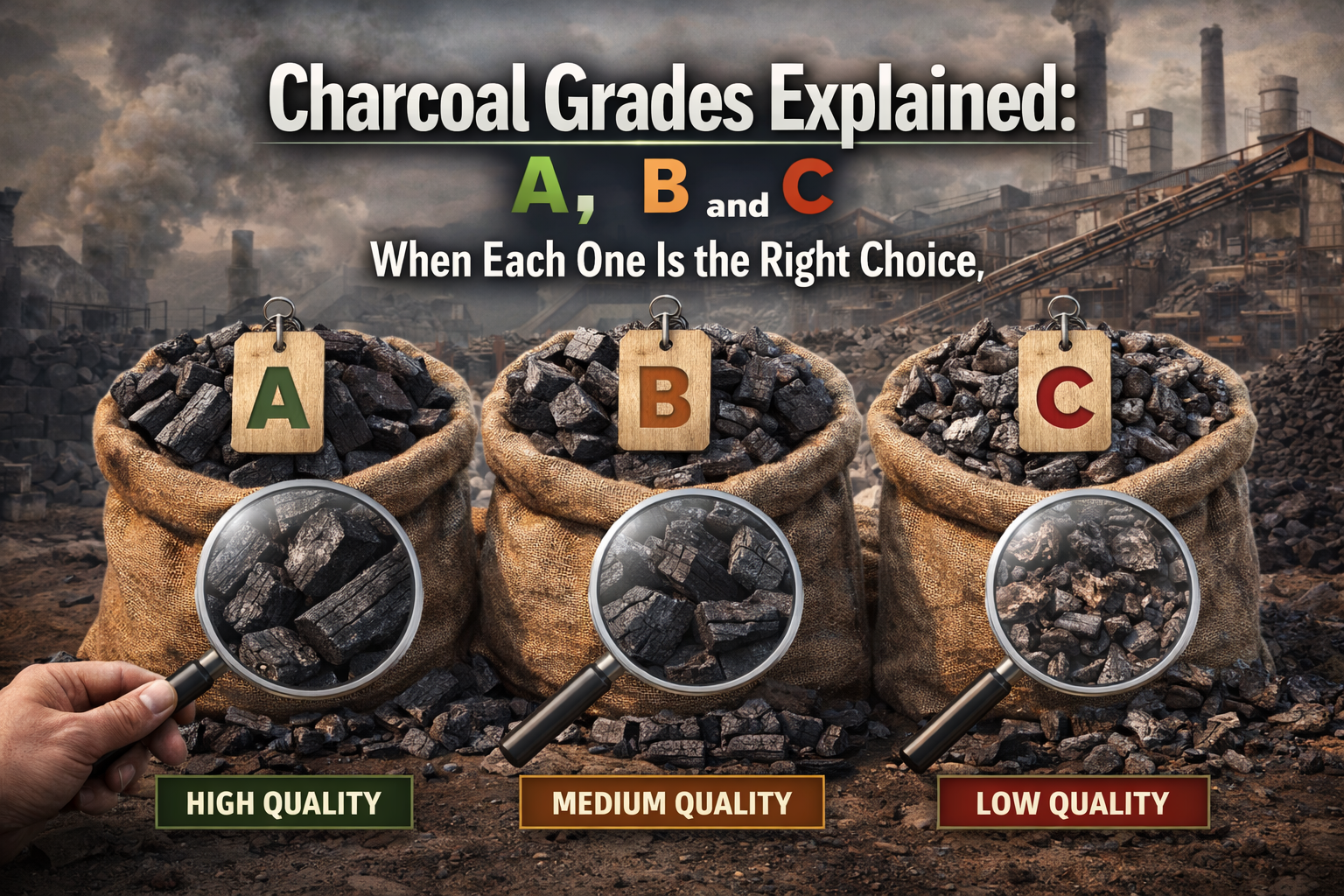
One of the most overlooked supplier qualities is clear, documented grading. A credible charcoal manufacturer should offer A, B, and C-grade products that are consistently defined and maintained across production runs. You should know exactly what grade you’re buying and what specifications of ash content, moisture, and burn time that grade guarantees. A Certificate of Analysis should be available for every A-Grade shipment.
3. Certifications and compliance documentation
At minimum, require the following: a phytosanitary certificate, Certificate of Origin, Certificate of Analysis (COA), commercial invoice, packing list, and bill of lading. These aren’t bureaucratic extras; they’re the documents that determine whether your shipment clears customs or sits in a bonded warehouse at your expense.
4. Private label and OEM capability
If you’re building a brand or distributing charcoal under your own label, packaging customisation is essential. Confirm that the supplier can handle your bag design, print your branding, support multiple packaging formats (bulk sacks, export cartons, retail bags, custom-printed boxes), and meet any regional compliance labelling requirements.
5. Factory verification before any deposit
Never transfer a deposit without first verifying that you’re dealing with a real manufacturer. Request a live video walkthrough of the facility. Legitimate charcoal factories will accommodate this without hesitation. If a supplier deflects this request, treat it as a serious red flag.
A critical warning: many online listings for “charcoal distributors” and “charcoal bulk suppliers” are brokers and agents, not factories. They add margin to every transaction, slow down communication, and have zero control over production quality or shipment timelines. Always verify direct factory access before making any financial commitment.
4. Packaging, Palletisation & MOQ Explained
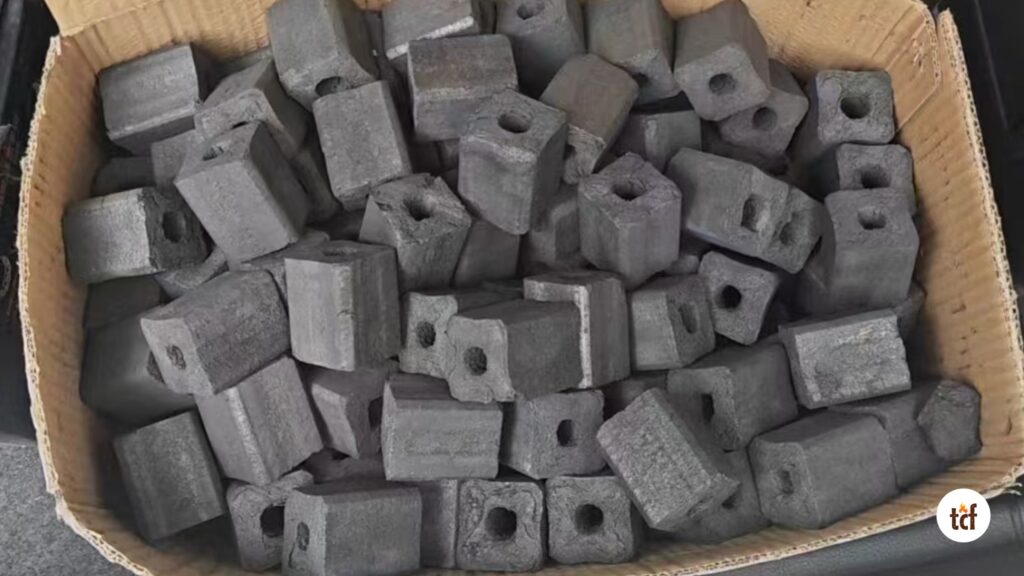
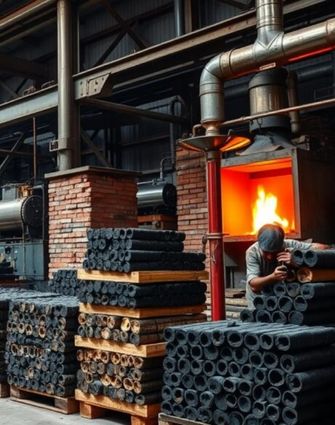
How your charcoal is packaged, stacked, and loaded onto a container has a direct impact on product safety during transit, container utilisation efficiency, and ultimately, the landed cost per kilogram. Buyers who ignore these details often discover the problem after the container arrives.
1. Packaging formats
Established charcoal manufacturers offer flexible packaging options to serve different market channels: bulk sacks for industrial buyers, export cartons for distributors, and retail bags for supermarket and e-commerce supply. For private-label buyers, the full range of custom-printed boxes, branded poly bags, and language-specific labelling should be available as standard.
If you’re doing a bulk buy for retail distribution, printed packaging is almost always the right choice, as it allows your product to go directly to the shelf without repackaging at your end.
2. Container loading
A standard 20-foot container (20GP) is the typical minimum order benchmark for serious bulk buyers and the industry-standard MOQ with reputable manufacturers. A 40-foot high-cube container accommodates significantly more volume. Ask your supplier for a container loading diagram with every quote. It tells you exactly how pallets are configured, how many bags per pallet, and the total weight per container.
3. Minimum order quantities
The MOQ for most established charcoal factories starts at one 20GP container. For long-term clients or recurring orders, production planning should be available to ensure a continuous supply without delays or stock shortages.
Explore Reliable Bulk Charcoal Supply
If you’re now evaluating suppliers, it’s important to choose a manufacturer that offers both product variety and consistent quality at scale.
At The Charcoal Factory, we are the bamboo charcoal suppliers and manufacturers, providing a complete range of bamboo charcoal products for global buyers, including:
- Bamboo Charcoal
- Machine-Made Bamboo Charcoal
- A-Grade Machine-Made Bamboo Charcoal
- Shaped Bamboo Charcoal
Alongside this, we also offer wood charcoal solutions for BBQ and restaurant use:
- Machine-Made Wood Charcoal
- Shaped Wood Charcoal
All products are available in bulk quantities with custom packaging, clear grade specifications, and export-ready documentation, making them suitable for distributors, importers, and private-label brands.
If you’re planning your first order or scaling supply, you can explore the full range and choose the right product based on your market needs.
5. What Affects the Wholesale Price of Charcoal
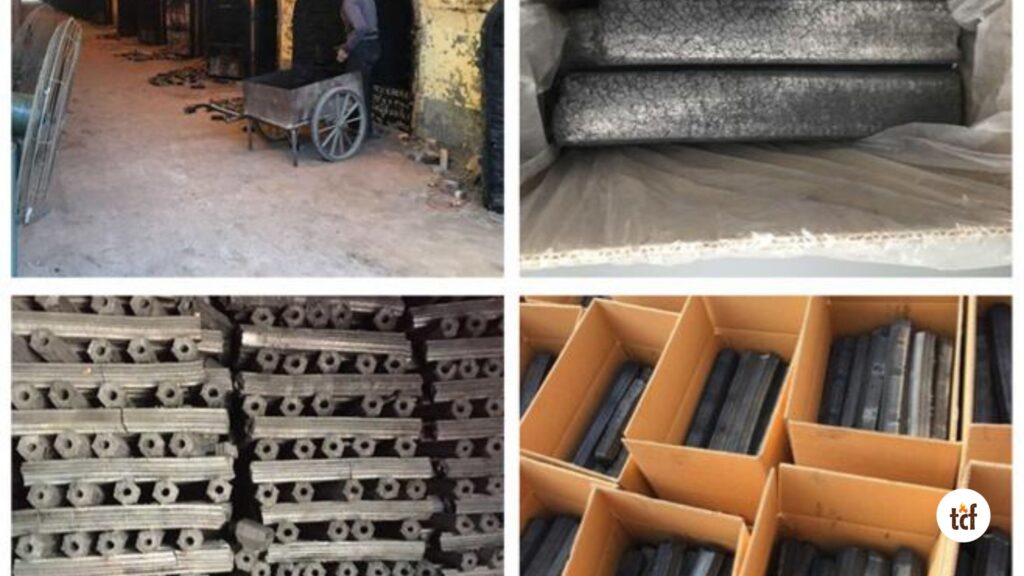
When you receive a charcoal wholesale price quote, the number reflects a complex set of upstream and downstream variables. Understanding what drives cost makes you a more effective negotiator and helps you avoid the trap of comparing incomparable quotes.
1. Raw material source
Bamboo charcoal is generally more economical than hardwood alternatives because bamboo grows faster, requires less land, and is harvested without replanting. Hardwood charcoal requires sourcing, processing, and burning of solid trees, which adds labour and cost at every stage. When evaluating quotes, always confirm the exact raw material type.
2. Grade and quality specifications
A-grade charcoal with high fixed carbon, low ash content, and precise size uniformity costs more to produce than B or C grade. Achieving these specifications requires better machines, tighter process controls, and consistent raw material sourcing. If a quote looks unusually low, check whether the product grade matches your requirements before assuming it’s a better deal.
3. Order volume
Full-container-load (FCL) orders give buyers significantly more negotiating leverage than smaller, consolidated shipments. If you’re currently buying below a full container, exploring whether you can consolidate orders either by product type or across SKUs can meaningfully reduce your unit cost.
4. Seasonality
Charcoal prices move with demand. The Middle Eastern market sees consistent price pressure ahead of Ramadan, when shisha consumption spikes. Western markets follow a similar pattern ahead of summer BBQ season. Buyers who plan inventory by placing orders in the off-season or building buffer stock consistently secure better pricing than those who buy reactively during peak periods.
5. Incoterms and total landed cost
An FOB price and a DDP price are not comparable on face value. Always request a full landed cost breakdown, including freight, insurance, port handling fees, customs duties, and last-mile delivery, before evaluating suppliers against each other. The lowest headline price is rarely the lowest total cost.
6. Logistics & Customs: FOB, CIF, DDP Explained

International shipping is often where first-time importers encounter the most friction. Understanding the three most common Incoterms used in the bulk charcoal trade removes most of the confusion before it becomes a problem.
1. FOB — Free On Board
Under FOB terms, the supplier is responsible for the product until it is loaded onto the vessel at the origin port. From that point, risk and cost transfer to the buyer. This is the preferred arrangement for experienced importers who have freight forwarding relationships in place and want full control over their shipping costs and carrier selection.
2. CIF — Cost, Insurance & Freight
With CIF, the supplier arranges and pays for ocean freight and marine insurance to the buyer’s destination port. The buyer takes responsibility once the shipment arrives at the port. This is a practical option for mid-scale importers who want the supplier to handle origin logistics without committing to the full-service DDP arrangement.
3. DDP — Delivered Duty Paid
DDP is the most hands-off option for the buyer. The supplier manages everything, freight, insurance, customs clearance, import duties, and delivery to the buyer’s warehouse. It’s the most convenient arrangement for first-time importers, but it comes at a cost premium and reduces your visibility into logistics expenses over time.
4. Documentation requirements
Regardless of the Incoterms you choose, your supplier should provide a complete documentation package with every shipment: phytosanitary certificate, Certificate of Origin, COA, MSDS, bill of lading, commercial invoice, and a detailed packing list. Missing any one of these documents can result in customs holds, demurrage fees, or outright rejection at the destination port.
Plan for lead times of 15 to 35 days from production completion to delivery, depending on origin and destination region. For seasonal orders, build a 4 to 6 week buffer into your procurement calendar.
7. Common Mistakes to Avoid When Bulk Buying Charcoal

Most sourcing failures in the charcoal trade are not caused by bad luck. They’re caused by predictable, avoidable mistakes.
1. Working with brokers who present themselves as factories
This is the single most common and costly mistake in bulk charcoal sourcing. Numerous online listings for charcoal suppliers are operated by intermediaries with no manufacturing capability of their own. They add margin, introduce communication delays, and cannot intervene when quality or shipment timelines go wrong. Always verify direct factory access before transferring any money.
2. Placing a full order without testing samples
No sales pitch substitutes for physically testing the product. Before committing to a container, request a sample of the exact product SKU you plan to order, same grade, same packaging, same specification. Test it for burn duration, smoke output, ash content, and physical consistency. Reputable manufacturers will ship samples readily.
3. Overlooking grade documentation
Not all charcoal sold as “A grade” meets the same standard. Insist on a Certificate of Analysis for every A-grade shipment that quantifies fixed carbon percentage, ash content, moisture level, and size uniformity. This protects you from receiving a product that was graded generously on the supplier’s end.
4. Ignoring seasonal pricing dynamics
Buyers who place reactive orders during peak demand periods consistently pay more. Build your procurement calendar around known demand events, Ramadan, summer BBQ season and place orders with enough lead time to avoid both price premiums and supply shortfalls.
5. Comparing quotes without aligning on Incoterms
Receiving three supplier quotes and choosing the lowest number is a mistake when the quotes are on different Incoterms. Always ask every supplier for the same basis, or request a full landed cost breakdown to your destination, so comparisons are meaningful.
8. Why The Charcoal Factory Is the Right Bulk Partner
If this guide has made one thing clear, it’s that bulk charcoal sourcing rewards buyers who work with manufacturers, not traders, not brokers, and not intermediaries, adding cost without adding value.
The Charcoal Factory is a wholesale charcoal manufacturer based in Anhui, China, operating a fully integrated production facility that covers everything from raw material sourcing to container loading and export documentation. Here’s why buyers across 60+ countries choose to work with them:
1. Two product lines. One reliable supply.
The Charcoal Factory produces both bamboo charcoal and wood charcoal, machine-made and shaped across A, B, and C grades. This gives buyers flexibility to serve multiple market segments from a single manufacturer relationship, rather than managing multiple supplier relationships for different SKUs.
Their bamboo charcoal range is particularly strong for shisha and premium retail buyers. Low ash content, long burn time, and clean combustion make it a top performer in demanding markets. The wood charcoal range delivers the high heat and stable performance that restaurant and BBQ-focused buyers require.
2. Grade transparency is built into every order
Every shipment from The Charcoal Factory comes with clearly documented grade specifications. A-grade orders include a Certificate of Analysis as standard, giving you a verifiable, documented record of what you purchased — and what your customers are receiving.
3. Full export documentation as standard
Every shipment includes a phytosanitary certificate, Certificate of Origin, commercial invoice, packing list, and bill of lading. No chasing paperwork, no customs surprises, no missing documentation on arrival.
4. Private label and custom packaging
Whether you’re building a retail brand for supermarkets, creating a private-label product for e-commerce, or supplying a wholesale channel under your own name, The Charcoal Factory handles the full packaging solution from bulk sacks to custom-printed retail boxes. Your brand, your artwork, their production infrastructure.
Sustainability credentials for buyers with ESG commitments
Bamboo grows from the same root system after harvest, no replanting required, no deforestation. For buyers in the EU and North American markets, where supply chain sustainability is increasingly a buyer expectation or regulatory requirement, bamboo charcoal from The Charcoal Factory comes with plantation sourcing documentation available on request.
MOQ starting at one 20GP container
The Charcoal Factory’s minimum order is one 20GP container, a practical, accessible entry point for new buyers who want to test product quality and build a supplier relationship before scaling to larger volumes.
10 years. 60+ countries. 1,000+ retail partners.
The Charcoal Factory has been manufacturing and exporting for over a decade, supplying importers, distributors, and retail chains across every major market. That track record is the clearest signal of what any bulk buyer needs most: a manufacturer that will still be there for the second order, the third, and the tenth.
9. Final Checklist Before Placing Your First Bulk Order
Use this checklist to confirm you’re operationally ready to move from supplier evaluation to purchase:
- Product type confirmed — You’ve decided between bamboo charcoal and wood charcoal, and the specific grade (A, B, or C) required for your end market
- Samples tested and approved — Your team has evaluated burn consistency, smoke output, ash content, and packaging quality from the actual supplier
- Supplier verified as a factory — You’ve confirmed direct manufacturing capability through a live video walkthrough, not just marketing materials
- Grade documentation in hand — COA is available and matches the specifications you agreed on at the quote stage
- Full export documentation confirmed — Phytosanitary certificate, Certificate of Origin, packing list, and bill of lading are included as standard with every shipment
- Full landed cost calculated — You’ve requested cost breakdowns on the same Incoterms basis across all shortlisted suppliers
- Packaging and labelling approved — Custom branding, language requirements, and regional compliance labels are confirmed before production starts
- MOQ and payment terms agreed — You understand the minimum order requirement, deposit structure, and balance payment terms
- Lead time and inventory buffer planned — Your order timeline accounts for production, transit, customs, and a seasonal demand buffer
Conclusion: Bulk Buying Charcoal the Smart Way
Buying charcoal in bulk is a meaningful business investment. When approached with the right framework, it delivers better unit economics, consistent product quality, and the supply chain depth to serve clients reliably through high-demand periods. When approached carelessly, it leads to costly lessons.
The buyers who succeed long-term are those who treat supplier selection as a strategic decision, not a price comparison exercise. They verify factories before paying deposits, test products before committing to containers, and plan procurement calendars around real demand patterns rather than reacting to them.
Whether you’re placing your first container order or managing a multi-container annual supply agreement, the fundamentals don’t change: know your product, know your supplier, and know your total landed cost. And this is what this Charcoal Bulk Buying Guide is all about.
If you’re ready to source from a manufacturer that takes all three seriously.
FAQs About Charcoal Business & Usage
Is charcoal a profitable business?
Yes, charcoal can be a highly profitable business if managed correctly. Demand is consistent across industries like BBQ restaurants, shisha lounges, and households. Profitability depends on sourcing cost, quality control, logistics, and finding reliable bulk buyers. Export markets, especially in the Middle East and Europe, often offer higher margins.
What are the 5 types of charcoal?
The main types of charcoal include lump charcoal, briquettes, coconut shell charcoal, bamboo charcoal, and hardwood charcoal. Lump charcoal is natural and burns hot, briquettes are uniform and long-lasting, coconut shell charcoal is popular for shisha, bamboo charcoal is eco-friendly, and hardwood charcoal is widely used for grilling due to its steady heat.
How long does 1kg of charcoal last?
1kg of charcoal typically lasts between 2 to 4 hours, depending on the type and usage. Lump charcoal burns faster with higher heat, while briquettes and coconut charcoal burn longer and more consistently, making them ideal for extended cooking or shisha use.
What factors affect charcoal burn time and quality?
Burn time and performance depend on moisture content, density, raw material, and airflow. High-quality charcoal with low moisture and high density burns longer, produces less ash, and maintains consistent heat, which is crucial for both commercial and personal use.