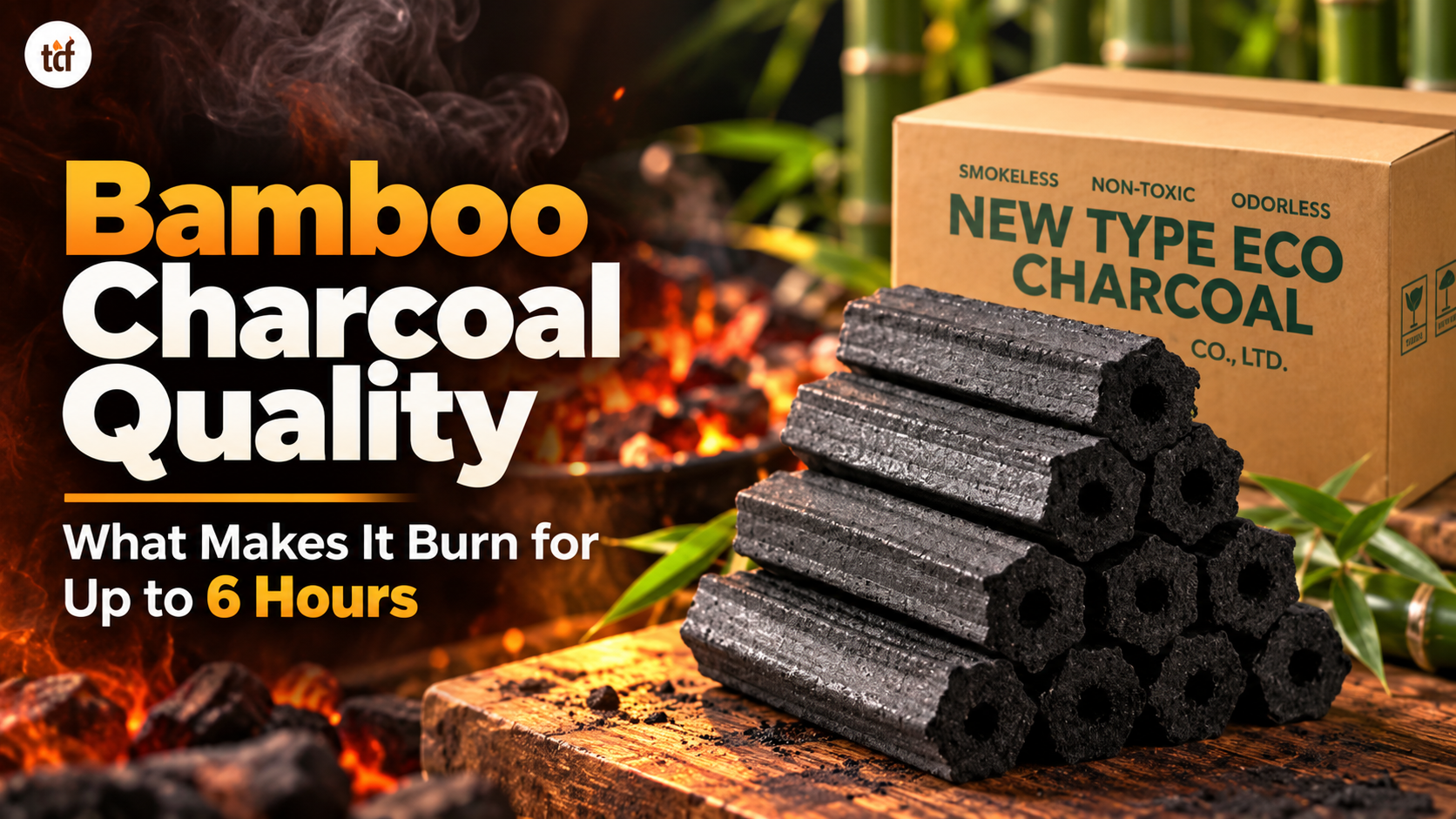



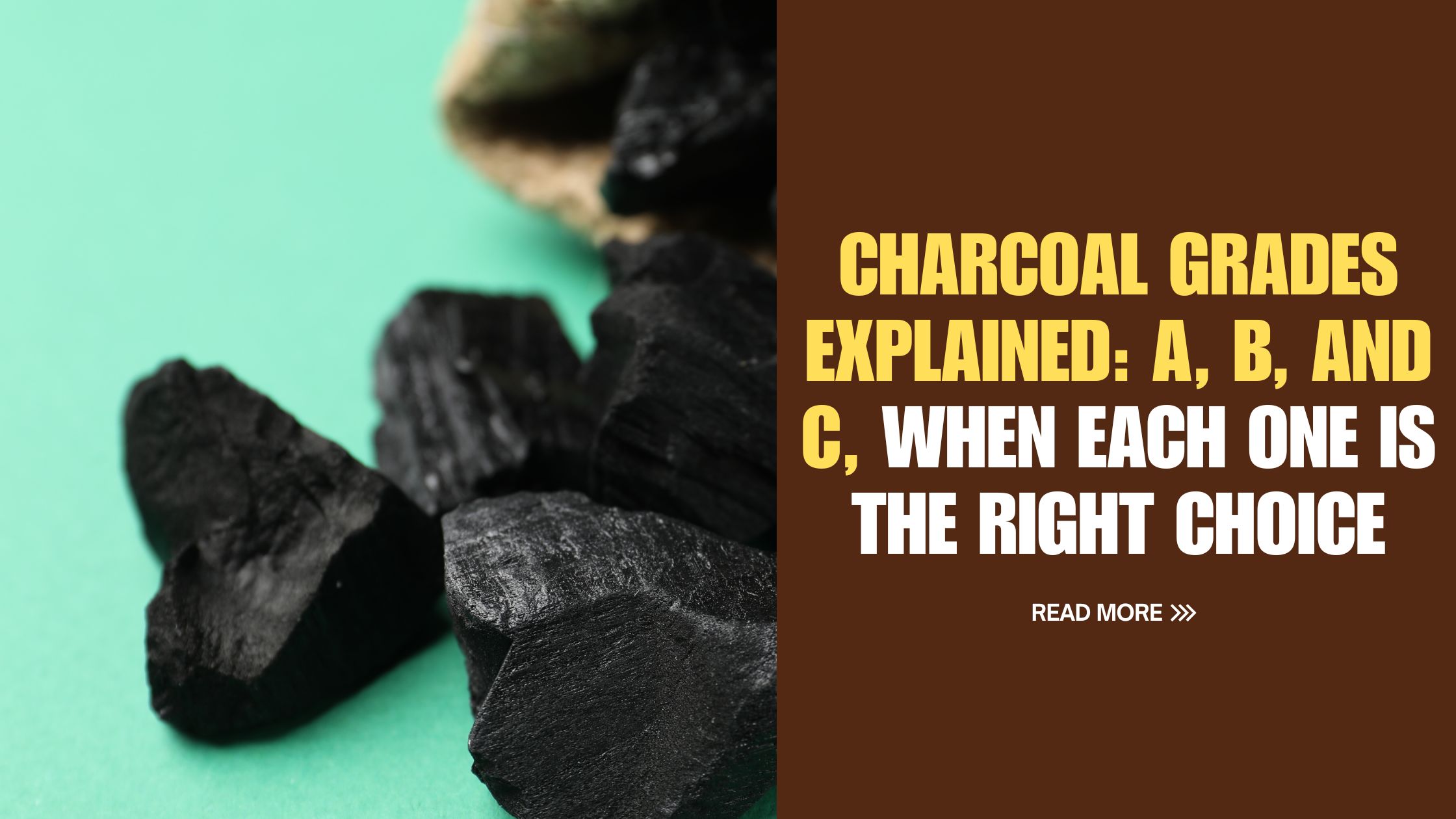
When you receive a charcoal quote and see “A grade,” “B grade,” and a price difference between them, what are you actually being told? This guide explains what each charcoal grade means in measurable terms, how the spec difference translates into real performance and pricing outcomes, and how to choose the right grade for your specific channel, market, and margin target.
Every charcoal supplier uses grade A, B, and C charcoal grades. Almost none of them define what those labels mean in a way that’s useful to a buyer. You’ll see “A grade” on quotes from suppliers across China, Indonesia, Vietnam, and beyond, but there is no international standard that defines what A-grade charcoal must contain. One supplier’s A grade is another supplier’s B grade. That absence of a universal standard is the source of most grade-related disputes between buyers and suppliers.
The result is that “grade” in charcoal is a relative label until you define it in spec terms. This guide gives you the framework to do that, for both bamboo charcoal and wood charcoal, across the five key specifications that determine how charcoal actually performs. It then maps those grades to real markets, real channels, and the margin implications of choosing the wrong grade in either direction.
At The Charcoal Factory, when we say A grade, B grade, and C grade, we mean specific, measurable numbers verified by SGS laboratory testing. We’ll use our own specifications throughout this guide as the reference point, and then explain how to use those same benchmarks when evaluating any supplier’s claim about their product grade.
What the five key charcoal specifications actually measure
Before Charcoal Grades make sense, the underlying specs need to be clear. A charcoal specification sheet lists five core measurements. Each one tells you something specific about how the product will perform in use.
1. Fixed carbon (%)
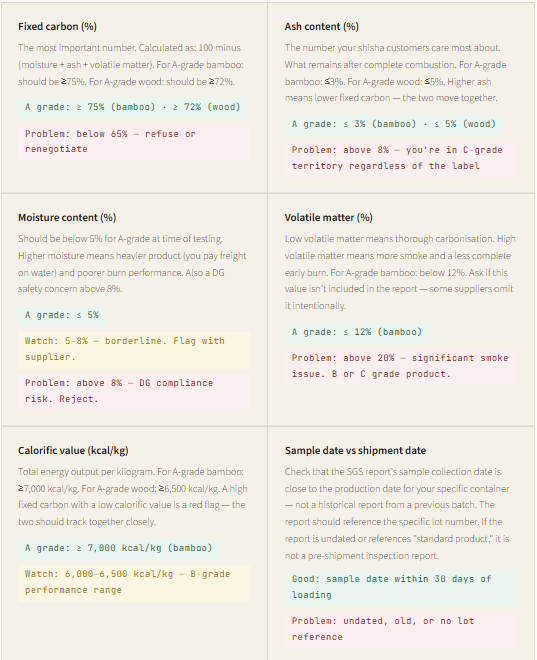
This is the most important single number on a spec sheet. Fixed carbon is the percentage of pure carbon remaining in the charcoal after moisture and volatile compounds have been removed it represents the actual fuel content of the product. Higher fixed carbon means more energy per kilogram, longer burn time, hotter and more stable heat, and less smoke. For shisha charcoal, high fixed carbon is what gives you the sustained, even heat that keeps the tobacco cooking consistently throughout a session. For BBQ charcoal, it’s what keeps temperatures stable during a long cook without constant reloading. A good quality A-grade bamboo charcoal from TCF has a fixed charcoal carbon content of 75% or above. Below 65%, and the product starts to behave like a lower-grade industrial fuel, not a premium cooking or shisha product.
2. Ash content (%)
Ash is what remains after the charcoal has finished burning, the inert mineral residue that doesn’t combust. Low ash content means cleaner use, less residue to manage, and a more efficient fuel. For shisha charcoal, ash content is the specification your customers are most sensitive to. A hookah lounge operator running 30 tables a night will notice ash fallout from coals with ash content above 3%, it lands on the bowl, on the table, and in the smoke. A-grade shisha charcoal with ash under 3% is what the UAE and GCC professional market specifies as standard. For BBQ charcoal, slightly higher ash is acceptable because it doesn’t directly affect the cooking experience in the same way, but ash above 8% creates noticeable cleanup and affects airflow in the grill bed.
3. Moisture content (%)
Moisture content is the percentage of water retained in the charcoal at the time of packing. Higher moisture means heavier product (you’re paying freight on water), reduced burn efficiency (the charcoal has to drive off water before it starts burning cleanly), more initial smoke, and, critically, increased risk of self-heating during sea freight (which is the reason charcoal is classified as DG Class 4.2 under the IMDG Code). Good A-grade charcoal should test at under 5% moisture before packing. If moisture is above 8%, you’re likely looking at an underdried product that either came from a rushed production cycle or was stored in humid conditions.
4. Calorific value (kcal/kg)
Calorific value measures the total heat energy the charcoal produces per kilogram when burned completely. It’s directly related to fixed carbon; higher fixed carbon content means higher calorific value. A-grade bamboo charcoal from TCF tests at 7,000–8,000 kcal/kg. For context, good hardwood lump charcoal runs 6,500–7,200 kcal/kg. Standard coal runs 7,000–8,000 kcal/kg. The calorific value tells you how hard the charcoal works per unit weight. It matters more for professional kitchens and industrial applications than for casual BBQ use.
5. Volatile matter (%)
Volatile matter is everything that evaporates when charcoal is heated, such as tars, residual organic compounds, and gases driven off during early combustion. High volatile matter means more smoke on lighting, more initial flavour impact (relevant for shisha use), and a less clean burn overall. Low volatile matter is a product of thorough carbonisation at the right temperature. A-grade charcoal should have volatile matter below 12–15%. Very high volatile matter (above 25%) indicates incomplete carbonisation; the charcoal was not heated long enough or at high enough temperature during production.
Also read – Charcoal Bulk Buying Guide
A, B, and C grades are defined in numbers, not descriptions
These are The Charcoal Factory’s grade specifications for bamboo charcoal. These are what we guarantee with our SGS lab reports. When evaluating other suppliers, use these benchmarks as your reference point and ask for lab reports that verify each number.
A Grade
The highest specification. Everything that professional lounge operators, restaurant kitchens, and premium retail buyers specify. A-grade is not merely “good quality”, it is measurably the highest performing charcoal by fixed carbon, ash, and calorific value. The UAE shisha market specification. The European premium BBQ shelf position. If your customers are experienced and quality-sensitive, this is the only Charcoal Grade they will accept long-term.
- Fixed carbon≥ 75%
- Ash content≤ 3%
- Moisture≤ 5%
- Calorific value≥ 7,000 kcal/kg
- Volatile matter≤ 12%
- Burn time (25mm cube)2.0–2.5 hrs
- B Grade
- Mid-tier retail household, value distribution
Solid, usable charcoal for markets where the end consumer prioritises price over maximum performance. B-grade burns adequately for household BBQ and casual shisha use, but will not satisfy a professional lounge operator whose customers can tell the difference. The right product for supermarket value charcoal ranges, household shisha retail packs in price-sensitive markets, and wholesale redistribution where margin pressure is high.
Fixed carbon70–75%
- Ash content3–5%
- Moisture≤ 6%
- Calorific value≥ 6,500 kcal/kg
- Volatile matter12–18%
- Burn time (25mm cube)1.5–2.0 hrs
- C Grade
- Value industrial, catering at scale, bulk redistribution
Lower specification charcoal for cost-sensitive applications where performance thresholds are lower. C-grade is not “bad” charcoal it burns reliably and generates heat, but it produces noticeably more ash, burns less consistently, and performs at a level that professional end-users would find unacceptable. The right product for large-volume industrial or commercial fuel buyers, and for redistribution markets where the buyer’s end customers are primarily price-driven. But also, irrespective of any grade, you must go through the charcoal supplier verification checklist before buying the charcoal.
- Fixed carbon60–70%
- Ash content5–8%
- Moisture≤ 8%
- Calorific value≥ 6,000 kcal/kg
- Volatile matter18–25%
- Burn time (25mm cube)1.0–1.5 hrs
Why grade specs differ between bamboo and wood charcoal
The specifications above are for bamboo charcoal. Wood charcoal has different absolute numbers for the same relative grades because the raw material carbonises differently. A-grade shaped wood charcoal from TCF runs fixed carbon above 72% (vs 75% for bamboo), and ash content is acceptable up to 5% at A-grade (vs 3% for bamboo). Bamboo charcoal achieves higher purity numbers because of bamboo’s higher cellulose density and the controlled machine-made production process.
When comparing a bamboo charcoal spec to a wood charcoal spec, you cannot use the same absolute benchmarks you need to compare like-for-like within each material type. A wood charcoal with 73% fixed carbon and 4.5% ash is an A-grade wood product. The same numbers on a bamboo charcoal would make it a B-grade bamboo product.
Charcoal Grades benchmark for wood charcoal TCF specifications
| Specification | A Grade | B Grade | Notes |
|---|---|---|---|
| Fixed carbon | ≥ 72% | 65–72% | C grade: 55–65% |
| Ash content | ≤ 5% | 5–8% | C grade: 8–12% |
| Moisture content | ≤ 6% | ≤ 8% | C grade: ≤ 10% |
| Calorific value | ≥ 6,500 kcal/kg | ≥ 6,000 kcal/kg | C grade: ≥ 5,500 kcal/kg |
| Volatile matter | ≤ 15% | 15–22% | C grade: 22–30% |
| Burn time | 1.5–2.5 hrs | 1.0–1.5 hrs | C grade: 0.75–1.0 hrs |
| Forms available | Pillow, hex, BBQ shaped | Pillow, shaped | C grade: bulk/shaped |
Which grade for which market is the decision that actually matters
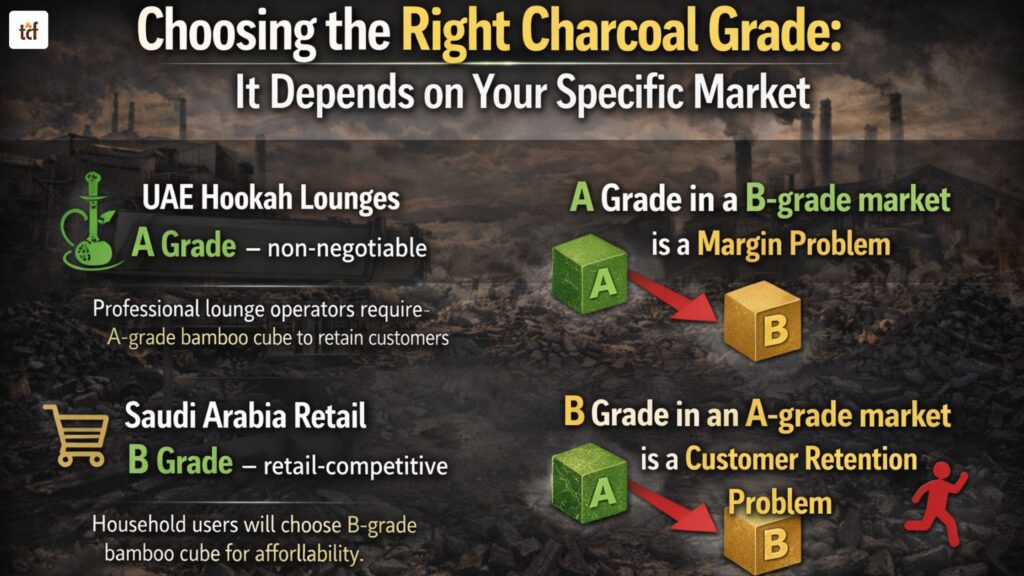
The Charcoal Grades you need is not determined by which one is technically best. It’s determined by what your specific market channel will pay, what your end users will accept, and what margin the price differential creates for your business. A-grade charcoal at A-grade pricing in a B-grade market is a margin problem. B-grade charcoal at B-grade pricing in an A-grade market is a customer retention problem. Getting this right is the whole point. And for each grade, you must know about the bamboo charcoal market first.
Also read – types of charcoal
UAE hookah lounge operators
A Grade — non-negotiable
Professional lounge operators in Dubai and Abu Dhabi running 20–40 tables per night require an A-grade bamboo cube. Their customers notice ash fallout and burn time variation immediately. Any distributor who supplies B-grade to a professional lounge expecting A-grade will lose the account within one delivery cycle. The price difference between A and B grades per container is justified by not losing the customer.
Saudi Arabia retail — household shisha
B Grade — retail-competitive
Saudi Arabia has a split market. High-end lounges and premium venues want A-grade. The mass retail segment, supermarkets, convenience stores, and household use, is more price-sensitive. B-grade bamboo cube in 1kg retail boxes is commercially viable in the Saudi retail channel because the price point is lower, and the household user’s tolerance for slightly higher ash content is greater than a professional lounge’s tolerance.
Must read – What Is Lump Charcoal Made Of?
Germany eco-retail — bamboo BBQ charcoal
A Grade — premium positioning required
The German eco-charcoal segment is premium-positioned. If you’re selling bamboo BBQ charcoal in a German supermarket’s sustainability range at a price premium over standard wood charcoal, an A-grade specification is what justifies that premium. A B-grade product receiving negative reviews for ash content or burn time on a premium shelf slot undermines the entire positioning strategy.
UK BBQ retail — shaped wood charcoal
A Grade for premium · B for value shelf
UK BBQ retail has two tiers. The premium shelf (garden centres, speciality outdoor stores, higher-end supermarkets) expects A-grade. The value shelf (discount grocery, petrol station, impulse buy) can accommodate B-grade at a lower price point. The key is not mixing them — B-grade product in premium packaging on a premium shelf creates reviews that destroy the brand.
Also read – charcoal ash content moisture specs
Wholesale redistribution — bulk buyers
B or C Grade — margin driven
Pure wholesale redistribution buyers- traders who buy charcoal by the container and sell to sub-distributors or traders who repackage at destination- are typically the most price-sensitive buyers in the market. B-grade charcoal gives them a usable product at a lower FOB cost. C-grade serves specific industrial or high-volume catering applications. The key question is: what does the end of their supply chain require? A B-grade buyer supplying A-grade customers downstream will create problems that they then bring back to you.
Restaurant & food service
A Grade — kitchen performance
Professional kitchens care about consistent heat for service. A restaurant that discovers its charcoal burns inconsistently mid-service has an operational problem, not a product preference. A-grade’s higher fixed carbon and lower volatile matter means a more stable cooking temperature throughout the evening. The cost difference between A and B grades per container is typically less than the cost of one service disruption caused by inferior charcoal.
Amazon & e-commerce sellers
A Grade — review risk management
On Amazon, a product with 4.2 stars outperforms one with 3.8 stars in search ranking and conversion. The difference between A-grade and B-grade charcoal in customer reviews is predictable: B-grade generates complaints about ash, smoke, and short burn time that are difficult to recover from once they accumulate. For an online seller building a charcoal brand, A-grade is the correct starting point — the marginal cost of better charcoal is lower than the brand cost of poor reviews.
Jordan & Levant value retail
B Grade — price sensitivity high
Jordan and its re-export markets (Iraq, West Bank) have a significant price-sensitive retail segment alongside professional lounge supply. B-grade bamboo cube is commercially viable for the household and budget lounge segment in this region. The professional lounge segment in Amman still specifies A-grade, so a Jordan distributor serving multiple customer tiers will typically stock both grades.
Must read – cost to import charcoal from China
Grade inflation: what it looks like and how to spot it
Grade inflation is the most common quality problem in charcoal supply, and it is almost entirely invisible until you receive the container and run a lab test. It works like this: a supplier labels their standard production as “A grade” in their marketing and quotation. The actual product tests at a B-grade or low-B-grade specification. The buyer, trusting the label, imports and distributes. Their customers, who have experience with genuine A-grade products, notice the difference. The buyer faces complaints they cannot explain, because from their perspective, they ordered an A-grade.
“A-grade is a claim. An SGS lab report is evidence. Never take a supplier’s grade label at face value until you have independent laboratory verification of the specific container being shipped.”
Grade inflation is most common in two scenarios. First, when a supplier is producing a large order and runs out of their highest-quality raw material mid-production, rather than stopping and disclosing the issue, they continue with lower-quality input and ship the container as A-grade. Second, when a supplier has set their internal “A-grade” threshold below what buyers in the professional market actually expect, their A-grade is genuinely what they call A-grade, but it would be classified as B-grade by an independent standard.
The practical defence against Charcoal Grades inflation is to require an SGS pre-shipment inspection report for every container, not just the first sample order. An SGS report is issued for the specific lot being shipped; it’s not a historical report on what the factory produced previously. If the fixed carbon on the SGS report for your container comes in at 71% when you specified 75%+, you have documentation to reject the shipment or renegotiate the price before you’ve paid the balance.
The cost of getting a charcoal grade wrong in both directions
Most buyers think of grade selection as a one-way risk, ordering too low a grade and disappointing customers. The less-discussed risk is ordering too high a grade for your market and paying for performance that your customers neither notice nor pay for. Both directions have real costs.
Grade mismatch — what it actually costs
Grade mismatch — what it actually costs
Ordering A-grade for a B-grade market: A distributor supplying value retail in a price-sensitive market orders A-grade bamboo cube to be safe. The FOB premium of A over B is approximately 12–18% per MT. On a 20GP container carrying 18MT of 1kg retail boxes, that’s roughly $1,400–2,500 in additional FOB cost. If the retail price point in that market doesn’t support A-grade pricing and the distributor can’t charge a premium, those dollars come out of margin. Multiply this across 10 containers per year and the over-specification costs $14,000–25,000 in unnecessary FOB spend.
Ordering B-grade for an A-grade market: A new distributor ordering their first container for UAE lounge supply saves money by ordering B-grade. Their lounge customers, used to A-grade from their previous supplier, notice the ash content difference within the first week. Complaints come in. The distributor offers to replace the product, but the replacement is also B-grade. The lounge operator switches back to their previous supplier after two deliveries. The cost: the loss of a customer worth 2–5 containers per year in future business, plus the reputational cost of the failed first supply relationship.
Receiving lower grade than ordered: A distributor orders A-grade, receives B-grade (grade inflation by supplier). They distribute without testing. Their customers complain. The distributor returns to the supplier, who denies the issue. Without an SGS report on the actual container shipped, the distributor has no leverage. The cost: direct complaints, customer relationship damage, and no recourse against the supplier. With an SGS report: immediate documented basis to reject the shipment or claim a price reduction.
How to specify grade correctly when placing an order
Most buyers make the mistake of specifying grade in words only: “Please supply A-grade bamboo charcoal.” This leaves the definition of “A-grade” entirely up to the supplier, which is where grade inflation lives.
The correct approach is to specify the grade by the underlying numbers, not just the label. A purchase order or specification sheet that says:
- Fixed carbon: minimum 75%
- Ash content: maximum 3%
- Moisture content: maximum 5%
- Calorific value: minimum 7,000 kcal/kg
- Verified by the SGS pre-shipment inspection report for this specific lot
…is a specification that a supplier cannot grade-inflate without producing a falsified lab report, which carries legal consequences well beyond a commercial dispute. A specification that says “A-grade” alone is a specification that can be silently downgraded to whatever the supplier calls A-grade on a given day.
At The Charcoal Factory, we provide SGS pre-shipment inspection reports for every container as a standard part of our export documentation, not as an optional add-on. The report references the specific lot number and loading date. Every grade we supply is defined by the spec numbers above, not by a label applied without measurement. If you’d like to see a sample SGS report format from a recent TCF container, email our sales team, and we’ll send one.
For Further Reading:
charcoal exporting countries
how is bamboo charcoal made
Charcoal HS Codes
lump charcoal vs briquettes
Quick reference grade by use case
| Use case | Material | Recommended grade | Reason |
|---|---|---|---|
| UAE / GCC hookah lounge supply | Bamboo cube | A Grade | Professional standard. Ash fallout visible to customers above 3%. |
| Saudi Arabia retail — household shisha | Bamboo cube | B Grade | Price-sensitive retail. B-grade acceptable for household use. |
| European eco BBQ retail | Bamboo shaped | A Grade | Premium shelf position. B-grade reviews will undermine positioning. |
| UK / US premium BBQ retail | Wood shaped | A Grade | Premium channel. Consistent burn performance expected. |
| Value BBQ retail — discount / mass market | Wood shaped | B Grade | Price competition. B-grade adequate for casual consumer use. |
| Restaurant & professional kitchen | Bamboo or wood | A Grade | Service stability requires consistent heat. B-grade creates variance. |
| Value BBQ retail — discount/mass market | Bamboo or wood | A Grade | Review management. B-grade ash and burn complaints accumulate fast. |
| Wholesale redistribution | Bamboo or wood | B or C Grade | Margin pressure. Match grade to the end channel being supplied. |
| Industrial / catering at scale | Wood | B or C Grade | Heat output prioritised over ash and smoke performance. |