


Hookah Charcoal Manufacturing Plant Cost? Hookah charcoal is one of the most specific and demanding products in the entire charcoal industry. It needs to do something that no other charcoal product is asked to do: burn at a precise, steady temperature for 45 to 90 minutes, produce absolutely no smell or flavor of its own, generate minimal ash, never spark, and light either instantly or within a few seconds on a stovetop coil. All of this, in a tablet the size of a large coin, used by someone sitting a few inches away from it in an enclosed hookah lounge.
That set of requirements- invisible heat, zero interference, total reliability, Charcoal grades, is why hookah charcoal manufacturing is a distinct specialization within the charcoal industry, not simply a variation of BBQ charcoal production. The raw material choices, the binder chemistry, the forming technology, and the quality control standards are all shaped by an end application where the user will immediately know if something is wrong.
This article (Hookah Charcoal Manufacturing Plant Cost)covers the complete manufacturing process, the real economics of setting up a plant, what differentiates natural charcoal from quick-light products, and why India is emerging as one of the most strategically positioned countries in the world for hookah charcoal export.
The Two Worlds of Hookah Charcoal
Before going into manufacturing, it’s essential to understand that “hookah charcoal” is not a single product. There are two fundamentally different types, made by different processes, from different raw materials, for different customers, and they are increasingly competing directly for the same market.
Quick-light charcoal is the product that most casual hookah users encounter first. It comes in rolls of ten tablets wrapped in foil, lights with a standard lighter in three to five seconds, and is ready to use in about a minute. It is convenient, inexpensive, and widely distributed. The reason it lights so quickly is the presence of an oxidizer, typically potassium nitrate coated on or mixed into the tablet. This oxidizer releases oxygen as it decomposes, sustaining rapid combustion without the need for a stovetop or torch lighter.
The tradeoff is a chemical smell at ignition that experienced hookah users find unpleasant, and a flavor contamination that persists briefly even after the tablet appears fully lit. Every serious hookah community forum in the world has threads debating how long you need to wait after lighting a quick-light tablet before placing it on the bowl. Answers typically range from 90 seconds to three minutes. That wait time is the potassium nitrate combustion products dissipating.
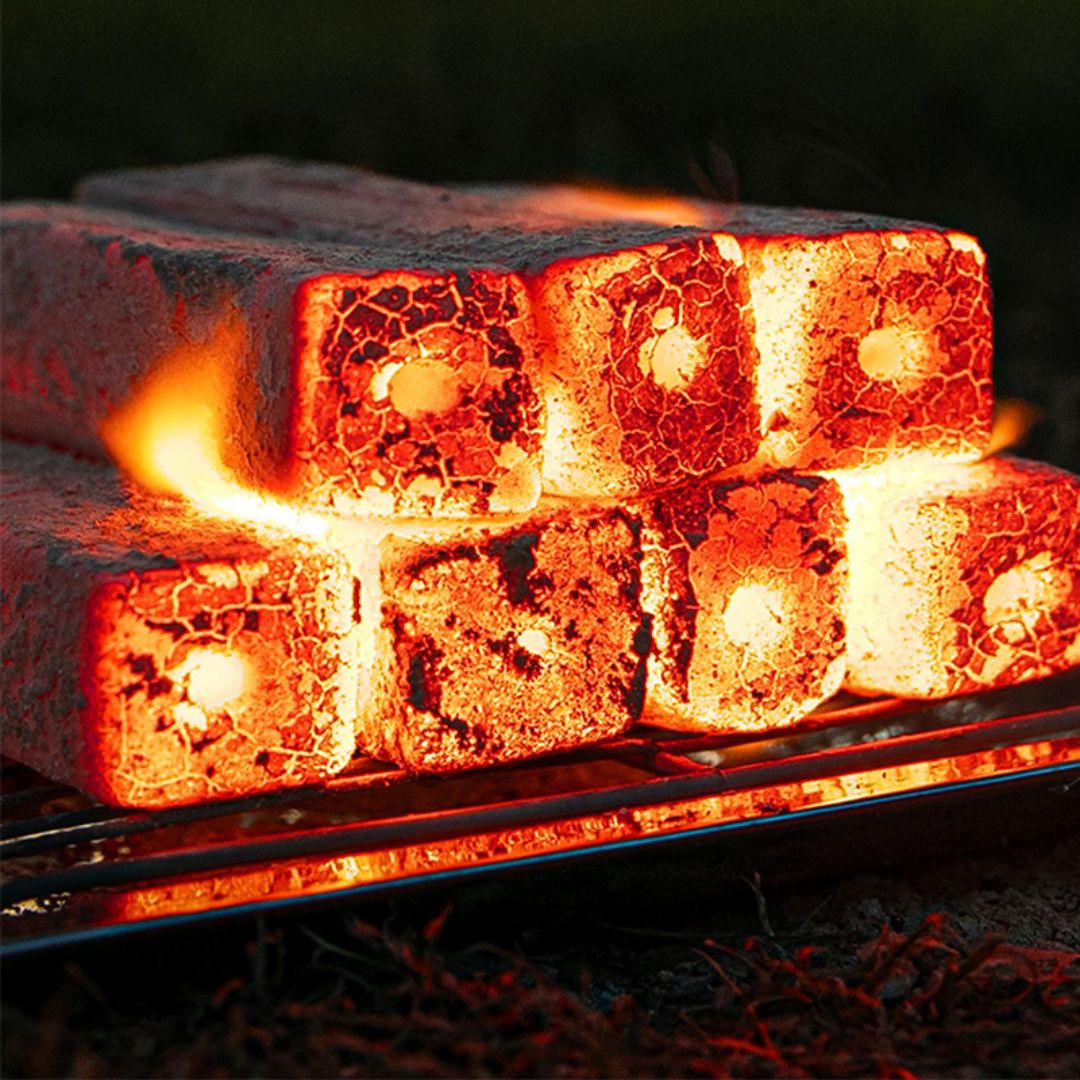
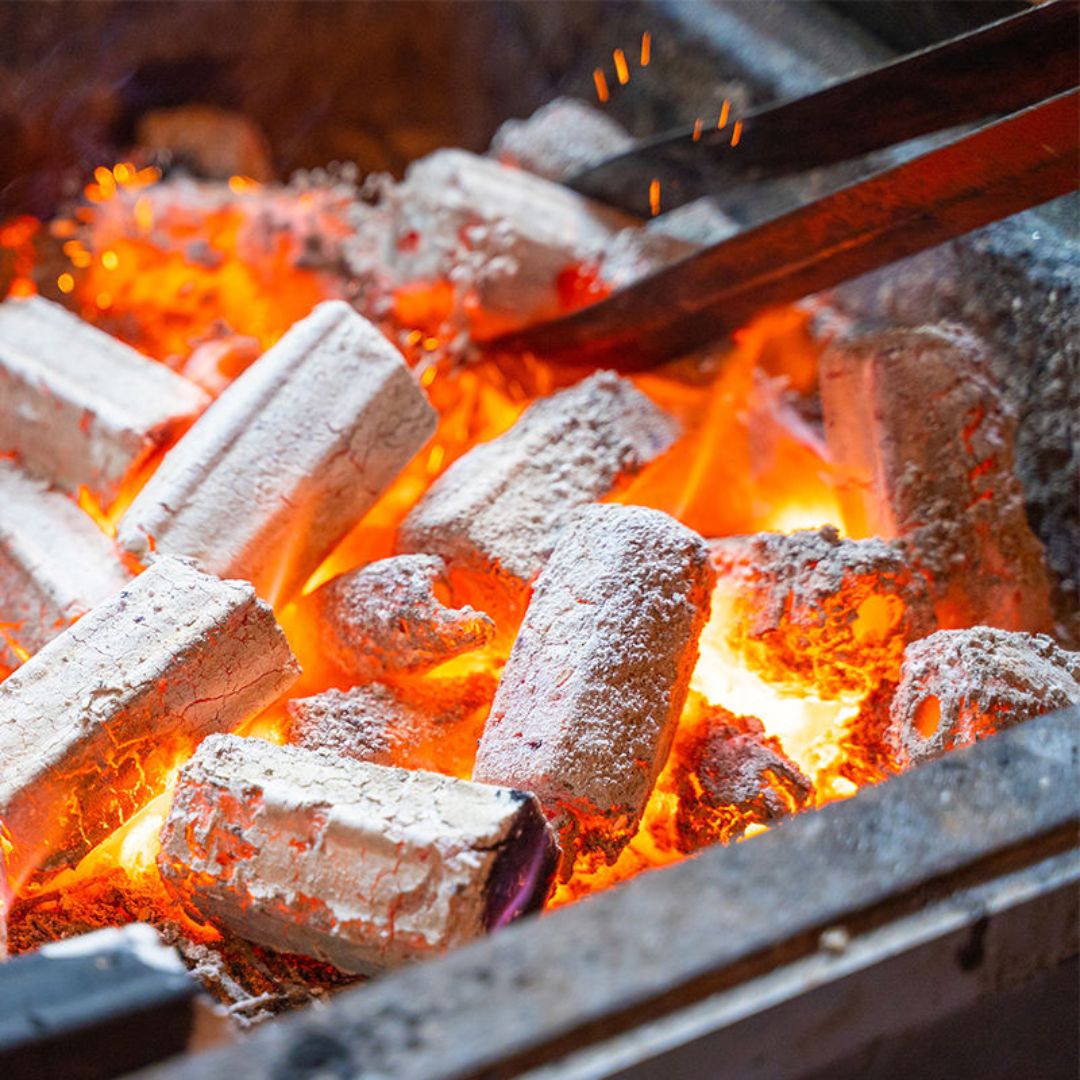
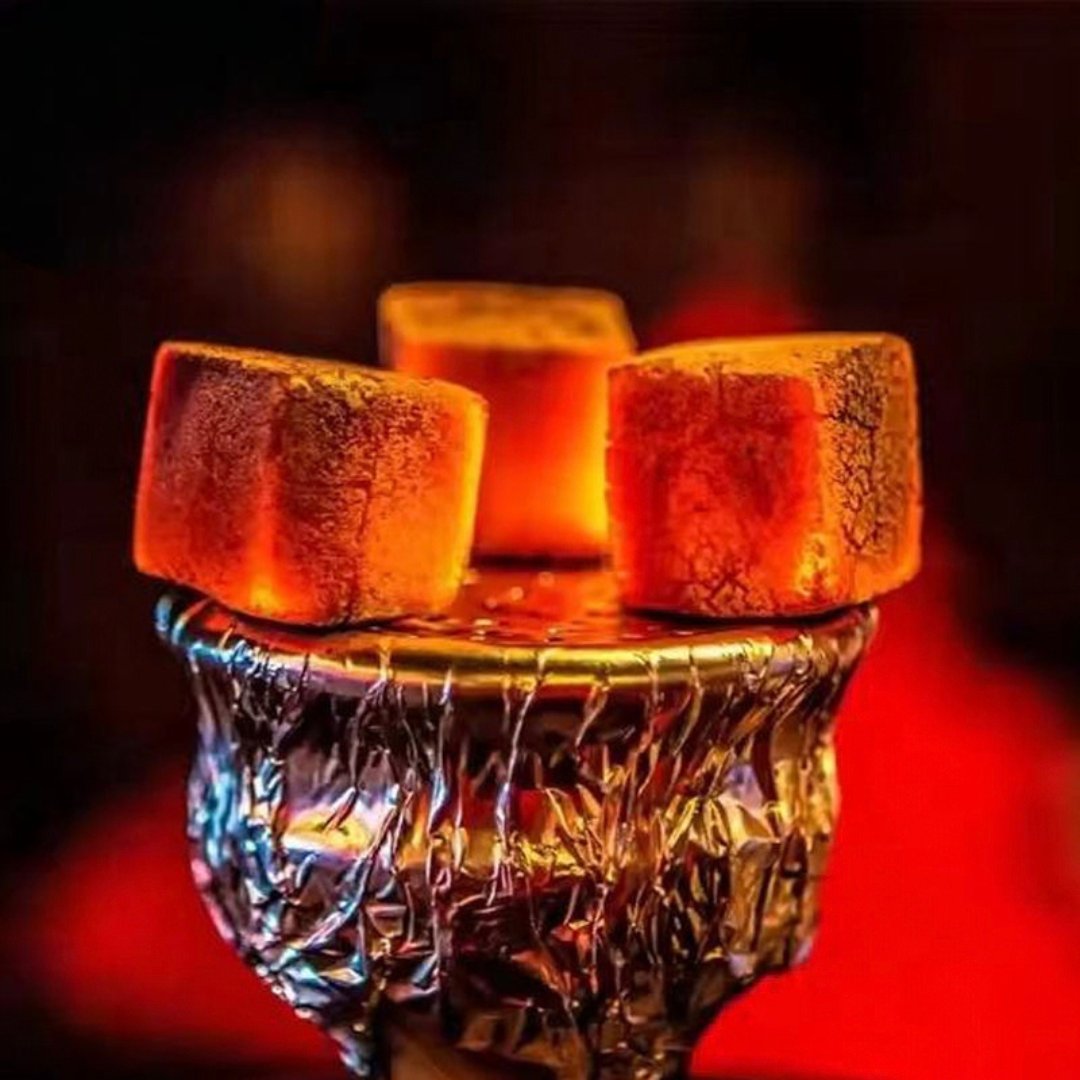
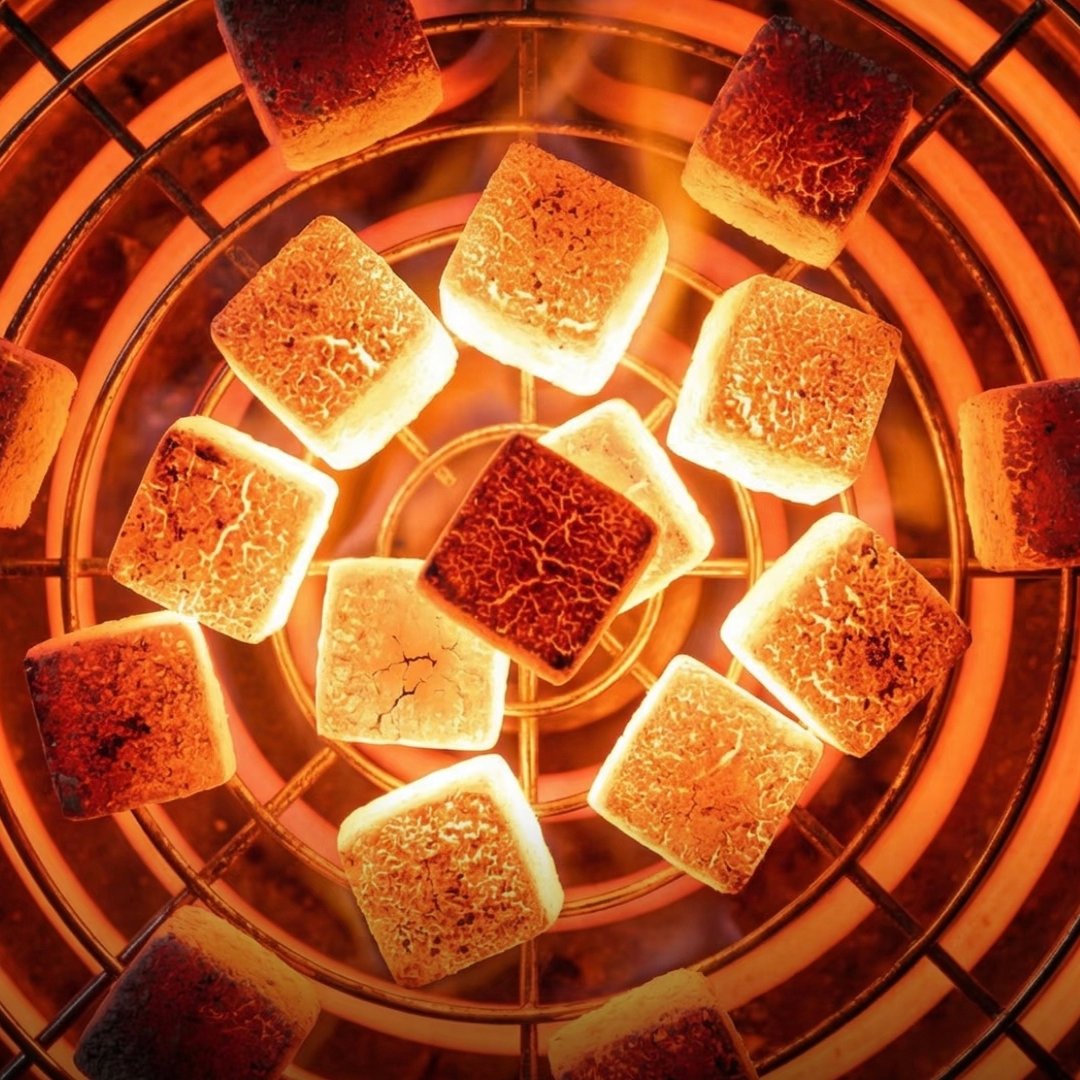
Natural charcoal tablets — almost always made from coconut shell charcoal have become the dominant choice among dedicated hookah users and the universal standard in hookah cafés and lounges. They contain no oxidizer and must be lit on an electric coil lighter or gas stovetop burner for four to six minutes until fully ashed over on all sides. Once properly lit, they burn at a higher temperature, last significantly longer, produce a fraction of the ash, and have no chemical character whatsoever. The smoke the user tastes is purely the shisha tobacco and whatever flavor it carries.
The shift in the premium hookah market from quick-light to natural coconut charcoal has been one of the defining trends of the past decade. A hookah lounge that used quick-light charcoal five years ago and still does today is, in the eyes of its core customers, signaling that it doesn’t take its product seriously.
Why Coconut Shell Is the Dominant Raw Material
Of all the possible feedstocks for natural hookah charcoal, coconut shell has become the overwhelming industry standard, and it earned that position on genuine performance merits rather than marketing.
Coconut shell is unusually dense for an agricultural byproduct, denser, in fact, than most of the hardwoods commonly used in lump charcoal production. This density comes from the multi-layered fiber structure of the endocarp, the hard shell surrounding the coconut meat. The cells in mature coconut shells are tightly packed, heavily lignified, and oriented in a complex interlocking pattern that gives the raw shell its remarkable hardness. When carbonized, this dense structure produces charcoal with a fixed carbon content of 78–88% among the highest of any natural feedstock and an extremely fine micropore network.
For hookah charcoal, the practical consequences of this structure are significant. High fixed carbon means more energy per gram, which means tablets can be made smaller and lighter while still delivering adequate heat. The micropore structure means combustion is more controlled, and the tablet burns from the outside in at a steady rate rather than having hot spots and cold spots. The very low ash content of coconut shell charcoal (typically 2–5%) means less residue on the bowl and less interference with heat management during the session.
The economics work in the coconut shell’s favor as well. The global coconut processing industry, primarily copra production for coconut oil generates enormous quantities of shell waste. In India, Indonesia, the Philippines, and Sri Lanka combined, an estimated 60–70 billion coconuts are processed annually. The shells, which have no food value, have historically been burned as waste or used as low-grade cooking fuel. The hookah charcoal industry transformed this waste stream into a valuable commodity, creating a supply chain where both the coconut processor and the charcoal manufacturer benefit.
Also read – bamboo charcoal market
The Manufacturing Process: Natural Coconut Shell Hookah Charcoal
Carbonizing the Shell
Everything begins in the carbonization unit. Coconut shells are loaded into a retort kiln or rotary furnace and carbonized at 600–700°C. The target is charcoal with a fixed carbon content of at least 78%, moisture below 5%, and ash content below 6%. These are tighter specifications than BBQ charcoal because any deviation from these targets shows up immediately in the finished tablet’s burn performance.
The carbonization process for coconut shell follows the same pyrolysis chemistry as wood moisture evaporation, then hemicellulose decomposition, then rapid cellulose breakdown, then carbon consolidation, but the dense, non-cellular structure of the shell means the process proceeds more evenly, and the yield is higher. A well-run coconut shell carbonization unit achieves yields of 28–35%, meaning 280–350 kilograms of charcoal from every metric ton of dry shell.
Quality control at this stage is critical and non-negotiable. Batches that don’t meet the fixed carbon specification will produce tablets that burn at the wrong temperature or run out too quickly. Batches with excessive ash content will produce tablets that ash unevenly, requiring constant management by the user. Every production batch should be tested before it advances to the grinding stage.
Grinding to Specification
The carbonized coconut shell comes out of the kiln as irregular fragments, some of the original shell shape, some broken into smaller pieces, all coated in the fine crumbles from the carbonization process. This material needs to be reduced to a very fine, uniform powder before it can be pressed into tablets.
The grinding process typically runs in two or three stages. A jaw crusher or hammer mill first reduces large fragments to pieces a centimeter or two across. A secondary hammer mill brings this down to the millimeter scale. Then a ball mill or Raymond mill grinds the material to the final target particle size, typically 150 to 250 mesh, or 60 to 100 micrometers. At this fineness, the charcoal powder has a silky texture and flows almost like a liquid when poured.
The reason for grinding this fine is tablet strength. The finer the particles, the more contact surface area between adjacent particles when the tablet is compressed, and the stronger the bond the binder can form between them. Tablets made from coarser charcoal are more porous, which sounds advantageous for burning but actually produces tablets that crumble during handling and may break apart on the hookah bowl.
Must read – charcoal supplier verification checklist
Preparing the Binder
The binder for natural hookah charcoal is invariably a starch, typically tapioca, cassava, or cornstarch, cooked to a gel in hot water. The cooking process is the same as described for briquettes: starch is mixed into cold water, heated to 75–85°C with constant stirring until gelatinization occurs, and the resulting paste is cooled to 40–50°C before use.
For hookah charcoal, the binder ratio runs at 8–12% of dry mixture weight, somewhat tighter than briquette production. Too little binder and the tablets crumble; too much and they are too hard and dense to burn evenly, or the drying time increases to the point of impracticality.
The most critical parameter is binder concentration consistency across batches. A deviation of 1–2% in binder content might be tolerable in BBQ briquettes, where users have low sensitivity to slight performance variation. In hookah charcoal, a 2% variation in binder content produces a measurable change in burn time and heat output that an experienced user will notice immediately.
Mixing
The cooked binder paste and charcoal powder are combined in a sigma blade mixer or double-arm kneader equipment borrowed directly from the food manufacturing and pharmaceutical industries. These mixers work the mixture intensively, ensuring every particle of charcoal is evenly coated with binder rather than leaving dry pockets or binder-rich clumps.
The mixing temperature and duration both matter. Mixing at 35–50°C keeps the starch fluid enough to distribute properly. Less than fifteen minutes of mixing typically produces uneven distribution; more than thirty begins to degrade the binder’s adhesive performance through mechanical shear. Most hookah charcoal manufacturers run mixing cycles of 15–25 minutes.
The finished mixture has the consistency of very stiff, slightly sticky dough. It should hold its shape when pressed in the palm but release cleanly from the surface without excessive sticking. If it’s crumbly, the binder is too dry or too little. If it sticks like clay to every surface, there is too much water.
Explore other Hookah charcoal:
Tablet Pressing: The Defining Step
This is where hookah charcoal manufacturing diverges most clearly from briquette production. Hookah charcoal tablets are pressed on rotary tablet presses, almost identical to those used in pharmaceutical pill manufacturing. This technology allows extraordinary precision in tablet weight, dimensions, and density, with production rates of 5,000 to 30,000 tablets per hour depending on machine size and configuration.
A rotary tablet press works by continuously cycling a set of punch-and-die assemblies through a filling, compression, and ejection sequence. The die cavity is filled with a precise volume of charcoal mixture by a dosing mechanism. Upper and lower punches converge and compress the mixture under a controlled force, typically 8 to 15 kilonewtons for hookah charcoal. The punches withdraw, the tablet is ejected onto a conveyor, and the cycle repeats with the next die station.
The compression force setting is one of the most consequential parameters in hookah charcoal manufacturing. Compress too lightly and the tablet is fragile, crumbles during handling, and may fracture on the hookah bowl. Compress too heavily and the tablet is so dense that airflow through it is restricted, causing uneven burning where the outer surfaces glow but the center never properly ignites. The optimal pressure for a given formulation must be determined empirically and maintained precisely throughout a production run.
Most hookah charcoal is produced in one of three standard formats: round tablets of 33 millimeters diameter weighing 6–8 grams (the global standard for quick-light rolls), round tablets of 40 millimeters diameter weighing 10–14 grams (preferred in Middle Eastern markets and for natural charcoal), or cube format 25×25×25 millimeter squares weighing 20–25 grams which has gained popularity because its shape allows heat management by partial removal from the bowl without the piece rolling off.
Drying: Patience Is the Differentiator In Hookah Charcoal Manufacturing Plant
Freshly pressed hookah charcoal tablets are extremely fragile; the starch binder has not yet dried and hardened, and the tablet is essentially still wet dough compressed into a disk shape. Rough handling at this stage means crumbled tablets and wasted production. The tablets must be moved carefully to drying equipment, ideally on mesh conveyor belts that support the full tablet surface rather than gripping only the edges.
Drying temperature must be controlled carefully. At temperatures above 120°C, the outer surface of the tablet dries rapidly and forms a hard skin before the interior has had a chance to dry, which creates internal stress that produces cracking sometimes visible immediately, sometimes only apparent when the tablet is placed on a heat source during use. Industrial hookah charcoal dryers typically operate at 70–100°C with controlled airflow, achieving a target moisture of 3–5% in four to ten hours.
The economics of drying are significant. Drying is the most energy-intensive step in the process, and the time it takes directly constrains production throughput. Manufacturers who want to increase output without proportionally expanding their dryer capacity are tempted to raise temperatures, and this shortcut produces the cracked tablets that appear in low-quality products. The best hookah charcoal manufacturers treat their drying parameters as core intellectual property and monitor them as carefully as any other production variable.
Quality Testing Before Packaging
Before any batch of hookah charcoal goes into packaging, it should be tested against a minimum set of specifications. This is not bureaucratic box-ticking; it is the practical gatekeeping that separates consistent products from variable ones.
The most important tests are moisture content (above 5% and the tablet produces excessive smoke during lighting), weight consistency (variation above ±5% across a batch indicates pressing inconsistency), drop fragility (tablets should survive a one-meter drop onto a hard surface with less than 2% breakage rate), burn time (tested under controlled air flow conditions natural tablets should burn for at least 60 minutes, quick-light at least 30), ash structure (the ash should form a coherent, gray-white ring around the tablet rather than collapsing into powder, which indicates structural integrity), and absence of chemical odor (particularly critical for natural tablets any chemical smell indicates contamination from a previous production run or a binder quality issue).
Also read – What Is Lump Charcoal Made Of
Setting Up a Hookah Charcoal Manufacturing Plant Cost: The Real Numbers
The investment required to set up a hookah charcoal manufacturing operation depends primarily on production scale, level of automation, and whether carbonization is done in-house or outsourced.
The Entry-Level Operation
The smallest viable commercial operation producing roughly 100 to 300 kilograms of tablets per day, roughly 50,000 to 150,000 tablets, can be started with a relatively modest capital investment. You need a grinding system (a hammer mill and ball mill combination runs USD 5,000–15,000), a starch cooking vessel and paddle mixer (USD 2,000–6,000), a semi-automatic or manually loaded rotary tablet press (USD 8,000–25,000), a tray or batch dryer (USD 3,000–10,000), a packaging machine (USD 2,000–8,000), and a working capital reserve for raw materials, typically one to two months of production.
If you are sourcing finished coconut shell charcoal rather than carbonizing your own shells, total capital investment at this scale runs USD 25,000–70,000. If you include a small carbonization unit to process your own shells, add another USD 15,000–40,000. This is accessible territory for a serious entrepreneur, particularly in India or Southeast Asia, where coconut shell charcoal is locally available at competitive prices.
The Commercial Operation
A medium-scale plant producing one to three metric tons of finished tablets per day, roughly 300,000 to 1,000,000 tablets, requires a substantially larger investment but begins to unlock the economies of scale that make export-oriented business viable. You need an industrial rotary kiln or continuous carbonization furnace (USD 40,000–120,000), a multi-stage grinding system with classification (USD 15,000–40,000), an industrial sigma blade mixer (USD 8,000–20,000), a high-speed multi-punch rotary tablet press (USD 30,000–80,000), a mesh belt conveyor dryer (USD 15,000–40,000), and an automated packaging line (USD 20,000–60,000).
Total capital investment at this scale runs USD 150,000–400,000 for the manufacturing equipment, plus land, building, utilities, and working capital. In India, where industrial land in manufacturing zones is available at reasonable lease rates and labor costs are competitive, the all-in investment to reach commercial production might be USD 250,000–600,000, depending on location and specifications.
The Operating Economics
What makes hookah charcoal financially attractive is the margin structure, particularly for export. The raw material, coconut shell charcoal powder, costs INR 30–55 per kilogram in India’s producing states (Kerala, Tamil Nadu, Andhra Pradesh). Starch binder adds another INR 4–8 per kilogram of product. Energy, labor, packaging, and overhead bring the total cost of production to roughly INR 90–150 per kilogram of finished tablets, depending on scale and location.
Export selling prices to Middle Eastern, European, and North American distributors range from INR 350 to 700 per kilogram (USD 4.20–8.50/kg), depending on quality tier, tablet format, and buyer relationship. The gross margin on well-run export operations is 40–60%, substantially above what most manufacturing businesses achieve.
The Middle East alone imports several hundred thousand metric tons of hookah charcoal annually. Saudi Arabia, the UAE, and Egypt are the three largest markets, collectively importing hundreds of millions of dollars in hookah charcoal each year. India is well-positioned to serve these markets from a cost, logistics, and raw material standpoint, and exports have grown significantly over the past decade.
The Quick-Light Product: A Different Manufacturing Logic
Quick-light hookah charcoal is manufactured through a largely similar process, but with several important differences in formulation and handling that are worth understanding separately.
The defining ingredient in quick-light charcoal is the oxidizer, almost universally potassium nitrate (KNO₃), sometimes supplemented with aluminum powder in small quantities. Potassium nitrate is a strong oxidizer that lowers the ignition temperature of the charcoal mixture and sustains combustion even with minimal external oxygen. This is what allows a tablet to be lit by a regular lighter rather than requiring a stovetop coil.
Potassium nitrate is incorporated into the tablet mixture at 5–10% by weight, either mixed uniformly throughout the charcoal powder before pressing or applied as a surface coating after pressing by spraying or dipping in a KNO₃ solution. Surface coating produces more predictable lighting behavior; the oxidizer is concentrated at the surface where the flame first contacts the tablet, but requires a separate coating step and careful drying of the coated tablet.
The critical safety consideration that separates quick-light manufacturing from natural charcoal production is the presence of an oxidizer in the production environment. Potassium nitrate mixed with carbon is, by definition, a reactive mixture — it is the chemical basis of black powder. The concentrations used in hookah charcoal are too low to create explosion risk under normal conditions, but the production area must be maintained meticulously free of ignition sources, grounded against static discharge, and operated with fire suppression equipment close at hand. Batch sizes of the mixed material should be kept small. Storage of KNO₃ and mixed charcoal must comply with hazardous materials regulations, which vary by country and jurisdiction.
Also read – Top countries exporting charcoal
What to Know Before You Start
The hookah charcoal market looks attractive on paper, with high margins, growing global demand, and abundant raw material in South Asia. But the people who succeed in this business consistently point to a few factors that aren’t obvious from the outside.
Quality consistency is everything. The hookah market, particularly in the export segment, runs on repeat business from cafés and distributors who will switch suppliers the moment quality becomes unreliable. A single bad batch of crumbling tablets, variable burn times, and unexpected chemical smell can cost a supplier a relationship that took years to build. The investment in quality control equipment and laboratory testing is not optional.
Regulatory compliance for export markets is more demanding than it appears. European markets require compliance with REACH chemical regulations, which means documentation of every ingredient and its chemical profile. Some Middle Eastern markets require country-specific certifications. The US market has its own import documentation requirements. Building relationships with an export compliance specialist before your first shipment is cheaper than discovering problems after it arrives.
The move toward natural coconut shell charcoal is structural and unlikely to reverse. Entrepreneurs entering this market today who are building quick-light production capacity are swimming against a tide of consumer preference. The capital investment required for natural charcoal production is not dramatically higher than for quick-light, and the market positioning is substantially better.
FAQs – Hookah Charcoal Manufacturing Plant Cost
What is a hookah charcoal manufacturing plant?
A hookah charcoal manufacturing plant is a production facility that converts raw materials such as coconut shells, bamboo, hardwood, or other biomass into hookah charcoal briquettes through processes including carbonization, crushing, mixing, molding, drying, and packaging.
How is hookah charcoal manufactured?
Hookah charcoal is manufactured by carbonizing raw materials, grinding the charcoal into powder, mixing it with a food-grade binder, compressing it into briquettes, drying the briquettes, and packaging them for distribution.
What raw materials are used to make hookah charcoal?
The most common raw materials include coconut shells, bamboo, hardwood, fruitwood, and other biomass materials. Coconut shell charcoal is generally preferred because it burns longer, produces less ash, and has a higher heat output.
What machines are required for a hookah charcoal manufacturing plant?
A typical hookah charcoal production line includes a carbonization furnace, crusher, wheel mill mixer, briquette machine, drying machine, screening equipment, and packaging machine.
How much does it cost to set up a hookah charcoal manufacturing plant?
The investment depends on plant capacity, automation level, and location. Small-scale plants may require tens of thousands of dollars, while fully automated industrial facilities can require significantly higher investments.